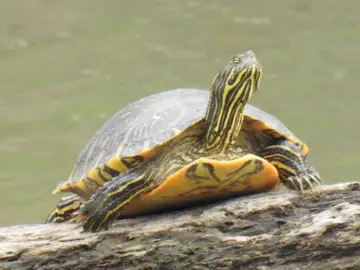
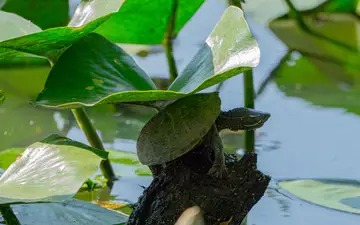
On this page All 24 turtles Lookalikes When they are active If you see one What official sources say About this list Sources
This page lists 24 turtles : 9 from Georgia DNR Wildlife Resources Division's Laws Related to Native Wildlife + Georgia Biodiversity Portal "All Rare Reptiles and Amphibians" + Sea Turtle Recovery Efforts and 15 named in other official sources.
All 24 turtles From A to Z.
Find by name
No confirmed photo of Alabama Map Turtle Alabama Map Turtle Graptemys pulchra
Conservation Georgia state protection: Rare (DNR portal code 'R'); US ESA code in DNR portal: SAT; Georgia state rank S3 (DNR portal) What the sources say Habitat: Rivers and large streams (Georgia DNR Wildlife Resources Division)
Photo: Eric Schmidt · CC BY 4.0 · iNaturalist Macrochelys temminckii
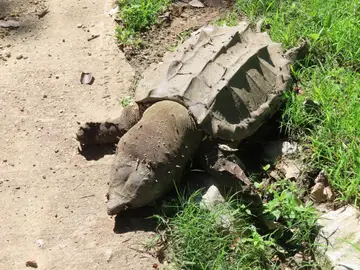
Size Usually 15 to 26 inches of shell and 35 to 150 pounds; males can reach 29 inches and 249 pounds, females about 22 inches and 62 pounds. Missouri records over 250 pounds. How to recognize it Three prominent ridges on the upper shell Very large head with a sharp, strongly hooked beak Extra row of scutes on each side of the shell Conservation Georgia state protection: Threatened (DNR portal code 'T'); US ESA code in DNR portal: PT; Georgia state rank S2 (DNR portal) What the sources say Habitat: Streams and rivers; impoundments; river swamps (Georgia DNR Wildlife Resources Division)
Full Alligator Snapping Turtle guide
No confirmed photo of Barbour's Map Turtle Barbour's Map Turtle Graptemys barbouri
Where in Georgia Southwest Georgia (SREL) Georgia DNR Wildlife Resources Division Conservation Georgia state protection: Threatened (DNR portal code 'T'); US ESA code in DNR portal: SAT; Georgia state rank S3 (DNR portal) What the sources say Habitat: Rivers and large creeks of Apalachicola River drainage possibly in Ochlockonee (Georgia DNR Wildlife Resources Division)
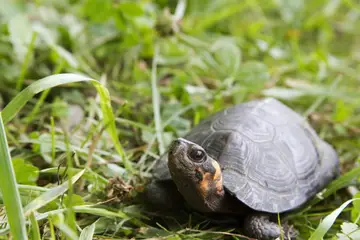
Photo: U.S. Fish and Wildlife Service Southeast Region · Public domain · Wikimedia Commons (U.S. federal work, public domain) Bog Turtle Glyptemys muhlenbergii
Where in Georgia Mountains of northeastern Georgia (SREL) Georgia DNR Wildlife Resources Division Conservation Georgia state protection: Endangered (DNR portal code 'E'); US ESA code in DNR portal: SAT; Georgia state rank S2 (DNR portal) What the sources say Habitat: Mountain bogs; wet meadows; edges of mountain streams (Georgia DNR Wildlife Resources Division)
No confirmed photo of Chicken Turtle Chicken Turtle Deirochelys reticularia
Conservation Georgia state rank S3? (DNR portal) What the sources say Habitat: Ephemeral herbaceous wetlands and surrounding pine uplands (Georgia DNR Wildlife Conservation Section)
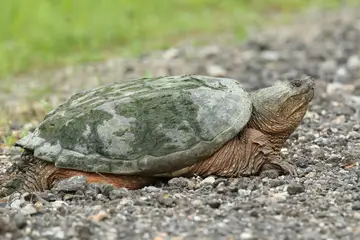
Photo: Cephas · CC BY-SA 4.0 · Wikimedia Commons · resized Chelydra serpentina
Size Upper shell usually 8 to 14 inches, occasionally to nearly 20; usually 10 to 35 lb, occasionally to 75 lb in the wild. How to recognize it Large head, long tail Saw-toothed scales on the long tail Small, cross-shaped lower shell Where in Georgia Statewide University of Georgia Savannah River Ecology Laboratory (SREL) Herpetology
J F M A M J J A S O N D
113 records by month. Full Common Snapping Turtle guide
Photo: Matthew Lumsden · CC BY 4.0 · iNaturalist Diamond-backed Terrapin Malaclemys terrapin
Where in Georgia Entire coast Georgia DNR Wildlife Resources Division Conservation Georgia state protection: Unusual (DNR portal code 'U'); Georgia state rank S4 (DNR portal) What the sources say Habitat: Entire coast, estuarine and marine edge; All saltmarsh, beaches (Georgia DNR Wildlife Resources Division)
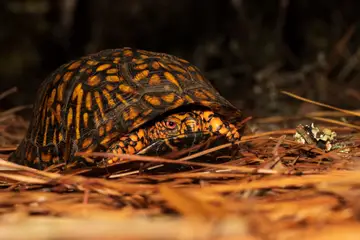
Photo: Joshua Liverman · CC BY 4.0 · iNaturalist Terrapene carolina
Size Small: adult shell usually 4.5 to 6 inches; up to about 7 to 8 inches (Alabama, Virginia). How to recognize it High, domed upper shell Hinged lower shell that closes the turtle in completely Ridge (keel) down the center of the shell, more obvious in young
J F M A M J J A S O N D
288 records by month. Full Eastern Box Turtle guide
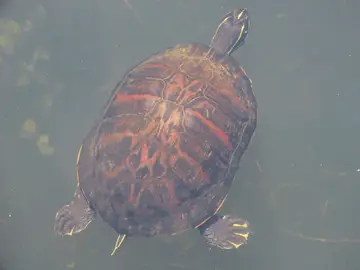
Photo: Viktor · CC BY 4.0 · iNaturalist Florida Redbelly Turtle Pseudemys nelsoni
Where in Georgia Very southeast Georgia; common on Cumberland Island (SREL) Georgia DNR Wildlife Conservation Section Conservation Georgia state rank S2 (DNR portal) What the sources say Habitat: Blackwater creeks; ponds; lakes; swamps (Georgia DNR Wildlife Conservation Section)
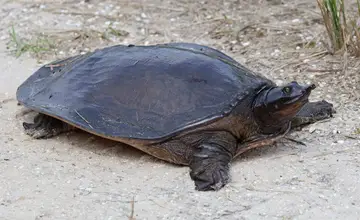
Photo: ALAN SCHMIERER · CC0 · Wikimedia Commons Florida Softshell Apalone ferox
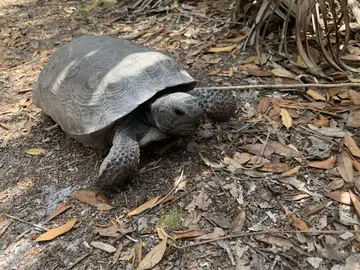
Where in Georgia Southern Georgia University of Georgia Savannah River Ecology Laboratory (SREL) Herpetology Photo: geosesarma · CC BY 4.0 · iNaturalist Gopherus polyphemus
Size Averages 9 to 11 inches long when grown; up to 15 inches. How to recognize it Stumpy, elephant-like hind feet and flat, shovel-like front legs covered in thick scales Domed, oblong shell with no keel Burrow entrance is half-moon shaped with a fan of bare sand (apron) in front Conservation Georgia state protection: Threatened (DNR portal code 'T'); Georgia state rank S3 (DNR portal)
J F M A M J J A S O N D
43 records by month. What the sources say Habitat: Sandhills; dry hammocks; longleaf pine-turkey oak woods; old fields (Georgia DNR Wildlife Resources Division)
Full Gopher Tortoise guide
No confirmed photo of Green Sea Turtle Green Sea Turtle Chelonia mydas
Where in Georgia Coastal waters; occasional nester Georgia DNR Wildlife Resources Division Conservation Georgia state protection: Threatened (DNR portal code 'T'); US ESA code in DNR portal: LT; Georgia state rank S3 (DNR portal) What the sources say Habitat: Open ocean; sounds; coastal rivers; beaches (Georgia DNR Wildlife Resources Division)
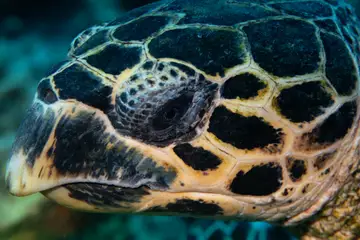
Photo: cello caruso-turiello · CC BY 4.0 · iNaturalist Hawksbill Sea Turtle Eretmochelys imbricata
Where in Georgia Coast (rare; DNR excludes it from regular foraging/migration) Georgia DNR Wildlife Resources Division Conservation Georgia state protection: Endangered (DNR portal code 'E'); US ESA code in DNR portal: LE; Georgia state rank SU (DNR portal) What the sources say Habitat: Shallow coastal waters with rocky bottoms, coral reefs (Georgia DNR Wildlife Resources Division)
No confirmed photo of Kemp's Ridley Sea Turtle Kemp's Ridley Sea Turtle Lepidochelys kempii
Where in Georgia Coastal waters Georgia DNR Wildlife Resources Division Conservation Georgia state protection: Endangered (DNR portal code 'E'); US ESA code in DNR portal: LE; Georgia state rank S2 (DNR portal) What the sources say Habitat: Open ocean; sounds; coastal rivers; beaches (Georgia DNR Wildlife Resources Division)
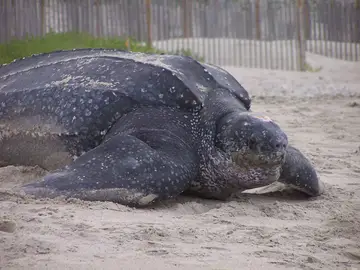
Photo: Rabon David, U.S. Fish and Wildlife Service · Public domain · Wikimedia Commons Dermochelys coriacea
Size Adults 5 to 6 feet long, 750 to 1,000 pounds (NOAA). Texas Parks and Wildlife cites weights up to 1,300 lb and shells up to 8 feet. How to recognize it The only sea turtle that lacks scales and a hard shell. Front flippers proportionally longer than in other sea turtles; rear flippers paddle-shaped. Usually a pink spot on top of the head that can identify individuals. Where in Georgia Coastal waters; occasional nester Georgia DNR Wildlife Resources Division Conservation Georgia state protection: Endangered (DNR portal code 'E'); US ESA code in DNR portal: LE; Georgia state rank S2 (DNR portal) What the sources say Habitat: Open ocean; sounds; coastal beaches (Georgia DNR Wildlife Resources Division)
Full Leatherback Sea Turtle guide
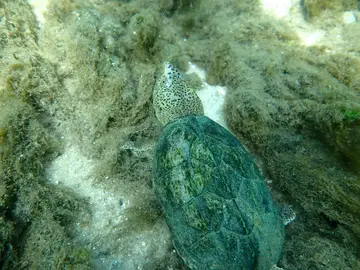
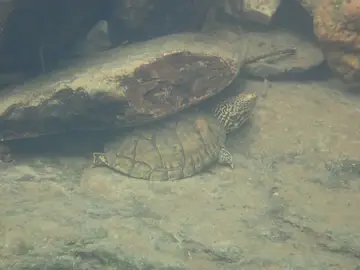
Photo: Josiah Londerée · CC BY 4.0 · iNaturalist Loggerhead Musk Turtle Sternotherus minor
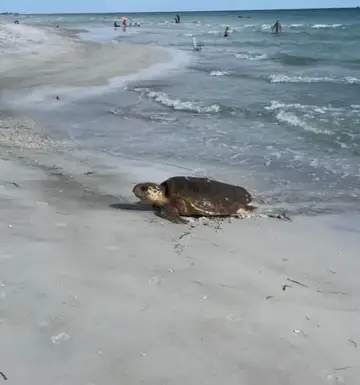
Where in Georgia Gulf Coastal Plain and Piedmont regions University of Georgia Savannah River Ecology Laboratory (SREL) Herpetology Photo: Kristiina Hurme · CC BY 4.0 · iNaturalist Caretta caretta
Size Adults 2.5 to 3.5 feet long and 200 to 350 pounds (NOAA). NCWRC gives 31 to 45 inches shell length and 170 to 350 pounds; SCDNR says adults can weigh as much as 300 pounds and reach up to four feet in shell length. How to recognize it Very large head with powerful jaws. Slightly heart-shaped top shell. Two pairs of scales (prefrontal scutes) between the eyes above the nostrils; two claws on each flipper. Where in Georgia Coast; nests on barrier islands Georgia DNR Wildlife Resources Division Conservation Georgia state protection: Threatened (DNR portal code 'T'); US ESA code in DNR portal: LT; Georgia state rank S3 (DNR portal) What the sources say Habitat: Open ocean; sounds; coastal rivers; beaches (Georgia DNR Wildlife Resources Division)
Full Loggerhead Sea Turtle guide
No confirmed photo of Northern (Common) Map Turtle Northern (Common) Map Turtle Graptemys geographica
Conservation Georgia state protection: Rare (DNR portal code 'R'); Georgia state rank SU (DNR portal) What the sources say Habitat: Large streams and rivers (Georgia DNR Wildlife Resources Division)
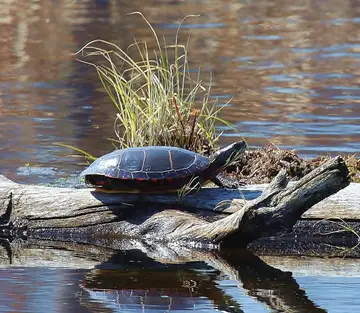
Photo: U. S. Fish and Wildlife Service - Northeast Region · Public domain · Wikimedia Commons Chrysemys picta
Size Small: adult shell usually 4 to 7 inches, up to about 10 inches; females are larger than males. How to recognize it Smooth, fairly flat shell with no keel and a smooth (not saw-toothed) rear edge Red markings on the marginal shell plates Yellow spot behind each eye and yellow stripes on the chin Where in Georgia Piedmont and mountains University of Georgia Savannah River Ecology Laboratory (SREL) Herpetology
J F M A M J J A S O N D
59 records by month. Full Painted Turtle guide
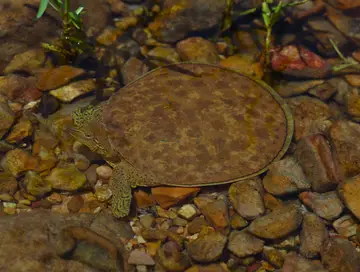
Photo: Peter Paplanus · CC BY 2.0 · Wikimedia Commons Spiny Softshell Apalone spinifera
Where in Georgia Georgia except mountains and south-central Coastal Plain University of Georgia Savannah River Ecology Laboratory (SREL) Herpetology
J F M A M J J A S O N D
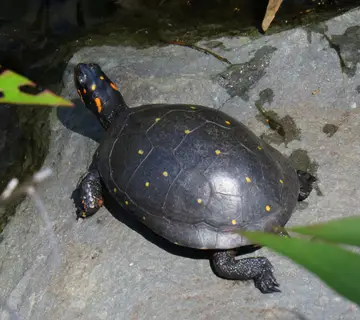
30 records by month. Photo: Nick Block · CC BY 4.0 · iNaturalist Spotted Turtle Clemmys guttata
Conservation Georgia state protection: Unusual (DNR portal code 'U'); Georgia state rank S3 (DNR portal) What the sources say Habitat: Heavily vegetated swamps, marshes, bogs, small ponds, and tidally influence freshwater wetlands; nest and possibly hibernate in surrounding uplands (Georgia DNR Wildlife Resources Division)
Photo: Michael A. Alcorn · CC BY 4.0 · Wikimedia Commons Stripe-necked Musk Turtle Sternotherus peltifer
Conservation Georgia state rank SU (DNR portal) What the sources say Habitat: Big rivers, reservoirs, rivers and streams and floodplains (Georgia DNR Wildlife Conservation Section)
No confirmed photo of Suwannee Alligator Snapping Turtle Suwannee Alligator Snapping Turtle Macrochelys suwanniensis
Conservation Georgia state protection: Threatened (DNR portal code 'T'); US ESA code in DNR portal: LT; Georgia state rank S2 (DNR portal) What the sources say Habitat: Large blackwater rivers and streams in reaches with woody debris, deep pools and undercut banks (Georgia DNR Wildlife Conservation Section)
Photo: Sam Kieschnick · CC BY 4.0 · iNaturalist Suwannee River Cooter Pseudemys concinna suwanniensis
Conservation Georgia state rank S1 (DNR portal) What the sources say Habitat: Tributaries of the Suwannee River; blackwater streams in areas with abundant snags and exposed limestone (Georgia DNR Wildlife Conservation Section)
Turtles people confuse Alligator Snapping Turtle or Snapping Turtle? The common snapping turtle has a more rounded shell without the three prominent ridges, a saw-toothed row of scales on top of the tail, and eyes visible from above.
Loggerhead sea turtle or Leatherback sea turtle? Adult leatherbacks differ from all other sea turtles, including the loggerhead, in their large size, spindle-shaped body and leathery shell without scales.
Loggerhead sea turtle or Loggerhead musk turtle (a different, freshwater animal)? Despite the name, the loggerhead musk turtle is a small freshwater turtle, usually 3 to 5 inches long, living in creeks and streams of the Southeast.
Photos show typical adults; individuals vary. Never get close to compare.
When turtles are active in Georgia Records of turtles in Georgia peak in March to July. They show when people record turtles, not how many there are (about month bars ).
Jan Feb Mar Apr May Jun Jul Aug Sep Oct Nov Dec
1,350 records of turtles in Georgia by month (GBIF, CC0 and CC BY records). If you see one Official advice from Georgia DNR Wildlife Resources Division:
What official sources say Are there sea turtles in Georgia? Yes. Five of the world's seven sea turtle species are found along Georgia's coast; the loggerhead is the only one that nests regularly on the barrier islands. Loggerhead nesting season in Georgia is late May to mid-August. Georgia DNR Wildlife Resources Division
“The world has only seven species of sea turtles and five are found along Georgia's coast: loggerhead, green, leatherback, Kemp's ridley and hawksbill. … Nesting season in Georgia is late May to mid-August.” Are there gopher tortoises in Georgia? Yes. Listed by Georgia DNR as a native species and state Threatened. Georgia DNR
“State Protection: Threatened” Sources Georgia DNR Wildlife Resources Division home page . Georgia DNR Wildlife Resources Division. undated page; checked November 3, 2026. Laws Related to Native Wildlife . Georgia DNR Wildlife Resources Division. undated page; checked November 3, 2026. All Rare Reptiles and Amphibians (Georgia Biodiversity Portal) . Georgia DNR Wildlife Conservation Section. data export July 7, 2026; checked November 3, 2026. Gopher Tortoise profile (Georgia Biodiversity Portal) . Georgia DNR. undated page; checked November 3, 2026. Quoted passages (3) “Its oblong carapace is unkeeled and domed, somewhat flattened, and brown or gray in color.” “Burrow openings are half-moon shaped and an apron of excavated sand fans out in front of the opening.” “State Protection: Threatened” Sea Turtle Recovery Efforts . Georgia DNR Wildlife Resources Division. undated page; checked November 3, 2026. Quoted passages (3) “If you encounter a sea turtle on the beach, observe at a distance.” “Nesting season in Georgia is late May to mid-August.” “The world has only seven species of sea turtles and five are found along Georgia's coast: loggerhead, green, leatherback, Kemp's ridley and hawksbill. … Nesting season in Georgia is late May to mid-August.” Common Snapping Turtle (Chelydra serpentina) . University of Georgia Savannah River Ecology Laboratory (SREL) Herpetology. undated page; checked November 3, 2026. Florida Softshell (Apalone ferox) . University of Georgia Savannah River Ecology Laboratory (SREL) Herpetology. undated page; checked November 3, 2026. Spiny Softshell (Apalone spinifera) . University of Georgia Savannah River Ecology Laboratory (SREL) Herpetology. undated page; checked November 3, 2026. Painted Turtle (Chrysemys picta) . University of Georgia Savannah River Ecology Laboratory (SREL) Herpetology. undated page; checked November 3, 2026. Stripeneck / Loggerhead Musk Turtle (Sternotherus minor) . University of Georgia Savannah River Ecology Laboratory (SREL) Herpetology. undated page; checked November 3, 2026. GBIF.org occurrence records, human observations licensed CC0 1.0 or CC BY 4.0 only, accessed November 3, 2026. The datasets behind these counts are listed on our Sources page.