Loggerhead sea turtle
Caretta caretta · also called Loggerhead turtle, Loggerhead and Atlantic loggerhead · Last checked November 3, 2026.
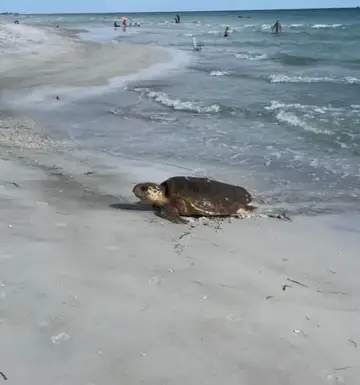
The loggerhead is a large sea turtle named for its big head and powerful jaws, which it uses to crush hard-shelled prey such as whelks and conchs. Adults are about 2.5 to 3.5 feet long and weigh 200 to 350 pounds, with a reddish-brown shell. It is the most common sea turtle in US coastal waters and the one that nests most on US beaches, mainly along the Atlantic coast of Florida, South Carolina, Georgia and North Carolina and the Florida and Alabama Gulf coasts. US Atlantic and Gulf loggerheads are listed as threatened under the Endangered Species Act. The official sources we checked do not describe it as a danger to people; their guidance is to watch from a distance and not to disturb turtles, nests or hatchlings. NOAA Fisheries
On this page
Is the loggerhead sea turtle dangerous?
How to identify a loggerhead sea turtle
A photo or description can narrow it down, but cannot confirm what an animal is or that it is safe. Look from a distance and do not handle wild animals.
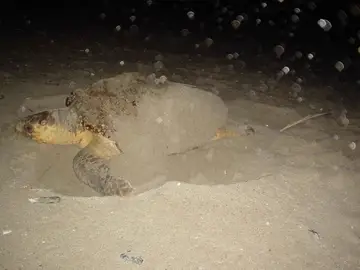

Size: Adults 2.5 to 3.5 feet long and 200 to 350 pounds (NOAA). NCWRC gives 31 to 45 inches shell length and 170 to 350 pounds; SCDNR says adults can weigh as much as 300 pounds and reach up to four feet in shell length.
Colors: Top shell reddish-brown; bottom shell pale yellowish. Neck and flippers dull brown to reddish-brown on top and yellow on the sides and bottom. Pattern: Head scales brown to reddish-brown, some with yellow borders; jaw usually yellow.
Key features
- Very large head with powerful jaws. NOAA Fisheries
- Slightly heart-shaped top shell. NOAA Fisheries
- Two pairs of scales (prefrontal scutes) between the eyes above the nostrils; two claws on each flipper. Outdoor Alabama
- Like all sea turtles, it cannot pull its head or flippers into its shell. NOAA Fisheries
Young
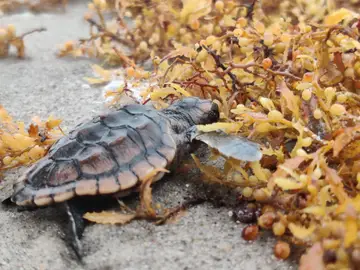
Hatchlings are mostly dark brown, with white to white-gray edges on the flippers and a yellowish to tan bottom shell.
Animals mistaken for the loggerhead sea turtle
Loggerhead sea turtle or Leatherback sea turtle?
Loggerhead sea turtle
Leatherback sea turtle Dermochelys coriacea
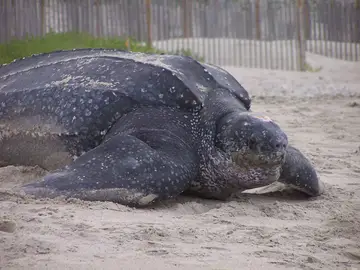

Adult leatherbacks differ from all other sea turtles, including the loggerhead, in their large size, spindle-shaped body and leathery shell without scales. Texas Parks and Wildlife Department
Loggerhead sea turtle or Loggerhead musk turtle (a different, freshwater animal)?
Loggerhead sea turtle
Loggerhead musk turtle (a different, freshwater animal) Sternotherus minor
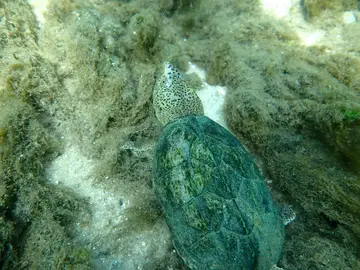
Despite the name, the loggerhead musk turtle is a small freshwater turtle, usually 3 to 5 inches long, living in creeks and streams of the Southeast. Outdoor Alabama
Where the loggerhead sea turtle lives
- Native or listed
- Nonnative or not established
- No official record in our data
- 1–9
- 10–99
- 100–999
- 1,000+
On our state guides
- Alabama turtles
- Alaska turtles
- California turtles
- Connecticut turtles
- Delaware turtles
- Florida turtles
- Georgia turtles
- Hawaii turtles
- Louisiana turtles
- Maine turtles
- Maryland turtles
- Massachusetts turtles
- Mississippi turtles
- New Jersey turtles
- New York turtles
- North Carolina turtles
- Oregon turtles
- Rhode Island turtles
- South Carolina turtles
- Texas turtles
- Virginia turtles
- Washington turtles
State boundaries: U.S. Census Bureau, cartographic boundary file cb_2024_us_state_20m.
When it is active
Nesting happens at night. In the northern hemisphere, females lay eggs from late April to early September; US nesting mostly early May to August, peaking in June and July (Alabama); Georgia's nesting season is late May to mid-August. Sea turtles are in South Carolina's near-shore waters April through November, and Maryland reports them May to November.
US open-licence records peak in May to June and August to September.
Habitat and habits
Habitat: Hatchlings and young juveniles live in the open ocean for 7 to 15 years, then move to nearshore coastal waters, bays and estuaries. Females nest on sandy beaches.
Behavior: Must surface to breathe. Adults migrate hundreds to thousands of miles between feeding grounds and nesting beaches; females usually return to nest near where they hatched.
Diet: Mostly carnivorous: bottom-dwelling invertebrates such as mollusks, crustaceans and horseshoe crabs, crushed with powerful jaws; young turtles in the open ocean eat floating items and sometimes mistake plastic for food.
Young: Females mature at about 35 years and nest every 2 to 3 years, laying 3 to 5 nests of about 100 eggs, two weeks apart. Eggs hatch after about two months; sand temperature sets the hatchlings' sex. Beachfront lights can lead hatchlings away from the sea.
Legal status and reporting
Federal: Listed under the Endangered Species Act as nine distinct population segments: the Northwest Atlantic Ocean population (US Atlantic and Gulf) is Threatened; the North Pacific Ocean population is Endangered. Also CITES Appendix I. NOAA Fisheries
Protection: Protected species: Georgia DNR says all sea turtles in Georgia are protected by state and federal law; NCWRC says the loggerhead is listed as threatened and protected by law. Maryland lists it as federally and state threatened; New Jersey lists it as endangered.
Report: Report stranded, injured, entangled or dead sea turtles. NOAA lists: Southeast Sea Turtle Stranding and Salvage Network (844) SEA-TRTL (844-732-8785); Florida FWC (888) 404-FWCC (888-404-3922); Northeast hotline (866) 755-NOAA (866-755-6622); West Coast Region (866) 767-6114; Hawaii (888) 256-9840. South Carolina DNR: report dead or injured sea turtles to 1-800-922-5431.
Sources
- Loggerhead Turtle (Species Directory). NOAA Fisheries. updated by NOAA Fisheries on 07/13/2026; checked November 3, 2026.
Quoted passages (7)
“Loggerheads have large heads with powerful jaws.”
“The top shell (carapace) is slightly heart-shaped”
“Unlike freshwater turtles and tortoises, sea turtles cannot withdraw their head or flippers into their shells.”
“Hatchlings are mostly dark brown, their flippers have white to white-gray margins, and the bottom shell is generally yellowish to tan.”
“Loggerheads are carnivores, only occasionally consuming plant material. … Juveniles and adults in coastal waters eat mostly bottom-dwelling invertebrates including mollusks, crustaceans, and horseshoe crabs. … Small fragments of plastic are often mistaken for food and eaten by turtles.”
“Loggerheads, like all sea turtles, are marine reptiles and must come to the surface to breathe. … Adult loggerhead turtles migrate hundreds to thousands of miles from their foraging grounds to their nesting beaches.”
“Female loggerheads reach maturity at about 35 years of age. Every 2 to 3 years they migrate to breed … Adult females lay three to five nests, sometimes more, two weeks apart during a single nesting season. Each nest contains about 100 eggs. … After about two months incubating in the warm sand, the eggs hatch … Hatchlings are particularly threatened by artificial beachfront lighting”
- Sea Turtle Recovery Efforts. Georgia DNR Wildlife Resources Division. undated page; checked November 3, 2026.
- Loggerhead Sea Turtle. Alabama Department of Conservation and Natural Resources (Outdoor Alabama). undated page; checked November 3, 2026.
Quoted passages (1)
“Has very large head with a massive jaw, and a short snout with two pairs of prefrontal scutes above the nostrils. … with two claws on each flipper.”
- TPWD Wildlife Fact Sheet: Leatherback Sea Turtle (Dermochelys coriacea). Texas Parks and Wildlife Department. undated page; checked November 3, 2026.
Quoted passages (1)
“Adults can be distinguished from all other species of sea turtles by their large size, spindle-shaped bodies, and leathery, unscaled carapaces.”
- Loggerhead Musk Turtle. Alabama Department of Conservation and Natural Resources (Outdoor Alabama). undated page; checked November 3, 2026.
Quoted passages (1)
“The loggerhead musk turtle is a relatively small aquatic turtle, usually averaging 3 to 5 inches in length.”
- GBIF.org occurrence records, human observations licensed CC0 1.0 or CC BY 4.0 only, accessed November 3, 2026. The datasets behind these counts are listed on our Sources page.
- State boundaries: U.S. Census Bureau, cartographic boundary file cb_2024_us_state_20m.