States Wildlife

New Jersey Turtles: Identification Guide With Pictures

Last checked November 3, 2026 against official sources.

On this page
  1. Which turtles can hurt you
  2. All 19 turtles
  3. Lookalikes
  4. When they are active
  5. If you are bitten or stung
  6. About this list
  7. Sources

This page lists 19 turtles: all from NJDEP Division of Fish & Wildlife's Reptiles of New Jersey. 2 are nonnative.

Which turtles can hurt you

Official sources single out these turtles in New Jersey, in their own words:

All 19 turtles

From A to Z. Do not handle them.

No confirmed photo of Atlantic Green Turtle

Atlantic Green Turtle

Chelonia mydas

Conservation
State Endangered (also federally endangered or threatened)
Atlantic Hawksbill
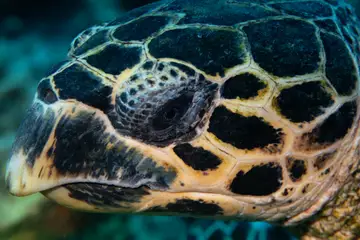
Photo: cello caruso-turiello · CC BY 4.0 · iNaturalist

Atlantic Hawksbill

Eretmochelys imbricata

Conservation
State Endangered (also federally endangered or threatened)
Atlantic Leatherback
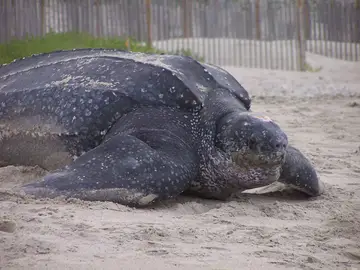
Photo: Rabon David, U.S. Fish and Wildlife Service · Public domain · Wikimedia Commons

Atlantic Leatherback

Dermochelys coriacea

Size
Adults 5 to 6 feet long, 750 to 1,000 pounds (NOAA). Texas Parks and Wildlife cites weights up to 1,300 lb and shells up to 8 feet.
How to recognize it
  • The only sea turtle that lacks scales and a hard shell.
  • Front flippers proportionally longer than in other sea turtles; rear flippers paddle-shaped.
  • Usually a pink spot on top of the head that can identify individuals.
Conservation
State Endangered (also federally endangered or threatened)

Full Atlantic Leatherback guide

Atlantic Loggerhead
Photo: Kristiina Hurme · CC BY 4.0 · iNaturalist

Atlantic Loggerhead

Caretta caretta

Size
Adults 2.5 to 3.5 feet long and 200 to 350 pounds (NOAA). NCWRC gives 31 to 45 inches shell length and 170 to 350 pounds; SCDNR says adults can weigh as much as 300 pounds and reach up to four feet in shell length.
How to recognize it
  • Very large head with powerful jaws.
  • Slightly heart-shaped top shell.
  • Two pairs of scales (prefrontal scutes) between the eyes above the nostrils; two claws on each flipper.
Conservation
State Endangered (also federally endangered or threatened)

Full Atlantic Loggerhead guide

No confirmed photo of Atlantic Ridley

Atlantic Ridley

Lepidochelys kempi

Conservation
State Endangered (also federally endangered or threatened)
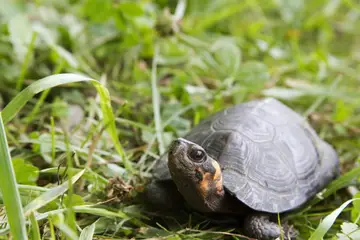
Bog Turtle
Photo: U.S. Fish and Wildlife Service Southeast Region · Public domain · Wikimedia Commons (U.S. federal work, public domain)

Bog Turtle

Clemmys muhlenbergi

Where in New Jersey
Entire state. Their greatest numbers occur in the agricultural landscapes of northwestern and southwestern New Jersey. NJDEP Division of Fish & Wildlife, ENSP
Conservation
State Endangered (also federally endangered or threatened)
What the sources say

Habitat: Bog turtles are found in bogs, swamps, and clear, slow-moving meadow streams with muddy bottoms. (NJDEP Division of Fish & Wildlife, ENSP)

No confirmed photo of Common Snapping Turtle

Common Snapping Turtle

Chelydra s. serpentina

Danger to people
“On land, Common Snapping Turtles are quite strike-prone.” NJDEP Division of Fish & Wildlife, ENSP
Where in New Jersey
Entire state. NJDEP Division of Fish & Wildlife, ENSP
What the sources say

Habitat: Snapping turtles require permanent bodies of freshwater, large or small. (NJDEP Division of Fish & Wildlife, ENSP)

No confirmed photo of Eastern Box Turtle

Eastern Box Turtle

Terrapene c. carolina

Where in New Jersey
Entire state. NJDEP Division of Fish & Wildlife, ENSP
Conservation
State Special Concern
What the sources say

Habitat: Although essentially terrestrial, these turtles sometimes soak themselves in mud or water. (NJDEP Division of Fish & Wildlife, ENSP)

No confirmed photo of Eastern Mud Turtle

Eastern Mud Turtle

Kinosternon s. subrubrum

Where in New Jersey
All of Southern Region … NJDEP Division of Fish & Wildlife, ENSP
Conservation
Undetermined-Unknown (state nongame list)
What the sources say

Range: All of Southern Region. All of Mercer, Middlesex, Union, Essex, Hudson, Bergen, and Somerset Counties; southeastern portions of Hunterdon, Morris, and Passaic Counties in the Northern Region.

Habitat: Mud turtles also prefer shallow water. (NJDEP Division of Fish & Wildlife, ENSP)

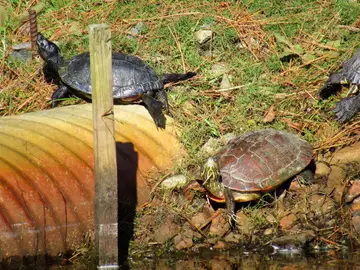
No confirmed photo of Eastern Painted Turtle

Eastern Painted Turtle

Chrysemys p. picta

Where in New Jersey
Entire state. NJDEP Division of Fish & Wildlife, ENSP
What the sources say

Habitat: Any standing body of water. (NJDEP Division of Fish & Wildlife, ENSP)

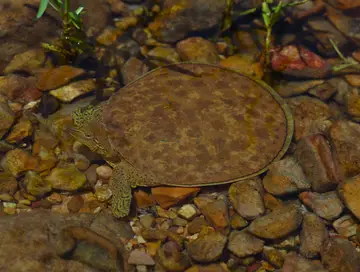
Eastern Spiny Softshell
Photo: Peter Paplanus · CC BY 2.0 · Wikimedia Commons

Eastern Spiny Softshell

Trionyx spiniferus

Nonnative

Where in New Jersey
An introduced and well-established population in the Maurice River system, Cumberland County. NJDEP Division of Fish & Wildlife, ENSP
What the sources say

Habitat: The Eastern Spiny Softshell is typically limited to rivers; however, they can also be found in lakes where mud bars are available. (NJDEP Division of Fish & Wildlife, ENSP)

No confirmed photo of Map Turtle

Map Turtle

Graptemys geographica

Where in New Jersey
Delaware River from Delaware Water Gap south to Trenton. NJDEP Division of Fish & Wildlife, ENSP
Conservation
Undetermined-Unknown (state nongame list)
What the sources say

Habitat: The Common Map Turtle prefers large bodies of water, like rivers and lakes. (NJDEP Division of Fish & Wildlife, ENSP)

No confirmed photo of N. Diamondback Terrapin

N. Diamondback Terrapin

Malaclemys t. terrapin

Where in New Jersey
The saltwater coast of the entire state. NJDEP Division of Fish & Wildlife, ENSP
Conservation
State Special Concern
What the sources say

Habitat: Coastal marshes, estuaries, coves, tidal flats, and inner edges of barrier beaches. (NJDEP Division of Fish & Wildlife, ENSP)

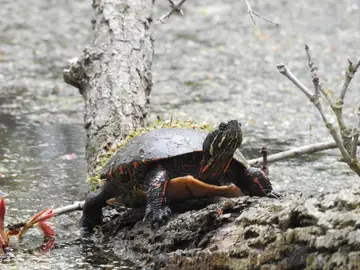
Red-bellied Turtle
Photo: Joshua Liverman · CC BY 4.0 · iNaturalist

Red-bellied Turtle

Pseudemys rubriventris

Where in New Jersey
All of the Southern Region. The Northern Region: Mercer, Monmouth, and southern Middlesex Counties. NJDEP Division of Fish & Wildlife, ENSP
What the sources say

Habitat: Ponds, rivers, ditches, and sloughs. (NJDEP Division of Fish & Wildlife, ENSP)

No confirmed photo of Red-eared Turtle

Red-eared Turtle

Pseudemys scripta elegans

Nonnative

Where in New Jersey
Entire state. NJDEP Division of Fish & Wildlife, ENSP
What the sources say

Habitat: This is not a species native to New Jersey, and can be found anywhere in the state. (NJDEP Division of Fish & Wildlife, ENSP)

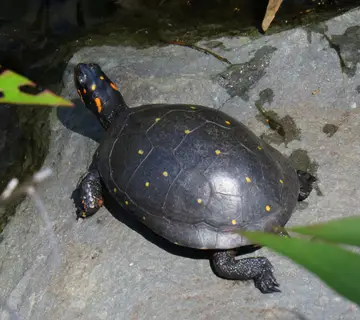
Spotted Turtle
Photo: Nick Block · CC BY 4.0 · iNaturalist

Spotted Turtle

Clemmys guttata

Where in New Jersey
Entire state. NJDEP Division of Fish & Wildlife, ENSP
Conservation
State Special Concern
What the sources say

Habitat: Spotted Turtles are found in marshy meadows, bogs, swamps, small ponds, ditches, and other shallow bodies of freshwater. (NJDEP Division of Fish & Wildlife, ENSP)

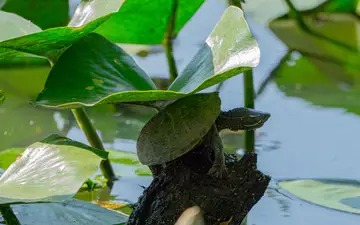
Stinkpot
Photo: Curtis Meyers · CC BY-SA 4.0 · iNaturalist · resized

Stinkpot

Sternotherus odoratus

Where in New Jersey
Entire state. NJDEP Division of Fish & Wildlife, ENSP
42 records by month.
What the sources say

Habitat: Musk turtles are found in the shallow waters of lakes, ponds, rivers, and canals. (NJDEP Division of Fish & Wildlife, ENSP)

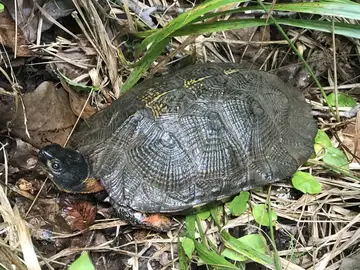
Wood Turtle
Photo: Michael Ellis · CC BY 4.0 · iNaturalist

Wood Turtle

Clemmys insculpta

Size
14-20 cm (5.5-8 in)
How to recognize it
  • Lower shell has no hinge
  • Combination of brown shell, orange front limbs and a lower shell solidly fused to the upper shell
  • Males: concave lower shell, long thick tail, broader head
Where in New Jersey
All of the Northern Region, except the urbanized regions of the eastern counties. Sparse records in the Southern Region. NJDEP Division of Fish & Wildlife, ENSP
Conservation
State Threatened
What the sources say

Habitat: This turtle is a riparian species that uses a mosaic of wetland and upland habitats in the vicinity of its stream habitat. (NJDEP Division of Fish & Wildlife, ENSP)

Full Wood Turtle guide

Turtles people confuse

Loggerhead sea turtle or Leatherback sea turtle?

Loggerhead sea turtle
Photo: Kristiina Hurme · CC BY 4.0 · iNaturalist

Loggerhead sea turtle Not stated

Leatherback sea turtle
Photo: Rabon David, U.S. Fish and Wildlife Service · Public domain · Wikimedia Commons

Leatherback sea turtle Not stated

Adult leatherbacks differ from all other sea turtles, including the loggerhead, in their large size, spindle-shaped body and leathery shell without scales.

Photos show typical adults; individuals vary. Never get close to compare.

When turtles are active in New Jersey

Records of turtles in New Jersey peak in April to June and August. They show when people record turtles, not how many there are (about month bars).

1,382 records of turtles in New Jersey by month (GBIF, CC0 and CC BY records).

If you are bitten or stung

Call 911 or Poison Help at 1-800-222-1222 right away. Poison Help connects you to your local poison center, any time of day.

About this list

The species list comes from Reptiles of New Jersey (checklist) (NJDEP Division of Fish & Wildlife, Last Updated: December 10, 2004).

Venom labels come only from official sources and link to them; "Not stated" never means harmless. How labels work.

"Nonnative" and "Invasive" follow the wording of the source list. See invasive species in New Jersey.

Sources

  1. New Jersey's Endangered, Threatened, and Special Concern Species. NJDEP Fish & Wildlife, ENSP. archived copy, captured August 25, 2026; checked November 3, 2026.
  2. Reptiles of New Jersey (checklist). NJDEP Division of Fish & Wildlife. updated December 10, 2004; checked November 3, 2026.
  3. Field Guide to Reptiles and Amphibians of New Jersey: Turtles. NJDEP Division of Fish & Wildlife, ENSP. 1st edition, February 2001; checked November 3, 2026.
    Quoted passages (2)
    “On land, Common Snapping Turtles are quite strike-prone.”
    “When to find them: Active April through November.”
  4. GBIF.org occurrence records, human observations licensed CC0 1.0 or CC BY 4.0 only, accessed November 3, 2026. The datasets behind these counts are listed on our Sources page.