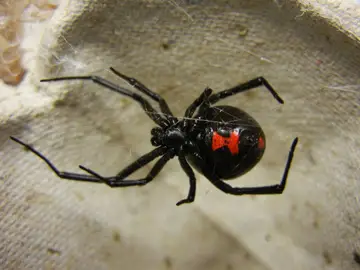

Southern black widow
Latrodectus mactans
What the sources say
Venom: “The southern black widow (Latrodectus mactans) is the most notorious because of its potent venom” (NJAES)
Last checked November 3, 2026 against official sources.
This page lists 4 spiders: 3 from NJAES's Spiders of Medical Importance and 1 named in other official sources. 2 are venomous by official accounts, and 1 mildly venomous.
Not every species: no complete official list of New Jersey spiders exists, so this page covers the ones state and Extension sources name. How lists are built.
Official sources single out these spiders in New Jersey, in their own words:
Venomous. “In North America, only the widow spiders in the genus Latrodectus and the recluse spiders, in the genus Loxosceles are dangerous to humans.” NJAES
Official sources single out these ticks in New Jersey, in their own words:
Disease. “Tick borne illnesses most commonly found in New Jersey are; Anaplasmosis, Babesiosis, Ehrlichiosis, Lyme Disease, and Rocky Mountain Spotted Fever.” NJ Poison Control Center (NJPIES), Rutgers New Jersey Medical School
Invasive tick listed by NJDEP among the most commonly encountered invasive animals and pests with known impacts. “Longhorned Tick Haemaphysalis longicornis” NJDEP
Official sources name the recluse spiders, including the brown recluse, in connection with New Jersey, but none we use says they live there. They are not counted on this page.
Presence not stated.
It is venomous, per NJAES. If you find one, do not touch it.
Venomous species first, then A to Z. Do not handle them.
Latrodectus mactans
Venom: “The southern black widow (Latrodectus mactans) is the most notorious because of its potent venom” (NJAES)
Latrodectus spp.
Venom: “Black widow spiders produce venom that contains a neurotoxin.” (NJAES)
Habitat: Under stones, in firewood piles, under decks, in hollow stumps and rodent burrows; indoors in garages, basements and crawl spaces (NJAES)
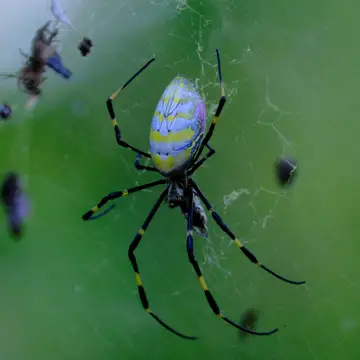
Trichonephila clavata
Venom: “While the Jorō spider has fangs and kills its prey with venom, it is generally harmless to humans and pets, as its fangs do not easily pierce skin.” (NJAES)
Cheiracanthium spp.
Records of spiders in New Jersey peak in April to July and September. They show when people record spiders, not how many there are (about month bars).
Call 911 or Poison Help at 1-800-222-1222 right away. Poison Help connects you to your local poison center, any time of day.
Yes. Rutgers Cooperative Extension says widow spiders occur in every US state. It does not give a New Jersey range for each widow species. NJAES
“They occur in every state in the United States.”
Rutgers says it is established over much of the southern US and recently in New York. NJAES
“…is now established over much of the southern USA, and recently in New York”
The species list comes from Spiders of Medical Importance (FS1121) (Rutgers Cooperative Extension (NJAES), May 2010). 1 more entry comes from other official sources named on each card.
Venom labels come only from official sources and link to them; "Not stated" never means harmless. How labels work.
“Black widow spiders produce venom that contains a neurotoxin.”
“In North America, only the widow spiders in the genus Latrodectus and the recluse spiders, in the genus Loxosceles are dangerous to humans.”
“The southern black widow (Latrodectus mactans) is the most notorious because of its potent venom”
“Brown recluse spiders posses a cytotoxin.”
“They occur in every state in the United States.”
“…is now established over much of the southern USA, and recently in New York”
“While the Jorō spider has fangs and kills its prey with venom, it is generally harmless to humans and pets, as its fangs do not easily pierce skin.”
“Tick borne illnesses most commonly found in New Jersey are; Anaplasmosis, Babesiosis, Ehrlichiosis, Lyme Disease, and Rocky Mountain Spotted Fever.”
“Longhorned Tick Haemaphysalis longicornis”