Joro spider
Trichonephila clavata · also called Jorō spider, Joro and Nephila clavata (older name) · Last checked November 3, 2026.
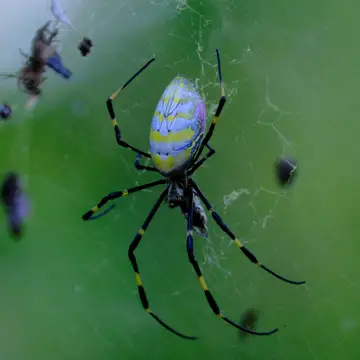
The Joro spider is a large yellow, blue-gray and black orb-weaving spider from East Asia. It was first found in the US in northeast Georgia in 2014 and has spread across the Southeast. UGA Extension says it is established in Georgia, North Carolina, South Carolina, Tennessee and Alabama, with isolated populations in Maryland, Virginia and Pennsylvania. Extension sources say it is not dangerous. Like nearly all spiders it has venom, but Clemson Extension says the venom is not medically relevant and is not known to harm people or pets. The spiders are timid and rarely bite. Mature spiders are most noticed in September and October, when their large golden webs appear at forest edges, between trees, on houses and porches, and on power lines. University of Georgia Cooperative Extension
On this page
Is the Joro spider dangerous?
Not dangerous to people or pets, according to extension sources. Its venom is not medically important. Clemson Cooperative Extension, Home & Garden Information Center
“…it is not medically relevant and is not known to harm people or pets.”
Bites and stings: Rarely bites. Clemson says females can bite but are docile and more likely to run away and hide; a bite is most likely if the spider is held tightly. Penn State says the fangs are small and have trouble piercing human skin. Reported bites caused a small, red, itchy welt (Clemson) or brief localized pain and redness (Penn State).
If someone is bitten or stung, call 911 or Poison Help at 1-800-222-1222.
How to identify a Joro spider
A photo or description can narrow it down, but cannot confirm what an animal is or that it is safe. Look from a distance and do not handle wild animals.
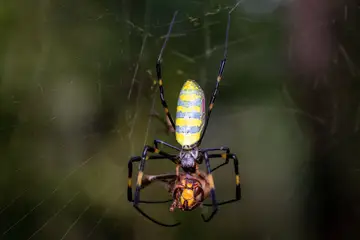
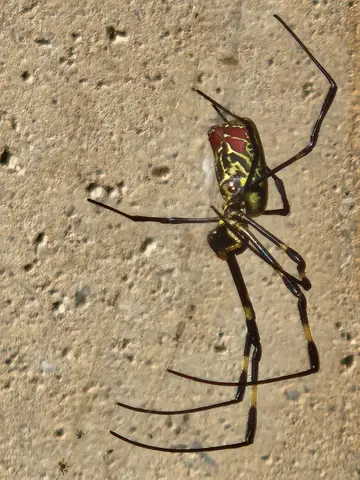
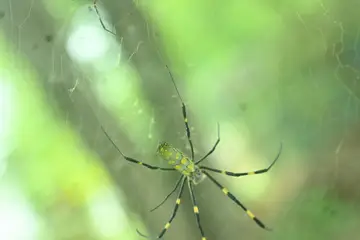
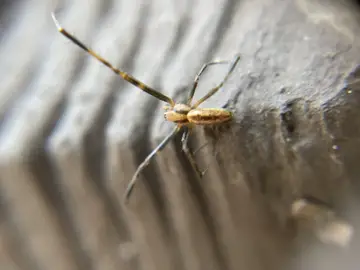
Size: Adult female body 0.67-1.2 in (17-30 mm); legs up to 3 in long, a leg span of 3-4 in. Males are much smaller, 0.16-0.31 in (4-8 mm). University of Georgia Cooperative Extension
Colors: bright yellow abdomen with blue-green or blue-gray bands (adult female); silver or white on top of the front body section (cephalothorax); large red markings on the underside; black legs with yellow bands; rarely all black. Pattern: broad crosswise bands across the top of the abdomen; black-and-white checked underside with red splotches near the tail end; banded legs.
Key features
- golden-yellow silk in very large webs, often high up between the tops of large trees; also on power lines (N.C. Extension, Henderson County)
- adult webs have no zigzag (stabilimentum); garden spiders often have one Penn State Extension
- one or more tiny brown males often sit in the female's web University of Georgia Cooperative Extension
- very timid University of Georgia Cooperative Extension
Young
Young spiders are much less colorful and hard to tell from other web spiders; juveniles are often silver and black checkered with yellow spots. They gain adult colors from mid-summer, and females are easy to recognize by mid-August.
Animals mistaken for the Joro spider
Joro spider or Golden silk orb-weaver?
Joro spider
Golden silk orb-weaver Trichonephila clavipes
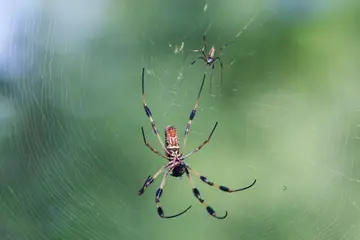
Native relative. Rows of silvery-white spots on the abdomen instead of blue bands; legs yellow-orange with brown bands and black hair tufts at the joints. University of Georgia Cooperative Extension
UGA CAES calls it harmless ("golden-silk orb weavers are harmless"); Penn State: does not readily bite and venom is weak and not medically important.
Joro spider or Yellow garden spider (black and yellow garden spider, writing spider)?
Joro spider
Yellow garden spider (black and yellow garden spider, writing spider) Argiope aurantia
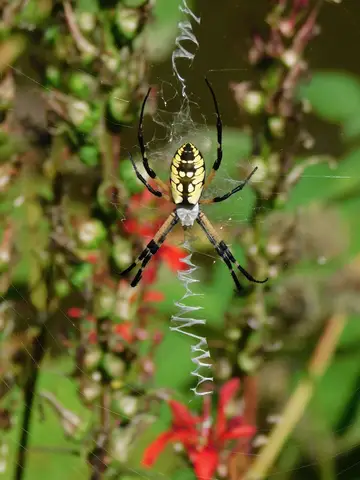
Yellow and black abdomen, smaller than a Joro; web often has a zigzag above and below the center.
UGA CAES calls it harmless ("this backyard beauty is harmless").
Joro spider or Banded garden spider?
Joro spider
Banded garden spider Argiope trifasciata
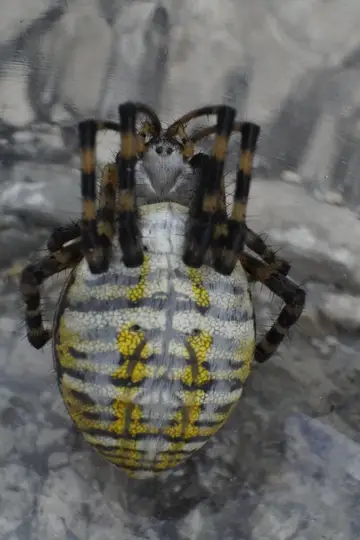
Many thin black, yellow and silvery-white bands on the abdomen; body 0.6-1.0 in. University of Georgia Cooperative Extension
Penn State: garden spiders do not readily bite and the venom is weak and not medically important ("neither species readily bite, even when handled, and if bites do occur the venom is weak and not medically important").
Where the Joro spider lives
- Native or listed
- Nonnative or not established
- No official record in our data
- 1–9
- 10–99
- 100–999
- 1,000+
On our state guides
State boundaries: U.S. Census Bureau, cartographic boundary file cb_2024_us_state_20m.
When it is active
One generation a year. Eggs hatch April-May; spiders grow through summer and mature in August-September. Adult females are most noticeable late September to mid-October, decline by late October, but can be found into December. Adults die after the first freeze; eggs overwinter. University of Georgia Cooperative Extension
US open-licence records peak in August to October.
Habitat and habits
Habitat: Forests, forest edges, parks, roadside vegetation, and suburban and urban yards with trees; webs also on buildings, streetlights and power lines. Rarely comes indoors. Clemson Cooperative Extension, Home & Garden Information Center
Behavior: Docile and shy: tends to run or hide rather than bite. Young spiderlings disperse by 'ballooning' on silk carried by the wind; adults stay in their webs and do not fly.
Diet: Insects caught in the web, including adult brown marmorated stink bugs (a crop pest); also other spiders. Webs can trap bees and other pollinators.
Young: Females lay eggs in fall (mid-October to December, before the first hard freeze) in fuzzy off-white silk sacs on leaves, bark or buildings. Sources give 400-500 eggs per sac (UGA C1273, Clemson); UT Extension gives 100-200.
Legal status and reporting
Invasive status: Non-native (introduced). Sources differ on the 'invasive' label: UGA CAES and N.C. Extension call it invasive. Alabama Extension (2022) said there was no evidence yet of harm to native species or ecosystems. Rutgers says its status as invasive is not yet determined. Ecological impact is still being studied. UGA College of Agricultural and Environmental Sciences
Report: Report sightings to UGA's Joro Watch (jorowatch.org) or the EDDMapS app. Alabama Extension points to the iNaturalist project 'Is this a Joro spider?'. In western North Carolina, Henderson County Extension takes reports by email ([email protected]). University of Georgia Cooperative Extension
Questions about the Joro spider
What are joro spiders?
A large orb-weaving spider native to East Asia. In the US it was first documented in northeast Georgia in 2014. Adult females are bright yellow with blue-green bands and have black-and-yellow banded legs.
Are joro spiders dangerous?
Extension sources say no. Clemson Extension says the venom is not medically relevant and is not known to harm people or pets. UGA says Joro spiders pose no threat to people or pets.
Are joro spiders venomous?
They have venom, like nearly all spiders, but it is weak and not medically important (Clemson, Penn State).
Are joro spiders poisonous?
They have venom, not poison. Clemson Extension says the venom is not medically relevant and is not known to harm people or pets.
Joro spider bite
Bites are rare. The spiders are docile, and Penn State says their small fangs have trouble piercing human skin. Clemson says a person who is bitten may get a small, red, itchy welt like a mosquito bite or bee sting that fades in a day or two. Penn State notes some people may be allergic to the venom.
Are joro spiders invasive?
They are non-native. UGA CAES calls the Joro an invasive species, but other extension sources say its effect on native species is not yet known, and Rutgers says its invasive status is undetermined.
Are joro spiders bad?
They are not a danger to people or pets (Clemson, UGA). Their big webs can be a nuisance, and webs can trap bees and other pollinators. Their effect on native wildlife is still being studied.
Are there joro spiders in georgia?
Yes. The first US records were in northeast Georgia in 2014, and UGA says the species is established there.
Are there joro spiders in north carolina?
Yes. UGA lists North Carolina as established, and N.C. Extension in Henderson County reports them across western North Carolina in 2026.
Are there joro spiders in south carolina?
Yes. UGA lists South Carolina as established, and Clemson Extension says they are becoming more common there.
Are there joro spiders in tennessee?
Yes. UT Extension says they were first found in Hamilton and Bradley counties in October 2021.
Are there joro spiders in alabama?
UGA Extension (2026) lists Alabama as established, and UT Extension (2026) includes Alabama. Alabama Extension's own page, written in 2022, said there were no reports yet.
Are there joro spiders in virginia?
UGA Extension reports isolated populations in Virginia.
Are there joro spiders in pennsylvania?
UGA Extension (2026) reports an isolated population in Pennsylvania. Penn State Extension's 2025 page called the immediate risk there relatively small.
Are there joro spiders in florida?
Not confirmed as established. UT Extension says 'possibly Florida', based on three observations: Kissimmee (2023), Gainesville (2024) and Boca Raton (2025).
Are there joro spiders in california?
Only a single individual, found in 2025, per Penn State. UT Extension calls the California and Illinois sightings questionable. No established population is reported.
Are joro spiders in oklahoma?
Only one specimen, found in 2021. Penn State says it likely did not represent an established population.
Joro spider size
Adult females have a body 0.67-1.2 in long and legs up to 3 in; Penn State gives a leg span up to 4 in. Males are only 0.16-0.31 in.
Joro spider web
Mature females spin strong, sticky golden-yellow silk. Webs can span 10 ft or more, with support lines of 20 ft or longer between treetops.
Joro spider vs banana spider
'Banana spider' usually means the native golden silk orb-weaver. Its adult female has rows of silvery-white spots instead of the Joro's blue bands, and black hair tufts on the legs.
When do joro spiders hatch?
In April and May.
When do joro spiders come out?
Small juveniles appear from May but are hard to spot. Mature spiders are noticed from late July and August, with peaks in September and October.
When do joro spiders lay eggs?
In fall: mid-October to November (UGA), or late November into December before the first major freeze (Clemson).
When do joro spiders die?
Adults die in winter after the first freeze. Numbers drop noticeably by late October, though some adult females last into December.
Sources
- Joro Spider: Trichonephila clavata (Circular 1273). University of Georgia Cooperative Extension. June 16, 2026; checked November 3, 2026.
Quoted passages (6)
“The female’s body is 0.67–1.2 in. (17–30 mm) long”
“If you look closely at one of their webs, you likely will find one or more males inhabiting the web”
“Egg sacs are laid mid-October to November and are dense, white silk sacs with 400–500 eggs. Sacs are attached to leaves, tree bark, and human-made structures.”
“Use the Joro Watch website (jorowatch.org) or the EDDMapS app to submit observations from parks, forests, and even your own yard.”
“The adult female golden silk orb weaver has rows of silvery white spots on its abdomen instead of blue bands, and her legs are yellow-orange with brown bands; three of the four pairs of legs have black tufts of hair at the joints.”
“Banded garden spider (Argiope trifasciata). Many thin black, yellow, and silvery white bands on abdomen. 0.6-1.0 in. body.”
- The Jorō Spider (HGIC 2517). Clemson Cooperative Extension, Home & Garden Information Center. November 21, 2024; checked November 3, 2026.
Quoted passages (4)
“…it is not medically relevant and is not known to harm people or pets.”
“Jorō spiders do have venom (all spiders have venom, as it is how they kill their prey), but it is not medically relevant and is not known to harm people or pets.”
“Jorō spider webs tend to be found at the edges of forests, in parks, on roadside vegetation, as well as in yards with trees. They can also be found on buildings and manmade structures, such as streetlights.”
“This is the only life stage when the Jorō spiders ever travel through the air, and it is a common behavior among many species of spiders.”
- Jorō Spiders. Penn State Extension. September 8, 2025; checked November 3, 2026.
Quoted passages (1)
“Immature jorō spiders rarely make a stablementum and adults never do, so the presence of a stablemenum in an orb web can help identify the maker of the web.”
- Managing Joro Spiders in the Landscape (Circular 1289). University of Georgia Cooperative Extension. August 27, 2026; checked November 3, 2026.
Quoted passages (3)
“Although these are large spiders, they are also very timid.”
“Immature Joros are much less colorful and can be difficult to differentiate from other web spiders (Figures 4B–4F), but they begin to acquire their adult colors in mid-summer (Figure 4). Females are easily recognizable by mid-August (Figure 4G).”
“Eggs hatch during April and May. The spiders spend the summer growing and begin to mature in August and September (Figure 4). There is just one generation per year.”
- W1415 Jorō Spider. University of Tennessee Extension (UT Institute of Agriculture). 2026-08; checked November 3, 2026.
Quoted passages (1)
“The diet of Jorō spiders includes adult brown marmorated stink bugs and dewdrop spiders, among a wide range of insects (4,”
- Joro Spider In North Carolina. N.C. Cooperative Extension, Henderson County Center. September 25, 2025; checked November 3, 2026.
- Joro or not? Test your spider-spotting skills with this quiz. UGA College of Agricultural and Environmental Sciences (CAES Field Report). October 30, 2025; checked November 3, 2026.
Quoted passages (1)
“The Joro is an invasive species, and researchers are still studying how it interacts with native spiders and the environment.”
- Jorō Spider: Description, Behavior, and Contrast with Similar Species (FS1386). Rutgers Cooperative Extension (NJAES). undated page; checked November 3, 2026.
- Joro Spiders: What You Need to Know. Alabama Cooperative Extension System. published 2022-03-11; checked November 3, 2026.
- GBIF.org occurrence records, human observations licensed CC0 1.0 or CC BY 4.0 only, accessed November 3, 2026. The datasets behind these counts are listed on our Sources page.
- State boundaries: U.S. Census Bureau, cartographic boundary file cb_2024_us_state_20m.