Yellow garden spider
Argiope aurantia · also called Black-and-yellow garden spider, Black and yellow argiope, Garden orbweaver and Writing spider · Last checked November 3, 2026.
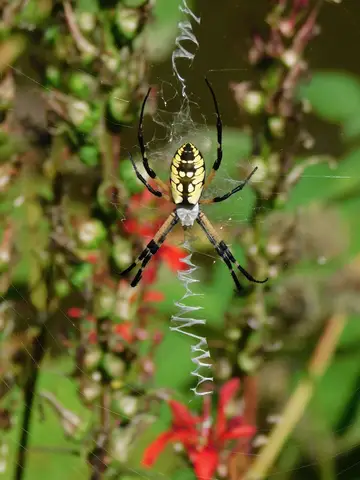
The yellow garden spider (also called the black-and-yellow garden spider or writing spider) is a large orb-weaving spider with a black-and-yellow abdomen. Females are about 3/4 to 1 inch long, not counting legs, and build a round web about 2 feet across with a white zigzag band down the middle. Official sources say it is not known to be medically important: Penn State Extension says a bite is unlikely unless someone handles a female, and would likely hurt no more than a bee or wasp sting for most people. Missouri calls these spiders harmless. It is found in gardens, tall weeds and grassy areas throughout most of the United States. Missouri Department of Conservation
On this page
Is the yellow garden spider dangerous?
Not known to be medically important; bites are unlikely unless a female with an egg sac is handled, and would likely cause no more discomfort than a bee or wasp sting for most people. Penn State Extension
“…they are not known to be medically important. People are not likely to be bitten unless they handle a female with an egg sac in the web. Even then, the bite would likely cause no more discomfort than a wasp or bee sting for most individuals.”
Bites and stings: Rarely. Penn State Extension: people are not likely to be bitten unless they handle a female with an egg sac in the web; for most people a bite would likely cause no more discomfort than a wasp or bee sting.
If someone is bitten or stung, call 911 or Poison Help at 1-800-222-1222.
How to identify a yellow garden spider
A photo or description can narrow it down, but cannot confirm what an animal is or that it is safe. Look from a distance and do not handle wild animals.
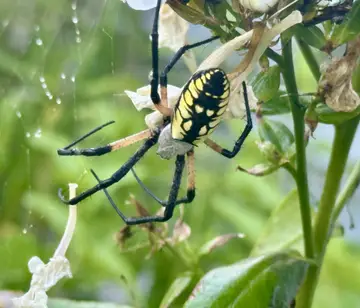
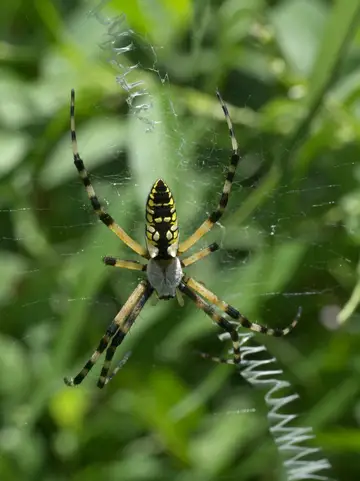

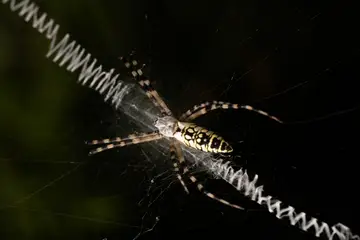
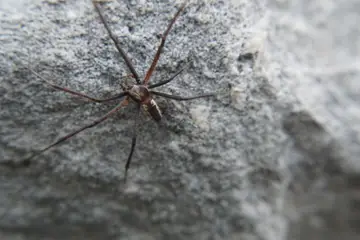
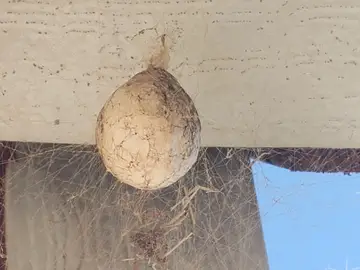
Size: Females 3/4 to 1 inch long, not counting legs (Missouri); 19 to 28 mm (Penn State); Texas A&M says the female body is more than 1 inch. Males about 1/4 inch (Missouri); 5 to 8 mm (Penn State).
Colors: Abdomen patterned with yellow (sometimes orange) and black; head region tipped with silver hairs; legs black with yellow-orange stripes; upper legs more solid orange-yellow. Pattern: A black midstripe with four white spots marks the top of the abdomen.
Key features
- Round web about 2 feet across, built only by females; the spider rests head-down at the center, where a zigzag silk band (stabilimentum) runs vertically. Missouri Department of Conservation
- Abdomen an elongated oval, pointed at the rear, with two humps (shoulders) at the front. Penn State Extension
- Males are much smaller than females and rarely noticed. Missouri Department of Conservation
Young
Young females have a narrower abdomen, usually lack the yellow, and have conspicuous black-and-white striped legs.
Animals mistaken for the yellow garden spider
Yellow garden spider or Golden silk orb weaver?
Yellow garden spider
Golden silk orb weaver Trichonephila clavipes
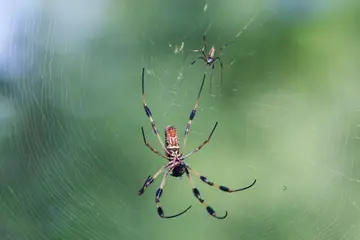
Argiope garden spiders differ in abdominal color pattern and have no tufts of hair on the legs. UF/IFAS Extension
Yellow garden spider or Banded garden spider (banded orb weaver)?
Yellow garden spider
Banded garden spider (banded orb weaver) Argiope trifasciata
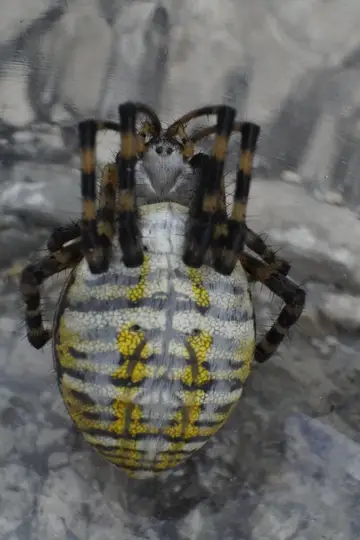
Missouri Department of Conservation: the banded garden spider is slightly smaller than the black-and-yellow garden spider, with a pointier hind end, and its abdomen has many thin silver and yellow crosswise lines and thicker black, spotty lines. MDC
Yellow garden spider or Jorō spider?
Yellow garden spider
Jorō spider Trichonephila clavata
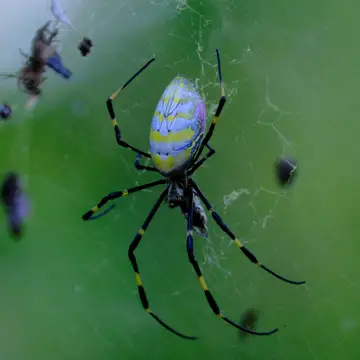
Penn State Extension: garden spiders (Argiope) are much smaller than Jorō spiders, up to an inch long with legs spanning up to 2.5 inches, and their abdomens are less cylindrical and patterned differently (black and yellow in the yellow garden spider). Penn State Extension
Where the yellow garden spider lives
- Native or listed
- Nonnative or not established
- No official record in our data
- 1–9
- 10–99
- 100–999
- 1,000+
On our state guides
- Arkansas spiders
- Florida spiders
- Illinois spiders
- Kansas spiders
- Maine spiders
- Maryland spiders
- Minnesota spiders
- Missouri spiders
- Montana spiders
- Nebraska spiders
- New Mexico spiders
- New York spiders
- Ohio spiders
- Pennsylvania spiders
- Texas spiders
- Virginia spiders
State boundaries: U.S. Census Bureau, cartographic boundary file cb_2024_us_state_20m.
When it is active
Active by day. Spiderlings hatch in spring but mostly go unnoticed until they mature in late summer; adults are most often seen in late summer and fall, and females die with the first frosts.
US open-licence records peak in July to September.
Habitat and habits
Habitat: Gardens, tall weeds, tall grasslands and sunny areas with bushes or other supports for the web; often near houses.
Behavior: Active by day; a female usually stays in the same area all season. When disturbed, it often shakes its web so it is harder for predators to see.
Diet: Insects caught in the web, especially grasshoppers and katydids.
Young: Spiderlings (500 to 1,000 per sac) emerge in spring and disperse on silk threads; adults breed once; females lay egg sacs through summer and die at first frost.
Legal status and reporting
Protection: New Mexico: "Not protected by State of NM" (BISON-M). Not stated elsewhere in the sources checked. New Mexico Department of Wildlife
Questions about the yellow garden spider
Garden spider bite
Yellow garden spiders are not known to be medically important. Penn State Extension says people are unlikely to be bitten unless they handle a female with an egg sac in the web, and for most people a bite would likely be no worse than a wasp or bee sting. Texas A&M AgriLife says people who are allergic to spider venom may react severely to any spider bite. If anyone has a severe reaction, call 911 or Poison Help at 1-800-222-1222.
Garden spider egg sac
The egg sacs are papery, tan and a little smaller than a ping-pong ball, usually attached to nearby plants. Each can hold more than 1,000 eggs, and a female makes about four in her life. Spiderlings come out in spring.
Garden spider web
Only the females build webs. A web is round and can be about 2 feet across, with a white zigzag band of silk (the stabilimentum) running down the center. The spider rests head-down in the middle. Penn State says the exact function of the zigzag is unclear, and UF/IFAS says it is the subject of much scientific debate.
Garden spider texas
Yes. Texas A&M AgriLife Extension describes the yellow garden spider (Argiope aurantia) as a Texas orbweaver, with a female body more than 1 inch long. It says orbweavers are harmless but can be a nuisance when they build large webs in inconvenient places.
Sources
- Black-and-Yellow Garden Spider (Field Guide). Missouri Department of Conservation. undated page; checked November 3, 2026.
Quoted passages (4)
“The circular webs, built only by females, can be approximately 2 feet in diameter, and the spider can be found resting head-down at the hub, where a zigzag silk band, the stabilimentum, extends vertically at the center.”
“Males are quite small and are rarely noticed.”
“Young females have a narrower abdomen, generally lack the yellow coloration, and have conspicuous black and white striping on their legs.”
“A variety of insects may fall prey to this spider, especially grasshoppers and katydids.”
- Yellow Garden Spider. Penn State Extension. updated June 24, 2026; checked November 3, 2026.
Quoted passages (2)
“…they are not known to be medically important. People are not likely to be bitten unless they handle a female with an egg sac in the web. Even then, the bite would likely cause no more discomfort than a wasp or bee sting for most individuals.”
“The abdomen is an elongated oval that is pointed to the rear, notched in front, patterned yellow and black, and has two anterior humps or shoulders.”
- Spiders (E-408 6/06), Jackman, Brown, Engler & Merchant. Texas A&M AgriLife Extension Service. 6/06; checked November 3, 2026.
- BISON-M (Biota Information System of New Mexico) species search export: taxonomic name "Araneae". New Mexico Department of Wildlife (BISON-M, with Natural Heritage New Mexico). updated March 16, 2022; checked November 3, 2026.
Quoted passages (1)
“State NM: Not protected by State of NM”
- ENY2080 An Introduction to Some Common and Charismatic Florida Spiders (Powell & Taylor). UF/IFAS Extension (EDIS). Original publication date February 2023; checked November 3, 2026.
Quoted passages (1)
“The abdominal color patterns of Argiope spp. and the lack of tufts of hair on the legs easily distinguishes them from the golden silk orb weavers”
- MDC Field Guide: Land Invertebrates and Butterflies and Moths (selected species accounts). Missouri Department of Conservation (MDC). undated page; checked November 3, 2026.
Quoted passages (1)
“The female banded garden spider is similar to its close relative, the black-and-yellow garden spider. However, the banded garden spider is slightly smaller overall, with a pointier hind end. Also, the abdomen is patterned with many thin silver and yellow transverse lines and thicker black, spotty lines.”
- Jorō Spiders. Penn State Extension. September 8, 2025; checked November 3, 2026.
Quoted passages (1)
“Argiope species are much smaller than Trichonephila species, with a body length of up to an inch and leg spans up to 2.5 inches. Both black and yellow and banded garden spiders have prosomas covered in dense, silvery hair, similar to jorō spiders. However, the opisthosomas are less cylindrical and differently patterned: black and yellow in black and yellow garden spiders”
- GBIF.org occurrence records, human observations licensed CC0 1.0 or CC BY 4.0 only, accessed November 3, 2026. The datasets behind these counts are listed on our Sources page.
- State boundaries: U.S. Census Bureau, cartographic boundary file cb_2024_us_state_20m.