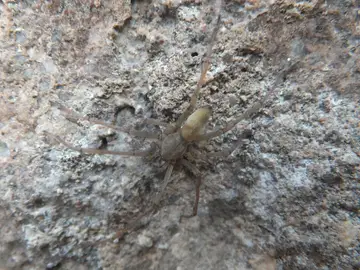
This page lists 12 spiders: 8 from Virginia Cooperative Extension, Virginia Tech's Spiders of Medical Concern in Virginia and 4 named in other official sources.
3 are venomous by official accounts. 1 is nonnative.
Not every species: no complete official list of Virginia spiders exists, so this page covers the ones state and Extension sources name. How lists are built.
Which spiders can hurt you
Official sources single out these spiders in Virginia, in their own words:
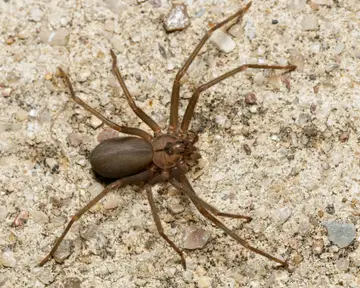
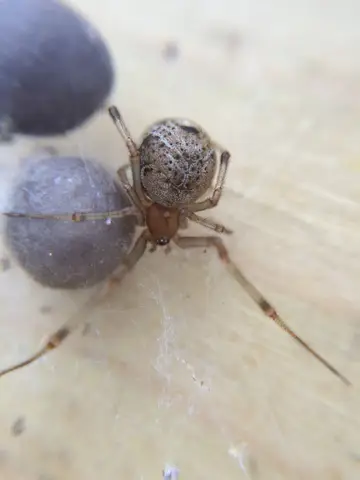
Body about 7 to 12 mm (about 3/8 inch); females average about 9 mm and males about 8 mm. UC IPM says a recluse body is not more than 3/8 inch long.
How to recognize it
Six equal-sized eyes in three pairs. UC IPM calls this the most definitive feature, since most spiders have eight eyes.
The violin mark alone is not a reliable way to identify it
UC IPM's five-point check: six eyes in pairs, evenly colored finely haired abdomen, no spines on the legs, evenly colored legs, body no more than 3/8 inch
Where in Virginia
Its natural range reaches to the very tip of southwestern Virginia, but isolated populations have been confirmed in several locations across Virginia. Virginia Cooperative Extension, Virginia Tech
What the sources say
Venom: “Spiders with Potentially Harmful Venom Found in Virginia” (Virginia Cooperative Extension, Virginia Tech)
Habitat: The spider commonly lives in basements and garages of houses and often hides behind boards and boxes. (Virginia Cooperative Extension, Virginia Tech)
No official source we use states whether this animal is venomous. That does not mean it is harmless: do not handle it.
Size
Females 3/4 to 1 inch long, not counting legs (Missouri); 19 to 28 mm (Penn State); Texas A&M says the female body is more than 1 inch. Males about 1/4 inch (Missouri); 5 to 8 mm (Penn State).
How to recognize it
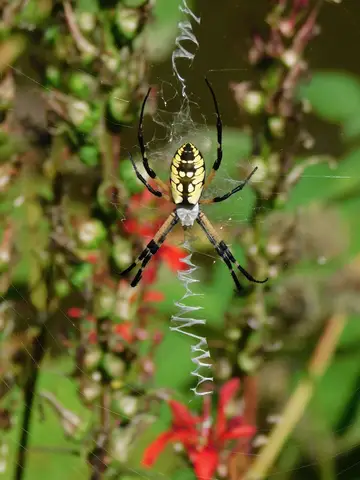
Round web about 2 feet across, built only by females; the spider rests head-down at the center, where a zigzag silk band (stabilimentum) runs vertically.
Abdomen an elongated oval, pointed at the rear, with two humps (shoulders) at the front.
Males are much smaller than females and rarely noticed.
No official source we use states whether this animal is venomous. That does not mean it is harmless: do not handle it.
Size
Females about 5 to nearly 9 mm (3/16 to 1/3 inch) long but wider than long, 10 to 13 mm (3/8 to 1/2 inch) wide. Males are much smaller, 2 to 3 mm (1/16 to 1/8 inch) long.
How to recognize it
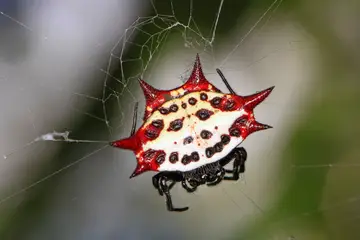
Female has six pointed spines on a hard, flattened, crab-like shell, which makes it easy to tell from other spiders
Sits at the center of a round orb web, staying on the web during the day; webs have conspicuous tufts of silk, mainly on the foundation lines
Males are tiny, gray with white spots, and lack the large spines (four or five small humps at the rear)
No official source we use states whether this animal is venomous. That does not mean it is harmless: do not handle it.
What the sources say
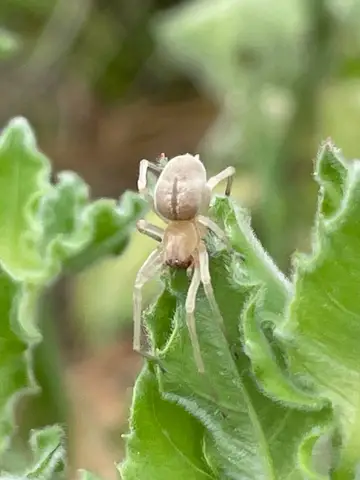
Habitat: Cheiracanthium mildei tends to be found inside man-made structures, often on walls and ceilings, while C. inclusum occurs outdoors on foliage and in grasses. (Virginia Cooperative Extension, Virginia Tech)
When spiders are active in Virginia
Records of spiders in Virginia peak in May and July to October. They show when people record spiders, not how many there are (about month bars).
JanFebMarAprMayJunJulAugSepOctNovDec
11,041 records of spiders in Virginia by month (GBIF, CC0 and CC BY records).
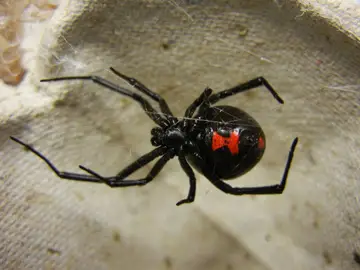
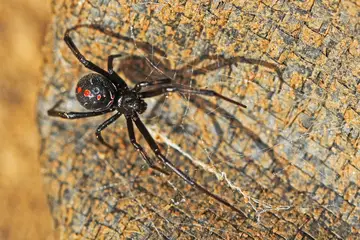
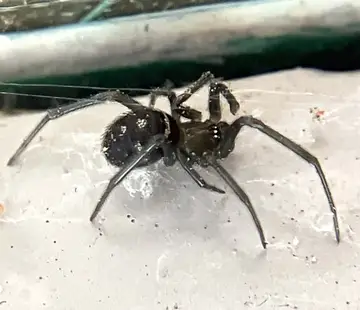
“Both the northern (L. variolus Walckenaer) and the southern (L. mactans F.) black widow spiders are commonly found in Virginia.”
Are there brown recluse spiders in Virginia?
Rarely. Natural range reaches only the very tip of southwestern Virginia; isolated (introduced) populations have been confirmed in several locations. Virginia Cooperative Extension, Virginia Tech
“Its natural range reaches to the very tip of southwestern Virginia, but isolated populations have been confirmed in several locations across Virginia.”
About this list
The species list comes from Spiders of Medical Concern in Virginia (ENTO-73NP / ENTO-346NP) (Virginia Cooperative Extension, Virginia Tech (T.A. Dellinger, E. Day), Publication Date August 1, 2025; first published February 2020, last reviewed July, 2025). 4 more entries come from other official sources named on each card.
Venom labels come only from official sources and link to them; "Not stated" never means harmless. How labels work.
“Spiders with Potentially Harmful Venom Found in Virginia Widow Spiders”
“Spiders with Potentially Harmful Venom Found in Virginia”
“Tissue death may occur at the bite wound and the skin may slough off.”
“Both the northern (L. variolus Walckenaer) and the southern (L. mactans F.) black widow spiders are commonly found in Virginia.”
“Its natural range reaches to the very tip of southwestern Virginia, but isolated populations have been confirmed in several locations across Virginia.”
Information Sheet: Black Widow Spiders. Blue Ridge Poison Center, UVA Health (state poison-control program). archived copy, captured August 9, 2025; checked November 3, 2026.Quoted passages (4)
“The black widow spider (Latrodectus mactans) is the only poisonous spider native to Virginia.”
“Call the Blue Ridge Poison Center toll free: 1-800-222-1222.”
“Always wear gloves and long sleeves when carrying firewood or working in places where Black Widows are known to live.”
“In fall, they may seek the warmth of indoors or may be accidentally carried inside with firewood.”