Spiny orb weaver (spinybacked orbweaver)
Gasteracantha cancriformis · also called spinybacked orbweaver, spiny-backed orb weaver, spiny orb weaver spider and crablike spiny orb weaver · Last checked November 3, 2026.
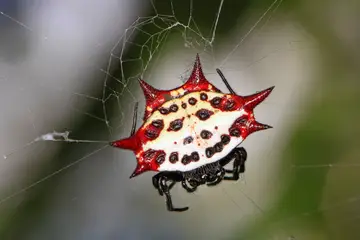
The spiny orb weaver (spinybacked orbweaver, Gasteracantha cancriformis) is a small, colorful orb-weaving spider. The female is wider than long (about 3/8 to 1/2 inch wide) with six pointed spines on a hard, usually white, yellow or orange back, and red or black spines; she sits in the middle of a round web on trees and shrubs, at woodland edges, in citrus groves and around homes, mostly in late summer and fall. UF/IFAS says its bite is not known to cause serious effects to humans; Mississippi State Extension says people who walk into a web and swat the spider are occasionally bitten, and most find the bite about as painful as a fire ant sting, usually with no lasting ill effects. Official sources confirm it in Florida, Texas and Virginia, and say it is established in Hawaii. UF/IFAS Extension
On this page
Is the spiny orb weaver dangerous?
UF/IFAS (EENY-167): the bite of this common species is not known to cause serious effects to humans. UF/IFAS Extension
“The bite of this common species is not known to cause serious effects to humans.”
Bites and stings: Occasional. Mississippi State Extension: gardeners, hikers and others outdoors in the fall are occasionally bitten, usually after walking into a web and swatting the spider on their skin; most people find the bite about as painful as a fire ant sting, usually with no lasting ill effects. UF/IFAS Extension Escambia County: bites are not common and not considered serious.
No official source we use states whether this animal is venomous. That does not mean it is harmless: do not handle it.
How to identify a spiny orb weaver
A photo or description can narrow it down, but cannot confirm what an animal is or that it is safe. Look from a distance and do not handle wild animals.
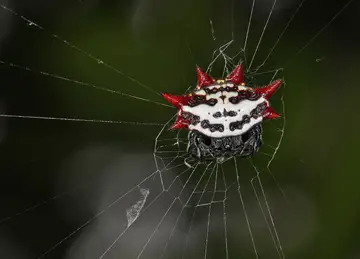
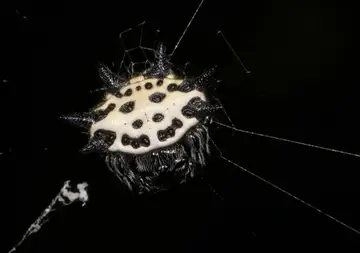
Size: Females about 5 to nearly 9 mm (3/16 to 1/3 inch) long but wider than long, 10 to 13 mm (3/8 to 1/2 inch) wide. Males are much smaller, 2 to 3 mm (1/16 to 1/8 inch) long. UF/IFAS Extension
Colors: Female back (abdomen) typically white with black spots and red spines in Florida; elsewhere it may be yellow instead of white, have black spines, or be almost entirely black; shell white, yellow or orange; spines black or red (Mississippi State); front body (carapace), legs and underside black, with some white spots under the abdomen. Pattern: Black spots on the back; six pointed spines around the edge of the abdomen.
Key features
- Female has six pointed spines on a hard, flattened, crab-like shell, which makes it easy to tell from other spiders UF/IFAS Extension
- Sits at the center of a round orb web, staying on the web during the day; webs have conspicuous tufts of silk, mainly on the foundation lines UF/IFAS Extension
- Males are tiny, gray with white spots, and lack the large spines (four or five small humps at the rear) UF/IFAS Extension
Young
Spiderlings make tiny, inconspicuous orb webs or hang from single strands; they grow noticeably in body and web size in late summer and early fall.
Animals mistaken for the spiny orb weaver
Spiny orb weaver (spinybacked orbweaver) or Spined micrathena (also grouped as a 'spinybacked orbweaver' by Texas A&M)?
Spiny orb weaver (spinybacked orbweaver)
Spined micrathena (also grouped as a 'spinybacked orbweaver' by Texas A&M) Micrathena gracilis
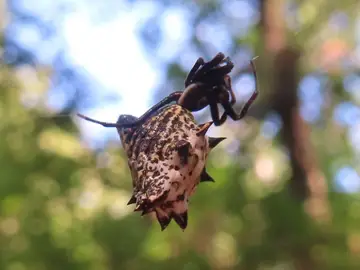
Penn State: female spined micrathena is typically black with white markings and has five pairs of black cones/spines around the edge of the abdomen, which is cone-shaped underneath; the spiny orb weaver female has six pointed spines (UF/IFAS). Mississippi State: other spiny orbweavers have a different shape and are easy to distinguish. Penn State Extension
Penn State: not known to bite people and probably not medically important.
Spiny orb weaver (spinybacked orbweaver) or Crab spiders?
Spiny orb weaver (spinybacked orbweaver)
Crab spiders Thomisidae
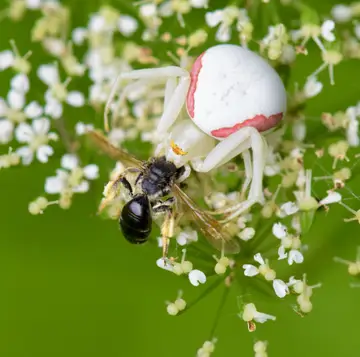
UF/IFAS: despite its crab-shaped name, the spiny orb weaver lives in an orb web; true crab spiders (Thomisidae) don't live in orb webs. UF/IFAS Escambia County: true crab spiders are active hunters often found resting on flowers. UF/IFAS Extension
See the crab spider page.
Spiny orb weaver (spinybacked orbweaver) or Orb weaver spiders (general)?
Spiny orb weaver (spinybacked orbweaver)
Orb weaver spiders (general) Araneidae
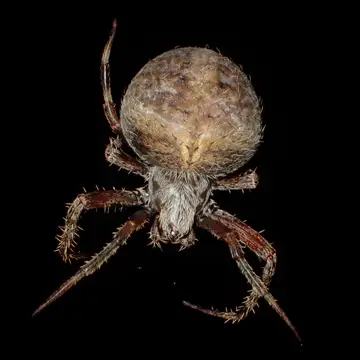
UF/IFAS: spiny orb weaver females are wider (10 to 13 mm) than long (5 to nearly 9 mm) and have six pointed abdominal projections called spines. UF/IFAS Extension
Where the spiny orb weaver lives
- Native or listed
- Nonnative or not established
- No official record in our data
- 1–9
- 10–99
- 100–999
- 1,000+
On our state guides
State boundaries: U.S. Census Bureau, cartographic boundary file cb_2024_us_state_20m.
When it is active
Most noticed in late summer and fall. In Florida, adult females are found all year but are most common from October through January; males are most common in October and November. Mississippi State University Extension Service
US open-licence records peak in July to December.
Habitat and habits
Habitat: Most often in mixed-mesophytic woodlands and citrus groves; also on trees and shrubs around houses and in nurseries, at the edges of wooded areas and in home landscapes. UF/IFAS Extension
Behavior: Builds an orb web whose catching area may be 30 to 60 cm (about 1 to 2 feet) across, from less than 1 to more than 6 m (about 3 to 20 feet) above ground, often at just the height people walk into. Its hard, spiny shell protects it from birds and other predators.
Diet: Whiteflies, flies, moths, beetles, mosquitoes and other small insects caught in the web.
Young: Females lay oval egg sacs (20 to 25 mm long) on the undersides of leaves next to the web from October through January, each with 101 to 256 eggs; eggs hatch in 11 to 13 days.
Legal status and reporting
Federal: No Gasteracantha record in the USFWS ECOS species database (query 2026-11-03 returned 0 rows). ECOS
Questions about the spiny orb weaver
Spiny orb weaver
The spiny orb weaver (spinybacked orbweaver, Gasteracantha cancriformis) is a small orb-weaving spider whose female has a hard, crab-shaped shell with six pointed spines, usually white, yellow or orange with red or black spines. It sits in a round web on trees and shrubs, at woodland edges and in yards, mostly in late summer and fall. UF/IFAS says its bite is not known to cause serious effects to humans; Mississippi State Extension says people who swat one are occasionally bitten, and most find it about as painful as a fire ant sting, usually with no lasting ill effects. It is not a true crab spider. Official sources confirm it in Florida, Texas and Virginia, and say it is established in Hawaii.
Sources
- EENY-167 Spiny Orb Weaver Spider, Gasteracantha cancriformis (Linnaeus) (G. B. Edwards). UF/IFAS Extension (EDIS). undated page; checked November 3, 2026.
Quoted passages (11)
“The bite of this common species is not known to cause serious effects to humans.”
“Females may be 5 to nearly 9 mm (3/16–1/3 in) in length, but 10 to 13 mm (3/8–½ in) wide.”
“This species can be easily distinguished from all other spiders in Florida.”
“Conspicuous tufts of silk occur on the web, primarily on the foundation lines.”
“Color is similar to the female, except the abdomen is gray with white spots. The large abdominal spines are lacking, although there are four or five posterior small humps”
“Spiderlings make tiny, inconspicuous orb webs or hang from single strands. In the late summer and early fall, significant increases occur in both body and web size.”
“Mixed-mesophytic woodlands and citrus groves are where they are most frequently found.”
“The spiders prey on whiteflies, flies, moths, and beetles that are caught in the webs.”
“The webs may be less than 1 to more than 6 m (3 ft 3 in–19 ft 8 in) above ground.”
“Ovate egg sacs, 20 to 25 mm (3/4–1 in) long by 10 to 15 mm (3/8–2/3 in) wide, are deposited on the undersides of leaves adjacent to the female’s web from October through January.”
“Females may be 5 to nearly 9 mm (3/16–1/3 in) in length, but 10 to 13 mm (3/8–½ in) wide. They have six pointed abdominal projections frequently referred to as spines.”
- Spinybacked Orbweaver, Vol. 4, No. 31 (Bug's Eye View), Blake Layton. Mississippi State University Extension Service. 2018; checked November 3, 2026.
Quoted passages (1)
“Spinybacked orbweavers are common throughout the South, especially in late summer and fall.”
- ENY2080 An Introduction to Some Common and Charismatic Florida Spiders (Powell & Taylor). UF/IFAS Extension (EDIS). Original publication date February 2023; checked November 3, 2026.
Quoted passages (1)
“Despite their name’s meaning, they should not be confused with crab spiders in the family Thomisidae, which don’t live in orb webs”
- Spiders (E-408 6/06), Jackman, Brown, Engler & Merchant. Texas A&M AgriLife Extension Service. archived copy, captured October 8, 2025; checked November 3, 2026.
- List of Native and Naturalized Fauna of Virginia. Virginia Department of Wildlife Resources (DWR). May, 2026; checked November 3, 2026.
- USFWS ECOS species report export (JSON), scientific-name query for Gasteracantha. U.S. Fish and Wildlife Service (ECOS). live query 2026-11-03; checked November 3, 2026.
- Spined Micrathena. Penn State Extension. updated January 19, 2026; checked November 3, 2026.
Quoted passages (1)
“The females are typically black with white markings and have five pairs of black cones/spines/conical tubercles encircling the lateral margins of the abdomen.”
- GBIF.org occurrence records, human observations licensed CC0 1.0 or CC BY 4.0 only, accessed November 3, 2026. The datasets behind these counts are listed on our Sources page.
- State boundaries: U.S. Census Bureau, cartographic boundary file cb_2024_us_state_20m.