Crab spiders
Thomisidae · also called flower crab spider, flower spider, goldenrod crab spider and ground crab spider · Last checked November 3, 2026.
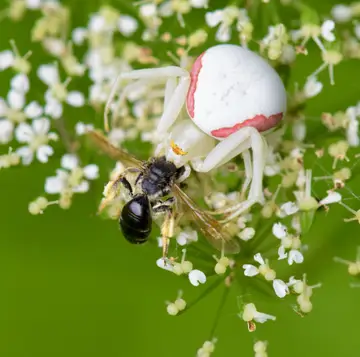
Crab spiders (family Thomisidae) are small, often flattened spiders that hold their long front two pairs of legs out to the sides like a crab and can scuttle sideways. They build no web; flower crab spiders sit still on flowers, often colored to match (white, yellow or pink), and grab bees, flies and butterflies, while drab brown ground crab spiders hide under bark and leaves. Like nearly all spiders they have venom for prey, but official sources do not list them among dangerous spiders: Ohio DNR says only widows and recluses are considered dangerous to humans there. Official sources place them on flowers, in fields and grasslands and on the forest floor. Missouri lists them statewide, and state or extension sources in Ohio, New York, Texas, California, Florida, Virginia and New Mexico also name them. NYSDEC, text by Cornell University Department of Entomology, reprinted from New York State Conservationist
This page covers a family (Thomisidae), not a single species.
On this page
Are crab spiders dangerous?
Not among the spiders official sources call dangerous. Ohio DNR: only black widows and recluse spiders are considered dangerous to humans in Ohio; Texas A&M AgriLife describes crab spiders among common spiders, separate from its 'Potentially dangerous spiders' (recluses and widows). Ohio Department of Natural Resources, Division of Wildlife
“Only two groups of Ohio spiders, the black widows and the recluse spiders are considered dangerous to humans.”
Bites and stings: No official source checked describes crab spider bites specifically. Ohio DNR: spiders bite humans only in self-defense, for example when pressed against skin. Texas A&M: with few exceptions spiders rarely bite and are not generally dangerous to people.
If someone is bitten or stung, call 911 or Poison Help at 1-800-222-1222.
How to identify crab spiders
A photo or description can narrow it down, but cannot confirm what an animal is or that it is safe. Look from a distance and do not handle wild animals.
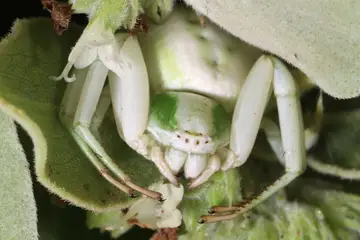

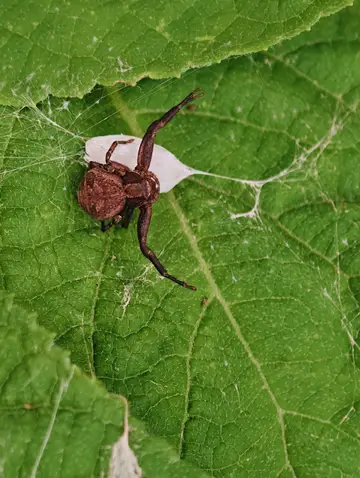
Size: Small: flower crab spiders about 1/4 inch (females; males smaller); ground crab spiders 1/4 to 3/8 inch (females), males about 1/8 inch; goldenrod crab spider females 5 to 10 mm. Missouri Department of Conservation
Colors: flower crab spiders: white, yellow, pink or orange, often matching the flower; ground crab spiders: dull gray and brown with rusty, tan, white or yellow markings. Pattern: goldenrod crab spider females sometimes have red bands on the sides of the abdomen.
Key features
- legs held out to the sides like a crab; walks sideways NYSDEC, text by Cornell University Department of Entomology, reprinted from New York State Conservationist
- front two pairs of legs enlarged, extending beyond the sides of a flattened body University of California Statewide IPM Program
- no web; waits on flowers or leaves to ambush insects Texas A&M AgriLife Extension Service
- some change color to match the flower over several days NYSDEC, text by Cornell University Department of Entomology, reprinted from New York State Conservationist
- tip: look for an insect sitting motionless at an odd angle on a flower NYSDEC, text by Cornell University Department of Entomology, reprinted from New York State Conservationist
Young
Spiderlings hatch in spring from egg cases that overwinter (Missouri).
Animals mistaken for crab spiders
Crab spiders or Running crab spiders?
Crab spiders
Running crab spiders Philodromidae
Formerly grouped with crab spiders and also hold their legs in a crab-like posture; Ohio DNR now treats them as a separate family. Common crab spiders (Philodromus) are often found near houses. Ohio Department of Natural Resources, Division of Wildlife
Not listed as dangerous by Ohio DNR (only widows and recluses are).
Crab spiders or Huntsman spider ("giant crab spider")?
Crab spiders
Huntsman spider ("giant crab spider") Heteropoda venatoria
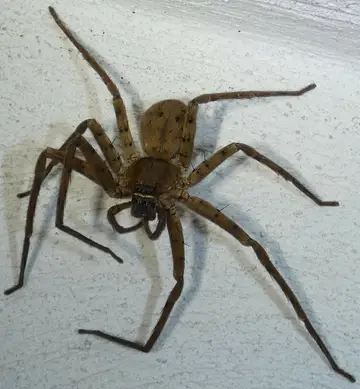
The pantropical huntsman is sometimes called the giant crab spider. UF/IFAS places it in the family Sparassidae, not the crab spider family Thomisidae, and describes it as an introduced spider of subtropical Florida, Texas and California and coastal Georgia and South Carolina. UF/IFAS Extension
See the huntsman spider page.
Crab spiders or Spinybacked orbweaver ("crab-like")?
Crab spiders
Spinybacked orbweaver ("crab-like") Gasteracantha cancriformis
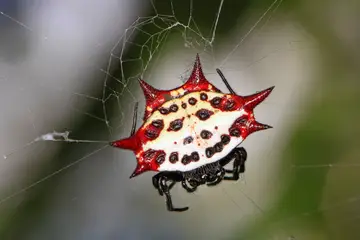
UF/IFAS: its species name means 'crab shaped' because its abdomen resembles a crab's carapace, but it catches prey in an orb web and should not be confused with crab spiders (Thomisidae), which don't live in orb webs. UF/IFAS Extension
Not described as dangerous in the source checked.
Where crab spiders live
- Native or listed
- Nonnative or not established
- No official record in our data
- 1–9
- 10–99
- 100–999
- 1,000+
State boundaries: U.S. Census Bureau, cartographic boundary file cb_2024_us_state_20m.
When it is active
Daytime hunters (UC IPM). In Missouri they hatch in spring, grow and breed through the growing season, and usually die at the first freeze; egg cases overwinter. University of California Statewide IPM Program
US open-licence records for all crab spiders (family Thomisidae) peak in June to September.
Habitat and habits
Habitat: Flower crab spiders: in flowers such as daisy fleabane, asters, goldenrods and Queen Anne's lace, in prairies, open fields and other grasslands. Ground crab spiders: under bark, leaves, rocks and logs on the forest floor, sometimes on fence posts and outbuildings. Missouri Department of Conservation
Behavior: Sit-and-wait hunters with good vision; no web. Flower crab spiders stay motionless on blossoms and lunge at visiting insects.
Diet: Insects, especially pollinators such as bees, flies, wasps and butterflies, and other spiders; they can catch prey larger than themselves.
Young: Females keep creating egg cases as long as the weather holds (Missouri). Ohio DNR: the northern crab spider female retreats to a folded leaf to lay eggs and stays near the egg case, probably to protect it.
Legal status and reporting
Federal: No record returned by USFWS ECOS for Misumena, Misumenoides, Mecaphesa, Xysticus or Thomisus on 2026-11-03. No source checked lists a crab spider under the Endangered Species Act. US Fish and Wildlife Service
Protection: New Mexico: Misumena vatia is 'Not protected by State of NM' (BISON-M). New Mexico Department of Wildlife
Sources
- Common spiders brochure (11 species and groups). NYSDEC, text by Cornell University Department of Entomology, reprinted from New York State Conservationist. June 2007; checked November 3, 2026.
Quoted passages (3)
“Crab spiders get their name from the way they hold their legs out to their sides and walk with a crab-like scuttle.”
“Many crab spiders are capable of camouflaging themselves to match the flower's color by changing their color to white, yellow, or pink over several days.”
“One of the best ways to find these spiders is to look on flowers for immobile insects situated at an odd angle.”
- Spiders (E-408 06/12), Wizzie Brown and Mike Merchant. Texas A&M AgriLife Extension Service. E-408 06/12; checked November 3, 2026.
Quoted passages (1)
“These spiders do not spin a web, instead they ambush their insect prey.”
- Common Spiders of Ohio Field Guide (Publication 5140). Ohio Department of Natural Resources, Division of Wildlife (text by Richard A. Bradley, Ph.D.). PUBLICATION 5140; checked November 3, 2026.
Quoted passages (4)
“Only two groups of Ohio spiders, the black widows and the recluse spiders are considered dangerous to humans.”
“In Ohio, all but one of our spiders possess venom, but their venom has little effect on humans or pets.”
“The female crab spider retreats to a folded leaf when laying eggs. She remains there, near the egg case, probably to protect it from potential predators or parasites.”
“This group used to be considered as part of the crab spider family, but are now considered distinct.”
- Flower Crab Spiders (Field Guide). Missouri Department of Conservation. undated page; checked November 3, 2026.
Quoted passages (5)
“Length (not including legs): about ¼ inch (females); males are slightly smaller.”
“Egg cases overwinter, and spiderlings hatch in spring.”
“This group of crab spiders can usually be found in the flowers of daisy fleabanes, asters, and goldenrods, as well as snapdragons, Queen Anne's lace, and marigolds.”
“When a bee, fly, or other prey lands on the flower seeking nectar, the crab spider attacks, injects venom into the prey, then holds it while drinking its juices.”
“Crab spiders don't use webs to capture their prey; instead, they hide in flowers and wait for insects to come to them.”
- Ground Crab Spiders (Field Guide). Missouri Department of Conservation. undated page; checked November 3, 2026.
- ENY2080 An Introduction to Some Common and Charismatic Florida Spiders (Powell & Taylor). UF/IFAS Extension (EDIS). Original publication date February 2023; checked November 3, 2026.
Quoted passages (1)
“Despite their name’s meaning, they should not be confused with crab spiders in the family Thomisidae, which don’t live in orb webs”
- Pest Notes: Spiders (UC ANR Publication 7442). University of California Statewide IPM Program (UC ANR, Cooperative Extension). 2020-10; checked November 3, 2026.
Quoted passages (2)
“Front 2 pairs of legs are enlarged and extend beyond the side of their flattened body, making them look like tiny crabs.”
“Diurnal hunters that do not spin webs.”
- ECOS species report query. U.S. Fish and Wildlife Service. live query 2026-11-03; checked November 3, 2026.
Quoted passages (1)
“Misumena vatia: no record returned”
- BISON-M (Biota Information System of New Mexico) species search export: taxonomic name "Araneae". New Mexico Department of Wildlife (BISON-M, with Natural Heritage New Mexico). database queried November 3, 2026; checked November 3, 2026.
Quoted passages (1)
“State NM: Not protected by State of NM”
- EENY-160 Pantropical Huntsman Spider, Heteropoda venatoria (Linnaeus) (Arachnida: Araneae: Sparassidae). UF/IFAS Extension (EDIS), author G. B. Edwards (FDACS Division of Plant Industry). undated page; checked November 3, 2026.
Quoted passages (1)
“…sometimes called the giant crab spider or the banana spider”
- GBIF.org occurrence records, human observations licensed CC0 1.0 or CC BY 4.0 only, accessed November 3, 2026. The datasets behind these counts are listed on our Sources page.
- State boundaries: U.S. Census Bureau, cartographic boundary file cb_2024_us_state_20m.