Hawaii State Department of Health, Disease Outbreak Control Division: There are many species of spiders known to be found throughout Hawaii.
This page lists 5 spiders.
2 are venomous by official accounts. 1 is nonnative.
Not every species: no complete official list of Hawaii spiders exists, so this page covers the ones state and Extension sources name. How lists are built.
Which spiders can hurt you
Official sources single out these spiders in Hawaii, in their own words:
Adult female body about 8-12 mm (0.3-0.5 in); UC IPM gives about 3/8 in (10 mm), smaller than a mature western black widow. Clemson (2003) gives 1 to 1 1/2 in with legs extended. Males are tiny, 2-5 mm.
How to recognize it
Spiky egg sac (covered in silk points, like a pollen grain or sandspur; about 10 mm per LSU AgCenter, 1/2 in per Clemson 2003) is diagnostic even without the spider
Egg sac surface: blunt silken spikes, about 10 mm
Egg sac described by UC IPM
What the sources say
Venom: “The brown widow is a little smaller than the black widow and its venom is twice as potent as the black widow's venom. However, the brown widows don't inject as much venom and are generally less aggressive in defending their webs.” (Hawaii State Department of Health, Disease Outbreak Control Division)
No official source we use states whether this animal is venomous. That does not mean it is harmless: do not handle it.
Size
Females about 5 to nearly 9 mm (3/16 to 1/3 inch) long but wider than long, 10 to 13 mm (3/8 to 1/2 inch) wide. Males are much smaller, 2 to 3 mm (1/16 to 1/8 inch) long.
How to recognize it
Female has six pointed spines on a hard, flattened, crab-like shell, which makes it easy to tell from other spiders
Sits at the center of a round orb web, staying on the web during the day; webs have conspicuous tufts of silk, mainly on the foundation lines
Males are tiny, gray with white spots, and lack the large spines (four or five small humps at the rear)
Where in Hawaii
All the main islands except Kaho'olawe; common, uncommon on O'ahu (Bishop Museum) Bishop Museum
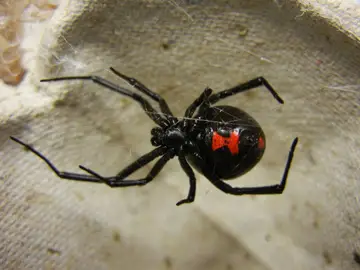
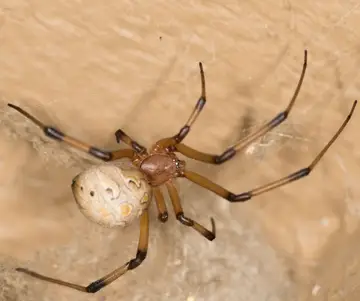
Adult female black widows are usually shiny black with red markings; very dark brown widows are flat black. The brown widow hourglass is usually orange to yellow-orange, but do not rely on color alone: UF/IFAS shows a brown widow with a red hourglass, Clemson says usually orange or red-orange, and black widow markings vary (northern black widows have two red spots; a western black widow's red can be almost imperceptible or absent). Brown widow egg sacs are spiky; Clemson (2003) and UF/IFAS Sarasota describe black widow sacs as smooth, and Clemson (2026) says the southern black widow's sac has a single small point.
Photos show typical adults; individuals vary. Never get close to compare.
When spiders are active in Hawaii
Records of spiders in Hawaii peak in February to April and June to July. They show when people record spiders, not how many there are (about month bars).
JanFebMarAprMayJunJulAugSepOctNovDec
1,804 records of spiders in Hawaii by month (GBIF, CC0 and CC BY records).
If you are bitten or stung
Call 911 or Poison Help at 1-800-222-1222 right away. Poison Help connects you to your local poison center, any time of day.
Official advice from Hawaii State Department of Health, Disease Outbreak Control Division:
“…two spider species of concern that are seen in Hawaii are the Southern Black Widow (Latrodectus mactans) and the Brown Widow Spider (Latrodectus geometricus).”
“The Brown recluse spider, a dangerous spider commonly found on the mainland, has not been documented as an established inhabitant of the Hawaiian Islands.”
Spider Bites. Hawaii State Department of Health, Disease Outbreak Control Division. page date July 21, 2022; checked November 3, 2026.Quoted passages (8)
“There are many species of spiders known to be found throughout Hawaii.”
“Their bites can be dangerous and would require a visit to the doctor.”
“The brown widow is a little smaller than the black widow and its venom is twice as potent as the black widow's venom. However, the brown widows don't inject as much venom and are generally less aggressive in defending their webs.”
“The brown widow is a little smaller than the black widow and its venom is twice as potent as the black widow's venom.”
“It might look harmless, but its bite is painful and may produce redness, swelling and blistering.”
“Wear protective clothing such as long covered sleeves, long pants, hats, gloves and boots when handling piles of materials, lumber, rocks, etc.”
“…two spider species of concern that are seen in Hawaii are the Southern Black Widow (Latrodectus mactans) and the Brown Widow Spider (Latrodectus geometricus).”
“The Brown recluse spider, a dangerous spider commonly found on the mainland, has not been documented as an established inhabitant of the Hawaiian Islands.”
Venomous Spiders at Work. CDC/NIOSH. archived copy, captured October 6, 2026; checked November 3, 2026.Quoted passages (1)
“Black widows and brown recluses are two types of venomous spiders in the United States.”