Orb weaver spiders
Araneidae · also called Orb weavers, Orbweavers and Orb-weaving spiders · Last checked November 3, 2026.
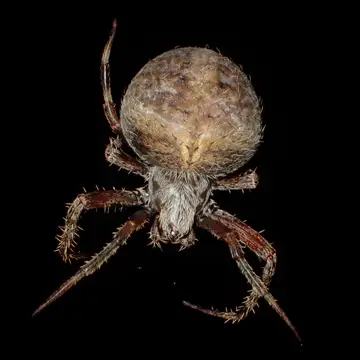
Orb weavers are the spiders that build the classic flat, round, wheel-shaped web. The family includes garden spiders (Argiope), spinybacked orb weavers and many others found across the US. Texas A&M AgriLife Extension says orb weavers are harmless to people, but their large webs can be a nuisance. Utah State University Extension says they are not known to be a health hazard. Like nearly all spiders they use venom on their prey (Texas A&M). Penn State says people are unlikely to be bitten by a yellow garden spider unless they handle a female with an egg sac, and that such a bite would likely cause no more discomfort than a wasp or bee sting for most people. Texas A&M AgriLife Extension Service
This page covers a family (Araneidae), not a single species.
On this page
Are orb weaver spiders dangerous?
Texas A&M AgriLife Extension: orb weavers are harmless to people, though their large webs can be a nuisance. Texas A&M AgriLife Extension Service
“Though orbweavers are harmless to people, their large webs can be a nuisance.”
Bites and stings: Rare. Penn State says people are unlikely to be bitten unless they handle a female with an egg sac. Even then the bite would likely cause no more discomfort than a wasp or bee sting for most people. UF/IFAS says bites of spiny orb weavers and Neoscona orb weavers are not known to cause serious effects in humans.
If someone is bitten or stung, call 911 or Poison Help at 1-800-222-1222.
How to identify orb weaver spiders
A photo or description can narrow it down, but cannot confirm what an animal is or that it is safe. Look from a distance and do not handle wild animals.
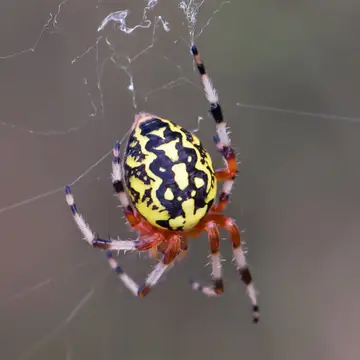
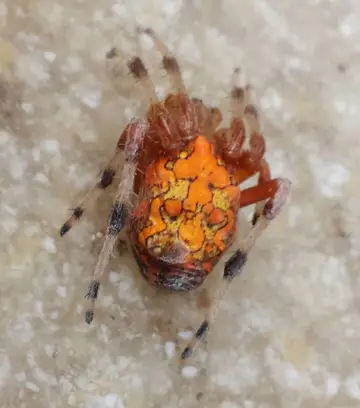

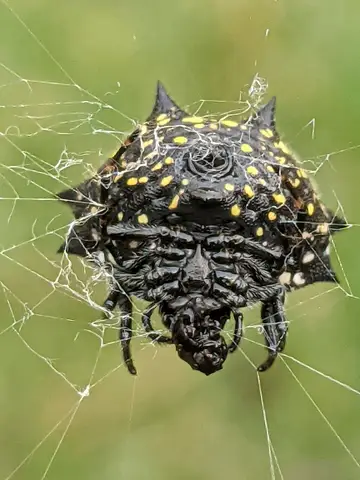

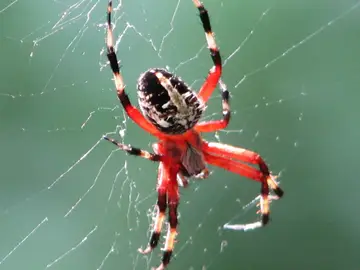

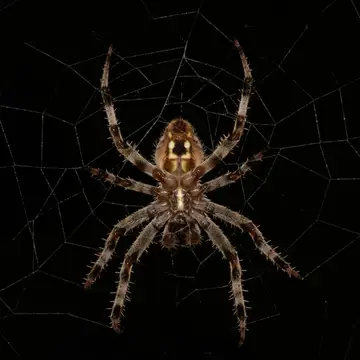
Size: Small to large. Yellow garden spider females are ¾ to 1 inch long, not counting legs; spinybacked orb weaver females are 5 to 9 mm long but wider than long. Utah State University Extension
Colors: varied, yellow, black, orange, brown and white. Pattern: varied.
Key features
- Usually a large, bulbous abdomen. Utah State University Extension
- Builds a vertical, round web of spokes with concentric sticky rings: the 'typical' spider web. Texas A&M AgriLife Extension Service
- Garden spiders (Argiope) add a zigzag band of heavy silk (stabilimentum) to the web. Texas A&M AgriLife Extension Service
- Orb weavers do not see well; they use the web to locate insects caught in it. Texas A&M AgriLife Extension Service
Young
Adults die each year, leaving egg sacs; eggs hatch in spring and the spiderlings disperse.
Where orb weaver spiders live
- Native or listed
- Nonnative or not established
- No official record in our data
- 1–9
- 10–99
- 100–999
- 1,000+
State boundaries: U.S. Census Bureau, cartographic boundary file cb_2024_us_state_20m.
When it is active
Most noticed in late summer and fall, when they are full grown. N.C. Cooperative Extension, Henderson County Center
US open-licence records for all orb weavers (family Araneidae) peak in July to October.
Habitat and habits
Habitat: Often around buildings and homes in late summer and early fall, especially porches, entryways, ornamental plantings and near outdoor lights. Garden spiders favor gardens, tall weeds and sunny areas. Utah State University Extension
Behavior: Orb weavers are considered beneficial: their webs catch insects, including moths whose caterpillars can be garden pests. Many rebuild at least part of their web daily.
Diet: Insects and spiders caught in the web.
Young: Adults die out each year and leave egg sacs; eggs hatch in spring. Yellow garden spider spiderlings, 500 to 1,000 per sac, emerge in early spring.
Questions about orb weaver spiders
Orb weaver spider bite
Bites are rare. Penn State Extension says people are unlikely to be bitten by a yellow garden spider unless they handle a female with an egg sac, and even then the bite is likely no worse than a wasp or bee sting for most people. UF/IFAS says spiny orb weaver and Neoscona bites are not known to cause serious effects in humans. If you are worried about any bite, call 911 or Poison Help at 1-800-222-1222.
Orb weaver spider poisonous
Orb weavers have venom for their prey, like almost all spiders, but Texas A&M AgriLife Extension says orb weavers are harmless to people. Utah State University Extension says they are not known to be a health hazard.
Orb weaver spider web
Orb weavers build a vertical, round web with concentric rings of silk, the 'typical' spider web. Some larger orb weavers (Argiope garden spiders) weave a zipperlike seam of heavy silk into the web. Orb-weaving spiders often rebuild their web each day (Ohio Division of Wildlife).
Orb weaver spider texas
Yes. Texas A&M AgriLife Extension describes orb weavers in Texas, including the yellow garden spider and the spinybacked orb weaver, and says they are harmless to people.
Orb weaver spider ohio
Yes. The Ohio Division of Wildlife's Common Spiders of Ohio guide includes several orb weavers and names the arabesque orbweaver as one of the most common.
Garden spider
The yellow (black-and-yellow) garden spider, Argiope aurantia, is a large orb weaver whose abdomen is patterned with yellow (sometimes orange) and black. Texas A&M says it is sometimes called the writing spider because of a thickened, interwoven section in the center of its web. Missouri Department of Conservation calls these harmless spiders; Penn State says it occurs throughout most of the US.
Sources
- Spiders (E-408 06/12), Wizzie Brown and Mike Merchant. Texas A&M AgriLife Extension Service. E-408 06/12; checked November 3, 2026.
Quoted passages (5)
“Though orbweavers are harmless to people, their large webs can be a nuisance.”
“Almost all spiders bite and use venom to paralyze their prey.”
“Most orbweavers make a vertically hanging orb web with concentric rings of silk—a ‘typical’ spider web.”
“Some of the larger orbweavers, known as Argiope spiders, weave a zipperlike seam of heavy silk into the web called a stabilimenta.”
“Unlike jumping and wolf spiders, orbweavers do not see well. Instead, they use the web to get information from the environment and to locate insects that are caught in the web.”
- Orb Weaving Spiders (Araneidae; Tetragnathidae). Utah State University Extension (Utah Pests / Plant Health). undated page; checked November 3, 2026.
Quoted passages (6)
“…small to large spiders”
“…generally with a large, bulbus abdomen”
“…spiders die out every year and leave egg sac behind”
“…often found around buildings and homes in late summer and early fall, especially around overhanging structures (e.g., porches or entryways) or in ornamental plantings”
“…insects and spiders”
“…eggs hatch in spring and spiderlings disperse”
- Yellow Garden Spider. Penn State Extension. updated June 24, 2026; checked November 3, 2026.
- Beneficial Arthropod Alert - Orb Weaver Spiders (Steve Pettis). N.C. Cooperative Extension, Henderson County Center. published 2024-09-19; checked November 3, 2026.
Quoted passages (2)
“Orb weavers are very beneficial to humans, capturing moths that might otherwise produce caterpillars which can be pests in our fall gardens.”
“If you see big spiders this fall, they are probably one of our native orb weavers.”
- EENY-167 Spiny Orb Weaver Spider, Gasteracantha cancriformis (Linnaeus) (G. B. Edwards). UF/IFAS Extension (EDIS). undated page; checked November 3, 2026.
- EENY316 Orb Weavers, Neoscona crucifera and Neoscona domiciliorum (G. B. Edwards). UF/IFAS Extension (EDIS). Original publication date March 2004 and June 2024; checked November 3, 2026.
- Common Spiders of Ohio Field Guide (Publication 5140). Ohio Department of Natural Resources, Division of Wildlife (text by Richard A. Bradley, Ph.D.). PUBLICATION 5140; checked November 3, 2026.
- Spiders (E-408 6/06), Jackman, Brown, Engler & Merchant. Texas A&M AgriLife Extension Service. 6/06; checked November 3, 2026.
- Black-and-Yellow Garden Spider (Field Guide). Missouri Department of Conservation. undated page; checked November 3, 2026.
- GBIF.org occurrence records, human observations licensed CC0 1.0 or CC BY 4.0 only, accessed November 3, 2026. The datasets behind these counts are listed on our Sources page.
- State boundaries: U.S. Census Bureau, cartographic boundary file cb_2024_us_state_20m.