This page lists 43 spiders: all from MDC's A Guide to Missouri's Common Spiders — 42 common spiders; not a complete list.
3 are venomous by official accounts. MDC gives a total of 450; the 43 here are the spiders official sources name one by one.
Not every species: no complete official list of Missouri spiders exists, so this page covers the ones state and Extension sources name. How lists are built.
Which spiders can hurt you
Official sources single out these spiders in Missouri, in their own words:
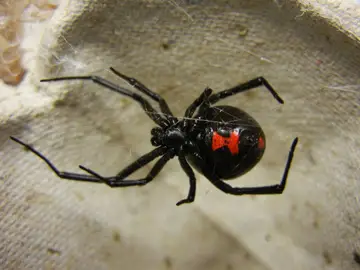
Venom can be harmful to humans (MDC). “Only two types have venom that can be harmful to humans — the brown recluse and the widow spiders (northern black widow and southern black widow).” MDC
All 43 spiders
Venomous species first, then A to Z. Do not handle them.
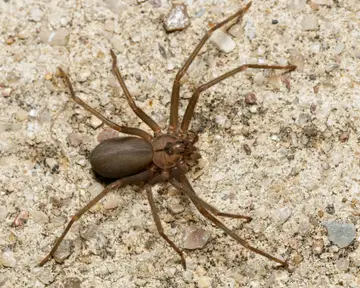
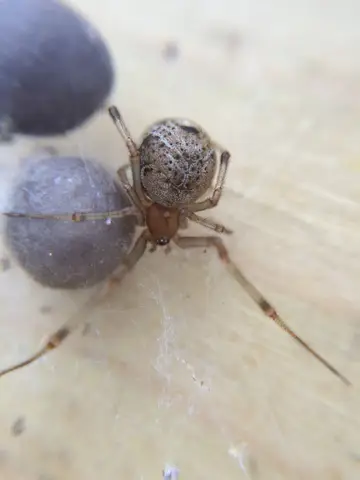
Body about 7 to 12 mm (about 3/8 inch); females average about 9 mm and males about 8 mm. UC IPM says a recluse body is not more than 3/8 inch long.
How to recognize it
Six equal-sized eyes in three pairs. UC IPM calls this the most definitive feature, since most spiders have eight eyes.
The violin mark alone is not a reliable way to identify it
UC IPM's five-point check: six eyes in pairs, evenly colored finely haired abdomen, no spines on the legs, evenly colored legs, body no more than 3/8 inch
JFMAMJJASOND
129 records by month.What the sources say
Venom: “Only two types have venom that can be harmful to humans — the brown recluse and the widow spiders (northern black widow and southern black widow).” (MDC)
Habitat: Brown recluse spiders often live in human dwellings, including houses, cabins, garages, sheds, wood, and cardboard boxes. They may also be found in outdoor settings such as log piles or beneath stones, usually near human habitation. These swift and secretive spiders are active hunters and do not rely on webs to capture prey. (MDC)
“Only female widow spiders have mouthparts capable of delivering venom dangerous to humans and may bite when pressed against the skin.” MDC
JFMAMJJASOND
31 records by month.What the sources say
Venom: “Southern black widows possess the more potent venom, while northern black widows have venom that is less powerful.” (MDC)
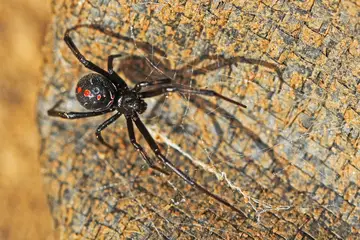
Habitat: Black widows are more likely to be encountered in rural than urban areas. They build remarkably strong and sticky cobwebs in a wide range of habitats, including rocky woods, glades, woodpiles, animal burrows, and hollow stumps. They can also inhabit outbuildings such as cabins, sheds, privies, garages, and basements, where they prefer undisturbed, cluttered areas and crawl spaces. (MDC)
“Only female widow spiders have mouthparts capable of delivering venom dangerous to humans and may bite when pressed against the skin.” MDC
What the sources say
Venom: “Southern black widows possess the more potent venom, while northern black widows have venom that is less powerful.” (MDC)
Habitat: Black widows are more likely to be encountered in rural than urban areas. They build remarkably strong and sticky cobwebs in a wide range of habitats, including rocky woods, glades, woodpiles, animal burrows, and hollow stumps. They can also inhabit outbuildings such as cabins, sheds, privies, garages, and basements, where they prefer undisturbed, cluttered areas and crawl spaces. (MDC)
No official source we use states whether this animal is venomous. That does not mean it is harmless: do not handle it.
JFMAMJJASOND
47 records by month.What the sources say
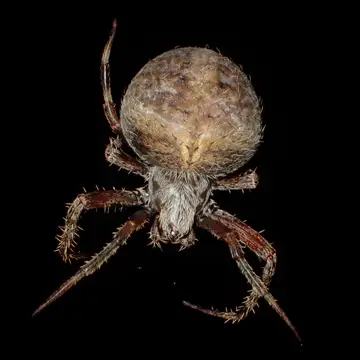
Habitat: The arboreal orbweaver inhabits woodlands, but it is also frequently encountered around buildings. Although juveniles can be found in summer, this species becomes more noticeable as they mature in late summer and early fall when the females construct large webs on trees and structures such as porches and sheds, especially near lights. Males are smaller and are rarely seen, unless they are visiting females. (MDC)
No official source we use states whether this animal is venomous. That does not mean it is harmless: do not handle it.
What the sources say
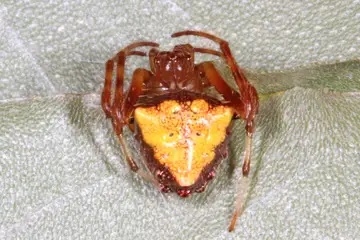
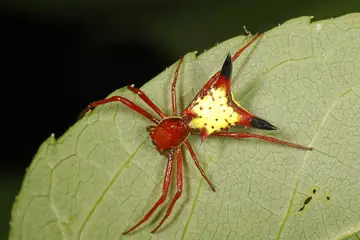
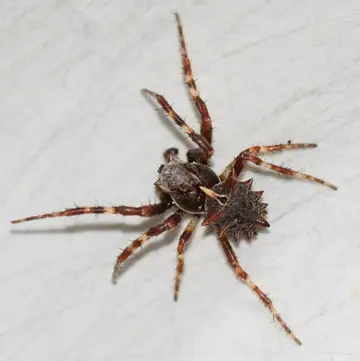
Habitat: The arrowhead spider constructs its vertically oriented, wheel-shaped web at night in forests and woodlands, from mid-summer to early fall. It often remains in its web well into the morning before dismantling it for the day. Hikers who inadvertently walk into these webs — or into the similar webs of the spined micrathena — strung between tree trunks at human height can take this as a sign that they are the first people to use the trail that day. (MDC)
No official source we use states whether this animal is venomous. That does not mean it is harmless: do not handle it.
What the sources say
Habitat: This species is active during the daytime and can often be found resting at the center of its orb web. Its web is notable for its narrowly spaced spiral lines and broad open zone near the center hub. The spider can be seen from summer into early fall in lowland forests and brushy woodlands. (MDC)
No official source we use states whether this animal is venomous. That does not mean it is harmless: do not handle it.
Size
Females 3/4 to 1 inch long, not counting legs (Missouri); 19 to 28 mm (Penn State); Texas A&M says the female body is more than 1 inch. Males about 1/4 inch (Missouri); 5 to 8 mm (Penn State).
How to recognize it
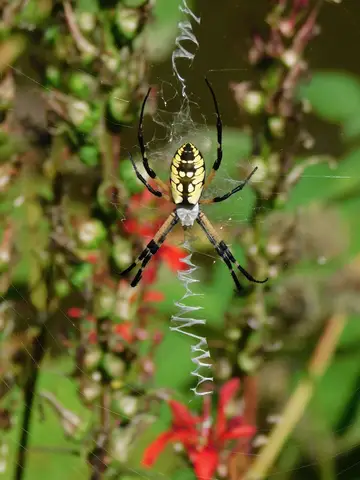
Round web about 2 feet across, built only by females; the spider rests head-down at the center, where a zigzag silk band (stabilimentum) runs vertically.
Abdomen an elongated oval, pointed at the rear, with two humps (shoulders) at the front.
Males are much smaller than females and rarely noticed.
JFMAMJJASOND
85 records by month.What the sources say
Habitat: The black-and-yellow garden spider typically inhabits prairies and fields but is also commonly found in native landscaping. These spiders are active during the day and become especially noticeable as they reach maturity in late summer. A similar species, the banded garden spider (Argiope trifasciata), is slightly smaller and has an abdomen marked with thin silver and yellow horizontal lines, along with thicker black, spotty bands. (MDC)
No official source we use states whether this animal is venomous. That does not mean it is harmless: do not handle it.
JFMAMJJASOND
172 records by month.What the sources say
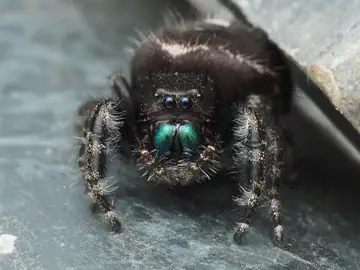
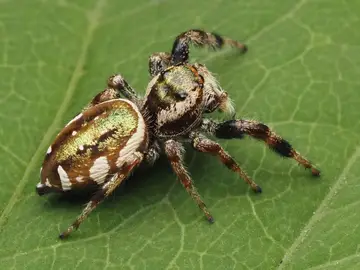
Habitat: Bold jumping spiders live in a wide variety of habitats, including in woodlands, fields, and landscaping. They are active during the day and rely on their excellent vision and climbing skills to stalk and leap onto their prey, often using a silk dragline to prevent falling. Juveniles are most seen in spring, while adults appear from summer through fall. (MDC)
No confirmed photo of Bowl and Doily Spider
Bowl and Doily Spider
Frontinella pyramitela
Not stated
Venom
No official source we use states whether this animal is venomous. That does not mean it is harmless: do not handle it.
What the sources say
Habitat: The bowl and doily spider inhabits a wide range of environments, including woodlands, prairie, fields, lawns, and landscaping. It constructs its web near the tops of loose clusters of nonleafy plant stems and on bare tree branches. These spiders can be found throughout the year, including during warm spells in winter. (MDC)
No confirmed photo of Cellar Spiders
Cellar Spiders
Pholcus spp.
Not stated
Venom
No official source we use states whether this animal is venomous. That does not mean it is harmless: do not handle it.
What the sources say
Habitat: Cellar spiders are strongly associated with human dwellings, especially basements, garages, and other undisturbed areas where they sit upside-down in their cobwebs, often close to the ceiling. Outdoors, they may also be found near the entrances of caves. Although the cellar spider species most frequently encountered in Missouri prey on insects and even other spiders within the spaces they inhabit, they are not native to North America. (MDC)
No official source we use states whether this animal is venomous. That does not mean it is harmless: do not handle it.
What the sources say
Habitat: This familiar spider has a worldwide distribution. It can be found in natural environments such as woodland branches, but it is most often encountered near or within buildings. Here, the spider constructs three-dimensional, tangled cobwebs in sheltered areas, frequently at windows of houses, garages, and cabins. (MDC)
No official source we use states whether this animal is venomous. That does not mean it is harmless: do not handle it.
JFMAMJJASOND
50 records by month.What the sources say
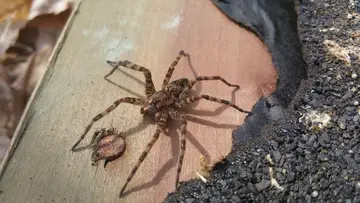
Habitat: This nocturnal hunting spider is commonly found on tree trunks and logs near lakes, streams, and rivers, where it sits vertically with its head facing downward, prepared to ambush prey that wanders nearby. It is also found in forests and woodlands and may hide in human structures such as garages, sheds, and wood piles during the day. The species can be encountered throughout the year, though it is most often seen from spring through fall. (MDC)
Venom: “Notably, spiders in this family lack venom, relying instead on their specialized silk for capturing insects.” (MDC)
Habitat: These orbweavers construct their webs horizontally and close to the ground, typically on vegetation in brushy woodlands and landscaping. Their circular webs often feature zigzag bands of silk called stabilimenta. In addition to spinnerets, these spiders possess an organ called a cribellum that produces a different kind of silk. (MDC)
No official source we use states whether this animal is venomous. That does not mean it is harmless: do not handle it.
What the sources say
Habitat: These spiders are found from spring through fall in forest understory shrubs as well as around fallen logs and shaded rock outcroppings. Once the dome-shaped web is sighted, the spider is usually seen resting upside down just beneath the top of the dome. Individuals may maintain and add to their webs over several days. (MDC)
No confirmed photo of Furrow Orbweaver
Furrow Orbweaver
Larinioides cornuta
Not stated
Venom
No official source we use states whether this animal is venomous. That does not mean it is harmless: do not handle it.
What the sources say
Habitat: Furrow orbweavers are primarily nocturnal forest spiders, though they can occasionally be seen in their webs during the day. Their webs are characterized by spiral circles that are more widely spaced than those of many other orbweavers. They are especially common near bodies of water such as lakes, where they build webs on docks and lakeside trees, shrubs, and buildings. (MDC)
No confirmed photo of Garden Ghost Spider
Garden Ghost Spider
Hibana gracilis
Not stated
Venom
No official source we use states whether this animal is venomous. That does not mean it is harmless: do not handle it.
What the sources say
Habitat: Garden ghost spiders can move very quickly and are experts at climbing on the smooth surfaces of stems and leaves and even glass. They actively hunt for prey on flowers and bushes, including in cultivated gardens. These spiders can be found year-round and are known to occasionally find their way into homes. (MDC)
No official source we use states whether this animal is venomous. That does not mean it is harmless: do not handle it.
What the sources say
Habitat: Golden jumpers are primarily found in lowland vegetation including prairies, fields, and forest edges. Like other jumping spiders, they rely on keen vision, the ability to walk on smooth vertical surfaces, and strong jumping skills to stalk and capture prey. They can be observed from spring through fall, but they are most abundant during the summer months. (MDC)
No confirmed photo of Grass Spiders
Grass Spiders
Agelenopsis spp.
Not stated
Venom
No official source we use states whether this animal is venomous. That does not mean it is harmless: do not handle it.
What the sources say
Habitat: Grass spiders can be found in their webs from spring through fall. They build their webs close to the ground in forest leaf litter and woody debris, low plants, lawns, landscaping, and on buildings. Often the webs of many individuals are found in an area, like a colony. (MDC)
No confirmed photo of Grayish Jumping Spider
Grayish Jumping Spider
Phidippus princeps
Not stated
Venom
No official source we use states whether this animal is venomous. That does not mean it is harmless: do not handle it.
What the sources say
Habitat: This species lives in prairies, fields, and woodland edges. It is a daytime hunter with excellent vision and strong climbing ability. The species is known to remember where prey was last seen as it stalks and will move to a better position before pouncing. (MDC)
No confirmed photo of Ground Crab Spiders
Ground Crab Spiders
Xysticus spp.
Not stated
Venom
No official source we use states whether this animal is venomous. That does not mean it is harmless: do not handle it.
What the sources say
Habitat: These spiders are ambush predators and can be found sitting motionless on tree bark, low vegetation, or within leaf litter in forests and woodlands, waiting to seize prey. They are most often noticed from spring through fall as they move across a trail or pathway. (MDC)
No confirmed photo of Lance Wolf Spider
Lance Wolf Spider
Schizocosa avida
Not stated
Venom
No official source we use states whether this animal is venomous. That does not mean it is harmless: do not handle it.
What the sources say
Habitat: This species lives in prairies, fields, and lawns and can be found from spring through fall. It hunts mainly at night, actively stalking and pouncing on prey. (MDC)
No confirmed photo of Longjawed Orbweaver
Longjawed Orbweaver
Tetragnatha elongata
Not stated
Venom
No official source we use states whether this animal is venomous. That does not mean it is harmless: do not handle it.
What the sources say
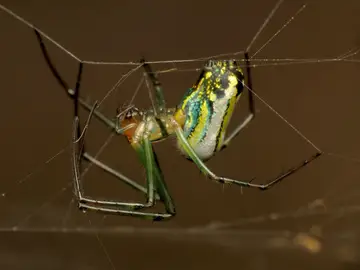
Habitat: These spiders are found along the edges of ponds, lakes, and rivers. They construct their horizontal orb webs at night on low vegetation or dock structures, often over the water, where they capture mosquitoes and other emerging aquatic insects. The spider may rest at the central hub of the web or lie stretched out on a nearby stem or branch, where it is very well camouflaged. (MDC)
No official source we use states whether this animal is venomous. That does not mean it is harmless: do not handle it.
What the sources say
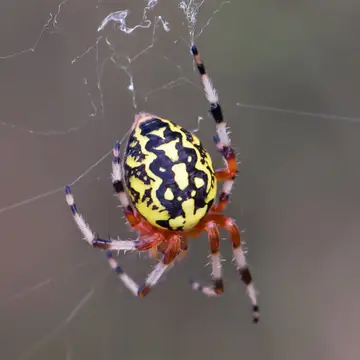
Habitat: Marbled orbweavers inhabit lowland forests and brushy woodlands, where they construct vertical webs in lower branches. They are primarily active at night and retreat beneath leaves for shelter during the day. These spiders are most commonly observed in late summer. (MDC)
No confirmed photo of Northern Crab Spider
Northern Crab Spider
Mecaphesa asperata
Not stated
Venom
No official source we use states whether this animal is venomous. That does not mean it is harmless: do not handle it.
What the sources say
Habitat: This crab spider is typically found on flowering plants in prairies and fields from spring through fall. It waits on blossoms and foliage to ambush passing insects. (MDC)
No official source we use states whether this animal is venomous. That does not mean it is harmless: do not handle it.
What the sources say
Habitat: This species is found from spring through fall in prairies, fields, and woodland edges, often near water. These spiders are active hunters that do not rely on webs to catch prey. Instead, they sit and wait to ambush insects that come within reach. (MDC)
No official source we use states whether this animal is venomous. That does not mean it is harmless: do not handle it.
What the sources say
Habitat: This common orbweaver is usually found close to the ground in moist woodlands and thickets, and on landscaping. It can be seen from spring to fall and is active from the early hours before dawn and throughout the day. This spider constructs a circular orb web that is nearly horizontal, positioning itself upside down on the underside of the central hub. (MDC)
No official source we use states whether this animal is venomous. That does not mean it is harmless: do not handle it.
What the sources say
Habitat: Parson spiders live in the leaf litter of forests and woodlands and hunt primarily at night. They can move very quickly, which helps them locate, capture, and subdue prey. During the daytime, these spiders hide in silken retreats under rocks, in crevices, and beneath loose tree bark. (MDC)
No confirmed photo of Pirate Spider
Pirate Spider
Mimetus puritanus
Not stated
Venom
No official source we use states whether this animal is venomous. That does not mean it is harmless: do not handle it.
What the sources say
Habitat: This species is most often found on buildings and landscaping close to natural forested areas, often near or within the webs of other spiders such as orb weavers and cobweb spiders. True to its common name, the pirate spider invades another spider’s web, deceiving the host by plucking the silk to mimic prey or a potential mate, before killing and consuming it. Afterward, it takes over the web and feeds on any additional prey caught within it. (MDC)
No official source we use states whether this animal is venomous. That does not mean it is harmless: do not handle it.
What the sources say
Habitat: This species can be found from spring through fall in prairies, fields, and woodland edges. It hunts mostly at night but may also be active during the day. It does not use a web to catch prey, though it may wrap captured insects in silk. (MDC)
No official source we use states whether this animal is venomous. That does not mean it is harmless: do not handle it.
What the sources say
Habitat: Purseweb spiders live in rocky woodlands and are most common in the southern half of Missouri. They build silk tubes, well camouflaged with small debris, at the base of tree trunks, on rocks, or along the ground. Because they spend most of their lives hidden inside their silk tubes, they are seldom seen. (MDC)
No official source we use states whether this animal is venomous. That does not mean it is harmless: do not handle it.
What the sources say
Habitat: These spiders are found in lawns and fields. Their webs resemble small delicate cobwebs and consist of a nonsticky base sheet beneath a loose tangle of threads. These threads serve to catch flying insects, causing them to fall into the main sheet where the spider waits to capture them. (MDC)
No official source we use states whether this animal is venomous. That does not mean it is harmless: do not handle it.
What the sources say
Habitat: Spined micrathenas are typically found in forests and woodlands. Like the arrowhead spider, as they mature in July and August, they construct upright circular webs between tree trunks in the forest understory, often across trails. Hikers who stumble into these spiders in their webs can be reassured that they pose no threat to humans. (MDC)
No official source we use states whether this animal is venomous. That does not mean it is harmless: do not handle it.
What the sources say
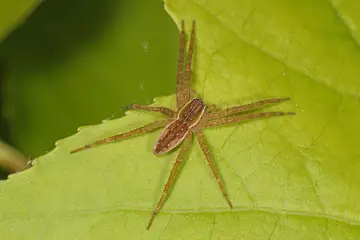
Habitat: This species lives among floating and emergent aquatic plants along the edges of ponds, lakes, and slow-moving streams. It can skim across the water’s surface like a water strider and is also capable of diving. A layer of specialized hairs traps a supply of air, allowing the spider to remain underwater while hunting aquatic insects and even tiny fish or tadpoles. (MDC)
No official source we use states whether this animal is venomous. That does not mean it is harmless: do not handle it.
What the sources say
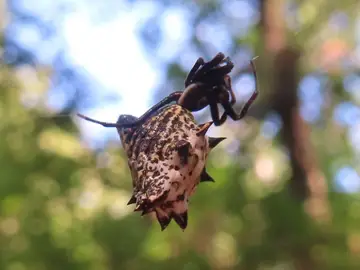
Habitat: Starbellied orbweavers build their vertical orb webs at night in prairies, glades, and grasslands, then rest in a hidden retreat during the day. When disturbed, they may drop to the ground and curl their legs tightly, effectively resembling a burr, clump of soil, or a piece of bark. They are present from spring through fall, with populations reaching their peak in late summer. (MDC)
No official source we use states whether this animal is venomous. That does not mean it is harmless: do not handle it.
What the sources say
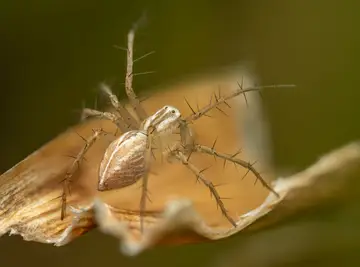
Habitat: Striped lynx spiders live in prairies and fields where they are well camouflaged. They are skilled runners, climbers, and jumpers and use these skills to actively stalk and pounce on their prey. They can be found and observed from spring through fall. (MDC)
No official source we use states whether this animal is venomous. That does not mean it is harmless: do not handle it.
What the sources say
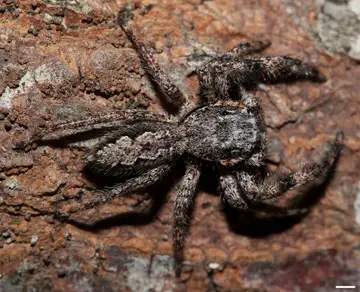
Habitat: This species lives in forests and woodlands, where it uses its excellent vision and climbing ability to stalk and ambush prey on the vertical surfaces of hickories and other hardwood trees. They are active during the day and sometimes near artificial lights at night. Because of their effective camouflage, these spiders are mostly noticed when they wander onto human-made surfaces such as walls, fences, or building exteriors. (MDC)
No official source we use states whether this animal is venomous. That does not mean it is harmless: do not handle it.
What the sources say
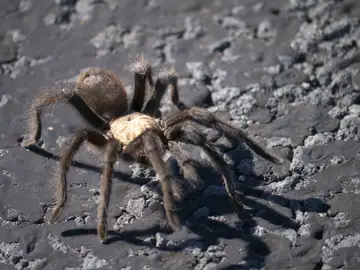
Habitat: Texas brown tarantulas inhabit dry, rocky, and grassy glades in the southern half of Missouri. During the day, they remain hidden in silk-lined burrows or natural cavities. Their vision is not acute, but they can detect shadows and movement nearby. (MDC)
No confirmed photo of Tigrosa Wolf Spiders
Tigrosa Wolf Spiders
Tigrosa spp.
Not stated
Venom
No official source we use states whether this animal is venomous. That does not mean it is harmless: do not handle it.
What the sources say
Habitat: Tigrosa wolf spiders live in leaf litter on the floors of forests and woodlands, though they can occasionally wander into houses or other buildings. They are active nocturnal hunters, stalking and seizing prey, and may dig burrows or tunnels for shelter, protection, or ambushing prey. They can be found throughout the year. (MDC)
No official source we use states whether this animal is venomous. That does not mean it is harmless: do not handle it.
What the sources say
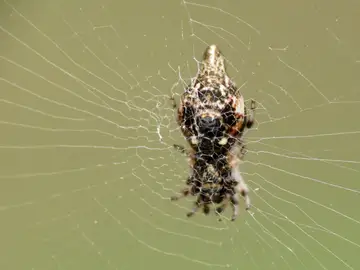
Habitat: Trashline orbweavers are commonly found in woodlands as well as on landscaping and around buildings. They are most frequently observed from summer through early fall. (MDC)
No confirmed photo of Truncated Web Meshweaver
Truncated Web Meshweaver
Arethyna volucripes
Not stated
Venom
No official source we use states whether this animal is venomous. That does not mean it is harmless: do not handle it.
What the sources say
Habitat: This species is most often observed in prairies and fields, from spring through the early winter months. (MDC)
No confirmed photo of White-Striped Running Crab Spider
White-Striped Running Crab Spider
Philodromus rufus
Not stated
Venom
No official source we use states whether this animal is venomous. That does not mean it is harmless: do not handle it.
What the sources say
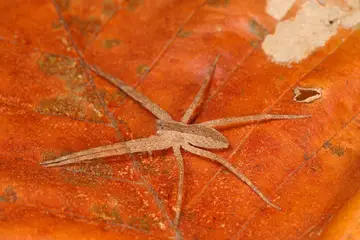
Habitat: Running crab spiders are well-named for their ability to dash quickly while hunting or escaping predators. They are skilled climbers and can move easily across smooth leaf surfaces in forests, fields, and landscaped areas where they live. They may be found throughout the year, but they are most commonly seen during the warmer months. (MDC)
No official source we use states whether this animal is venomous. That does not mean it is harmless: do not handle it.
What the sources say
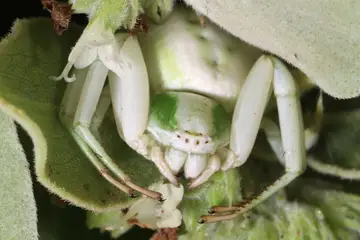
Habitat: These spiders are found on flowering plants in prairies and fields. They often occupy flowers that match their own colors, allowing them to remain well hidden while waiting to ambush prey. They can be encountered from late spring into fall. (MDC)
No confirmed photo of Woodlouse Hunter
Woodlouse Hunter
Dystera crocata
Not stated
Venom
No official source we use states whether this animal is venomous. That does not mean it is harmless: do not handle it.
What the sources say
Habitat: This species is found most in areas impacted by people. As the common name suggests, these spiders specialize in hunting woodlice, more commonly known as isopods, sowbugs, pillbugs, and roly-polies. Because of this, woodlouse hunters are usually found in moist environments such as under rocks, fallen logs, leaf litter, compost heaps, and other debris where their prey lives. (MDC)
When spiders are active in Missouri
Records of spiders in Missouri peak in May to June and August to September. They show when people record spiders, not how many there are (about month bars).
JanFebMarAprMayJunJulAugSepOctNovDec
1,921 records of spiders in Missouri by month (GBIF, CC0 and CC BY records).
Brown recluses can be found year-round, most often spring through fall. MDC
Black widows can be found spring through fall. MDC
If you are bitten or stung
Call 911 or Poison Help at 1-800-222-1222 right away. Poison Help connects you to your local poison center, any time of day.
Official advice from Missouri Poison Center (SSM Health Cardinal Glennon Children's Hospital), Missouri's poison-control program and MDC:
Reduce spider bites: shake out clothing, blankets and towels stored where spiders may be; brown recluse bites can occur when a person puts on clothing or shoes where a spider may be hiding. MDC
“Notably, spiders in this family lack venom, relying instead on their specialized silk for capturing insects.”
“Southern black widows possess the more potent venom, while northern black widows have venom that is less powerful.”
“Only female widow spiders have mouthparts capable of delivering venom dangerous to humans and may bite when pressed against the skin.”
“Only two types have venom that can be harmful to humans — the brown recluse and the widow spiders (northern black widow and southern black widow).”
“Shake out clothing, blankets, and towels if they have been stored in places where spiders may be present. … Brown recluses are not aggressive toward humans; however, bites can occur when a person puts on clothing or shoes where a spider may be hiding.”
“Brown recluses are primarily active at night and can be found year-round, most frequently from spring through fall.”
“Black widows can be found from spring through fall.”