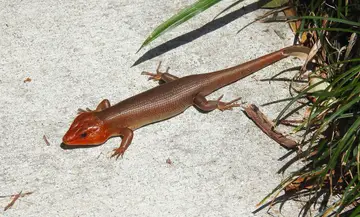
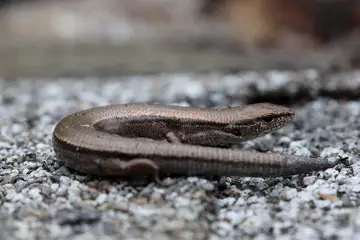
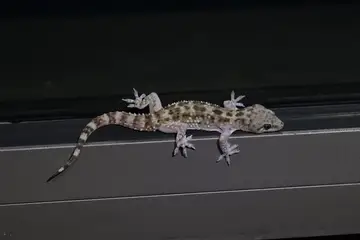
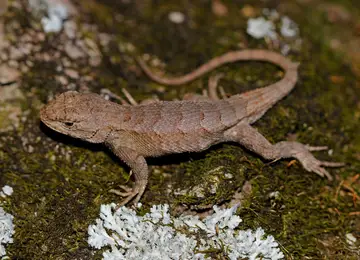
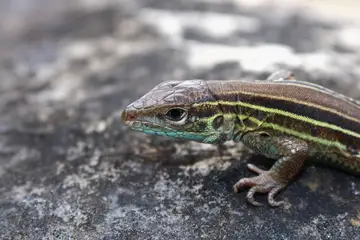
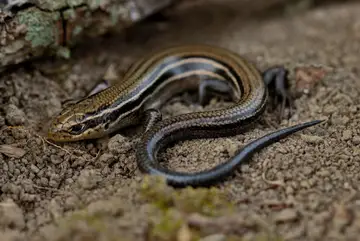
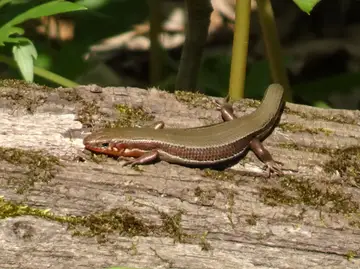
About 6.5 to 12.75 inches in total length. Oklahoma gives about 12 inches for large adults and SREL up to 13 inches. Males are larger than females.
How to recognize it
Large, wide head; breeding males have swollen orange-red jowls.
Smooth, glass-like scales, short legs and a stocky body.
Upper-lip scales separate it from five-lined skinks: Maryland, Tennessee and North Carolina count five labial scales between the nostril and the eye rather than four. Oklahoma and Missouri count differently, around 8 or 9 in the full lip row.
Venom: “All of Missouri’s lizards are harmless to humans, although some will attempt to bite if handled, usually causing a mild pain similar to being pinched. Some Missourians call broad-headed skinks ‘scorpions,’ but they are not venomous.” (MDC)
Habitat: As with all Missouri lizards, the broad-headed skink is active during the daytime, mainly between April and October. (MDC)
Enlarged middle row of scales under the tail (separates it from the southeastern five-lined skink)
Tail breaks off easily and twitches to distract predators; it grows back shorter
Where in Missouri
Nearly statewide, except for the extreme northern part of the state. MDC
JFMAMJJASOND
74 records by month.What the sources say
Venom: “All of Missouri’s lizards are harmless to humans, although some will attempt to bite if handled, usually causing a mild pain similar to being pinched. Lizard myths: "MYTH: The tail of a skink is ‘poisonous’ and can sting you." The bright blue is not an indication of the tail being poisonous or venomous” (MDC)
Habitat: These skinks live in open woods, along wooded bluffs and on rocky, south-facing hillsides. (MDC)
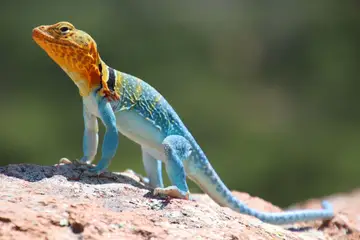
Adult total length 8 to 14 inches (Missouri); up to about 14 inches (Colorado). Snout to vent up to 4.65 inches (Arizona).
How to recognize it
Large head, long tail about twice the body length, distinct black collar
Round tail in cross-section, separating it from the Great Basin collared lizard; inside of mouth and throat often black
Runs on its hind legs at top speed
Where in Missouri
Mainly southern half of the state, especially the Ozark Highlands. MDC
Conservation
MDC lizard guide: Rare Species; MDC field guide: Species of Conservation Concern
What the sources say
Venom: “All of Missouri’s lizards are harmless to humans, although some will attempt to bite if handled, usually causing a mild pain similar to being pinched.” (MDC)
Habitat: In Missouri these lizards live among rocks on dry, open, south- or southwest-facing limestone, sandstone, and granite glades. (MDC)
MDC lizard guide: Rare Species; MDC field guide: Species of Conservation Concern
What the sources say
Venom: “All of Missouri’s lizards are harmless to humans, although some will attempt to bite if handled, usually causing a mild pain similar to being pinched.” (MDC)
Habitat: A rare species in Missouri, as our westernmost counties represent part of the easternmost extent of their overall range. (MDC)
Venom: “All of Missouri’s lizards are harmless to humans, although some will attempt to bite if handled, usually causing a mild pain similar to being pinched.” (MDC)
Nearly statewide except for northern and northwestern counties. MDC
What the sources say
Venom: “All of Missouri’s lizards are harmless to humans, although some will attempt to bite if handled, usually causing a mild pain similar to being pinched.” (MDC)
Habitat: Little brown skinks, formerly called ground skinks, are a woodland species. (MDC)
Adults about 4 to 5 inches long in total (Missouri gives 3.9 to 5.0 inches); up to 2.4 inches from snout to vent.
How to recognize it
Warty skin, large bulging eyes with vertical pupils, and wide toe pads for climbing.
Large eyes without eyelids, covered by a clear scale.
Unlike any native lizard in Georgia and South Carolina, geckos have sticky toe pads, vertical pupils and lidless eyes.
Where in Missouri
Scattered throughout the southern half of the state in urban areas. MDC
What the sources say
Venom: “All of Missouri’s lizards are harmless to humans, although some will attempt to bite if handled, usually causing a mild pain similar to being pinched.” (MDC)
Southern half and into the northeastern part of the state. MDC
What the sources say
Venom: “All of Missouri’s lizards are harmless to humans, although some will attempt to bite if handled, usually causing a mild pain similar to being pinched.” (MDC)
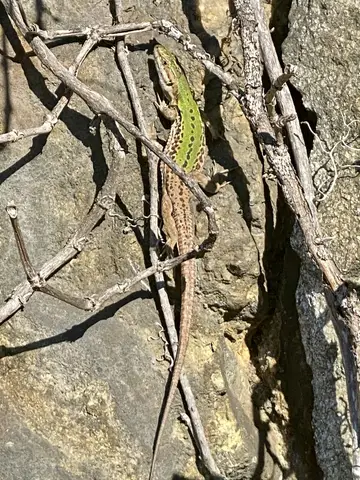
Habitat: In Missouri, prairie lizards live in open woodlands or along the edges of woods and fields and on rocky glades. (MDC)
The prairie racerunner occurs in most of state, excluding northcentral Missouri, and it intergrades with the six- lined racerunner, Aspidoscelis sexlineata sexlineata … MDC
What the sources say
Venom: “All of Missouri’s lizards are harmless to humans, although some will attempt to bite if handled, usually causing a mild pain similar to being pinched.” (MDC)
Range: The prairie racerunner occurs in most of state, excluding northcentral Missouri, and it intergrades with the six- lined racerunner, Aspidoscelis sexlineata sexlineata (Linnaeus), in the southeastern part of the state.
Habitat: Racerunners live in open areas with loose soil or sand and sparse vegetation, especially in fields, grasslands, along river floodplains, and rocky, south-facing hillsides throughout the state. (MDC)
The northern prairie skink occurs in northwestern Missouri, while a subspecies, the southern prairie skink, Plestiodon septentrionalis obtusirostris (Bocourt), is known … MDC
Conservation
MDC lizard guide: Rare Species; MDC field guide: Species of Conservation Concern
What the sources say
Venom: “All of Missouri’s lizards are harmless to humans, although some will attempt to bite if handled, usually causing a mild pain similar to being pinched.” (MDC)
Range: The northern prairie skink occurs in northwestern Missouri, while a subspecies, the southern prairie skink, Plestiodon septentrionalis obtusirostris (Bocourt), is known along the Kansas border in the southwestern part of the state.
Habitat: Prairie skinks are mainly active from April to September, with peak activity in April into June. (MDC)
Southern half of the state, except for the southeastern corner. MDC
What the sources say
Venom: “All of Missouri’s lizards are harmless to humans, although some will attempt to bite if handled, usually causing a mild pain similar to being pinched.” (MDC)
Habitat: In Missouri, the southern coal skink is active from mid-March to early October; it is most easily found in April. (MDC)
MDC lizard guide: Rare Species; MDC field guide: Species of Conservation Concern
What the sources say
Venom: “All of Missouri’s lizards are harmless to humans, although some will attempt to bite if handled, usually causing a mild pain similar to being pinched.” (MDC)
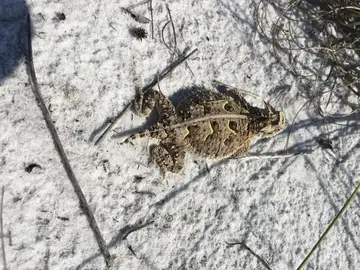
Habitat: The active season for Texas horned lizards in Missouri is from April to early October. (MDC)
Venom: “All of Missouri’s lizards are harmless to humans, although some will attempt to bite if handled, usually causing a mild pain similar to being pinched.” (MDC)
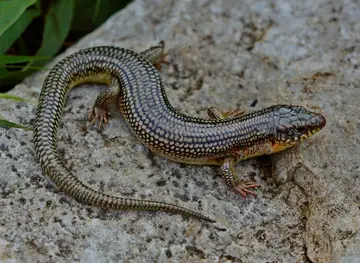
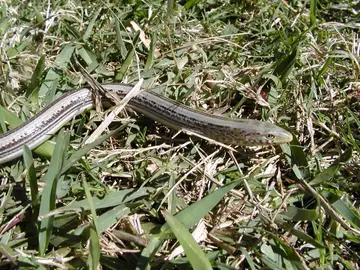
Habitat: In Missouri, the western glass lizard occurs on prairies and pastures, in open woods, on dry, rocky hillsides, on glades, and in fens. (MDC)
NCWRC: broadhead skinks reach a much larger size. ODWC: juveniles can be told apart by counting the upper lip scales (five-lined: seven, with two post-labials; broad-headed: nine, with no post-labials).
Oklahoma: its background color is tan to yellow, each scale bordered with black, giving the look of eleven irregular narrow stripes.
Photos show typical adults; individuals vary. Never get close to compare.
When lizards are active in Missouri
Records of lizards in Missouri peak in April to May and August to September. They show when people record lizards, not how many there are (about month bars).
JanFebMarAprMayJunJulAugSepOctNovDec
394 records of lizards in Missouri by month (GBIF, CC0 and CC BY records).
How to report
Report sightings of black bears, elk, mountain lions, feral hogs, rare furbearers and some small mammals to MDC. MDC
“All of Missouri’s lizards are harmless to humans, although some will attempt to bite if handled, usually causing a mild pain similar to being pinched.”
“All of Missouri’s lizards are harmless to humans, although some will attempt to bite if handled, usually causing a mild pain similar to being pinched. Lizard myths: "MYTH: The tail of a skink is ‘poisonous’ and can sting you." The bright blue is not an indication of the tail being poisonous or venomous”
“All of Missouri’s lizards are harmless to humans, although some will attempt to bite if handled, usually causing a mild pain similar to being pinched. Some Missourians call broad-headed skinks ‘scorpions,’ but they are not venomous.”
“MDC is taking reports for sightings of black bears, elk, mountain lions, feral hogs, rare furbearers, and small mammals such as Franklin's ground squirrels and plains pocket gophers.”