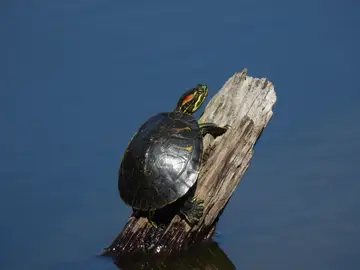
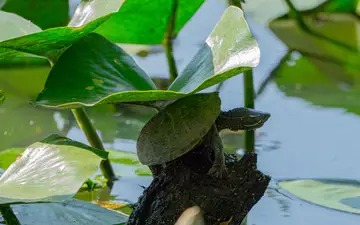
Can carry salmonella per MDC. “When it became known that the turtles and their water can harbor salmonella bacteria, and that humans handling the turtles might be affected, sales of the turtles mostly ended.” MDC
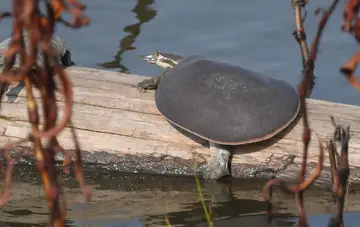
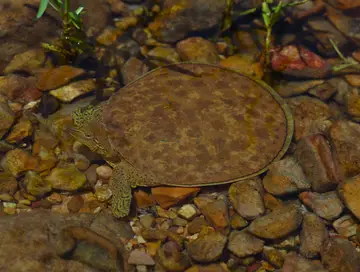
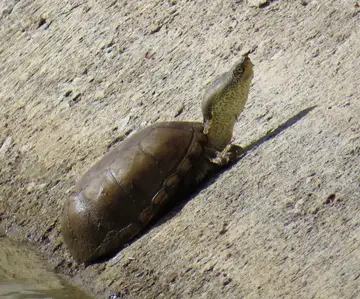
Strong jaws. “Though softshells have notoriously strong jaws and should always be handled with caution, smooth softshells are less inclined to bite when captured compared to spiny softshells.” MDC
Bites when captured (MDC). “Spiny softshells are defensive and will try to bite when captured.” MDC
All 18 turtles
From A to Z. Do not handle them.
No confirmed photo of Blanding's Turtle
Blanding's Turtle
Emydoidea blandingii
Where in Missouri
Occurs in a few counties in extreme northeastern and northwestern Missouri with historic accounts in the St. Louis area. MDC
Conservation
MDC turtle guide: State Endangered; MDC field guide: Endangered, Species of Conservation Concern
What the sources say
Habitat: This semiaquatic turtle spends a considerable amount of time in shallow water along the edge of wetlands in prairie and grassland habitats. (MDC)
Occurs throughout most of Missouri except for the northwestern third of the state. MDC
What the sources say
Habitat: In Missouri, this mostly aquatic species is most abundant in slow-current sections of rivers and larger streams of the Ozarks; the swamps, sloughs, and small ditches of the Bootheel; and in a few rivers in the northeastern part of the state. (MDC)
“Though softshells have notoriously strong jaws and should always be handled with caution, smooth softshells are less inclined to bite when captured compared to spiny softshells.” MDC
Habitat: Midland smooth softshells live mainly in rivers and larger streams, especially the Missouri and Mississippi rivers, usually with moderate to fast current, and abundant sand or mud. (MDC)
Occurs in large rivers, such as the Missouri, Osage, and upper Mississippi, while a subspecies, the Mississippi map turtle, G. p. kohnii (Baur) occurs in southern and … MDC
What the sources say
Range: Occurs in large rivers, such as the Missouri, Osage, and upper Mississippi, while a subspecies, the Mississippi map turtle, G. p. kohnii (Baur) occurs in southern and southeastern part of the state. Mississippi Map Turtle ▼
Habitat: Large rivers and their backwaters are the preferred aquatic habitat for northern false map turtles. (MDC)
No confirmed photo of Northern Map Turtle
Northern Map Turtle
Graptemys geographica
Where in Missouri
Occurs primarily in the Ozark Highlands and upper Mississippi River in northeastern part of state. MDC
What the sources say
Habitat: Northern map turtles are active from late March to October. (MDC)
Habitat: The northern spiny softshell mainly inhabits large rivers and streams, but it also lives in lakes, large ponds, and even roadside and irrigation ditches. (MDC)
Statewide, except for the southeastern corner of the state. MDC
What the sources say
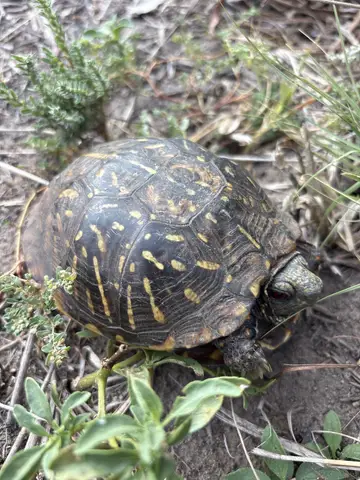
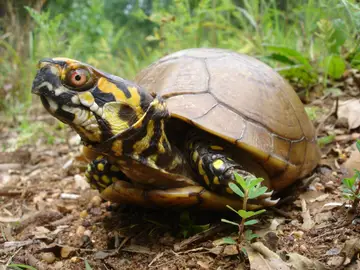
Habitat: Ornate box turtles are a prairie species, living where there is a mixture of prairie grasses and forbs. (MDC)
No confirmed photo of Ouachita Map Turtle
Ouachita Map Turtle
Graptemys ouachitensis
Where in Missouri
Scattered throughout much of the state, except for southeastern and northwestern parts of the state. MDC
What the sources say
Habitat: Generally, this species has habitat needs and life history similar to the northern false map turtle (G. p. pseudogeographica), with which it used to be considered a sister subspecies: living in the main channels of large rivers during the active season, and overwintering underwater, in the mud at the bottom of lakes or other sluggish waters, likely among rocks, tree debris, and undercut banks. (MDC)
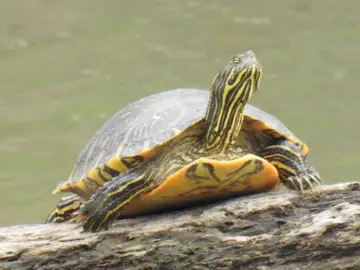
“When it became known that the turtles and their water can harbor salmonella bacteria, and that humans handling the turtles might be affected, sales of the turtles mostly ended.” MDC
Where in Missouri
Statewide, except for a few northern counties of the state. MDC
What the sources say
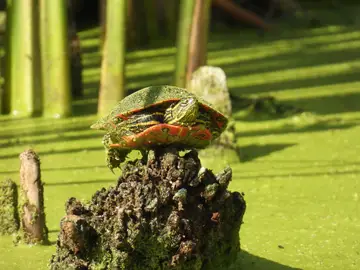
Habitat: The red-eared slider occurs in a wide variety of aquatic habitats, but it prefers a mud bottom, plenty of aquatic plants, and abundant basking sites. (MDC)
Usually 15 to 26 inches of shell and 35 to 150 pounds; males can reach 29 inches and 249 pounds, females about 22 inches and 62 pounds. Missouri records over 250 pounds.
How to recognize it
Three prominent ridges on the upper shell
Very large head with a sharp, strongly hooked beak
Extra row of scutes on each side of the shell
Where in Missouri
Occurs in the southern, southeastern, and eastern sections of the state. MDC
Conservation
MDC turtle guide: Rare Species; MDC field guide: Species of Conservation Concern
What the sources say
Habitat: The preferred habitats include deep sloughs, oxbow lakes, and deep pools of large rivers. (MDC)
MDC turtle guide: State Endangered; MDC field guide: Endangered, Species of Conservation Concern
What the sources say
Habitat: Although the broader active season is from mid-March into August, western chicken turtles are apparently only active for a brief period in the spring and early summer (into July) and remain buried underground for the remainder of the year. (MDC)
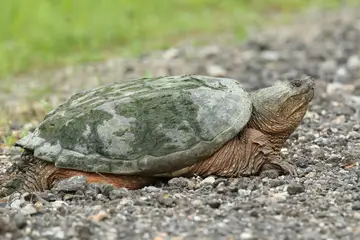
Tennessee (TWRA): the alligator snapping turtle has a longer snout with a hooked beak, extra marginal scutes (shell-edge plates) and more conspicuous ridges on the shell. Missouri (MDC): its upper shell has 3 prominent ridges, one along the center line and one on either side, and its large head ends in a sharp, strongly hooked beak. Texas (TPWD): the common snapping turtle has an oval-shaped head and a comparatively smooth, rounded shell; the alligator snapper has three distinct ridges, a triangular head and a fleshy lure in its mouth. Caution: young common snapping turtles also have three keels on the shell (MDC, NCWRC, CT DEEP), so ridges alone do not separate small turtles.
Photos show typical adults; individuals vary. Never get close to compare.
When turtles are active in Missouri
Records of turtles in Missouri peak in April to June and September. They show when people record turtles, not how many there are (about month bars).
JanFebMarAprMayJunJulAugSepOctNovDec
856 records of turtles in Missouri by month (GBIF, CC0 and CC BY records).
If you are bitten or stung
Call 911 or Poison Help at 1-800-222-1222 right away. Poison Help connects you to your local poison center, any time of day.
“When it became known that the turtles and their water can harbor salmonella bacteria, and that humans handling the turtles might be affected, sales of the turtles mostly ended.”
“Though softshells have notoriously strong jaws and should always be handled with caution, smooth softshells are less inclined to bite when captured compared to spiny softshells.”
“Spiny softshells are defensive and will try to bite when captured.”