Broad-headed skink
Plestiodon laticeps · also called Broadhead skink, Red-headed scorpion (folk name in Tennessee) and "Scorpion" (folk name for young skinks in North Carolina) · Last checked November 3, 2026.
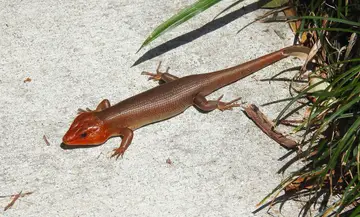
The broad-headed skink is a large, shiny, smooth-scaled lizard of the eastern and southeastern US, about 6.5 to 12.75 inches long that spends most of its time in or near trees. Adult males are olive brown and develop a swollen orange-red head in breeding season; females keep faded stripes; young are black with five light stripes and a bright blue tail. It is not venomous. North Carolina says it is non-venomous and poses no danger, and that young skinks are wrongly called "scorpions", but a large adult can bite: Maryland says the bite can be painful. N.C. Wildlife Resources Commission
On this page
Is the broad-headed skink dangerous?
N.C. Wildlife Resources Commission: young skinks are mistakenly called "scorpions" because of their blue tails and tail-thrashing, but they are completely harmless to humans. A large adult may give a noticeable bite, but broad-headed skinks are non-venomous and pose no danger. N.C. Wildlife Resources Commission
“In reality, they are completely harmless to humans. Although a large adult may deliver a noticeable bite, broad-headed skinks are non-venomous and pose no danger.”
Bites and stings: Can bite if handled. North Carolina: a large adult may deliver a noticeable bite. Maryland: powerful jaws, and the bite of the male is very painful. LSU AgCenter: the male will bite if handled.
How to identify a broad-headed skink
A photo or description can narrow it down, but cannot confirm what an animal is or that it is safe. Look from a distance and do not handle wild animals.
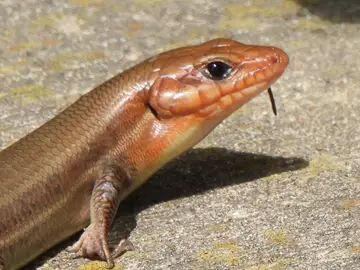
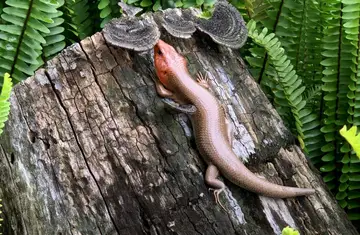
Size: About 6.5 to 12.75 inches in total length. Oklahoma gives about 12 inches for large adults and SREL up to 13 inches. Males are larger than females. MDC
Colors: olive brown, tan, brown, black, yellow, white, blue, orange and red. Pattern: striped (young and females); plain (large males).
Key features
- Large, wide head; breeding males have swollen orange-red jowls. MDC
- Smooth, glass-like scales, short legs and a stocky body. Oklahoma Department of Wildlife Conservation
- Upper-lip scales separate it from five-lined skinks: Maryland, Tennessee and North Carolina count five labial scales between the nostril and the eye rather than four. Oklahoma and Missouri count differently, around 8 or 9 in the full lip row. DNR
- Tail of juveniles is bright blue and breaks off easily; it fades at sexual maturity. Oklahoma Department of Wildlife Conservation
Young
Black or dark brown with five (sometimes seven) yellow or white stripes and a vivid blue tail. This pattern closely matches young five-lined skinks.
Animals mistaken for the broad-headed skink
Broad-headed skink or Common five-lined skink?
Broad-headed skink
Common five-lined skink Plestiodon fasciatus
Young and females are very similar. Missouri: five-lined skinks do not grow as large, to only 5 to 8.75 inches. Illinois: the only reliable way to tell them apart is by counting lip scales, which usually requires a hand lens. MDC
Virginia DWR: not venomous or poisonous
Broad-headed skink or Southeastern five-lined skink?
Broad-headed skink
Southeastern five-lined skink Plestiodon inexpectatus
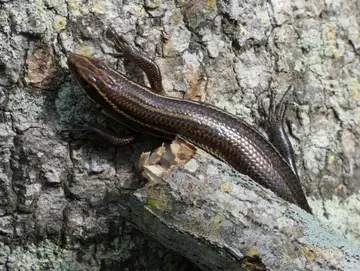
Tennessee: the southeastern five-lined skink does not have an enlarged middle row of scales under the tail; positive identification requires examining the scales. Tennessee Wildlife Resources Agency
Virginia DWR: not venomous or poisonous
Broad-headed skink or Great Plains skink?
Broad-headed skink
Great Plains skink Plestiodon obsoletus
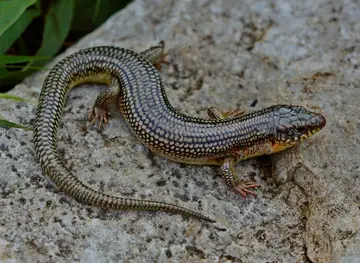

Oklahoma: its background color is tan to yellow, each scale bordered with black, giving the look of eleven irregular narrow stripes. Oklahoma Department of Wildlife Conservation
Not addressed in this source
Broad-headed skink or Argentine black and white tegu (invasive)?
Broad-headed skink
Argentine black and white tegu (invasive) Salvator merianae
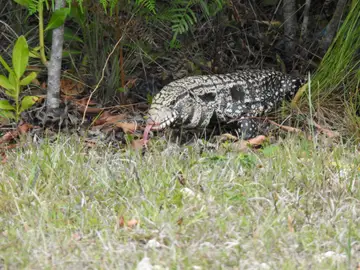
Georgia DNR: tegus might be confused with native reptiles such as broadhead skinks, although even adult native lizards would be no larger than a hatchling tegu. Georgia DNR Wildlife Resources Division
See the Argentine tegu page
Where the broad-headed skink lives
- Native or listed
- Nonnative or not established
- No official record in our data
- 1–9
- 10–99
- 100–999
- 1,000+
On our state guides
- Alabama lizards
- Arkansas lizards
- Delaware lizards
- Florida lizards
- Georgia lizards
- Illinois lizards
- Indiana lizards
- Kansas lizards
- Kentucky lizards
- Maryland lizards
- Mississippi lizards
- Missouri lizards
- North Carolina lizards
- Ohio lizards
- Oklahoma lizards
- Pennsylvania lizards
- South Carolina lizards
- Tennessee lizards
- Texas lizards
- Virginia lizards
- West Virginia lizards
State boundaries: U.S. Census Bureau, cartographic boundary file cb_2024_us_state_20m.
When it is active
Active in the daytime, mainly April to October in Missouri and April through November in Oklahoma, depending on local climate; juveniles can be out on sunny days as early as March. MDC
US open-licence records peak in April to May and July.
Habitat and habits
Habitat: Hardwood and mixed forests, swamp forests and forest openings with rotting logs, stumps and tree cavities; also woodland edges, old farm buildings and, in cities, wood piles and decks. N.C. Wildlife Resources Commission
Behavior: Strongly tied to trees and often climbs high when disturbed, using cavities, branches and loose bark. The tail breaks off easily to escape predators and grows back shorter. Young thrash their blue tails when threatened. Males interact aggressively in spring.
Diet: Mainly insects, spiders and other invertebrates; also land snails and some small vertebrates such as other lizards and baby mice.
Young: Mates in spring, roughly April to June. Females lay about 5 to 25 eggs (the number varies by source) in rotting logs, tree cavities or similar spots in June or July and stay with the eggs until they hatch in mid to late summer.
Legal status and reporting
Protection: Pennsylvania: Candidate Species. Georgia: may not be held as a pet. Mississippi: a nongame species in need of management under state rule. Ohio: uncommon. Alabama: lowest conservation concern. Check your state agency. Pennsylvania Fish and Boat Commission
Questions about the broad-headed skink
Broad headed skink
A large, smooth-scaled, tree-climbing lizard of the eastern and southeastern US. Adult males are olive brown with an orange-red head in breeding season; young are black with light stripes and a blue tail. North Carolina says it is non-venomous and poses no danger, though a large adult may deliver a noticeable bite; Maryland says the bite can be painful.
Sources
- Broad-Headed Skink (NCWRC species page). N.C. Wildlife Resources Commission. undated page; checked November 3, 2026.
Quoted passages (4)
“In reality, they are completely harmless to humans. Although a large adult may deliver a noticeable bite, broad-headed skinks are non-venomous and pose no danger.”
“Although a large adult may deliver a noticeable bite, broad-headed skinks are non-venomous and pose no danger.”
“Juveniles are dark brown or black, marked with five to seven yellow stripes and vivid blue tails.”
“Their preferred habitats include swamp forests, moist hardwood and mixed forests, cypress swamps, and even abandoned urban lots with debris.”
- Broad-headed Skink (DNR field guide species page). Maryland Department of Natural Resources (DNR). archived copy, captured March 8, 2026; checked November 3, 2026.
Quoted passages (1)
“Broad-headed skinks have five scales; five-lined skinks have four.”
- MDC Field Guide: Reptiles and Amphibians > Lizards (species accounts). Missouri Department of Conservation (MDC). undated page; checked November 3, 2026.
Quoted passages (7)
“Adult total length: 6½ to 12¾ inches.”
“The broad-headed skink is a large, shiny, smooth-scaled lizard with a large, wide head.”
“The diet of broad-headed skinks includes insects, spiders, land snails, small lizards and their eggs, and snakes, as well as baby mice.”
“Most of their time is spent in or near trees; of all Missouri's lizards, this one is most associated with trees.”
“…is active during the daytime, mainly between April and October”
“…a single female may lay 6–25 eggs. The female remains with her eggs until they hatch in July or August.”
“Five-lined skinks are very similar, though they do not attain as large a size (to only 5 to 8¾ inches in length).”
- Reptiles » Lizards (Tennessee Watchable Wildlife species accounts). Tennessee Wildlife Resources Agency (Tennessee Watchable Wildlife website). undated page; checked November 3, 2026.
Quoted passages (1)
“Southeastern Five-lined Skinks do not have enlarged middle row of scales under the tail”
- Broad-headed Skink (ODWC Field Guide). Oklahoma Department of Wildlife Conservation. undated page; checked November 3, 2026.
Quoted passages (3)
“…relatively large lizards with smooth, glass-like scales”
“The brightly-colored tails of juveniles are easily lost.”
“…their background coloration is tan to yellow, and each scale is bordered by black, giving the impression that the skink has eleven irregular narrow stripes”
- Pennsylvania Native Reptile and Amphibian Species (PA Species and Endangered Species Act listing status). Pennsylvania Fish and Boat Commission. undated page; checked November 3, 2026.
Quoted passages (1)
“Broad-headed Skink Plestiodon laticeps C”
- Argentine Black and White Tegus. Georgia DNR Wildlife Resources Division. undated page; checked November 3, 2026.
Quoted passages (1)
“…tegus might be confused with native reptiles such as juvenile alligators (which are protected), broadhead skinks and eastern fence lizards (although even as adults, all native lizards would be no larger than a hatchling tegu)”
- GBIF.org occurrence records, human observations licensed CC0 1.0 or CC BY 4.0 only, accessed November 3, 2026. The datasets behind these counts are listed on our Sources page.
- State boundaries: U.S. Census Bureau, cartographic boundary file cb_2024_us_state_20m.