Tennessee Wildlife Resources Agency: Wildlife Species in Tennessee … Currently, there are more than 325 species of fish, 89 mammals, 61 reptiles, 70 amphibians, and 340+ birds known to inhabit or migrate through Tennessee.
This page lists 9 lizards: all from Tennessee Wildlife Resources Agency's Reptiles » LIZARDS.
No official source we use states whether this animal is venomous. That does not mean it is harmless: do not handle it.
Size
About 6.5 to 12.75 inches in total length. Oklahoma gives about 12 inches for large adults and SREL up to 13 inches. Males are larger than females.
How to recognize it
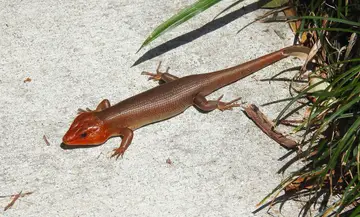
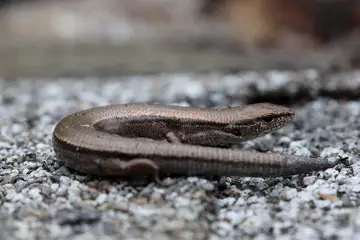
Large, wide head; breeding males have swollen orange-red jowls.
Smooth, glass-like scales, short legs and a stocky body.
Upper-lip scales separate it from five-lined skinks: Maryland, Tennessee and North Carolina count five labial scales between the nostril and the eye rather than four. Oklahoma and Missouri count differently, around 8 or 9 in the full lip row.
Where in Tennessee
The Broad-headed Skink is the largest skink in Tennessee and can be found across the state, except the extreme northeastern corner. Tennessee Wildlife Resources Agency
JFMAMJJASOND
49 records by month.What the sources say
Habitat: Prefers moist woodlands and edges of wood lots. Found on stumps, logs, fences, old farm buildings, and in trees. (Tennessee Wildlife Resources Agency)
No official source we use states whether this animal is venomous. That does not mean it is harmless: do not handle it.
Where in Tennessee
Two subspecies occur in TN; Southern Coal Skink (P. a. pluvialis) is found next to the Tennessee River in western part of state and Northern Coal Skink (P. a … Tennessee Wildlife Resources Agency
What the sources say
Range: Two subspecies occur in TN; Southern Coal Skink (P. a. pluvialis) is found next to the Tennessee River in western part of state and Northern Coal Skink (P. a. anthracinus) exists in Great Smoky Mountains National Park.
Habitat: Prefers open, moist forests near streams, river, or sloughs. Also, occurs on rocky hillsides and near springs. (Tennessee Wildlife Resources Agency)
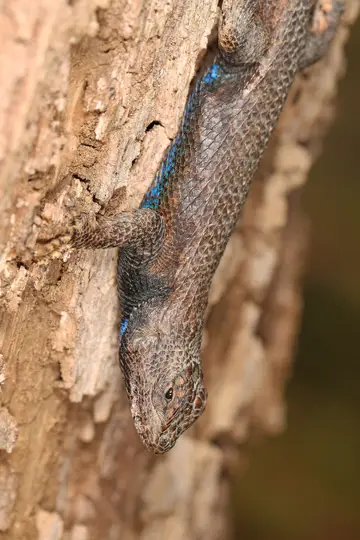
Habitat: Found in many habitats, but usually found in dry, open forests or forest edges. Commonly found on trees, fallen trees, stumps, fences, firewood piles, and rock piles. (Tennessee Wildlife Resources Agency)
No official source we use states whether this animal is venomous. That does not mean it is harmless: do not handle it.
Size
5 to 8 inches (12.5 to 20 cm) including the tail; the tail can be twice as long as the body.
How to recognize it
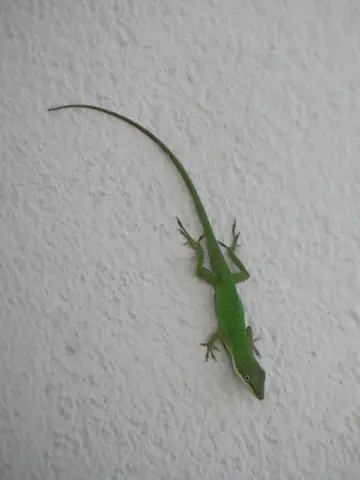
Males have a pink throat fan (dewlap); TWRA says females have a white throat.
Sticky toe pads for climbing walls, fences, shrubs and trees.
Can change color between green and brown.
Where in Tennessee
Occurs in the southern half of the state. Only one subspecies occurs in TN; Northern Green Anole (A. c. carolinensis). Tennessee Wildlife Resources Agency
JFMAMJJASOND
65 records by month.What the sources say
Habitat: Mainly a tree dwelling species, often on shaded tree branches, but may be found anywhere. Frequently found in suburban areas, including roof tops and fence posts. (Tennessee Wildlife Resources Agency)
No official source we use states whether this animal is venomous. That does not mean it is harmless: do not handle it.
Where in Tennessee
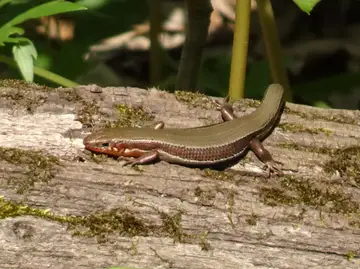
Also known as Ground Skink or “brown-backed skink.” Found across the state, except the extreme northeastern corner. Tennessee Wildlife Resources Agency
JFMAMJJASOND
62 records by month.What the sources say
Habitat: Prefers woodlands with plenty of cover such as leaf litter, loose soil, decaying wood, pine needles, logs, or other debris. (Tennessee Wildlife Resources Agency)
No official source we use states whether this animal is venomous. That does not mean it is harmless: do not handle it.
Where in Tennessee
Occurs across TN except for the northern Cumberland Plateau, upper East TN, extreme northwest TN, and parts of the Highland Rim and Central Basin … Tennessee Wildlife Resources Agency
What the sources say
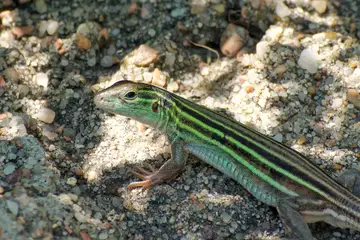
Range: Occurs across TN except for the northern Cumberland Plateau, upper East TN, extreme northwest TN, and parts of the Highland Rim and Central Basin. Of the 3 recognized subspecies, only Eastern Six-lined Racerunner (A. s. sexlineata) occurs in TN.
Habitat: Prefers open areas with loose sand or soil and sparse vegetation. Typical habitats include fields, glades, river floodplains, railroad tracks, edge of gravel roads, and rocky, south-facing hillsides. (Tennessee Wildlife Resources Agency)
No official source we use states whether this animal is venomous. That does not mean it is harmless: do not handle it.
Where in Tennessee
The only legless lizard in TN occurs across the state, except for the northwest and northeast portions … Tennessee Wildlife Resources Agency
What the sources say
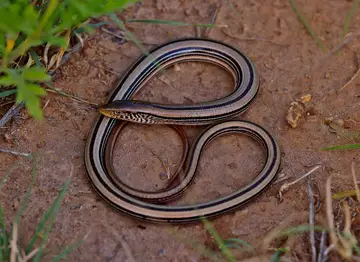
Range: The only legless lizard in TN occurs across the state, except for the northwest and northeast portions. Only one subspecies, Eastern Slender Glass Lizard (O. a. longicaudus), is found in TN.
Habitat: This secretive species prefers dry, open grasslands or woodlands. Typically found in dried grass or burrows; occasionally in vacant lots and farms. (Tennessee Wildlife Resources Agency)
Distribution across TN is poorly known. Occurs from Appalachian Mountains in southeast corner to Mississippi River in western coastal plain. Tennessee Wildlife Resources Agency
What the sources say
Venom: “Both the five-lined skinks are mistakenly thought to be venomous.” (Tennessee Wildlife Resources Agency)
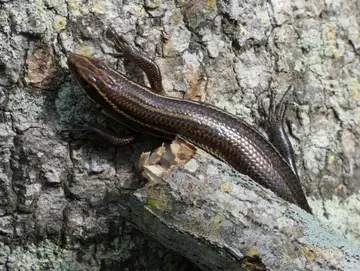
Habitat: Found in a variety of wooded habitats, but generally prefers drier sites than similar species. Often seen on fallen trees, limbs, stumps, logs, fences, and rock piles; will occasionally climb trees when threatened. (Tennessee Wildlife Resources Agency)
NCWRC: broadhead skinks reach a much larger size. ODWC: juveniles can be told apart by counting the upper lip scales (five-lined: seven, with two post-labials; broad-headed: nine, with no post-labials).
Common Five-lined Skink or Southeastern Five-lined Skink?
Tennessee: the southeastern five-lined skink does not have an enlarged middle row of scales under the tail; positive identification requires examining the scales. Tennessee Wildlife Resources Agency
Photos show typical adults; individuals vary. Never get close to compare.
When lizards are active in Tennessee
Records of lizards in Tennessee peak in March to May and August. They show when people record lizards, not how many there are (about month bars).
JanFebMarAprMayJunJulAugSepOctNovDec
550 records of lizards in Tennessee by month (GBIF, CC0 and CC BY records).
How to report
TWRA "Report Wildlife Encounters, Incidents, or Illness" page (https://www.tn.gov/twra/wildlife/report-wildlife.html): bear conflicts (800) 831-1174; online forms for bear sightings, sick deer, and dead or sick birds. Rare birds: [email protected] (2013 checklist). Aquatic invasive species: TWRA directs people to its Invasive Fish Species page. Tennessee Wildlife Resources Agency
What official sources say
Are there venomous lizards in Tennessee?
Southeastern Five-lined Skink account: "Both the five-lined skinks are mistakenly thought to be venomous." Tennessee Wildlife Resources Agency
“Both the five-lined skinks are mistakenly thought to be venomous.”
“Both the five-lined skinks are mistakenly thought to be venomous.”
“Southeastern Five-lined Skinks do not have enlarged middle row of scales under the tail”
Wildlife Species in Tennessee. Tennessee Wildlife Resources Agency. archived copy, captured August 11, 2026; checked November 3, 2026.Quoted passages (1)
“Wildlife Species in Tennessee … Currently, there are more than 325 species of fish, 89 mammals, 61 reptiles, 70 amphibians, and 340+ birds known to inhabit or migrate through Tennessee.”