This page lists 4 spiders.
3 are venomous by official accounts. 1 is nonnative.
Not every species: no complete official list of Tennessee spiders exists, so this page covers the ones state and Extension sources name. How lists are built.
Which spiders can hurt you
Official sources single out these spiders in Tennessee, in their own words:
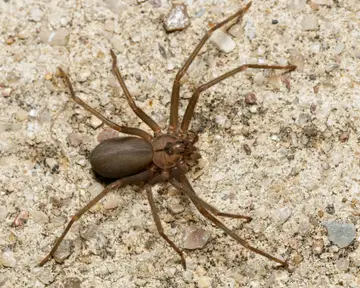
Body about 7 to 12 mm (about 3/8 inch); females average about 9 mm and males about 8 mm. UC IPM says a recluse body is not more than 3/8 inch long.
How to recognize it
Six equal-sized eyes in three pairs. UC IPM calls this the most definitive feature, since most spiders have eight eyes.
The violin mark alone is not a reliable way to identify it
UC IPM's five-point check: six eyes in pairs, evenly colored finely haired abdomen, no spines on the legs, evenly colored legs, body no more than 3/8 inch
Where in Tennessee
The brown recluse spider is found in every county in Tennessee with the possible exception of a few extreme eastern counties. University of Tennessee Extension
JFMAMJJASOND
35 records by month.What the sources say
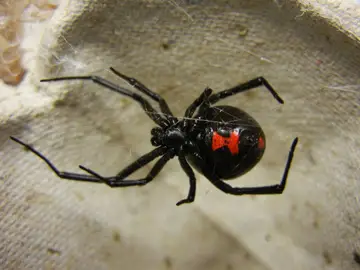
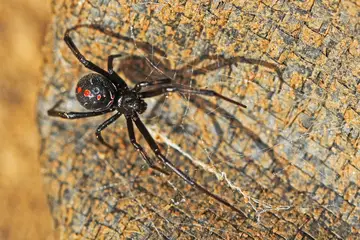
Venom: “Tennessee is home to many species of spiders; however, only two are venomous - the black widow and the brown recluse. Both species are found in every Tennessee county.” (Tennessee Poison Center (Vanderbilt University Medical Center), Tennessee's poison-control program)
Habitat: Brown recluse spiders prefer sheltered areas with low moisture levels. In homes, they tend to prefer darkened storage areas in closets, garages, basements, attics and cupboards. (University of Tennessee Extension)
No official source we use states whether this animal is venomous. That does not mean it is harmless: do not handle it.
Size
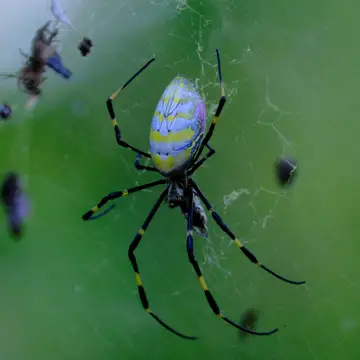
Adult female body 0.67-1.2 in (17-30 mm); legs up to 3 in long, a leg span of 3-4 in. Males are much smaller, 0.16-0.31 in (4-8 mm).
How to recognize it
Golden-yellow silk in very large webs, often high up between the tops of large trees; also on power lines (N.C. Extension, Henderson County)
Adult webs have no zigzag (stabilimentum); garden spiders often have one
One or more tiny brown males often sit in the female's web
Where in Tennessee
In Tennessee, the first two counties where Jorō spiders were found were Hamilton and Bradley counties in October 2021. University of Tennessee Extension
TWRA "Report Wildlife Encounters, Incidents, or Illness" page (https://www.tn.gov/twra/wildlife/report-wildlife.html): bear conflicts (800) 831-1174; online forms for bear sightings, sick deer, and dead or sick birds. Rare birds: [email protected] (2013 checklist). Aquatic invasive species: TWRA directs people to its Invasive Fish Species page. Tennessee Wildlife Resources Agency
Yes. The brown recluse spider is found in every county in Tennessee with the possible exception of a few extreme eastern counties. University of Tennessee Extension
“The brown recluse spider is found in every county in Tennessee with the possible exception of a few extreme eastern counties.”
Are there black widows in Tennessee?
Yes. Both the northern and the southern black widows are found in Tennessee, with the southern species being most common. University of Tennessee Extension
“Both the northern and the southern black widows are found in Tennessee, with the southern species being most common.”
About this list
Venom labels come only from official sources and link to them; "Not stated" never means harmless. How labels work.
PB1191 The Brown Recluse Spider. University of Tennessee Extension (UT Institute of Agriculture). PB1191-500-7/02 [July 2002 reprint]; checked November 3, 2026.Quoted passages (1)
“The brown recluse spider is found in every county in Tennessee with the possible exception of a few extreme eastern counties.”
Bites & Stings | Tennessee Poison Center. Tennessee Poison Center (Vanderbilt University Medical Center), Tennessee's poison-control program. undated page; checked November 3, 2026.Quoted passages (4)
“Tennessee is home to many species of spiders; however, only two are venomous - the black widow and the brown recluse. Both species are found in every Tennessee county.”
“FREE 24/7 Poison Help Hotline 800.222.1222”
“Shake clothing and shoes before wearing”
“Since most brown recluse spiders hibernate in the winter (except for those that live indoors), most bites occur between March and October when humans accidentally disturb their habitat: closets, out-buildings or woodpiles.”
PB1193 The Black Widow Spider. University of Tennessee Extension (UT Institute of Agriculture). PB1193-500-7/02 [July 2002 revision]; checked November 3, 2026.Quoted passages (2)
“Although both male and female black widow spiders are highly venomous [PB1193];”
“Both the northern and the southern black widows are found in Tennessee, with the southern species being most common.”
W1415 Jorō Spider. University of Tennessee Extension (UT Institute of Agriculture). W1415 08/26 [August 2026]; checked November 3, 2026.