Tennessee Wildlife Resources Agency: Wildlife Species in Tennessee … Currently, there are more than 325 species of fish, 89 mammals, 61 reptiles, 70 amphibians, and 340+ birds known to inhabit or migrate through Tennessee.
This page lists 21 species: all from Tennessee Wildlife Resources Agency's Amphibians » Frogs and Toads.
Which frogs and toads can hurt you
Official sources single out these frogs and toads in Tennessee, in their own words:
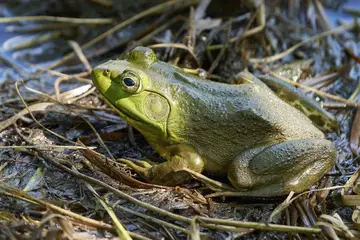
Photo: U.S. Fish and Wildlife Service - Midwest Region · Public domain · Wikimedia Commons
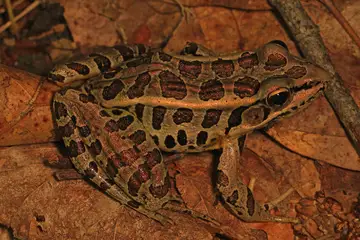
Toxic skin secretions irritating to humans, deadly to small animals. “One of the few poisonous frogs found in the U.S., Pickerel Frogs produce toxic skin secretions that can be irritating to humans and deadly to small animals” Tennessee Wildlife Resources Agency
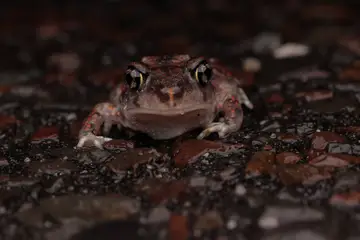
Skin toxins harmful on contact with eyes, nose or mouth. “Like many toads, Eastern spadefoots secret toxins from their skin which can be harmful if they come into contact with the eyes, nose or mouth” Tennessee Wildlife Resources Agency
No official source we use states whether this animal is venomous. That does not mean it is harmless: do not handle it.
Size
Usually 6 to 8 inches long (NCWRC); can reach 8 inches or more and weigh over 2 pounds (CDFW). Missouri gives 3.5 to 6 inches snout to vent, occasionally to 8.75.
How to recognize it
No ridge (dorsolateral fold) down each side of the back
Large round eardrum: about twice the eye in males, about eye-sized in females
Fully webbed hind feet, longest toe extends past the webbing
Where in Tennessee
The largest native frog in the United States, the American Bullfrog is common across Tennessee in permanent bodies of water … Tennessee Wildlife Resources Agency
JFMAMJJASOND
75 records by month.What the sources say
Range: The largest native frog in the United States, the American Bullfrog is common across Tennessee in permanent bodies of water. In the frog and toad chorus, this species sings the deep bass parts, its call a sound heard often in the warmer months.
Habitat: American bullfrogs live in medium to large permanent bodies of water (lakes or ponds) throughout Tennessee. (Tennessee Wildlife Resources Agency)
2 to 3.5 inches long (NCWRC: up to 4 inches); females are larger than males.
How to recognize it
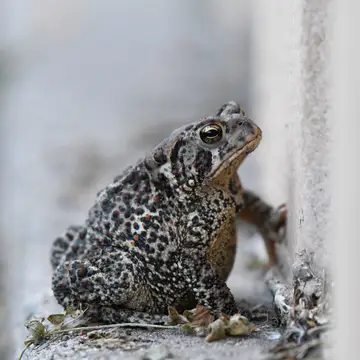
Dark spots on the back hold only a few large warts; the similar Fowler's toad has three or more. Agencies give different counts for the American toad (TWRA: one or two; Ohio DNR: one, two or three; Georgia DNR: usually no more than one), so wart count alone does not settle it; check the head crests too (see lookalikes).
A large, kidney- or bean-shaped parotoid gland behind each eye that usually does not touch the bony ridge (cranial crest) above the eye, or touches it only by a short spur.
Enlarged warts on the lower leg.
Where in Tennessee
Often seen in backyards, gardens and fields, the American toad is a common and adaptable species found all across the state, limited only by access to water for breeding … Tennessee Wildlife Resources Agency
JFMAMJJASOND
172 records by month.What the sources say
Range: Often seen in backyards, gardens and fields, the American toad is a common and adaptable species found all across the state, limited only by access to water for breeding. Solitary and mainly nocturnal, they are most active during warm, humid weather.
Habitat: As long as they have access to water for breeding and cover for hiding during the day, American toads are found in a variety of habitats. They readily adapt to human encroachment. (Tennessee Wildlife Resources Agency)
No official source we use states whether this animal is venomous. That does not mean it is harmless: do not handle it.
Where in Tennessee
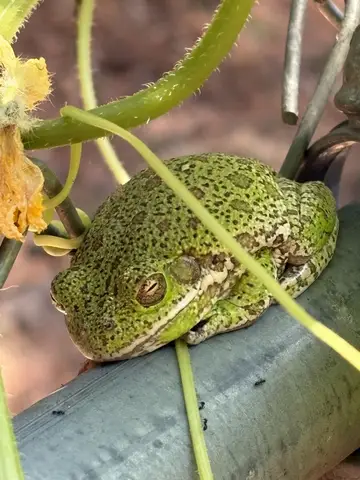
Large and colorful, the Barking Treefrog, which gets its name from its doglike call, is primarily a species of the southern Coastal Plain but it occurs in several parts … Tennessee Wildlife Resources Agency
What the sources say
Range: Large and colorful, the Barking Treefrog, which gets its name from its doglike call, is primarily a species of the southern Coastal Plain but it occurs in several parts of Tennessee.
Habitat: Found in wet woodlands, shallow ponds, and cypress swamps, Barking Treefrogs are both climbers and burrowers, and will use habitat between those two extremes. During hot, dry weather they often take refuge by burrowing into sand or by hiding underneath vegetation. (Tennessee Wildlife Resources Agency)
No confirmed photo of Bird-voiced Treefrog
Bird-voiced Treefrog
Hyla avivoca
Not stated
Venom
No official source we use states whether this animal is venomous. That does not mean it is harmless: do not handle it.
Where in Tennessee
A medium-sized treefrog, the Bird-voiced Treefog is found in swamps, creeks and rivers in the western part of the state. Tennessee Wildlife Resources Agency
What the sources say
Habitat: The Bird-voiced Treefrog is found in bottoms, sloughs and swamps along rivers and large creeks in the western portion of the state. (Tennessee Wildlife Resources Agency)
No confirmed photo of Cope's Gray Treefrog
Cope's Gray Treefrog
Hyla chrysoscelis
Not stated
Venom
No official source we use states whether this animal is venomous. That does not mean it is harmless: do not handle it.
Where in Tennessee
A medium-sized, tree-dwelling frog, Cope's Gray Treefrog is heard more often than seen as it spends much of its time in the tops of trees all across Tennessee. Tennessee Wildlife Resources Agency
What the sources say
Habitat: This species occurs in a variety of habitats. During breeding season they can be found in small bodies of water including swimming pools and rain barrels. Outside of the breeding season they are found in the canopies of trees. (Tennessee Wildlife Resources Agency)
No official source we use states whether this animal is venomous. That does not mean it is harmless: do not handle it.
Where in Tennessee
A resident of the Coastal Plain of western Tennessee, the Crawfish Frog is a shy, secretive and nocturnal species that is not often seen or heard. Tennessee Wildlife Resources Agency
What the sources say
Habitat: Crawfish frogs are normally found in lowland woods, river floodplains and wetland prairies in western Tennessee. They remain underground in the burrows of other animals, often those of crayfish, during the day. (Tennessee Wildlife Resources Agency)
No confirmed photo of Eastern Narrow-mouthed Toad
Eastern Narrow-mouthed Toad
Gastrophryne carolinensis
Not stated
Venom
No official source we use states whether this animal is venomous. That does not mean it is harmless: do not handle it.
JFMAMJJASOND
74 records by month.What the sources say
Habitat: They are found statewide, except in the Blue Ridge Mountains, often under rocks, logs or in underground in burrows and old sawdust piles, in a variety of habitats including old fields and cedar glades. (Tennessee Wildlife Resources Agency)
No official source we use states whether this animal is venomous. That does not mean it is harmless: do not handle it.
Danger to people
“Like many toads, Eastern spadefoots secret toxins from their skin which can be harmful if they come into contact with the eyes, nose or mouth” Tennessee Wildlife Resources Agency
Where in Tennessee
Named for the spade-like protuberance on their hind feet that they use for digging, the Eastern spadefoot is found all across the state except in the Blue Ridge … Tennessee Wildlife Resources Agency
What the sources say
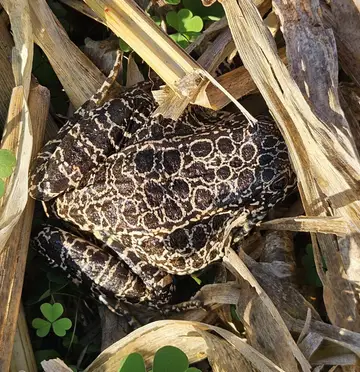
Range: Named for the spade-like protuberance on their hind feet that they use for digging, the Eastern spadefoot is found all across the state except in the Blue Ridge Mountains. It is the only spadefoot that appears east of the Mississippi River.
Habitat: It has a preference for forested areas with loose or sandy soil. (Tennessee Wildlife Resources Agency)
No official source we use states whether this animal is venomous. That does not mean it is harmless: do not handle it.
Where in Tennessee
Known only from two records near Tullahoma in Coffee County, the Gopher Frog is unlikely to be seen in Tennessee. Tennessee Wildlife Resources Agency
What the sources say
Habitat: The Gopher Frog is found in wooded areas where it spends the daylight hours underground in the burrows of other animals. (Tennessee Wildlife Resources Agency)
No official source we use states whether this animal is venomous. That does not mean it is harmless: do not handle it.
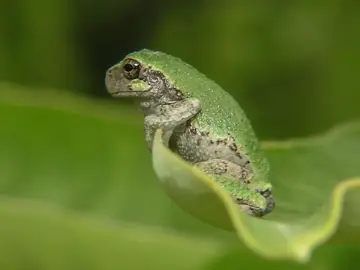
Size
Small: body usually 1¼ to 2½ inches long (snout to vent); Tennessee gives 1.25 to 2 inches.
How to recognize it
Large white or gray spot below each eye
Warty (granular) skin and sticky pads on fingers and toes
Bright orange or golden yellow on the underside of each hind leg, shown as a flash color
What the sources say
Habitat: Gray Treefrogs inhabit all elevations of wooded areas near temporary and permanent waters in a wide variety of habitat including swamps, ponds, lakes, old fields, thickly wooded suburban neighborhoods, farm woodlots, and mixed or deciduous forests. During the summer months, they are most often found in damp rotten logs or hollow trees. However, they are rarely seen outside of the breeding season as they forage in the canopy. (Tennessee Wildlife Resources Agency)
No official source we use states whether this animal is venomous. That does not mean it is harmless: do not handle it.
Where in Tennessee
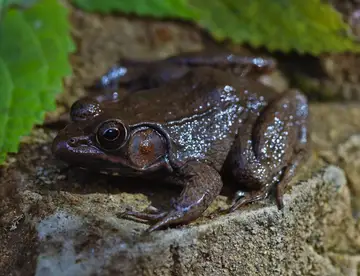
Similar in appearance to the larger American Bullfrog, the Green Frog is a handsome species that occurs throughout Tennessee. Tennessee Wildlife Resources Agency
JFMAMJJASOND
209 records by month.What the sources say
Habitat: Green Frogs live in semi-permanent to permanent shallow bodies of water (lakes, ponds, streams or ditches) across Tennessee. (Tennessee Wildlife Resources Agency)
No official source we use states whether this animal is venomous. That does not mean it is harmless: do not handle it.
Size
Adults reach about 2.5 inches: USGS gives 1.25 to 2.5 inches snout to vent. Virginia DWR says up to 2 inches.
How to recognize it
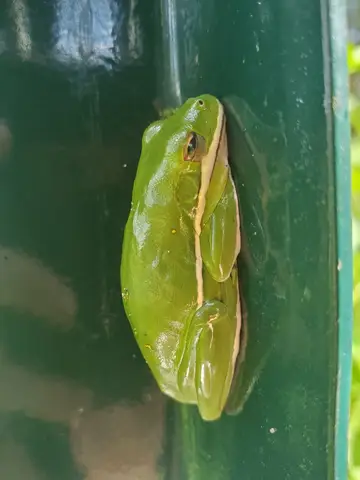
Smooth skin
Prominent toe pads
Loud nasal call, like cowbells from a distance
Where in Tennessee
One of the most attractive of Tennessee's frogs, the Green Treefrog is a sleek, long-legged inhabitant of cypress swamps and marshes in the western portion of the state. Tennessee Wildlife Resources Agency
JFMAMJJASOND
176 records by month.What the sources say
Habitat: These frogs are found in forested areas and swamps in western Tennessee that have abundant vegetation surrounding the shoreline. (Tennessee Wildlife Resources Agency)
No official source we use states whether this animal is venomous. That does not mean it is harmless: do not handle it.
What the sources say
Habitat: This species is found at higher elevations in the Cumberland Plateau and the eastern mountains, chiefly on hilltops and forested slopes, and often far away from water. They breed in ditches, pools along streams and even in tire ruts along gravel roads in the mountains. (Tennessee Wildlife Resources Agency)
No confirmed photo of Northern Cricket Frog
Northern Cricket Frog
Acris crepitans
Not stated
Venom
No official source we use states whether this animal is venomous. That does not mean it is harmless: do not handle it.
Where in Tennessee
A small frog found near ponds, lakes and slow moving streams, the Northern Cricket Frog is widespread in Tennessee, occurring statewide except in the highest parts of … Tennessee Wildlife Resources Agency
JFMAMJJASOND
139 records by month.What the sources say
Range: A small frog found near ponds, lakes and slow moving streams, the Northern Cricket Frog is widespread in Tennessee, occurring statewide except in the highest parts of the eastern mountains.
Habitat: The Northern Cricket Frog prefers the edges of ponds and streams with submerged or emergent vegetation. (Tennessee Wildlife Resources Agency)
No official source we use states whether this animal is venomous. That does not mean it is harmless: do not handle it.
Danger to people
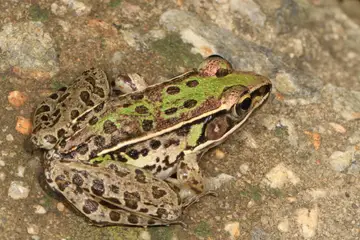
“One of the few poisonous frogs found in the U.S., Pickerel Frogs produce toxic skin secretions that can be irritating to humans and deadly to small animals” Tennessee Wildlife Resources Agency
Size
About 1.75 to 3 inches long; large females reach about 3.5 inches. Males are smaller than females.
How to recognize it
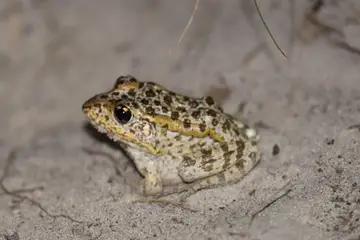
Two rows of square or rectangular dark spots down the back between two light ridges (dorsolateral folds); spots sometimes merge into bars
Bright yellow or orange on the hidden inner surfaces of the hind legs and groin
No white spot on the eardrum (tympanum), unlike the southern leopard frog
JFMAMJJASOND
60 records by month.What the sources say
Habitat: Pickerel Frogs typically inhabit cool wooded streams and can be found in creeks, springs, ponds and reservoirs. However, they often wander into grassy fields and weedy areas during the summer. (Tennessee Wildlife Resources Agency)
Habitat: The Southern Cricket Frog is found in southwest Tennessee near semi-permanent bodies of water including shallow ponds with vegetation, meadows, creeks, and roadside ditches. (Tennessee Wildlife Resources Agency)
No official source we use states whether this animal is venomous. That does not mean it is harmless: do not handle it.
What the sources say
Habitat: Most often found at the edges of farm ponds, creeks, reservoirs, swamps and sloughs. In the summer the Southern Leopard Frog disperse from the water and can be seen leaping through tall grasses in moist areas. (Tennessee Wildlife Resources Agency)
No official source we use states whether this animal is venomous. That does not mean it is harmless: do not handle it.
Size
Adults 3/4 to 1 1/4 inches snout to vent, occasionally to 1 1/2 inches; males are smaller than females.
How to recognize it
Clear, high-pitched peep about once per second; a chorus can sound like small jingle bells
Adhesive pads on the tips of fingers and toes
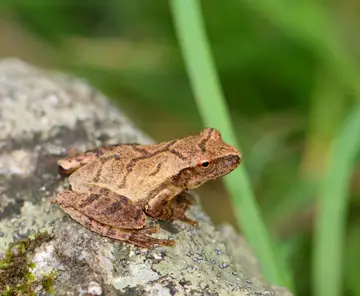
Some individuals have little to no markings
Where in Tennessee
Common and widespread both in Tennessee and the eastern United States and Canada, the little Spring Peeper-and its call-is familiar and beloved to many. Tennessee Wildlife Resources Agency
JFMAMJJASOND
62 records by month.What the sources say
Habitat: Spring Peepers are found in wooded or brushy areas close to temporary or semi-permanent bodies of water in all parts of Tennessee. Although they are good climbers, they appear to prefer to be on the ground or in leaf litter. (Tennessee Wildlife Resources Agency)
No official source we use states whether this animal is venomous. That does not mean it is harmless: do not handle it.
What the sources say
Habitat: Upland Chorus Frogs are found in swampy areas of broad valleys, grassy swales, moist woodlands, and around heavily vegetated ponds. They are present across the state except in the highest elevations of the eastern mountains. (Tennessee Wildlife Resources Agency)
No confirmed photo of Wood Frog
Wood Frog
Lithobates sylvatica
Not stated
Venom
No official source we use states whether this animal is venomous. That does not mean it is harmless: do not handle it.
Where in Tennessee
A frog of the eastern and north central portion of Tennessee, the Wood Frog is one of the earliest breeders, and the first frog to begin calling, often beginning before … Tennessee Wildlife Resources Agency
What the sources say
Range: A frog of the eastern and north central portion of Tennessee, the Wood Frog is one of the earliest breeders, and the first frog to begin calling, often beginning before ice has completely left its breeding ponds.
Habitat: Wood frogs are found in moist woodlands in eastern to north central Tennessee. Breeding may take place in open water ponds to roadside ditches. (Tennessee Wildlife Resources Agency)
Frogs and Toads people confuse
American toad or Fowler's toad?
Photo: U.S. Fish and Wildlife Service - Midwest Region · Public domain · Wikimedia Commons
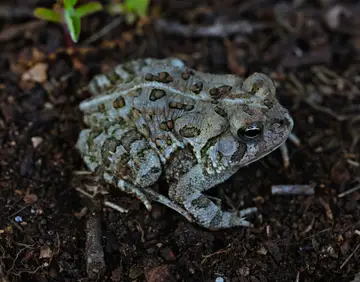
The difference official sources agree on is at the head: in the American toad the ridge (cranial crest) behind each eye is separate from the parotoid gland or joined to it only by a short spur; in Fowler's toad the two touch. Fowler's toad also has three or more warts in each of the larger dark spots, while the American toad has fewer (TWRA: one or two; Ohio DNR: one, two or three; Georgia DNR: usually no more than one). Fowler's toad has a whitish belly, often with a single dark spot on the chest; the American toad's belly is peppered with dark spots. The two can hybridize, so some toads cannot be told apart. Tennessee Wildlife Resources Agency
The difference official sources agree on is at the head: in the American toad the ridge (cranial crest) behind each eye is separate from the parotoid gland or joined to it only by a short spur; in Fowler's toad the two touch. Fowler's toad also has three or more warts in each of the larger dark spots, while the American toad has fewer (TWRA: one or two; Ohio DNR: one, two or three; Georgia DNR: usually no more than one). Fowler's toad has a whitish belly, often with a single dark spot on the chest; the American toad's belly is peppered with dark spots. The two can hybridize, and hybrids have intermediate features. Tennessee Wildlife Resources Agency
Missouri Department of Conservation calls both gray treefrogs gray, unlike the green treefrog, but its gray treefrog account says their color may be green to light greenish gray, gray, brown or dark brown, so color alone does not settle it. MDC: gray treefrogs have warty (granular) skin; the green treefrog's back is smooth and a light stripe runs from its upper lip down the side of the body.
Ohio: two dark, curved stripes on the back like reversed parentheses, which on some frogs form a crude X or H (so it is easily confused with the spring peeper); it usually has a dark triangle between the eyes and a white line on the upper lip.
Photos show typical adults; individuals vary. Never get close to compare.
When frogs and toads are active in Tennessee
Records of frogs and toads in Tennessee peak in March and May to August. They show when people record frogs and toads, not how many there are (about month bars).
JanFebMarAprMayJunJulAugSepOctNovDec
1,612 records of frogs and toads in Tennessee by month (GBIF, CC0 and CC BY records).
If you are bitten or stung
Call 911 or Poison Help at 1-800-222-1222 right away. Poison Help connects you to your local poison center, any time of day.
How to report
TWRA "Report Wildlife Encounters, Incidents, or Illness" page (https://www.tn.gov/twra/wildlife/report-wildlife.html): bear conflicts (800) 831-1174; online forms for bear sightings, sick deer, and dead or sick birds. Rare birds: [email protected] (2013 checklist). Aquatic invasive species: TWRA directs people to its Invasive Fish Species page. Tennessee Wildlife Resources Agency
“Like many toads, Eastern spadefoots secret toxins from their skin which can be harmful if they come into contact with the eyes, nose or mouth”
“…the American toad has 1 or 2 warts in each of the largest spots on its back-the similar Fowler's toad has 3 or more.”
“Like many toads, the American toad produces a milky poison from its skin.”
“The American toad is 2 to 3.5 inches long, has short legs, a stout body and thick warty skin.”
“Distinguished from the American toad by the lack of space between the cranial crests and the parotoid glands.”
“Like many toads, the Fowler’s toad produces a toxin from its skin.”
“Fowler's toads are 2 to 3 inches long.”
“Similar Species: Southern Leopard Frogs have a white spot in the tympanum (eardrum) that Pickerel Frogs lack.”
“One of the few poisonous frogs found in the U.S., Pickerel Frogs produce toxic skin secretions that can be irritating to humans and deadly to small animals”
“Among the most attractive of Tennessee's frogs, Pickerel Frogs are typically 1.75 to 3 inches long.”
“Distinguished from the Fowler's toad by the space between the cranial crest and the parotoid glands; these features abut in the Fowler's toad.”
Wildlife Species in Tennessee. Tennessee Wildlife Resources Agency. archived copy, captured August 11, 2026; checked November 3, 2026.Quoted passages (1)
“Wildlife Species in Tennessee … Currently, there are more than 325 species of fish, 89 mammals, 61 reptiles, 70 amphibians, and 340+ birds known to inhabit or migrate through Tennessee.”