Green Treefrog
Dryophytes cinereus · also called Green Tree Frog, rain frog and cowbell frog · Last checked November 3, 2026.
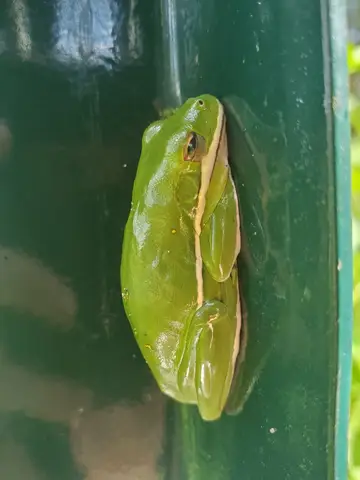
The green treefrog is a slender, smooth-skinned frog of the southeastern US, usually bright green with a white or pale yellow stripe along the side, reaching about 2.5 inches. No official source checked says whether it is venomous or poisonous; CDC says amphibians often carry Salmonella even when healthy. USGS lists it as native from Delaware to Florida and west to eastern Texas and southeastern Oklahoma, and it has been introduced to areas beyond that range. USGS Nonindigenous Aquatic Species Database
On this page
Is the green treefrog dangerous?
No official source checked gives a danger statement specific to this frog. CDC, for all reptiles and amphibians: they often carry Salmonella, even when healthy. Centers for Disease Control and Prevention
“Reptiles and amphibians often carry Salmonella bacteria in their digestive tracts. Even healthy reptiles and amphibians can carry the bacteria.”
No official source we use states whether this animal is venomous. That does not mean it is harmless: do not handle it.
How to identify a green treefrog
A photo or description can narrow it down, but cannot confirm what an animal is or that it is safe. Look from a distance and do not handle wild animals.
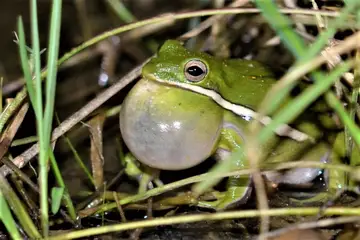
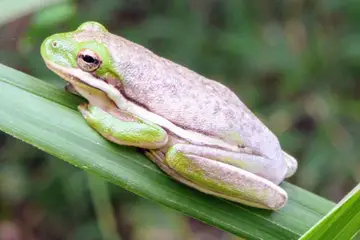
Size: Adults reach about 2.5 inches: USGS gives 1.25 to 2.5 inches snout to vent. Virginia DWR says up to 2 inches. USGS Nonindigenous Aquatic Species Database
Colors: Light to dark green; USGS also records nearly yellow or dull greenish or slate gray; white or yellow belly. Pattern: White or pale yellow side stripe, varying in length and sometimes absent; tiny gold specks on the back in many individuals.
Key features
- Smooth skin Missouri Department of Conservation
- Prominent toe pads Virginia Department of Wildlife Resources
- Loud nasal call, like cowbells from a distance N.C. Wildlife Resources Commission
Animals mistaken for the green treefrog
Green Treefrog or Cuban Treefrog?
Green Treefrog
Cuban Treefrog Osteopilus septentrionalis
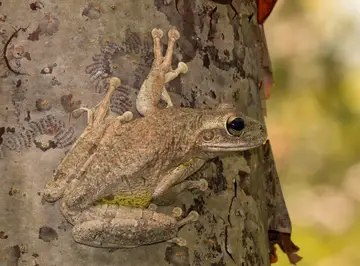

Florida Museum: the invasive Cuban treefrog is larger, with larger toe pads and irregularly bumpy skin. UF/IFAS: any treefrog in Florida longer than 3 inches is almost certainly a Cuban treefrog. Florida Museum of Natural History
UF/IFAS: Cuban treefrog secretions are extremely irritating to mucous membranes, causing burning and itching of the eyes and nose. In Florida, do not assume a treefrog is a green treefrog.
Green Treefrog or Barking Treefrog?
Green Treefrog
Barking Treefrog Dryophytes gratiosus
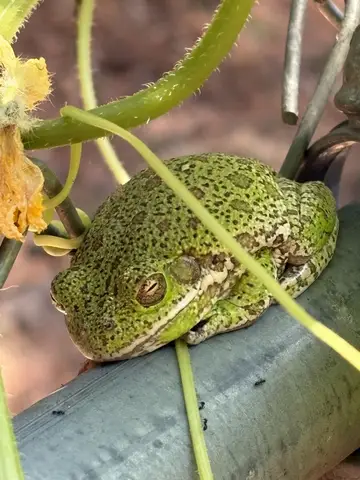
USGS: unlike the barking treefrog, the green treefrog's skin is not granular. USGS Nonindigenous Aquatic Species Database
Green Treefrog or Gray Treefrog and Cope's Gray Treefrog?
Green Treefrog
Gray Treefrog and Cope's Gray Treefrog Dryophytes versicolor; D. chrysoscelis
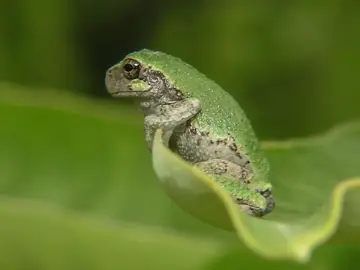
Missouri Department of Conservation calls both gray treefrogs gray, unlike the green treefrog, but its gray treefrog account says their color may be green to light greenish gray, gray, brown or dark brown, so color alone does not settle it. MDC: gray treefrogs have warty (granular) skin; the green treefrog's back is smooth and a light stripe runs from its upper lip down the side of the body. Missouri Department of Conservation
SREL (UGA): skin secretions of Cope's gray treefrog contain toxins that may irritate eyes, lips, mucous membranes and open cuts; see its page.
Where the green treefrog lives
- Native or listed
- Nonnative or not established
- No official record in our data
- 1–9
- 10–99
- 100–999
- 1,000+
On our state guides
- Alabama frogs and toads
- Arkansas frogs and toads
- Delaware frogs and toads
- Florida frogs and toads
- Georgia frogs and toads
- Illinois frogs and toads
- Indiana frogs and toads
- Iowa frogs and toads
- Kentucky frogs and toads
- Louisiana frogs and toads
- Maryland frogs and toads
- Mississippi frogs and toads
- Missouri frogs and toads
- New Jersey frogs and toads
- North Carolina frogs and toads
- Oklahoma frogs and toads
- South Carolina frogs and toads
- Tennessee frogs and toads
- Texas frogs and toads
- Virginia frogs and toads
State boundaries: U.S. Census Bureau, cartographic boundary file cb_2024_us_state_20m.
When it is active
Mainly at night. Breeding season varies by state: April to August in Alabama and Virginia, March to October per SREL, mid-April to early August for Missouri choruses. University of Georgia Savannah River Ecology Laboratory
US open-licence records peak in April to May and July to September.
Habitat and habits
Habitat: Vegetated areas near permanent water: cattail marshes, cypress swamps, pond banks, river sloughs and oxbows. Also around buildings, porches, gutters and pipes. Missouri Department of Conservation
Behavior: Shy and nocturnal; rests among green plants by day and often gathers at porch lights at night to eat insects.
Diet: Insects, especially flies, moths, crickets, grasshoppers, ants and beetles.
Young: Breeds in permanent water with emergent vegetation. A female may lay multiple clutches of up to 1,000 eggs each in Virginia.
Legal status and reporting
Federal: Not listed under the Endangered Species Act: the ECOS query for Hyla and Dryophytes returned no record for this species. ECOS
Protection: North Carolina: a nongame species with no open season; taking or possessing requires a collection license unless within NCWRC's stated limit. Rules differ by state. N.C. Wildlife Resources Commission
Invasive status: Native in most of its range. USGS tracks it as a native transplant outside that range and says it had no impact where not established. USGS Nonindigenous Aquatic Species Database
Questions about the green treefrog
Green tree frog
The green treefrog is a slender southeastern frog, usually bright green with a white or pale yellow stripe along the side and smooth skin, up to about 2.5 inches long.
Missouri tree frogs poisonous
No official source checked says whether Missouri's green treefrog is poisonous. Missouri Department of Conservation describes a mucous layer from a skin gland that reduces water loss, and CDC says amphibians often carry Salmonella.
Kentucky tree frogs poisonous
No official source checked says whether the green treefrog, which USGS lists as native in western Kentucky, is poisonous. CDC says amphibians often carry Salmonella.
Georgia tree frogs
The green treefrog is one of them. Georgia DNR's frog notes call it Georgia's state amphibian and describe a nasally, duck-like call.
Alabama tree frogs
The green treefrog lives in Alabama. Outdoor Alabama says its distribution there is essentially statewide.
Virginia tree frogs
Virginia DWR says the green treefrog primarily occurs in the Coastal Plain, with scattered records in the Piedmont and introduced populations in Pulaski and Craig counties.
North carolina tree frogs
NCWRC says the green treefrog is found primarily in the Coastal Plain, and its range is expanding into many parts of the Piedmont.
Tennessee tree frogs
TWRA describes the green treefrog as an inhabitant of cypress swamps and marshes in the western part of the state.
Missouri tree frogs
Missouri Department of Conservation says the green treefrog occurs mainly in the southeastern corner of the state, with several isolated populations elsewhere.
Sources
- Green Treefrog (Dryophytes cinereus) - Species Profile. USGS Nonindigenous Aquatic Species Database. Revision date 5/3/2018; checked November 3, 2026.
Quoted passages (3)
“…a SVL (snout-vent length) of 32-64 mm (1.25-2.5 in)”
“Green treefrogs have had no impact on those areas in which they were not established (Massachusetts), or temporarily established (Kansas and Tulsa, Oklahoma).”
“Unlike Dryophytes gratiosus, the barking treefrog, the skin is not granular”
- Green Treefrog (MDC Field Guide). Missouri Department of Conservation. undated page; checked November 3, 2026.
Quoted passages (3)
“The back is smooth and may have a few small gold spots.”
“Green treefrogs generally live in vegetative areas near permanent bodies of water, especially cattail marshes, cypress swamps, pond banks, or river sloughs and oxbows.”
“…green treefrogs climb among vegetation in search of insects, especially flies, moths, crickets, grasshoppers, ants, and beetles.”
- Reptiles and Amphibians (Healthy Pets, Healthy People). Centers for Disease Control and Prevention. archived copy, captured October 10, 2026; checked November 3, 2026.
Quoted passages (1)
“Reptiles and amphibians often carry Salmonella bacteria in their digestive tracts. Even healthy reptiles and amphibians can carry the bacteria.”
- Green Treefrog (Virginia DWR species profile). Virginia Department of Wildlife Resources. updated August 14, 2024; checked November 3, 2026.
Quoted passages (1)
“Toe pads are prominent.”
- Green Treefrog (NCWRC species page). N.C. Wildlife Resources Commission. undated page; checked November 3, 2026.
Quoted passages (2)
“From a distance, large congregations of green treefrogs sound like cowbells ringing.”
“The green treefrog is classified as a nongame species with no open season.”
- Green Treefrog (Hyla cinerea). University of Georgia Savannah River Ecology Laboratory (linked by SCDNR as its species information). undated page; checked November 3, 2026.
Quoted passages (1)
“Primarily nocturnal. During the breeding season (March–October), males call from emergent vegetation”
- USFWS ECOS species report: Scientific Name like 'Hyla%' or 'Dryophytes%' (ESA listing status). U.S. Fish and Wildlife Service (ECOS). database queried November 3, 2026; checked November 3, 2026.
- Green Treefrog (Florida Frog Calls). Florida Museum of Natural History. updated November 30, 2020; checked November 3, 2026.
Quoted passages (1)
“This frog look similar to the invasive Cuban treefrog which is larger, and has larger toe pads and irregularly bumpy skin.”
- Gray Treefrog and Cope's Gray Treefrog (MDC Field Guide). Missouri Department of Conservation. undated page; checked November 3, 2026.
Quoted passages (1)
“The color may be green to light greenish gray, gray, brown, or dark brown.”
- Froggin' by Ear notes (Linda May, Urban Wildlife Outreach Coordinator, Georgia DNR). Georgia DNR (hosted by Georgia Adopt-A-Stream, Georgia EPD). undated page; checked November 3, 2026.
- Green Treefrog. Alabama Department of Conservation and Natural Resources (Outdoor Alabama). undated page; checked November 3, 2026.
- Green Treefrog (Tennessee Watchable Wildlife species account). Tennessee Wildlife Resources Agency (Tennessee Watchable Wildlife website). undated page; checked November 3, 2026.
- GBIF.org occurrence records, human observations licensed CC0 1.0 or CC BY 4.0 only, accessed November 3, 2026. The datasets behind these counts are listed on our Sources page.
- State boundaries: U.S. Census Bureau, cartographic boundary file cb_2024_us_state_20m.