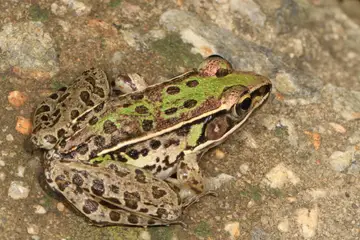
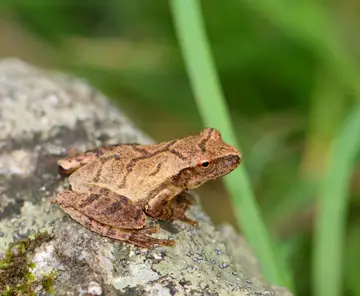
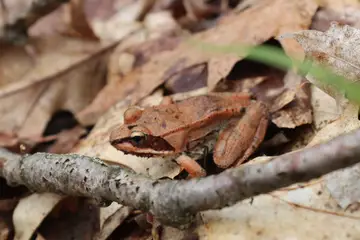
KDFWR: Our 23 species of frogs and their relatives are classified into five different major groups, or families, each differing in several ways from the others.
No official source we use states whether this animal is venomous. That does not mean it is harmless: do not handle it.
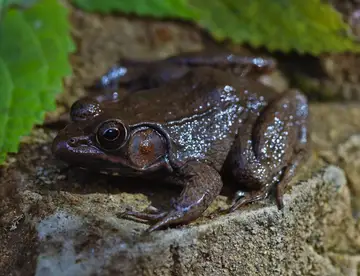
Size
Usually 6 to 8 inches long (NCWRC); can reach 8 inches or more and weigh over 2 pounds (CDFW). Missouri gives 3.5 to 6 inches snout to vent, occasionally to 8.75.
How to recognize it
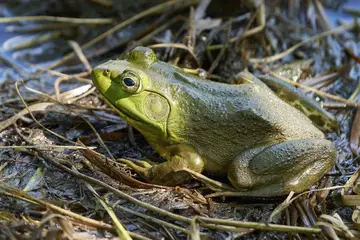
No ridge (dorsolateral fold) down each side of the back
Large round eardrum: about twice the eye in males, about eye-sized in females
Fully webbed hind feet, longest toe extends past the webbing
Where in Kentucky
American Bullfrogs occur in every Kentucky county and are always found close to permanent water. KDFWR
JFMAMJJASOND
83 records by month.What the sources say
Habitat: Favored habitats include large ponds, lakes, swamps, wetlands, and slow-moving sections of rivers and streams. (KDFWR)
No official source we use states whether this animal is venomous. That does not mean it is harmless: do not handle it.
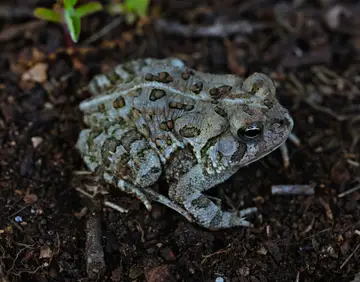
Size
2 to 3.5 inches long (NCWRC: up to 4 inches); females are larger than males.
How to recognize it
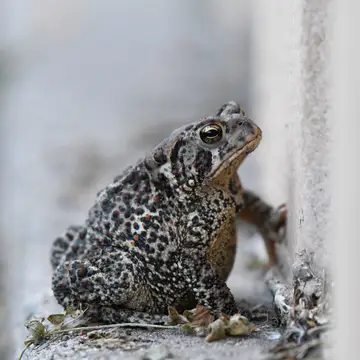
Dark spots on the back hold only a few large warts; the similar Fowler's toad has three or more. Agencies give different counts for the American toad (TWRA: one or two; Ohio DNR: one, two or three; Georgia DNR: usually no more than one), so wart count alone does not settle it; check the head crests too (see lookalikes).
A large, kidney- or bean-shaped parotoid gland behind each eye that usually does not touch the bony ridge (cranial crest) above the eye, or touches it only by a short spur.
Enlarged warts on the lower leg.
Where in Kentucky
American toads can be found statewide and live in a wide variety of habitats but seem most partial to woodlands. KDFWR
JFMAMJJASOND
188 records by month.What the sources say
Habitat: They breed mostly from mid-March through May in temporary ponds, especially water-filled ruts left behind by logging equipment, ATVs, and other vehicles. (KDFWR)
No official source we use states whether this animal is venomous. That does not mean it is harmless: do not handle it.
Where in Kentucky
Barking Treefrogs are unique in our state because they only live in the Western Pennyrile section of the state from southern Logan County to the southern tip of … KDFWR
Conservation
KY SWAP 2023 Species of Greatest Conservation Need (data deficient); priority group: Data Deficient; state rank S3S4
No confirmed photo of Bird-voiced Treefrog
Bird-voiced Treefrog
Hyla avivoca
Not stated
Venom
No official source we use states whether this animal is venomous. That does not mean it is harmless: do not handle it.
Where in Kentucky
Bird-voiced Treefrogs live in forested wetland habitats in the Jackson Purchase and Western Coal Field regions. KDFWR
Conservation
KY SWAP 2023 Species of Greatest Conservation Need; priority group: High; state rank S3S4
What the sources say
Habitat: They spend most of their time high in the trees in cypress swamps and flooded bottomland hardwood forests. (KDFWR)
No confirmed photo of Blanchard's Cricket Frog
Blanchard's Cricket Frog
Acris blanchardi
Not stated
Venom
No official source we use states whether this animal is venomous. That does not mean it is harmless: do not handle it.
Where in Kentucky
Blanchard’s Cricket Frogs live in the north-central part of the state from the Kentucky River drainage to the Ashland area. KDFWR
Conservation
KY SWAP 2023 Species of Greatest Conservation Need (data deficient); priority group: Data Deficient; state rank S5
What the sources say
Habitat: Cricket Frogs are small, active amphibians that spend most of their time on the open weedy shorelines next to lakes, ponds, and streams. (KDFWR)
No confirmed photo of Cope's Gray Treefrog
Cope's Gray Treefrog
Hyla chrysoscelis
Not stated
Venom
No official source we use states whether this animal is venomous. That does not mean it is harmless: do not handle it.
Where in Kentucky
Cope’s Gray Treefrogs occur statewide and have been documented from every Kentucky county. KDFWR
What the sources say
Habitat: These treefrogs mate and lay their eggs from April through the middle of August, mostly in small ponds, ditches, and temporary pools but also in water-filled tire ruts or water that collects on swimming pool covers on rainy nights. (KDFWR)
No official source we use states whether this animal is venomous. That does not mean it is harmless: do not handle it.
Size
Small: body usually 1¼ to 2½ inches long (snout to vent); Tennessee gives 1.25 to 2 inches.
How to recognize it
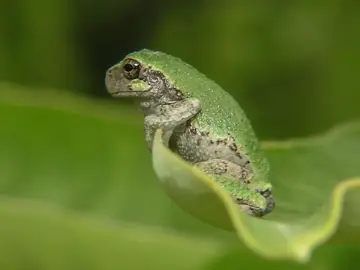
Large white or gray spot below each eye
Warty (granular) skin and sticky pads on fingers and toes
Bright orange or golden yellow on the underside of each hind leg, shown as a flash color
Where in Kentucky
Eastern Gray Treefrogs have only been found in two areas – northeastern Kentucky in Boyd and Greenup counties and just west of Fort Knox in parts of Meade, Hardin, and … KDFWR
Conservation
KY SWAP 2023 Species of Greatest Conservation Need; priority group: Moderate; state rank S2S3
What the sources say
Range: Eastern Gray Treefrogs have only been found in two areas – northeastern Kentucky in Boyd and Greenup counties and just west of Fort Knox in parts of Meade, Hardin, and Breckinridge counties.
Habitat: Eastern Gray Treefrogs mate and lay their eggs from April through the middle of August in small ponds, ditches, and temporary pools including water-filled tire ruts. (KDFWR)
No official source we use states whether this animal is venomous. That does not mean it is harmless: do not handle it.
Where in Kentucky
These curious little frogs can be found across southern and western Kentucky in a variety of habitats ranging from mature forests to overgrazed pastures, rocky glades … KDFWR
What the sources say
Range: These curious little frogs can be found across southern and western Kentucky in a variety of habitats ranging from mature forests to overgrazed pastures, rocky glades, and abandoned quarries, gravel pits, and surface mines.
Habitat: They call and breed from late May through early August in wet grassy meadows, roadside ditches, and small ponds. (KDFWR)
No official source we use states whether this animal is venomous. That does not mean it is harmless: do not handle it.
Where in Kentucky
Green Frogs are found statewide in Kentucky in a variety of habitats but are usually near water - the margins of ponds, wetlands, springs, and streams in woodlands and … KDFWR
JFMAMJJASOND
129 records by month.What the sources say
Range: Green Frogs are found statewide in Kentucky in a variety of habitats but are usually near water - the margins of ponds, wetlands, springs, and streams in woodlands and open habitats are suitable homes for them.
Habitat: The eggs are laid in a large clear floating film on the surface of a pond or wetland and are usually seen amid emergent or floating vegetation. (KDFWR)
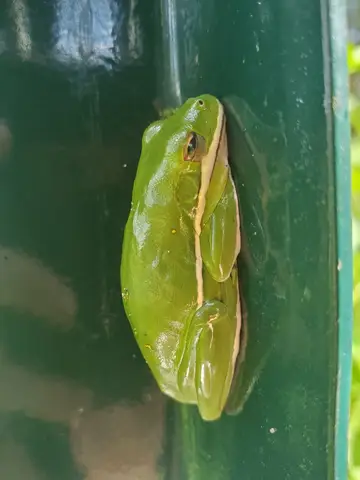
No official source we use states whether this animal is venomous. That does not mean it is harmless: do not handle it.
Size
Adults reach about 2.5 inches: USGS gives 1.25 to 2.5 inches snout to vent. Virginia DWR says up to 2 inches.
How to recognize it
Smooth skin
Prominent toe pads
Loud nasal call, like cowbells from a distance
Where in Kentucky
Until the early 1980’s Green Treefrogs could be found only in cypress swamps and other extensive wetlands bordering the Mississippi River in Fulton, Hickman, Carlisle … KDFWR
What the sources say
Range: Until the early 1980’s Green Treefrogs could be found only in cypress swamps and other extensive wetlands bordering the Mississippi River in Fulton, Hickman, Carlisle, and Ballard counties.
Habitat: Buttonbush swamps and beaver ponds are especially favored. (KDFWR)
No official source we use states whether this animal is venomous. That does not mean it is harmless: do not handle it.
Where in Kentucky
The hopeful high-pitched trills of Midland Chorus Frogs in wet meadows and shallow pools offer the first promise of the coming spring from the Tennessee River east to … KDFWR
No confirmed photo of Mountain Chorus Frog
Mountain Chorus Frog
Pseudacris brachyphona
Not stated
Venom
No official source we use states whether this animal is venomous. That does not mean it is harmless: do not handle it.
Where in Kentucky
They are common throughout eastern and southern Kentucky, westward to the vicinity of Mammoth Cave National Park, but do not occur in the Bluegrass Region. KDFWR
What the sources say
Habitat: Mountain Chorus Frogs breed in temporary woodland pools and are especially likely to be found calling from shallow roadside ditches, shallow pools along tiny streams, and water-filled tire ruts just after a rain. (KDFWR)
No official source we use states whether this animal is venomous. That does not mean it is harmless: do not handle it.
Where in Kentucky
This unique frog occurs only in the Jackson Purchase and Western Coal Field Regions of Kentucky. KDFWR
Conservation
KY SWAP 2023 Species of Greatest Conservation Need (data deficient); priority group: Data Deficient; state rank S3
What the sources say
Habitat: As the common name implies each Crawfish Frog spends most of the year living in and around a crayfish burrow in an open grassland, pasture, or old field. (KDFWR)
No confirmed photo of Northern Cricket Frog
Northern Cricket Frog
Acris crepitans
Not stated
Venom
No official source we use states whether this animal is venomous. That does not mean it is harmless: do not handle it.
Where in Kentucky
Northern Cricket Frogs are very common all across the state everywhere south and west of the Kentucky River drainage. KDFWR
JFMAMJJASOND
39 records by month.What the sources say
Habitat: Cricket Frogs are small, active amphibians that spend most of their time on the open weedy shorelines next to lakes, ponds, and streams. (KDFWR)
No official source we use states whether this animal is venomous. That does not mean it is harmless: do not handle it.
Size
About 1.75 to 3 inches long; large females reach about 3.5 inches. Males are smaller than females.
How to recognize it
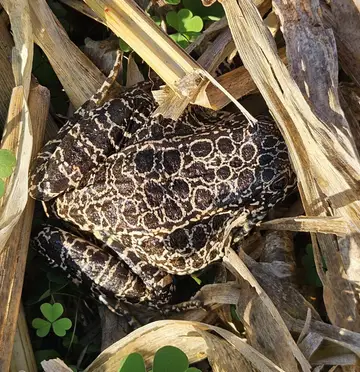
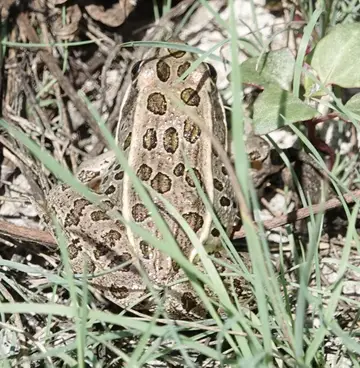
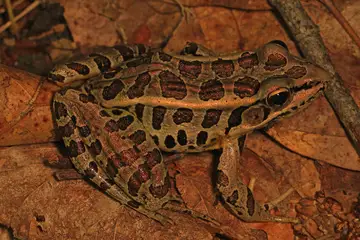
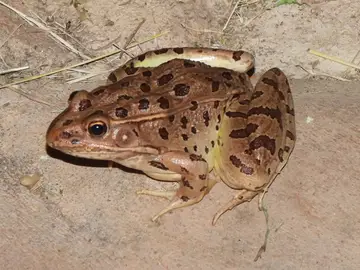
Two rows of square or rectangular dark spots down the back between two light ridges (dorsolateral folds); spots sometimes merge into bars
Bright yellow or orange on the hidden inner surfaces of the hind legs and groin
No white spot on the eardrum (tympanum), unlike the southern leopard frog
Where in Kentucky
Pickerel Frogs are found nearly statewide in Kentucky but are curiously absent from the Western Coal Field and Jackson Purchase. KDFWR
JFMAMJJASOND
59 records by month.What the sources say
Habitat: The adults live in forested habitats, often close to small woodland streams, and can also be found in caves or in narrow rock crevices along the bases of cliffs and rock outcrops. (KDFWR)
No official source we use states whether this animal is venomous. That does not mean it is harmless: do not handle it.
Where in Kentucky
This frog ranges from the Mississippi River lowlands eastward across the state to the Louisville area and the Knobs region. KDFWR
JFMAMJJASOND
50 records by month.What the sources say
Habitat: These frogs can be found in nearly all habitats from croplands, pastures, and grassy fields to mature forests as long as ponds, ditches, and wetlands are available nearby for breeding. (KDFWR)
No official source we use states whether this animal is venomous. That does not mean it is harmless: do not handle it.
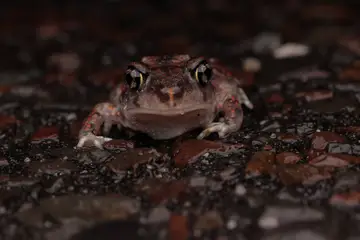
Size
Adults 3/4 to 1 1/4 inches snout to vent, occasionally to 1 1/2 inches; males are smaller than females.
How to recognize it
Clear, high-pitched peep about once per second; a chorus can sound like small jingle bells
Adhesive pads on the tips of fingers and toes
Some individuals have little to no markings
Where in Kentucky
In Kentucky, Spring Peepers can be found statewide. KDFWR
JFMAMJJASOND
68 records by month.What the sources say
Habitat: The distinctive high-pitched call can be heard across Kentucky from mid-February through early summer at just about any pond or wetland close to a wooded area. (KDFWR)
No official source we use states whether this animal is venomous. That does not mean it is harmless: do not handle it.
Where in Kentucky
The hopeful high-pitched trills of Upland Chorus Frogs in wet meadows and shallow pools offer the first promise of the coming spring in both the Jackson Purchase Region … KDFWR
What the sources say
Range: The hopeful high-pitched trills of Upland Chorus Frogs in wet meadows and shallow pools offer the first promise of the coming spring in both the Jackson Purchase Region and in southeastern Kentucky.
Habitat: After breeding, these chorus frogs live on land in habitats ranging from pastures and weed fields to wetland borders, low wooded areas, and even forested hillsides. (KDFWR)
No official source we use states whether this animal is venomous. That does not mean it is harmless: do not handle it.
Size
Adults 1.5 to 2.75 inches snout to vent, occasionally to 3.5 inches; females are larger than males.
How to recognize it
Dark eye mask: SREL calls it the only frog in the Southeast with such a facial pattern
Distinct ridge of skin (dorsolateral fold) down each side of the back to the groin
Call: a rapid, hoarse 'waaaduck' like a quacking duck, repeated three or four times
Where in Kentucky
Wood Frogs can be found across much of Kentucky east of Land Between The Lakes but these frogs are mostly absent from the Bluegrass Region and scarce through the Western … KDFWR
JFMAMJJASOND
50 records by month.What the sources say
Range: Wood Frogs can be found across much of Kentucky east of Land Between The Lakes but these frogs are mostly absent from the Bluegrass Region and scarce through the Western Coal Field.
Habitat: Wood Frogs come out of hibernation and travel to woodland ponds and vernal pools to mate and lay their eggs. (KDFWR)
The difference official sources agree on is at the head: in the American toad the ridge (cranial crest) behind each eye is separate from the parotoid gland or joined to it only by a short spur; in Fowler's toad the two touch. Fowler's toad also has three or more warts in each of the larger dark spots, while the American toad has fewer (TWRA: one or two; Ohio DNR: one, two or three; Georgia DNR: usually no more than one). Fowler's toad has a whitish belly, often with a single dark spot on the chest; the American toad's belly is peppered with dark spots. The two can hybridize, so some toads cannot be told apart.
The difference official sources agree on is at the head: in the American toad the ridge (cranial crest) behind each eye is separate from the parotoid gland or joined to it only by a short spur; in Fowler's toad the two touch. Fowler's toad also has three or more warts in each of the larger dark spots, while the American toad has fewer (TWRA: one or two; Ohio DNR: one, two or three; Georgia DNR: usually no more than one). Fowler's toad has a whitish belly, often with a single dark spot on the chest; the American toad's belly is peppered with dark spots. The two can hybridize, and hybrids have intermediate features.
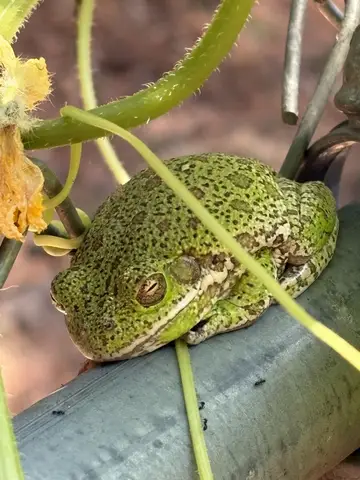
Missouri Department of Conservation calls both gray treefrogs gray, unlike the green treefrog, but its gray treefrog account says their color may be green to light greenish gray, gray, brown or dark brown, so color alone does not settle it. MDC: gray treefrogs have warty (granular) skin; the green treefrog's back is smooth and a light stripe runs from its upper lip down the side of the body.
Photos show typical adults; individuals vary. Never get close to compare.
When frogs and toads are active in Kentucky
Records of frogs and toads in Kentucky peak in March to July. They show when people record frogs and toads, not how many there are (about month bars).
JanFebMarAprMayJunJulAugSepOctNovDec
1,032 records of frogs and toads in Kentucky by month (GBIF, CC0 and CC BY records).
American Bullfrog calling season (KDFWR): American bullfrogs call from late April into September. KDFWR
Barking Treefrog calling season (KDFWR): When water is present in the breeding ponds, Barking Treefrogs may call during rainy periods from mid-May through mid-July. KDFWR
Blanchard's Cricket Frog calling season (KDFWR): Cricket Frogs call day and night from late April into August. KDFWR
Eastern Narrowmouth Toad calling season (KDFWR): They call and breed from late May through early August in wet grassy meadows, roadside ditches, and small ponds. KDFWR
Green Frog calling season (KDFWR): Green Frogs begin to call in late April and a few are still calling in early September. KDFWR
Green Treefrog calling season (KDFWR): Green Treefrogs call from May through mid-August from just about any shallow permanent body of water with plenty of emergent vegetation. KDFWR
Midland Chorus Frog calling season (KDFWR): Eager males often start calling on sunny afternoons in January when the air temperature is only in the 40’s. KDFWR
Mountain Chorus Frog calling season (KDFWR): Mountain Chorus Frogs are about the same size as Spring Peepers (to 1 ½ inches) and generally call over about the same time period (February to July). KDFWR
Northern Cricket Frog calling season (KDFWR): Cricket Frogs call both day and night from late April into August. KDFWR
Plains Leopard Frog calling season (KDFWR): Calling has been heard in March and April. KDFWR
Southern Leopard Frog calling season (KDFWR): Calling usually begins in March, and the major part of the breeding season spans March and April. KDFWR
Upland Chorus Frog calling season (KDFWR): Eager males often start calling on sunny afternoons in January when the air temperature is only in the 40’s. KDFWR
How to report
Report people feeding bears or aggressive bears to Kentucky Fish and Wildlife at 1-800-25ALERT (1-800-252-5378); report sick or injured bats via the KDFWR online Report a Bat form; report suspected fire ant mounds or stings to UK Entomology at [email protected]. KDFWR
Snakes (Snakes of Kentucky). Kentucky Department of Fish and Wildlife Resources (KDFWR). archived copy, captured August 27, 2025; checked November 3, 2026.
Overview of Frogs and Toad Species in Kentucky. Kentucky Department of Fish and Wildlife Resources (KDFWR). archived copy, captured November 18, 2025; checked November 3, 2026.Quoted passages (1)
“Our 23 species of frogs and their relatives are classified into five different major groups, or families, each differing in several ways from the others.”
“Mountain Chorus Frogs are about the same size as Spring Peepers (to 1 ½ inches) and generally call over about the same time period (February to July).”
Black Bears. Kentucky Department of Fish and Wildlife Resources (KDFWR). archived copy, captured September 14, 2026; checked November 3, 2026.Quoted passages (1)
“Immediately report any instances of people feeding bears to Kentucky Fish and Wildlife by calling 1-800-25ALERT (1-800-252-5378). [UK Entfact 469: "You can report a suspicious ant mound or a stinging event to the University of Kentucky Entomology Department through email, [email protected]"]”