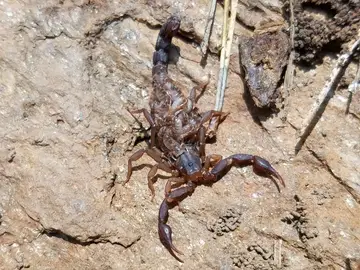
This page lists 1 scorpion: all from University of Kentucky Department of Entomology's Scorpions in Kentucky.
1 is venomous by official accounts.
Not every species: no complete official list of Kentucky scorpions exists, so this page covers the ones state and Extension sources name. How lists are built.
Which scorpions can hurt you
Official sources single out these scorpions in Kentucky, in their own words:
Venomous sting. “They will strike if touched or accidentally grabbed. A venom, produced by a pair of glands located near the end of the tail, is injected by the stinger.” University of Kentucky Department of Entomology
The one scorpion on the list
Venomous species first, then A to Z. Do not handle them.
“They will strike if touched or accidentally grabbed. A venom, produced by a pair of glands located near the end of the tail, is injected by the stinger.” University of Kentucky Department of Entomology
Where in Kentucky
Specimens have been sent in from Adair, Barren, Bullitt, Casey, Estill, Fayette, Hardin, Madison, Marion, Metcalfe, Monroe, Pulaski, and Wayne counties. University of Kentucky Department of Entomology
JFMAMJJASOND
38 records by month.What the sources say
Venom: “A venom, produced by a pair of glands located near the end of the tail, is injected by the stinger. The sensation is a sharp pain that usually lasts for 15 to 20 minutes.” (University of Kentucky Department of Entomology)
Habitat: Southern devil scorpions are usually found around rocky hillsides. Crumbling rock faces, brick walls, crawl spaces, leaf-covered areas, and log piles are favorite habitats. (University of Kentucky Department of Entomology)
When scorpions are active in Kentucky
Records of scorpions in Kentucky peak in April to May and August to September. They show when people record scorpions, not how many there are (about month bars).
JanFebMarAprMayJunJulAugSepOctNovDec
42 records of scorpions in Kentucky by month (GBIF, CC0 and CC BY records).
“The southern devil scorpion, Vejovis carolinianus, occurs in several southeastern states, including Kentucky.”
About this list
The species list comes from Scorpions in Kentucky (UK Entfact 633) (University of Kentucky Department of Entomology (Cooperative Extension), Revised: 3/26).
Venom labels come only from official sources and link to them; "Not stated" never means harmless. How labels work.
Sources
Snakes (Snakes of Kentucky). Kentucky Department of Fish and Wildlife Resources (KDFWR). archived copy, captured August 27, 2025; checked November 3, 2026.
Scorpions in Kentucky (Entfact 633). University of Kentucky Department of Entomology (Cooperative Extension). Revised: 3/26; checked November 3, 2026.Quoted passages (4)
“A venom, produced by a pair of glands located near the end of the tail, is injected by the stinger. The sensation is a sharp pain that usually lasts for 15 to 20 minutes.”
“They will strike if touched or accidentally grabbed. A venom, produced by a pair of glands located near the end of the tail, is injected by the stinger.”
“Scorpions are most likely to be seen in or around houses from April through June but can be active until fall.”
“The southern devil scorpion, Vejovis carolinianus, occurs in several southeastern states, including Kentucky.”