Wood frog
Lithobates sylvaticus · Last checked November 3, 2026.
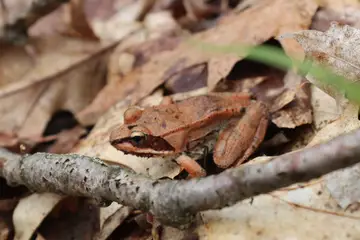
The wood frog is a small to medium-sized tan, brown or reddish frog of northern and eastern forests, best known for the dark brown 'mask' running through each eye and for surviving winter frozen solid. Adults are about 1.5 to 2.75 inches long. No official source describes it as dangerous; the Missouri Department of Conservation says people normally are not affected by frog skin secretions, though they sting if they get in the eyes. It ranges from Alaska (where it is the only amphibian north of the Arctic Circle) across Canada to the Northeast, south in the Appalachians to northern Georgia and Alabama, with scattered populations in the Ozarks and Rocky Mountains. Missouri Department of Conservation
On this page
Is the wood frog dangerous?
Missouri Department of Conservation (about all Missouri toads and frogs): people normally are not affected by their skin secretions, but human eyes are sensitive to them and even a small amount in the eyes causes pain and burning. MDC says handwashing after handling a toad or frog is important. MDC
“People normally are not affected by the skin secretions of toads and frogs, though human eyes are sensitive to these substances. The pain and burning that result when even a slight amount of skin secretion gets in the eyes is unforgettable. Handwashing after … handling a toad or frog is important.”
Bites and stings: No official source checked describes bites to people.
No official source we use states whether this animal is venomous. That does not mean it is harmless: do not handle it.
How to identify a wood frog
A photo or description can narrow it down, but cannot confirm what an animal is or that it is safe. Look from a distance and do not handle wild animals.
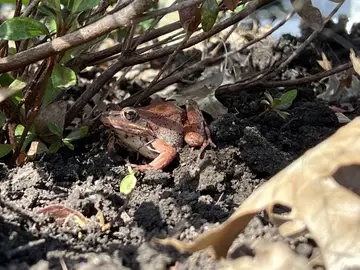
Size: Adults 1.5 to 2.75 inches snout to vent, occasionally to 3.5 inches; females are larger than males. Missouri Department of Conservation
Colors: Pinkish tan, light brown, reddish brown or dark brown above; white belly with scattered dusky marks; in Alaska: brown, tan, gray or green above, cream below. Pattern: Dark brown 'mask' from the snout through the eye to behind the eardrum, with a white line along the upper lip; hind legs usually barred brown; some have small dark spots on the back; many northern frogs have a light stripe down the middle of the back.
Key features
- Dark eye mask: SREL calls it the only frog in the Southeast with such a facial pattern University of Georgia Savannah River Ecology Laboratory (SREL) Herpetology
- Distinct ridge of skin (dorsolateral fold) down each side of the back to the groin Missouri Department of Conservation
- Call: a rapid, hoarse 'waaaduck' like a quacking duck, repeated three or four times Missouri Department of Conservation
Young
Eggs hatch in 10 to 14 days; tadpoles develop quickly and, in Missouri, transform into froglets from May to mid-June. Tadpoles eat algae and plant material but may eat amphibian eggs and larvae when food is short.
Animals mistaken for the wood frog
Wood frog or Green frog (young; including bronze color form)?
Wood frog
Green frog (young; including bronze color form) Lithobates clamitans
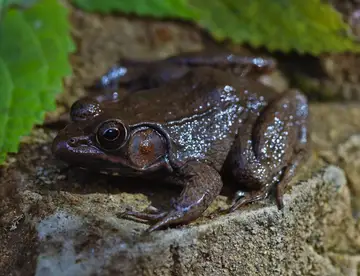

MDC: young green frogs can be similar in color but lack the dark brown mask through each eye. Missouri Department of Conservation
Wood frog or Columbia spotted frog (Alaska)?
Wood frog
Columbia spotted frog (Alaska) Rana luteiventris
ADF&G: slightly bumpy skin covered with irregular black spots and salmon-red undersides of the legs and belly; in Alaska it is mostly confined to Southeast river corridors. The wood frog has a dark eye mask and a light lip line and a uniformly cream underside. Alaska Department of Fish and Game
Where the wood frog lives
- Native or listed
- Nonnative or not established
- No official record in our data
- 1–9
- 10–99
- 100–999
- 1,000+
On our state guides
- Alaska frogs and toads
- Arkansas frogs and toads
- Colorado frogs and toads
- Connecticut frogs and toads
- Delaware frogs and toads
- Georgia frogs and toads
- Idaho frogs and toads
- Illinois frogs and toads
- Indiana frogs and toads
- Kentucky frogs and toads
- Maine frogs and toads
- Maryland frogs and toads
- Massachusetts frogs and toads
- Michigan frogs and toads
- Minnesota frogs and toads
- Missouri frogs and toads
- New Jersey frogs and toads
- New York frogs and toads
- North Dakota frogs and toads
- Ohio frogs and toads
- Pennsylvania frogs and toads
- South Carolina frogs and toads
- South Dakota frogs and toads
- Vermont frogs and toads
- Virginia frogs and toads
- West Virginia frogs and toads
- Wisconsin frogs and toads
- Wyoming frogs and toads
State boundaries: U.S. Census Bureau, cartographic boundary file cb_2024_us_state_20m.
When it is active
Missouri: active February to October, breeding early February to late March on warm rainy nights. Alaska: thaws and breeds in early spring (April and May). Tennessee: often the first frog to call, sometimes before the ice has left the ponds. Missouri Department of Conservation
US open-licence records peak in March to May.
Habitat and habits
Habitat: Moist, cool forests with deep leaf litter (oak-hickory in Missouri), shady ravines and north-facing slopes; in Alaska also meadows, muskeg, tundra and even suburban yards. Breeds in small fishless ponds and temporary pools; lives on land the rest of the year, often far from water. Missouri Department of Conservation
Behavior: Secretive and solitary outside the short breeding season; hides under leaf litter. Survives winter frozen: ADF&G calls it one of the most freeze-tolerant species on Earth, able to freeze solid and thaw in spring, protected by glucose that acts as antifreeze.
Diet: Adults eat insects and other invertebrates (Maine IFW lists spiders, beetles, moth larvae and slugs); tadpoles eat algae and plant material.
Young: Explosive breeder: a pond's eggs are laid within a few nights. Egg masses hold 500 to 1,000 eggs and hatch in 10 to 14 days.
Legal status and reporting
Federal: ECOS shows 'Status Undefined' and no listing date for Lithobates sylvaticus (query 2026-11-03); no source checked reports an Endangered Species Act listing. ECOS
Protection: Alabama: protected nongame species; unlawful to take, capture, kill or possess without a permit. Alaska: amphibians are legally 'fish'; holding, transporting or releasing native amphibians needs a permit. Missouri: species of conservation concern. Outdoor Alabama
Report: Maine IFW asks the public to submit photo-documented observations to the Maine Amphibian & Reptile Atlas Project (MARAP). Maine Department of Inland Fisheries and Wildlife
Questions about the wood frog
Wood frog
A small to medium-sized tan to brown frog (about 1.5 to 2.75 inches) with a dark brown mask through each eye and a white upper-lip line. It lives in cool, moist forests, breeds in fishless spring pools, and survives winter frozen solid with the help of glucose 'antifreeze'.
Alaska wood frogs
ADF&G says the wood frog is the most widely distributed amphibian in Alaska, from the Southeast mainland north to the Brooks Range, and the only amphibian found above the Arctic Circle. It freezes solid in winter and thaws to breed in April and May. In Alaska, holding, transporting or releasing native amphibians requires a permit.
Wood frogs maine
Yes. Maine IFW lists the wood frog among Maine's frogs and calls it one of a few Maine frogs that can survive freezing in the forest leaf litter. It breeds in vernal pools, and Maine asks the public to submit photo-documented sightings to the Maine Amphibian & Reptile Atlas Project.
Wood frogs vermont
Yes. The Vermont Fish & Wildlife Department's 2022 list of reptiles and amphibians known to occur in Vermont includes the wood frog, with state rank S5.
Sources
- Wood Frog (Field Guide). Missouri Department of Conservation. undated page; checked November 3, 2026.
Quoted passages (9)
“Adult length (snout to vent): 1½–2¾ inches; occasionally to 3½ inches. Males are smaller than females.”
“The dorsolateral fold (ridge of skin running along each side of the back) is distinct and extends to the groin.”
“The call of a male is a rapid, hoarse ‘waaaduck’ sound that lasts about one second and may be quickly repeated three or four times; they sound like quacking ducks.”
“The eggs hatch within 10–14 days. Development is rapid, and the tadpoles transform into froglets from May to mid-June. … Wood frog tadpoles prefer to eat algae and other plant material when available, but if such food sources become scarce, they will shift their diet to eggs and larvae of amphibians”
“They prefer forested, rocky ravines that are moist and cool. … They breed in small, fishless woodland ponds and ephemeral (temporary seasonal) pools.”
“Wood frogs eat a variety of insects and other invertebrates.”
“Active between February and October. … In Missouri, breeding takes place between early February and late March, depending on local weather conditions.”
“The wood frog is an explosive breeder in late winter and early spring. … By the second or third night, all the eggs are laid and few wood frogs remain at the pond or pool. … An egg mass contains 500–1,000 eggs”
“Young green frogs (including their bronze frog color morph) can have a similar color, but they lack the distinctive dark brown mask through each eye.”
- A Guide to Missouri's Toads and Frogs (MDC publication E00430). Missouri Department of Conservation (MDC). printed code "3/2022 E00430"; checked November 3, 2026.
Quoted passages (1)
“People normally are not affected by the skin secretions of toads and frogs, though human eyes are sensitive to these substances. The pain and burning that result when even a slight amount of skin secretion gets in the eyes is unforgettable. Handwashing after … handling a toad or frog is important.”
- Wood Frog Rana sylvatica (species account, Alaska Natural Heritage Program, hosted by ADF&G). Alaska Department of Fish and Game (account authored by Alaska Natural Heritage Program, T.A. Gotthardt). undated page; checked November 3, 2026.
- Frogs and Toads (Wildlife Notebook Series). Alaska Department of Fish and Game. undated page; checked November 3, 2026.
Quoted passages (2)
“…it is one of the most freeze tolerant species on Earth; it has the amazing ability to freeze solid and thaw out as temperatures warm in the spring”
“Their slightly bumpy skin is smooth, moist, and typically brown, red-brown, or olive, and is covered in irregular black spots. … a distinctive salmon-red coloring on the undersurface of the legs and stomach … Distinguishing characteristics generally include a prominent dark eye mask and a contrasting light colored lip line”
- Wood Frog. Alabama Department of Conservation and Natural Resources (Outdoor Alabama). undated page; checked November 3, 2026.
- Wood Frog (Rana [Lithobates] sylvatica). University of Georgia Savannah River Ecology Laboratory (SREL) Herpetology. undated page; checked November 3, 2026.
Quoted passages (1)
“This is the only frog in the Southeast with such a facial pattern.”
- USFWS ECOS species report export (JSON), scientific-name query. U.S. Fish and Wildlife Service (ECOS). live query 2026-11-03; checked November 3, 2026.
- Nongame Amphibians Protected by Alabama Regulations. Alabama Department of Conservation and Natural Resources (Outdoor Alabama). undated page; checked November 3, 2026.
Quoted passages (1)
“It shall be unlawful to take, capture, kill, or attempt to take, capture or kill; possess … Lithobates sylvaticus”
- Wood Frog (Species Information: Reptiles & Amphibians). Maine Department of Inland Fisheries and Wildlife. undated page; checked November 3, 2026.
Quoted passages (1)
“…we encourage members of the public to share their photo-documented observations as part of the Maine Amphibian & Reptile Atlas Project (MARAP)”
- Reptiles & Amphibians: Species Information. Maine Department of Inland Fisheries and Wildlife. undated page; checked November 3, 2026.
- Reptiles and Amphibians of Vermont. Vermont Fish & Wildlife Department (Vermont Natural Heritage Inventory). March 13, 2022; checked November 3, 2026.
- GBIF.org occurrence records, human observations licensed CC0 1.0 or CC BY 4.0 only, accessed November 3, 2026. The datasets behind these counts are listed on our Sources page.
- State boundaries: U.S. Census Bureau, cartographic boundary file cb_2024_us_state_20m.