States Wildlife

Alaska Frogs and Toads: Pictures & ID Guide

Last checked November 3, 2026 against official sources.

On this page
  1. All 5 frogs and toads
  2. Lookalikes
  3. When they are active
  4. How to report
  5. About this list
  6. Sources

This page lists 5 species: all from Alaska Department of Fish and Game's Alaska Wildlife Action Plan, Appendix 4: Native Amphibians. 2 are nonnative.

All 5 frogs and toads

From A to Z.

No confirmed photo of Columbia Spotted Frog

Columbia Spotted Frog

Rana luteiventris

Not stated

Venom
No official source we use states whether this animal is venomous. That does not mean it is harmless: do not handle it.
Where in Alaska
The Columbia Spotted Frog may be found in coastal forests of Southeast Alaska. Alaska Department of Fish and Game
What the sources say

Habitat: Coastal forests of Southeast Alaska (Alaska Department of Fish and Game)

No confirmed photo of Pacific Chorus Frog

Pacific Chorus Frog

Pseudacris regilla

Not stated Nonnative

Venom
No official source we use states whether this animal is venomous. That does not mean it is harmless: do not handle it.
Where in Alaska
They apparently have viable but restricted populations in the Alexander Archipelago of Southeast Alaska on Revillagigedo Island and Chichagof Island. Alaska Department of Fish and Game
Red-legged Frog
Photo: Mandy Hackney · CC BY 4.0 · iNaturalist

Red-legged Frog

Rana aurora

Not stated Invasive

Venom
No official source we use states whether this animal is venomous. That does not mean it is harmless: do not handle it.
Where in Alaska
In Alaska, red-legged frogs were introduced from Washington State to Chichagof Island (southeast of Hoonah) in 1982. Alaska Department of Fish and Game
No confirmed photo of Western Toad

Western Toad

Bufo boreas

Not stated

Venom
No official source we use states whether this animal is venomous. That does not mean it is harmless: do not handle it.
Where in Alaska
This species has the widest distribution of all amphibians in Southeast Alaska. Alaska Department of Fish and Game
What the sources say

Habitat: Coastal rainforest of southeast Alaska. (Alaska Department of Fish and Game)

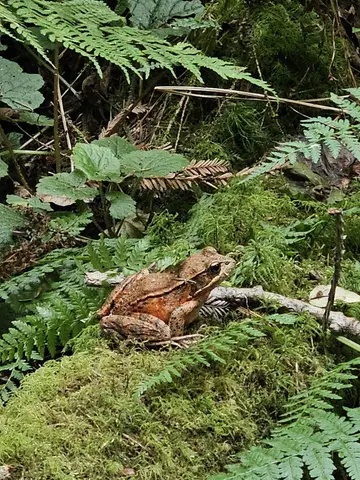
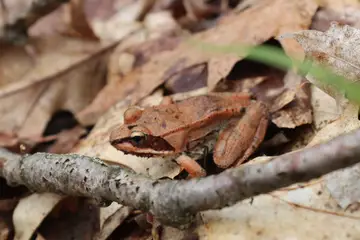
Wood Frog
Photo: Jackson Kusack · CC0 1.0 · iNaturalist

Wood Frog

Rana sylvatica

Not stated

Venom
No official source we use states whether this animal is venomous. That does not mean it is harmless: do not handle it.
Size
Adults 1.5 to 2.75 inches snout to vent, occasionally to 3.5 inches; females are larger than males.
How to recognize it
  • Dark eye mask: SREL calls it the only frog in the Southeast with such a facial pattern
  • Distinct ridge of skin (dorsolateral fold) down each side of the back to the groin
  • Call: a rapid, hoarse 'waaaduck' like a quacking duck, repeated three or four times
Where in Alaska
Widely distributed throughout Alaska and is the only amphibian found above the Arctic Circle. Alaska Department of Fish and Game
Conservation
State rank S2S3 (23Jun2004) in the ADF&G species account PDF
944 records by month.

Full Wood Frog guide

Frogs and Toads people confuse

Wood frog or Columbia spotted frog (Alaska)?

Wood frog
Photo: Jackson Kusack · CC0 1.0 · iNaturalist

Wood frog Not stated

No confirmed photo of Columbia spotted frog (Alaska)

Columbia spotted frog (Alaska) Not stated

ADF&G: slightly bumpy skin covered with irregular black spots and salmon-red undersides of the legs and belly; in Alaska it is mostly confined to Southeast river corridors. The wood frog has a dark eye mask and a light lip line and a uniformly cream underside.

Photos show typical adults; individuals vary. Never get close to compare.

When frogs and toads are active in Alaska

Records of frogs and toads in Alaska peak in June to July. They show when people record frogs and toads, not how many there are (about month bars).

1,720 records of frogs and toads in Alaska by month (GBIF, CC0 and CC BY records).

How to report

Report invasive species to the ADF&G Invasive Species Hotline 1-877-INVASIV (1-877-468-2748) or [email protected]. Report dangerous wildlife encounters with the ADF&G wildlife encounter form (https://www.adfg.alaska.gov/index.cfm?adfg=reportwildlifeencounter.main). Alaska Department of Fish and Game
About this list

The species list comes from Alaska Wildlife Action Plan, Appendix 4: Native Amphibians (ADF&G) (Alaska Department of Fish and Game, undated PDF; retrieved 2026-11-03).

Venom labels come only from official sources and link to them; "Not stated" never means harmless. How labels work.

"Nonnative" and "Invasive" follow the wording of the source list. See invasive species in Alaska.

Sources

  1. Our Agency: Mission. Alaska Department of Fish and Game. undated page; checked November 3, 2026.
  2. Alaska Wildlife Action Plan, Appendix 4: Native Amphibians. Alaska Department of Fish and Game. undated page; checked November 3, 2026.
  3. Wood Frog (species account PDF, prepared by the Alaska Natural Heritage Program). Alaska Department of Fish and Game. undated page; checked November 3, 2026.
  4. Columbia Spotted Frog Species Profile. Alaska Department of Fish and Game. undated page; checked November 3, 2026.
  5. Western Toad Species Profile. Alaska Department of Fish and Game. undated page; checked November 3, 2026.
    Quoted passages (1)
    “The western toad's breeding period is variable depending on the location but it generally occurs late April to July in Alaska.”
  6. Invasive Species: Red-legged Frog (Distribution). Alaska Department of Fish and Game. undated page; checked November 3, 2026.
  7. How to Report an Invasive Species you saw in Alaska. Alaska Department of Fish and Game. undated page; checked November 3, 2026.
    Quoted passages (1)
    “Call the Invasive Species Hotline: 1-877-INVASIV (1-877-468-2748)”
  8. GBIF.org occurrence records, human observations licensed CC0 1.0 or CC BY 4.0 only, accessed November 3, 2026. The datasets behind these counts are listed on our Sources page.