States Wildlife

Alaska Bugs and Insects That Sting or Bite

Last checked November 3, 2026 against official sources.

On this page
  1. Which insects can hurt you
  2. Ticks (arachnids, not insects)
  3. All 3 insects and 8 ticks
  4. When they are active
  5. If you are bitten or stung
  6. How to report
  7. About this list
  8. Sources

This page lists 3 insects and 8 ticks. 3 are nonnative.

Not every species: no complete official list of Alaska insects exists, so this page covers the ones state and Extension sources name. How lists are built.

Which insects can hurt you

Official sources single out these insects in Alaska, in their own words:

Ticks (arachnids, not insects)

Official sources single out these ticks in Alaska, in their own words:

All 3 insects and 8 ticks

From A to Z. Do not handle them.

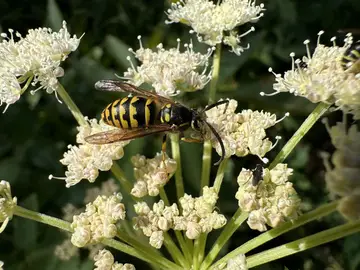
Aerial yellowjacket
Photo: Darin J McGuire · CC BY 4.0 · iNaturalist

Aerial yellowjacket

Dolichovespula arenaria

Not stated

Venom
No official source we use states whether this animal is venomous. That does not mean it is harmless: do not handle it.
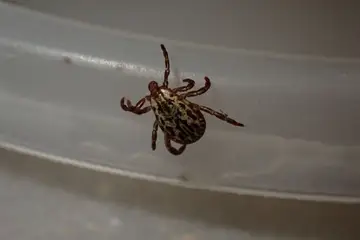
American Dog Tick (arachnid)
Photo: Turner Brockman · CC BY-SA 4.0 · iNaturalist · resized

American Dog Tick (arachnid)

Dermacentor variabilis

Not stated Nonnative Tick: an arachnid, not an insect

Venom
No official source we use states whether this animal is venomous. That does not mean it is harmless: do not handle it.
Danger to people
“The American dog tick is a vector of Rocky Mountain Spotted Fever (RMSF) and tularemia.” Alaska Department of Fish and Game
Where in Alaska
Fairbanks and North Pole area (also in Anchorage/Eagle River, Chugiak and Valdez) Alaska Department of Fish and Game
No confirmed photo of Bird Tick (arachnid)

Bird Tick (arachnid)

Ixodes auritulus

Not stated Tick: an arachnid, not an insect

Venom
No official source we use states whether this animal is venomous. That does not mean it is harmless: do not handle it.
No confirmed photo of Bird Tick (arachnid)

Bird Tick (arachnid)

Ixodes howelli

Not stated Tick: an arachnid, not an insect

Venom
No official source we use states whether this animal is venomous. That does not mean it is harmless: do not handle it.
No confirmed photo of Brown Dog Tick (arachnid)

Brown Dog Tick (arachnid)

Rhipicephalus sanguineus

Not stated Nonnative Tick: an arachnid, not an insect

Venom
No official source we use states whether this animal is venomous. That does not mean it is harmless: do not handle it.
Where in Alaska
Fairbanks and North Pole area (also in Anchorage/Eagle River, Chugiak and Valdez) Alaska Department of Fish and Game
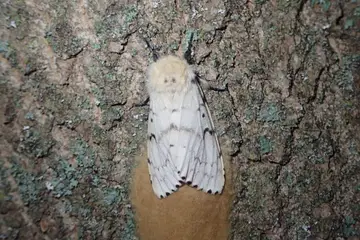
Gypsy moth
Photo: Emmett Collins-Sussman · CC BY 4.0 · iNaturalist

Gypsy moth

Lymantria dispar

Not stated Invasive

Venom
No official source we use states whether this animal is venomous. That does not mean it is harmless: do not handle it.
Size
Mature caterpillars 1.5 to 2.5 inches long (Missouri: up to 2 inches). Male moths about 1.5-inch wingspread; females larger, about 2 to 2.5 inches.
How to recognize it
  • Older caterpillars have a double row of five pairs of blue spots followed by six pairs of red spots down the back, and tufts of hair on each segment.
  • Spongy moth caterpillars do not make silk webs or tents.
  • Females are white and cannot fly; males are brown and fly erratically in daytime in July and August.
Where in Alaska
The Asian strain has been discovered in the U.S. and Canada recently, and a single male moth was found in a Fairbanks campground in 2006. Alaska Department of Fish and Game

Full Gypsy moth guide

No confirmed photo of Hare or Rabbit Tick (arachnid)

Hare or Rabbit Tick (arachnid)

Haemaphysalis leporispalustris

Not stated Tick: an arachnid, not an insect

Venom
No official source we use states whether this animal is venomous. That does not mean it is harmless: do not handle it.
No confirmed photo of Seabird Tick (arachnid)

Seabird Tick (arachnid)

Ixodes signatus

Not stated Tick: an arachnid, not an insect

Venom
No official source we use states whether this animal is venomous. That does not mean it is harmless: do not handle it.
No confirmed photo of Seabird Tick (arachnid)

Seabird Tick (arachnid)

Ixodes uriae

Not stated Tick: an arachnid, not an insect

Venom
No official source we use states whether this animal is venomous. That does not mean it is harmless: do not handle it.
No confirmed photo of Squirrel or Vole Tick (arachnid)

Squirrel or Vole Tick (arachnid)

Ixodes angustus

Not stated Tick: an arachnid, not an insect

Venom
No official source we use states whether this animal is venomous. That does not mean it is harmless: do not handle it.
No confirmed photo of Yellowjackets

Yellowjackets

Vespinae (subfamily)

Not stated

Venom
No official source we use states whether this animal is venomous. That does not mean it is harmless: do not handle it.
Danger to people
“Some species are nuisance pests when their stinging and scavenging behavior puts them in contact with humans.” University of Alaska Fairbanks Cooperative Extension Service

When insects are active in Alaska

Records of insects in Alaska peak in June to July. They show when people record insects, not how many there are (about month bars).

14,823 records of insects in Alaska by month (GBIF, CC0 and CC BY records).

If you are bitten or stung

Call 911 or Poison Help at 1-800-222-1222 right away. Poison Help connects you to your local poison center, any time of day.

How to report

Report invasive species to the ADF&G Invasive Species Hotline 1-877-INVASIV (1-877-468-2748) or [email protected]. Report dangerous wildlife encounters with the ADF&G wildlife encounter form (https://www.adfg.alaska.gov/index.cfm?adfg=reportwildlifeencounter.main). Alaska Department of Fish and Game

About this list

The species list comes from No official complete list; stinging insects and ticks from UAF Cooperative Extension, ADF&G and Alaska DEC (Office of the State Veterinarian) pages (University of Alaska Fairbanks Cooperative Extension Service, various; see sources). 9 more entries come from other official sources named on each card.

Venom labels come only from official sources and link to them; "Not stated" never means harmless. How labels work.

"Nonnative" and "Invasive" follow the wording of the source list. See invasive species in Alaska.

Sources

  1. Our Agency: Mission. Alaska Department of Fish and Game. undated page; checked November 3, 2026.
  2. Beneficial Arthropods of Alaska: Natural Enemies (PMC-10075). University of Alaska Fairbanks Cooperative Extension Service. Revised January 2023; checked November 3, 2026.
    Quoted passages (1)
    “Some species are nuisance pests when their stinging and scavenging behavior puts them in contact with humans.”
  3. Invasive Species. Alaska Department of Fish and Game. undated page; checked November 3, 2026.
  4. Invasive Species: Gypsy Moth (Distribution). Alaska Department of Fish and Game. undated page; checked November 3, 2026.
  5. Information on Ticks. Alaska Department of Environmental Conservation, Office of the State Veterinarian. archived copy, captured May 21, 2026; checked November 3, 2026.
  6. Dog ticks have been introduced and are establishing in Alaska (Wildlife Health and Disease Surveillance Program memorandum). Alaska Department of Fish and Game. 2016 (per file name; checked November 3, 2026.
    Quoted passages (1)
    “The American dog tick is a vector of Rocky Mountain Spotted Fever (RMSF) and tularemia.”
  7. Ticks and Tickborne Disease Information. Alaska Department of Health, Section of Epidemiology. archived copy, captured March 26, 2025; checked November 3, 2026.
    Quoted passages (1)
    “Tularemia occurs sporadically in Alaska, and humans can become infected from a tick bite and through direct contact with an infected animal.”
  8. How to Report an Invasive Species you saw in Alaska. Alaska Department of Fish and Game. undated page; checked November 3, 2026.
    Quoted passages (1)
    “Call the Invasive Species Hotline: 1-877-INVASIV (1-877-468-2748)”
  9. GBIF.org occurrence records, human observations licensed CC0 1.0 or CC BY 4.0 only, accessed November 3, 2026. The datasets behind these counts are listed on our Sources page.