Spongy moth
Lymantria dispar · also called gypsy moth (former name), European gypsy moth and European spongy moth · Last checked November 3, 2026.
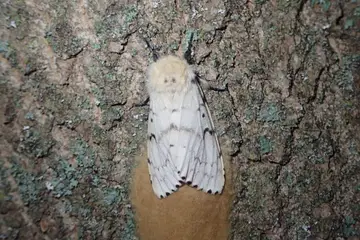
The spongy moth, formerly called the gypsy moth, is an invasive moth from Europe that was introduced into Massachusetts in 1869 and now infests the northeastern US. Its caterpillars are hairy, grow to about 1.5 to 2.5 inches, and have five pairs of blue spots followed by six pairs of red spots on the back. In outbreak years they strip oaks and many other trees. No official source checked calls it venomous, but Wisconsin DNR warns that the caterpillar hairs can cause skin rashes and other reactions in some people, and says not to touch them. USDA APHIS says it is currently found in 20 states and Washington, D.C., from Maine to North Carolina and west to Wisconsin, Illinois and Minnesota, and that all states are at high risk. Missouri reports occasional finds but no known infestations. MDC
On this page
Is the spongy moth dangerous?
Wisconsin DNR: the caterpillar hairs can cause skin rashes and other reactions in some people; don't touch the caterpillars. Wisconsin Department of Natural Resources
“In addition, the caterpillar hairs can cause skin rashes and other reactions in some people.”
No official source we use states whether this animal is venomous. That does not mean it is harmless: do not handle it.
If someone is bitten or stung, call 911 or Poison Help at 1-800-222-1222.
How to identify a spongy moth
A photo or description can narrow it down, but cannot confirm what an animal is or that it is safe. Look from a distance and do not handle wild animals.
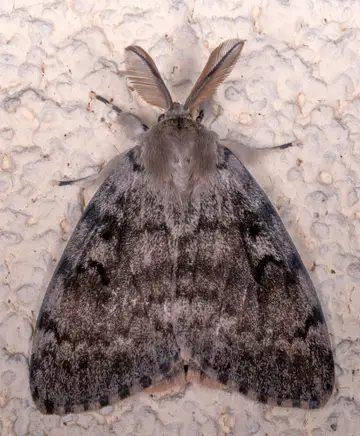

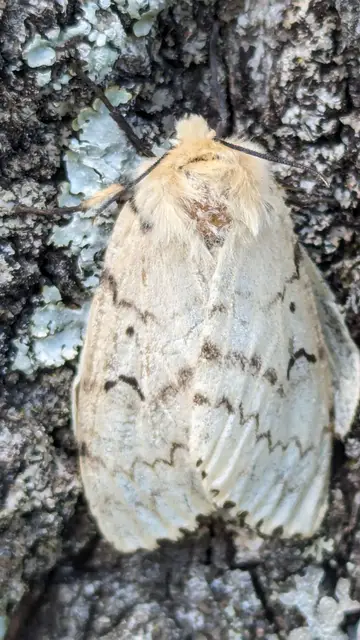
Size: Mature caterpillars 1.5 to 2.5 inches long (Missouri: up to 2 inches). Male moths about 1.5-inch wingspread; females larger, about 2 to 2.5 inches. Vermont Invasives
Colors: brownish-gray (caterpillar); blue and red spots (caterpillar); tan to brown (male moth); white or cream (female moth); buff/tan (egg mass). Pattern: 5 pairs of blue spots then 6 pairs of red spots (caterpillar); hairy tufts; dark wavy bands on wings.
Key features
- Older caterpillars have a double row of five pairs of blue spots followed by six pairs of red spots down the back, and tufts of hair on each segment. Vermont Invasives
- Spongy moth caterpillars do not make silk webs or tents. Wisconsin Department of Natural Resources, Forest Health Program
- Females are white and cannot fly; males are brown and fly erratically in daytime in July and August. Wisconsin Department of Natural Resources, Forest Health Program
- Egg masses are tan, fuzzy or velvety, about 1 to 1.5 inches long, plastered on trees, rocks, buildings, vehicles and outdoor objects; the name 'spongy' refers to them. MDC
Young
Younger caterpillars are dark with orange dots along the back; the blue and red spot pairs appear as they grow.
Animals mistaken for the spongy moth
Spongy moth or Eastern tent caterpillar?
Spongy moth
Eastern tent caterpillar Malacosoma americanum
Eastern tent caterpillar has a dark head, a cream or yellow stripe down the back and small blue spots on the sides, and builds silk nests in branch forks. Spongy moth has pairs of blue then red dots and makes no web or tent. Wisconsin Department of Natural Resources, Forest Health Program
Not stated for this species alone; WI DNR's caution about irritating hairs covers all three spring defoliator caterpillars on its sheet.
Spongy moth or Forest tent caterpillar?
Spongy moth
Forest tent caterpillar Malacosoma disstria
Forest tent caterpillar has a blue head, cream or yellow footprint-shaped spots down the back and blue side stripes, and makes no silk nests, though WI DNR says silk may be found on bark or along twigs. Wisconsin Department of Natural Resources, Forest Health Program
Not stated for this species alone; WI DNR's caution about irritating hairs covers all three spring defoliator caterpillars on its sheet.
Spongy moth or Native tussock moths (adults)?
Spongy moth
Native tussock moths (adults)
Compared with male spongy moths, native tussock moths have erratic diamond patterns on the wings and are smaller. MDC
Spongy moth or Underwing moths (adults)?
Spongy moth
Underwing moths (adults) Catocala
Underwing moths have erratic zigzag wing lines and are larger than male spongy moths. MDC
Where the spongy moth lives
- Native or listed
- Nonnative or not established
- No official record in our data
- 1–9
- 10–99
- 100–999
- 1,000+
On our state guides
- Alaska insects and bugsNonnative
- Colorado insects and bugsNonnative
- Delaware insects and bugsNonnative
- Indiana insects and bugsNonnative
- Maine insects and bugsNonnative
- Maryland insects and bugsNonnative
- New Jersey insects and bugsNonnative
- Vermont insects and bugsNonnative
- West Virginia insects and bugsNonnative
- Wisconsin insects and bugsNonnative
State boundaries: U.S. Census Bureau, cartographic boundary file cb_2024_us_state_20m.
When it is active
Eggs hatch mid-April to mid-May; caterpillars are seen on tree trunks and buildings in June and July; pupae late June to August; moths fly in July and August. Egg masses stay on surfaces through winter. Wisconsin Department of Natural Resources, Forest Health Program
US open-licence records peak in June to July.
Habitat and habits
Habitat: Oak hardwood forests of the eastern US; can also live in urban areas. Colorado Parks and Wildlife
Behavior: Caterpillars tend to feed at night and hide in sheltered spots by day. Young caterpillars spread by 'ballooning' on silk threads carried by the wind. Numbers boom in outbreaks about every 10 to 12 years in Wisconsin, lasting 2 to 3 years.
Diet: Caterpillars eat the leaves of more than 300 trees and shrubs, favoring oak, apple, alder, basswood, birch, poplar, sweet gum, willow and hawthorn; older ones also eat evergreens. Adults do not feed.
Young: One generation per year. Each female lays a single egg mass of several hundred eggs (Vermont: 500 to 1,000) in summer, covered with hair from her body; the eggs overwinter and hatch in spring.
Legal status and reporting
Federal: Regulated by USDA APHIS under a federal domestic quarantine (7 CFR 301.45 through 301.45-12); APHIS publishes the list of quarantined areas on its website. USDA Animal and Plant Health Inspection Service, in the Federal Register
Invasive status: Invasive, nonnative and extremely destructive (Missouri); one of the most destructive pests of fruit and ornamental trees and hardwood forests (APHIS). MDC
Report: Report it if you are outside the known infested area. Wisconsin (non-quarantined counties): call 1-800-642-MOTH (6684) or email [email protected]. Minnesota: report new locations to the Minnesota Department of Agriculture, 1-888-545-6684. Missouri: MDC asks people to watch for and report any occurrences. Elsewhere outside quarantine areas, USDA APHIS says to contact your State plant health director or State plant regulatory official. Wisconsin Department of Natural Resources
Questions about the spongy moth
Invasive moth species maryland
Maryland DNR lists the gypsy moth (now called spongy moth, Lymantria dispar) among the state's invasive animals, in forests in western Maryland, and USDA APHIS lists Maryland among the states where it is currently found.
Invasive moth species massachusetts
The spongy moth (formerly gypsy moth) was first introduced in Medford, Massachusetts, in 1869, according to USDA APHIS, which still lists Massachusetts among the states where it is currently found.
Invasive moth species pennsylvania
The spongy moth (formerly gypsy moth) is present: USDA APHIS lists Pennsylvania among the states where it is currently found.
Caterpillar identification wisconsin
Wisconsin DNR says three caterpillars commonly found on defoliating trees in spring can sometimes be mistaken for one another. Spongy moth: yellow and black head, pairs of blue dots near the head and red dots behind, no silk tent. Eastern tent caterpillar: dark head, a cream or yellow stripe down the back, and silk nests in branch forks. Forest tent caterpillar: blue head, footprint-shaped spots down the back, no silk nests (silk may be on bark or twigs). DNR advises not touching any of them because the hairs can irritate skin and may cause a rash.
Sources
- MDC Field Guide: Spongy Moth. Missouri Department of Conservation (MDC). undated page; checked November 3, 2026.
Quoted passages (4)
“Egg masses are about an inch long, buff- or cream-colored, fuzzy, and are often "plastered" onto trees, rocks, and other objects, looking like a gum wad under a chair. The common name is in reference to the spongy quality of the egg masses.”
“Extremely destructive, invasive, nonnative species.”
“Our native tussock moths have erratic diamond patterns on the wings and are smaller.”
“Underwing moths (genus Catocala) have erratic zigzag lines on the wings and are larger.”
- Notice of Request for Extension of Approval of an Information Collection; Spongy Moth Identification Worksheet and Checklist (FR Doc. 2026-07891). USDA Animal and Plant Health Inspection Service, in the Federal Register. April 23, 2026; checked November 3, 2026.
Quoted passages (1)
“The spongy moth regulations can be found in 7 CFR 301.45 through 301.45-12.”
- Spongy Moth (formally gypsy moth). Vermont Invasives (Vermont Department of Forests, Parks and Recreation and UVM Extension). undated page; checked November 3, 2026.
Quoted passages (5)
“Mature larvae are from 1 1/2 to 2 1/2 inches long.”
“Older larvae (caterpillars) are brownish-gray, with tufts of hair on each segment and a double row of five pairs of blue spots, followed by six pairs of red spots, on the back.”
“Favored hosts include oak, apple, alder, basswood, birch, poplar, sweet gum, willow, and hawthorn.”
“The caterpillars are voracious eaters, tend to feed at night, and gather in protected areas during the day.”
“This species produces one generation per year. Eggs: egg mass are laid in the fall and will typically contain between 500 and 1,000 eggs per mass.”
- Spongy moth. Wisconsin Department of Natural Resources. undated page; checked November 3, 2026.
Quoted passages (2)
“In addition, the caterpillar hairs can cause skin rashes and other reactions in some people.”
“If you do, call 1-800-642-MOTH (6684) or email [email protected] to report it”
- Spongy Moth (Forest Health Fact Sheet, PUB-FR-824). Wisconsin Department of Natural Resources, Forest Health Program. May 2023; checked November 3, 2026.
Quoted passages (3)
“Spongy moth caterpillars do not make a silk web or tent in trees.”
“The female moths are white and cannot fly even though they have wings. The males are brown and fly erratically during the daytime in July and August.”
“Eggs hatch between mid-April and mid-May.”
- 7 CFR 301.45-3 Generally infested areas (point-in-time version 2022-12-29). eCFR (Office of the Federal Register); USDA APHIS regulation. eCFR version 2022-12-29; checked November 3, 2026.
- Spongy Moth. USDA Animal and Plant Health Inspection Service. page last modified 2026-09-17; checked November 3, 2026.
- Spring Defoliator Caterpillars: Comparisons, Differences, Controls (PUB-FR-622p). Wisconsin Department of Natural Resources, Forest Health Program. July 2023; checked November 3, 2026.
Quoted passages (3)
“Younger caterpillars are dark, with orange dots along the back.”
“Description: Dark head, cream or yellow stripe down the back; small blue spots on sides.”
“Description: Blue head; cream or yellow-colored spots in the shape of footprints down the back; blue stripes on the sides.”
- Species profile: Spongy Moth. Colorado Parks and Wildlife. undated page; checked November 3, 2026.
Quoted passages (1)
“It is well established in oak hardwood forests of the eastern United States, but could survive in urban settings as well.”
- Invasive and Exotic Species in Maryland: Animals. Maryland Department of Natural Resources (DNR). archived copy, captured May 15, 2026; checked November 3, 2026.
- GBIF.org occurrence records, human observations licensed CC0 1.0 or CC BY 4.0 only, accessed November 3, 2026. The datasets behind these counts are listed on our Sources page.
- State boundaries: U.S. Census Bureau, cartographic boundary file cb_2024_us_state_20m.