This page lists 25 insects and 1 tick.
2 are venomous by official accounts. 4 are nonnative.
Not every species: no complete official list of Colorado insects exists, so this page covers the ones state and Extension sources name. How lists are built.
Which insects can hurt you
Official sources single out these insects in Colorado, in their own words:
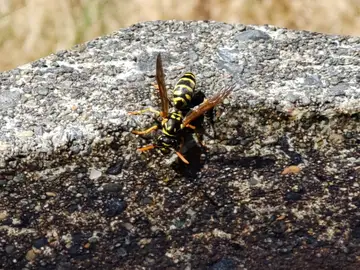
Yellowjackets
Stings. “Several yellowjacket species are native to Colorado and these historically have been the most significant stinging insects of the region.” Colorado State University Extension
Very painful sting. “Female tarantula hawks have one of the most painful stings of all insects but are docile and rarely sting humans.” Colorado State University Extension
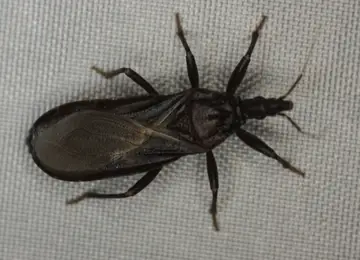
Disease. “The greatest concern about these insects is that they can transmit a pathogen (Trypanosoma cruzi) that produces Chagas Disease.” Colorado State University Extension
Culex mosquitoes
Disease. “Culex tarsalis, one of the main West Nile virus vectors, commonly occurs up to altitudes of 8,500 feet and is found as high as 10,000 feet above sea level.” Colorado State University Extension
“Female tarantula hawks have one of the most painful stings of all insects but are docile and rarely sting humans.” Colorado State University Extension
What the sources say
Venom: “They have among the largest quantity of venom per body mass of any insect (Schmidt 2004).” (Colorado State University Extension)
Venom: “…the implied claim about its ability to kill a cow is absurd and their venom is not particularly toxic.” (CSU Extension, Western Colorado Insects (Tri River Area) - Colorado Insects of Interest)
No confirmed photo of American Bumble Bee
American Bumble Bee
Bombus pensylvanicus
Not stated
Venom
No official source we use states whether this animal is venomous. That does not mean it is harmless: do not handle it.
Where in Colorado
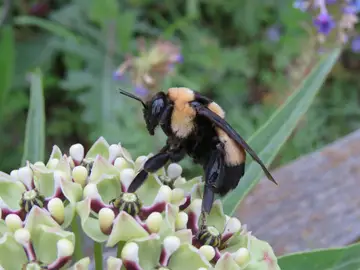
As its name suggests, the American bumble bee has a large range across most of the United States. However, it is largely absent from much of the mountain West. Colorado Parks and Wildlife
What the sources say
Habitat: The American bumble bee is primarily found in grassland habitats but can also be found in urban environments. (Colorado Parks and Wildlife)
No official source we use states whether this animal is venomous. That does not mean it is harmless: do not handle it.
Size
Missouri: workers 1/2 to 3/4 inch, queens 3/4 inch. University of Maryland: workers 5/8 to 3/4 inch, queens just over an inch. Penn State gives 13 to 20 mm for the queen and her offspring.
How to recognize it
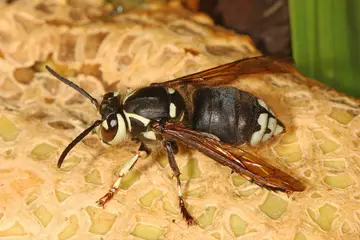
Not yellow, unlike typical yellowjackets; larger, black and ivory
Large, rounded, gray paper nest hanging in trees or shrubs, sometimes on buildings
Nest entrance is the lowest opening of the cone- or egg-shaped nest
No official source we use states whether this animal is venomous. That does not mean it is harmless: do not handle it.
Where in Colorado
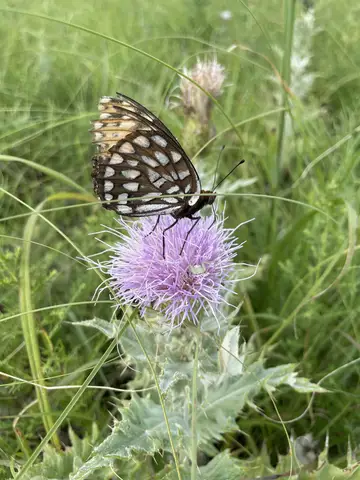
Large marbles, the species, can be found across the western United States and Canada; however, only the subspecies Colorado large marble can be found in Colorado. Colorado Parks and Wildlife
What the sources say
Habitat: The large marble prefers grasslands and meadows, as well as riparian areas. (Colorado Parks and Wildlife)
No official source we use states whether this animal is venomous. That does not mean it is harmless: do not handle it.
Size
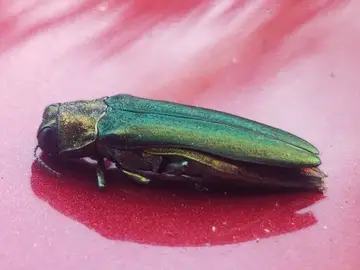
About 3/8 to 1/2 inch long and 1/8 inch wide; small enough to fit on a penny
How to recognize it
Slender, bullet-shaped body
Signs on ash trees: S-shaped galleries under the bark and D-shaped exit holes about 1/8 inch across
Tree symptoms: dead branches near the top, sprouts on the trunk, vertical bark cracks, and woodpecker 'blonding'
What the sources say
Habitat: The emerald ash borer relies on ash trees (genus Fraxinus) to complete its life cycle. Adult female beetles lay eggs on the bark of ash trees, and the resulting larvae chew their way into the cambium (inner) layer of the tree bark. The larvae remain here until they emerge as adults. (Colorado Parks and Wildlife)
No official source we use states whether this animal is venomous. That does not mean it is harmless: do not handle it.
Size
Adults about 1/3 to 1/2 inch long (WSDA); 7/16 inch (Kentucky); 3/8 inch long and 1/4 inch wide (Iowa State).
How to recognize it
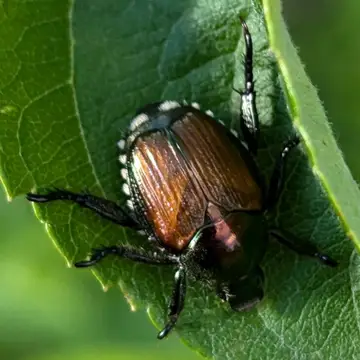
Row of five white hair tufts on each side of the abdomen
Leaves eaten between the veins look lace-like (skeletonized)
JFMAMJJASOND
280 records by month.What the sources say
Habitat: Most beetle larvae pass the winter 2-6 inches below the soil surface, although some may go as deep as 8-10 inches. They live in the soil and feed on grass roots, among other plant species. (Colorado Parks and Wildlife)
No official source we use states whether this animal is venomous. That does not mean it is harmless: do not handle it.
Where in Colorado
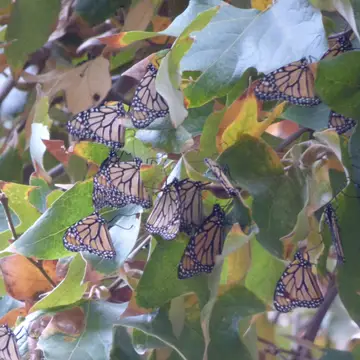
Monarchs can be found across North America, with their summer range extending all the way into the southern part of Canada, and the migration taking them down into the … Colorado Parks and Wildlife
JFMAMJJASOND
1,407 records by month.What the sources say
Range: Monarchs can be found across North America, with their summer range extending all the way into the southern part of Canada, and the migration taking them down into the heart of Mexico.
Habitat: Monarchs require an abundance of their milkweed host plants across their entire summer breeding range. Adults also require abundant nectar sources throughout the breeding season. As long as these needs are met, monarchs will occupy a vast diversity of habitat types, from grasslands and wetlands, to roadsides, urban gardens and agricultural fields. (Colorado Parks and Wildlife)
No confirmed photo of Morrison's Bumble Bee
Morrison's Bumble Bee
Bombus morrisoni
Not stated
Venom
No official source we use states whether this animal is venomous. That does not mean it is harmless: do not handle it.
What the sources say
Habitat: This species is typically found in dry shrubland habitats. Data from the Xerces Bumble Bee Atlas demonstrated it was also surprisingly common in sagebrush and human-altered habitats. (Colorado Parks and Wildlife)
No confirmed photo of Nokomis Fritillary or Great Basin Silverspot
Nokomis Fritillary or Great Basin Silverspot
Argynnis nokomis nokomis
Not stated
Venom
No official source we use states whether this animal is venomous. That does not mean it is harmless: do not handle it.
Where in Colorado
This subspecies is found in western Colorado, eastern Utah, and northern New Mexico and Arizona. Colorado Parks and Wildlife
Conservation
CPW: Federally Threatened
What the sources say
Habitat: The Great Basin silverspot requires wet meadow habitats with an abundance of bog violets. (Colorado Parks and Wildlife)
No confirmed photo of Northern house mosquito
Northern house mosquito
Culex pipiens
Not stated
Venom
No official source we use states whether this animal is venomous. That does not mean it is harmless: do not handle it.
No confirmed photo of Pawnee Montane Skipper
Pawnee Montane Skipper
Hesperia leonardus montana
Not stated
Venom
No official source we use states whether this animal is venomous. That does not mean it is harmless: do not handle it.
Where in Colorado
The Pawnee montane skipper is endemic to Colorado, meaning it lives in Colorado and nowhere else on Earth … Colorado Parks and Wildlife
Conservation
CPW: Federally Threatened
What the sources say
Range: The Pawnee montane skipper is endemic to Colorado, meaning it lives in Colorado and nowhere else on Earth. It occupies a very narrow area of approximately 25,044 acres, predominantly in Pike National Forest.
Habitat: The Pawnee montane skipper’s habitat is highly specific, limited to open ponderosa pine woodlands within an elevational range of 6,000 to 7,500 feet. The sites must have blue grama grass (the host plant for the caterpillars) and prairie gayfeather (the primary food for adults). The skipper has a very narrow range of about 25,044 acres, mostly limited to the small area where ponderosa pine and blue grama communities overlap. (Colorado Parks and Wildlife)
No confirmed photo of Rocky Mountain wood tick (arachnid; listed here with biting pests)
Rocky Mountain wood tick (arachnid; listed here with biting pests)
Dermacentor andersoni
Not statedTick: an arachnid, not an insect
Venom
No official source we use states whether this animal is venomous. That does not mean it is harmless: do not handle it.
No official source we use states whether this animal is venomous. That does not mean it is harmless: do not handle it.
Size
Mature caterpillars 1.5 to 2.5 inches long (Missouri: up to 2 inches). Male moths about 1.5-inch wingspread; females larger, about 2 to 2.5 inches.
How to recognize it
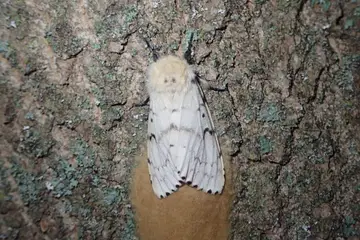
Older caterpillars have a double row of five pairs of blue spots followed by six pairs of red spots down the back, and tufts of hair on each segment.
Spongy moth caterpillars do not make silk webs or tents.
Females are white and cannot fly; males are brown and fly erratically in daytime in July and August.
What the sources say
Habitat: It is well established in oak hardwood forests of the eastern United States, but could survive in urban settings as well. (Colorado Parks and Wildlife)
No official source we use states whether this animal is venomous. That does not mean it is harmless: do not handle it.
Where in Colorado
Historically, Suckley’s cuckoo bumble bee had a broad range across western North America … Colorado Parks and Wildlife
What the sources say
Range: Historically, Suckley’s cuckoo bumble bee had a broad range across western North America. However, its range has been vastly reduced; it hasn't been documented in Colorado in a decade.
Habitat: Historically, Suckley’s cuckoo bumble bee has lived in grassland and meadow habitats across a wide range of elevations. Prime habitat contains a high abundance and diversity of flowers. (Colorado Parks and Wildlife)
No confirmed photo of Uncompahgre Fritillary
Uncompahgre Fritillary
Boloria improba acrocnema
Not stated
Venom
No official source we use states whether this animal is venomous. That does not mean it is harmless: do not handle it.
Where in Colorado
The UFB is endemic to Colorado, meaning it lives in Colorado and nowhere else on Earth … Colorado Parks and Wildlife
Conservation
CPW: Federally Endangered
What the sources say
Range: The UFB is endemic to Colorado, meaning it lives in Colorado and nowhere else on Earth. It’s found only in a narrow range in high alpine sites above 11,800 feet in the San Juan Mountains.
Habitat: The UFB requires habitat on northeastern facing slopes above 11,800 feet that have the correct microclimate and their host plant, snow willow (Salix nivalis). (Colorado Parks and Wildlife)
No confirmed photo of Variable Cuckoo Bumble Bee
Variable Cuckoo Bumble Bee
Bombus variabilis
Not stated
Venom
No official source we use states whether this animal is venomous. That does not mean it is harmless: do not handle it.
Where in Colorado
The variable cuckoo bumble bee has historically been predominantly an eastern species. Colorado is at the western edge of its historic range. Colorado Parks and Wildlife
What the sources say
Habitat: In the west, variable cuckoo bumble bees mainly live in open grasslands. Habitats well-suited for its host, the American bumble bee, are key habitats. (Colorado Parks and Wildlife)
No confirmed photo of Western Bumble Bee
Western Bumble Bee
Bombus occidentalis
Not stated
Venom
No official source we use states whether this animal is venomous. That does not mean it is harmless: do not handle it.
Where in Colorado
Prior to 1998, the western bumble bee was widely distributed across the western United States and Canada … Colorado Parks and Wildlife
What the sources say
Range: Prior to 1998, the western bumble bee was widely distributed across the western United States and Canada. Its numbers have since dramatically declined, and its range is very limited.
Habitat: Based on observations from the Xerces Society Bumble Bee Atlas, the western bumble bee is found mostly in meadows and grasslands. However, it can be found in a wide diversity of habitats spanning 5,000 to 11,000 feet in elevation, including roadsides, shrublands, agricultural fields, urban areas and forests. (Colorado Parks and Wildlife)
No official source we use states whether this animal is venomous. That does not mean it is harmless: do not handle it.
Danger to people
“The greatest concern about these insects is that they can transmit a pathogen (Trypanosoma cruzi) that produces Chagas Disease.” Colorado State University Extension
No confirmed photo of Western encephalitis mosquito (Culex tarsalis)
Western encephalitis mosquito (Culex tarsalis)
Culex tarsalis
Not stated
Venom
No official source we use states whether this animal is venomous. That does not mean it is harmless: do not handle it.
Danger to people
“Culex tarsalis, one of the main West Nile virus vectors, commonly occurs up to altitudes of 8,500 feet and is found as high as 10,000 feet above sea level.” Colorado State University Extension
No confirmed photo of Western harvester ant
Western harvester ant
Pogonomyrmex occidentalis
Not stated
Venom
No official source we use states whether this animal is venomous. That does not mean it is harmless: do not handle it.
No official source we use states whether this animal is venomous. That does not mean it is harmless: do not handle it.
Where in Colorado
The western regal fritillary can be found in native grasslands in the central and northern Great Plains. Eastern Colorado is the southwestern limit of its range … Colorado Parks and Wildlife
What the sources say
Range: The western regal fritillary can be found in native grasslands in the central and northern Great Plains. Eastern Colorado is the southwestern limit of its range. It’s thought that sightings in Colorado are not individuals that went through a complete life cycle here, but dispersered from other states in the late season; much of the short-grass prairie habitat is too dry to support large or persistent populations.
Habitat: The western regal fritillary requires habitats with abundant violets (host plants for the caterpillars) and nectar-bearing flowers (food for the adult butterflies). A grassland butterfly, it depends on periodic, natural fires that maintain a high-quality habitat of grasses and forbs (Colorado Parks and Wildlife)
No confirmed photo of Yellowjackets
Yellowjackets
Not stated
Venom
No official source we use states whether this animal is venomous. That does not mean it is harmless: do not handle it.
Danger to people
“Several yellowjacket species are native to Colorado and these historically have been the most significant stinging insects of the region.” Colorado State University Extension
Call 911 or Poison Help at 1-800-222-1222 right away. Poison Help connects you to your local poison center, any time of day.
Official advice from Colorado Parks and Wildlife:
Rattlesnake country: wear sturdy footwear and long pants; watch where you put hands and feet. Colorado Parks and Wildlife
How to report
Invasive species: file a report with CPW (online "Report a Sighting" form linked from cpw.state.co.us/invasive-wildlife). Injured/abandoned animals, feeding or illegal activity: CPW Denver Headquarters 303-297-1192 or any CPW office; anonymous: Operation Game Thief 877-265-6648. After-hours emergency: Colorado State Patrol 303-239-4500. Wildlife posing immediate danger: local CPW office or law enforcement. Colorado Parks and Wildlife
Harvester Ants (Colorado Insects of Interest). CSU Extension, Western Colorado Insects (Tri River Area) - Colorado Insects of Interest. undated page; checked November 3, 2026.Quoted passages (1)
“If their nests are directly disturbed, harvester ants will vigorously defend the mound and are capable of very painful stings.”
Tarantula Hawks of Colorado. Colorado State University Extension. Published August 2025; checked November 3, 2026.Quoted passages (2)
“They have among the largest quantity of venom per body mass of any insect (Schmidt 2004).”
“Female tarantula hawks have one of the most painful stings of all insects but are docile and rarely sting humans.”
Velvet Ants (Colorado Insects of Interest). CSU Extension, Western Colorado Insects (Tri River Area) - Colorado Insects of Interest. undated page; checked November 3, 2026.Quoted passages (2)
“…the implied claim about its ability to kill a cow is absurd and their venom is not particularly toxic.”
“Indeed the sting of a velvet ant is very painful”
“Culex tarsalis, one of the main West Nile virus vectors, commonly occurs up to altitudes of 8,500 feet and is found as high as 10,000 feet above sea level.”