Emerald ash borer
Agrilus planipennis · also called EAB and emerald ash borer beetle · Last checked November 3, 2026.
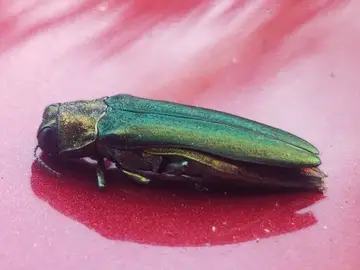
The emerald ash borer (EAB) is a small, metallic green beetle from Asia, about half an inch long, that kills ash trees. Its larvae tunnel under the bark in S-shaped galleries, and adults leave D-shaped exit holes. Rhode Island DEM says it poses no human health risk. The danger to people comes from EAB-killed ash trees, which become brittle and can drop limbs or fall. USDA APHIS reports infestations in 38 states and the District of Columbia. Washington confirmed its first detection in August 2026. APHIS
On this page
Is the emerald ash borer dangerous?
Rhode Island DEM: EAB does not pose any human health risk. The hazard is from infested and dead ash trees, which become brittle and can fall or drop branches. Rhode Island Department of Environmental Management
“EAB does not pose any human health risk.”
No official source we use states whether this animal is venomous. That does not mean it is harmless: do not handle it.
How to identify an emerald ash borer
A photo or description can narrow it down, but cannot confirm what an animal is or that it is safe. Look from a distance and do not handle wild animals.
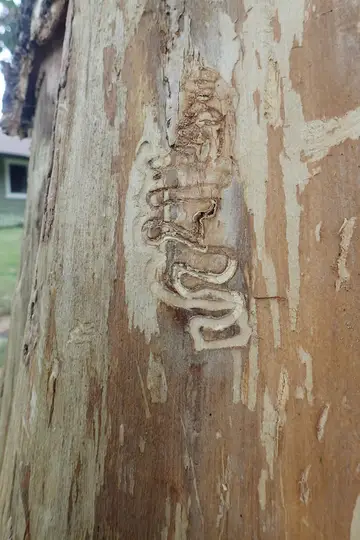

Size: About 3/8 to 1/2 inch long and 1/8 inch wide; small enough to fit on a penny Minnesota Department of Agriculture
Colors: Metallic green with a coppery-red abdomen; dark metallic green; top of the abdomen under the wings is metallic purplish red.
Key features
- Slender, bullet-shaped body Missouri Department of Conservation
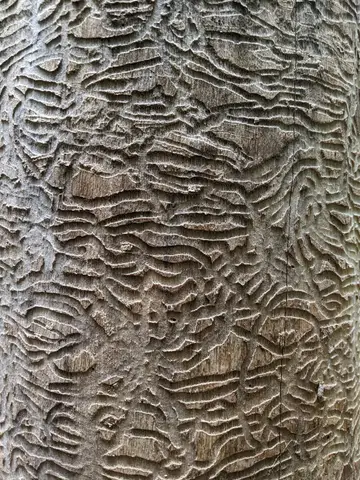
- Signs on ash trees: S-shaped galleries under the bark and D-shaped exit holes about 1/8 inch across Missouri Department of Conservation
- Tree symptoms: dead branches near the top, sprouts on the trunk, vertical bark cracks, and woodpecker 'blonding' APHIS
- Attacks ash trees (Fraxinus); also found on white fringetree Purdue University Extension Entomology
Young
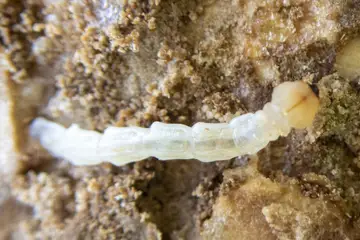
Larvae are cream-colored, flattened, worm-like, with bell-shaped segments and two spine-like projections at the tail end; about 1 inch long when grown
Animals mistaken for the emerald ash borer
Emerald ash borer or Japanese beetle?
Emerald ash borer
Japanese beetle Popillia japonica
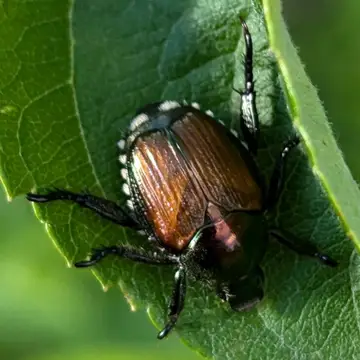
Listed by the Minnesota Department of Agriculture and DNR among insects confused with EAB. The sheet gives photos, not a written test. Minnesota Department of Agriculture and Minnesota DNR
Emerald ash borer or Six-spotted tiger beetle?
Emerald ash borer
Six-spotted tiger beetle Cicindela sexguttata
Listed by MDA and MN DNR among insects confused with EAB (photo sheet; no written test) Minnesota Department of Agriculture and Minnesota DNR
Emerald ash borer or Bronze birch borer and two-lined chestnut borer (native Agrilus)?
Emerald ash borer
Bronze birch borer and two-lined chestnut borer (native Agrilus)
Listed by MDA and MN DNR among insects confused with EAB. Minnesota Department of Agriculture
Emerald ash borer or Green stink bug, Buprestis metallic wood-boring beetle, others?
Emerald ash borer
Green stink bug, Buprestis metallic wood-boring beetle, others
MDA sheet lists 16 insects confused with EAB, including the green stink bug and Buprestis metallic wood-boring beetle Minnesota Department of Agriculture and Minnesota DNR
Where the emerald ash borer lives
- Native or listed
- Nonnative or not established
- No official record in our data
- 1–9
- 10–99
- 100–999
- 1,000+
On our state guides
- Colorado insects and bugsNonnative
- Indiana insects and bugsNonnative
- Iowa insects and bugsNonnative
- Louisiana insects and bugsNonnative
- Maryland insects and bugsNonnative
- New Jersey insects and bugsNonnative
- Vermont insects and bugsNonnative
- West Virginia insects and bugsNonnative
- Wisconsin insects and bugsNonnative
State boundaries: U.S. Census Bureau, cartographic boundary file cb_2024_us_state_20m.
When it is active
Adults emerge in spring and stay active until the end of summer (APHIS). Minnesota treats May 1 to September 30 as flight season. Missouri: adults most active by day, late May to mid-June. APHIS
US open-licence records peak in March to July and December.
Habitat and habits
Habitat: Ash trees in forests and in urban, suburban and rural settings; spread long distances in infested firewood, logs and nursery stock APHIS
Behavior: Adults live about three weeks and are most active on warm, sunny days. They fly well, but spread on their own only about half a mile a year (Purdue); people move them in firewood.
Diet: Larvae feed on the inner bark (phloem) of ash trees, cutting off water and nutrients; adults nibble ash leaves and do little damage
Young: Usually a 1-year life cycle (1-2 years in Minnesota). A female lays 30-60 eggs singly in ash bark crevices; larvae hatch in 7-10 days, feed under the bark and overwinter there
Legal status and reporting
Federal: APHIS removed its domestic EAB quarantine regulations (final rule effective January 14, 2021). APHIS
Invasive status: Invasive wood-boring beetle from Asia APHIS
Report: USDA APHIS: report a suspected sighting or ash damage with the APHIS online form, or call 1-866-322-4512. Many states run their own lines, e.g. Minnesota 'Report a Pest' 1-888-545-6684; Washington: report to the Washington Invasive Species Council (Washington Invasives app; the email [email protected] is for reports seen on social media); Texas EAB hotline 1-866-322-4512. APHIS
Questions about the emerald ash borer
Emerald ash borer in washington state
Yes. WSDA and USDA APHIS confirmed emerald ash borer in Vancouver, Washington. USDA confirmed the specimen on August 19, 2026; it was Washington's first detection. WSDA's firewood quarantine took effect August 18, 2026. Report suspected sightings to the Washington Invasive Species Council.
Emerald ash borer minnesota
Yes. EAB was first found in Minnesota in 2009 (Minnesota Department of Agriculture). It is regulated at the state level, and MDA keeps an EAB status map of affected areas and quarantine boundaries. Report suspects to MDA at 1-888-545-6684.
Emerald ash borer larvae
The larvae are cream-colored and flattened with bell-shaped segments and two small spine-like projections at the tail end (MDA). They feed under the bark of ash trees in S-shaped galleries (MDC).
Emerald ash borer damage
Larvae feed under the bark and cut off the tree's water and nutrients (MDC). Signs include dead branches near the top, excessive branching on the trunk, vertical bark cracks, D-shaped exit holes and an increase in woodpecker activity (APHIS). Dead ash trees become brittle and can drop limbs or fall (Purdue).
Emerald ash borer beetle
The adult is a metallic green beetle with a coppery-red abdomen, about half an inch long (APHIS), with a slender, bullet-shaped body (MDC).
Emerald ash borer treatment
APHIS says treatment options are sold at local retail outlets and suggests asking your local Cooperative Extension agent. Wisconsin DNR says protecting ash trees in yards requires insecticide treatment, typically with repeated applications for the life of the tree, and suggests a certified arborist. This site gives no product advice.
Is emerald ash borer harmful to humans?
Rhode Island DEM says EAB does not pose any human health risk. The danger is from dead, EAB-killed ash trees, which become brittle and can drop branches or fall (Purdue, University of Maryland).
Sources
- Emerald Ash Borer. USDA Animal and Plant Health Inspection Service (APHIS). archived copy, captured October 20, 2026; checked November 3, 2026.
Quoted passages (7)
“Symptoms of an infestation may include dead branches near the top of ash trees, excessive branching on tree trunks and vertical cracks in tree bark.”
“This invasive insect can attack and kill healthy ash trees in forests, and urban, suburban and rural settings.”
“Adult beetles live for about three weeks. They are most active during the day, particularly when the weather is warm and sunny.”
“They pupate in winter and emerge as adults in spring, leaving D-shaped exit holes. The adults remain active until the end of summer.”
“APHIS removed its domestic EAB quarantine regulations in 2020. The final rule was effective January 14, 2021.”
“The emerald ash borer (EAB), an invasive wood-boring beetle from Asia, is responsible for the death and decline of tens of millions of ash trees in North America.”
“If you think you've seen the pest or ash tree damage caused by an EAB infestation, please complete the form below. If you have questions or need additional assistance, call 1-866-322-4512.”
- DEM announces Emerald Ash Borer found in Rhode Island (press release). Rhode Island Department of Environmental Management (via RI.gov). Release date: 07-25-2018; checked November 3, 2026.
Quoted passages (1)
“EAB does not pose any human health risk.”
- Emerald Ash Borer FAQ. Purdue University Extension Entomology. undated page; checked November 3, 2026.
Quoted passages (1)
“EAB primarily attacks true ash trees (Faxinus spp.), but it has also been found on white fringetree (Chionanthus virginicus).”
- State officials confirm first detection of emerald ash borer in Washington state. Washington State Department of Agriculture (official GovDelivery bulletin). Bulletin sent 08/19/2026; checked November 3, 2026.
- Emerald Ash Borer. Minnesota Department of Agriculture. undated page; checked November 3, 2026.
Quoted passages (3)
“Adult emerald ash borers are about 3/8 to 1/2 inch long and 1/8 inch wide, small enough to fit on a penny.”
“Larvae are cream-colored with bell-shaped body segments. Larvae have two spine-like projections at the end of the body, called urogomphi, which are a defining characteristic.”
“There are many insects in Minnesota that can be mistaken for EAB due to their size, shape, or metallic green color. Identification can be difficult if the insect is not found associated with an ash tree host.”
- Emerald Ash Borer - Field Guide. Missouri Department of Conservation. undated page; checked November 3, 2026.
Quoted passages (4)
“The adult emerald ash borer is a dark metallic green beetle with a bullet-shaped, slender body.”
“Signs: Larvae feed under the bark of ash trees, leaving S-shaped galleries. Adults emerge from the tree, leaving D-shaped exit holes that are ⅛ inch in diameter.”
“Adult beetles nibble on ash foliage but cause little damage. The larvae, however, feed on the inner bark of ash trees, disrupting the tree's ability to transport water and nutrients, which eventually kills the tree.”
“Usually has a 1-year life cycle. A female can mate numerous times and lay a total of 30-60 eggs before dying at the end of the season.”
- Insects in Minnesota Confused with Emerald Ash Borer. Minnesota Department of Agriculture and Minnesota DNR. file path 2025-07; checked November 3, 2026.
Quoted passages (3)
“11. Japanese Beetle”
“17. Six-spotted Tiger Beetle”
“13. Green Stink Bug”
- Emerald Ash Borer. Wisconsin Department of Natural Resources. undated page; checked November 3, 2026.
- Emerald Ash Borer. University of Maryland Extension. undated page; checked November 3, 2026.
- GBIF.org occurrence records, human observations licensed CC0 1.0 or CC BY 4.0 only, accessed November 3, 2026. The datasets behind these counts are listed on our Sources page.
- State boundaries: U.S. Census Bureau, cartographic boundary file cb_2024_us_state_20m.