This page lists 14 insects.
8 are venomous by official accounts. 7 are nonnative.
Not every species: no complete official list of Indiana insects exists, so this page covers the ones state and Extension sources name. How lists are built.
Which insects can hurt you
Official sources single out these insects in Indiana, in their own words:
Missouri: workers 1/2 to 3/4 inch, queens 3/4 inch. University of Maryland: workers 5/8 to 3/4 inch, queens just over an inch. Penn State gives 13 to 20 mm for the queen and her offspring.
How to recognize it
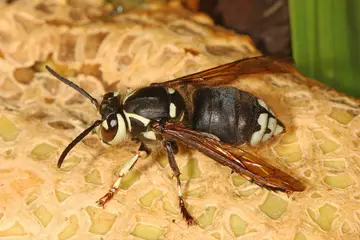
Not yellow, unlike typical yellowjackets; larger, black and ivory
Large, rounded, gray paper nest hanging in trees or shrubs, sometimes on buildings
Nest entrance is the lowest opening of the cone- or egg-shaped nest
JFMAMJJASOND
92 records by month.What the sources say
Venom: “Stings are painful because they inject venom that contains specific chemicals that cause an immediate burning sensation.” (Purdue University Cooperative Extension Service, Department of Entomology)
Venom: “Relatively very little has been reported on the chemistry of bumble bee venoms, but they share at least some allergens with honey bee venom and have been associated with allergic reactions.” (Purdue University Cooperative Extension Service, Department of Entomology)
Workers up to 1 inch (25 mm); queens slightly larger, up to about 1.3 inches.
How to recognize it
Large size plus reddish-brown color on the thorax and first abdominal segment
C-shaped eyes; somewhat hairy body
Flies at night and comes to porch lights
What the sources say
Venom: “Stings are painful because they inject venom that contains specific chemicals that cause an immediate burning sensation.” (Purdue University Cooperative Extension Service, Department of Entomology)
Venom: “Stings are painful because they inject venom that contains specific chemicals that cause an immediate burning sensation.” (Purdue University Cooperative Extension Service, Department of Entomology)
Venom: “Stings are painful because they inject venom that contains specific chemicals that cause an immediate burning sensation.” (Purdue University Cooperative Extension Service, Department of Entomology)
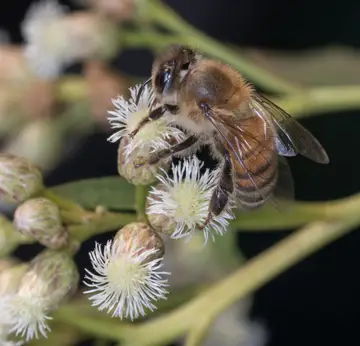
About 10 percent smaller than a European honey bee, a difference too subtle to see without measurement or lab tests.
How to recognize it
Cannot be identified by eye: only DNA testing or microscopic measurements can tell it from a European honey bee.
Clue is behavior and nest site: very defensive, and may nest in small cavities such as water meter boxes, old tires, house eaves or the ground.
JFMAMJJASOND
289 records by month.What the sources say
Venom: “Honey bees are a medical risk because they can be very common even in urban areas, people commonly come in contact with them, colonies can consist of many thousands of workers, workers sting if their colony is disturbed, and their venom contains several chemicals involved in allergic reactions.” (Purdue University Cooperative Extension Service, Department of Entomology)
Venom: “Stings are painful because they inject venom that contains specific chemicals that cause an immediate burning sensation.” (Purdue University Cooperative Extension Service, Department of Entomology)
Venom: “Stings are painful because they inject venom that contains specific chemicals that cause an immediate burning sensation.” (Purdue University Cooperative Extension Service, Department of Entomology)
Habitat: Most build subterranean nests (similar in architecture to baldfaced hornet nests) in such areas as creek banks, the forest floor, lawns, and garden and flower beds. (Purdue University Cooperative Extension Service, Department of Entomology)
No official source we use states whether this animal is venomous. That does not mean it is harmless: do not handle it.
Size
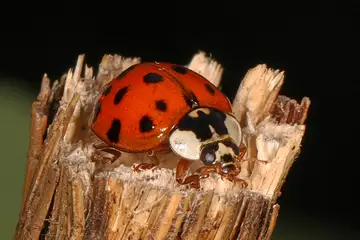
About 1/4 to 1/3 in long; Penn State gives 9/32 in (7 mm) long, larger than most native lady beetles.
How to recognize it
Black mark behind the head, the most reliable identifying feature per Minnesota Extension, which describes it as an M. Penn State and Iowa State describe it as a W, and it may look thick, thin, broken or filled in. It can be hard to see on dark beetles.
Dome-shaped, oval body
Releases a smelly yellow fluid from the leg joints when disturbed, which can stain surfaces
No official source we use states whether this animal is venomous. That does not mean it is harmless: do not handle it.
Size
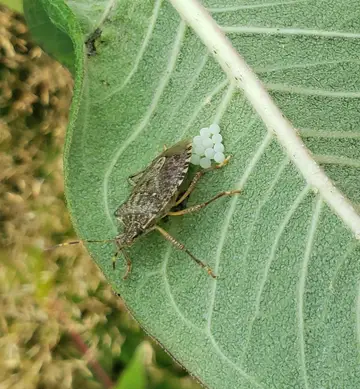
Adults about 5/8 inch (about 17 mm) long; shield-shaped, almost as wide as long.
How to recognize it
Two white bands on the antennae; blunt front edge of head; smooth shoulder margin; dark bands at the tip of the membranous forewings; banded abdominal edge visible beside the wings
Smooth (not spiny) shoulders; slightly larger than most native stink bugs
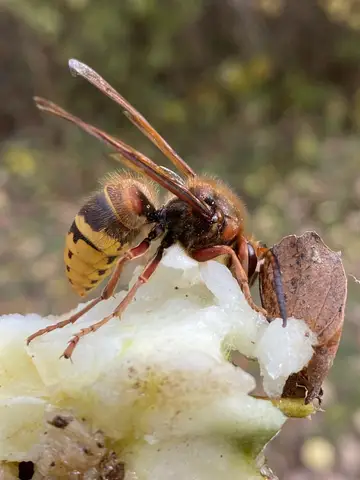
NC State Extension: European hornets are much larger (about 1 1/2 in.), brownish red with a dull yellow abdomen, and rarely build free-hanging or exposed nests (the bald-faced hornet is black and ivory and hangs its nest in the open).
Photos show typical adults; individuals vary. Never get close to compare.
When insects are active in Indiana
Records of insects in Indiana peak in June to August. They show when people record insects, not how many there are (about month bars).
JanFebMarAprMayJunJulAugSepOctNovDec
34,498 records of insects in Indiana by month (GBIF, CC0 and CC BY records).
Blacklegged tick nymphs are most active in spring and summer, adults in fall and early spring, and adults any winter day above freezing. Indiana Department of Health
Call 911 or Poison Help at 1-800-222-1222 right away. Poison Help connects you to your local poison center, any time of day.
Official advice from Indiana Department of Health:
Ticks: prevent bites, use EPA-registered repellent, and check your body for ticks soon after being outdoors. Indiana Department of Health
How to report
Invasive species: report online via EDDMapS or the GLEDN app; terrestrial invasives 1-866-NO-EXOTIC (1-866-663-9684), [email protected]; aquatic invasives [email protected]. Nuisance wildlife: DNR does not remove wildlife; hire a licensed wildlife control operator; DNR Customer Service 317-232-4200 or [email protected]. Mammal sightings (armadillo, mountain lion, etc.): DNR Report a Mammal form. Gecko / wall lizard sightings: [email protected]. Indiana Department of Natural Resources
“The Africanized honey bee or the so-called "killer bee" is found in parts of the southern, southwestern, and western U.S., but does not occur in Indiana.”
About this list
Venom labels come only from official sources and link to them; "Not stated" never means harmless. How labels work.
Reptiles of Indiana List. Indiana Department of Natural Resources, Division of Fish & Wildlife. page states "Revised September 2021"; checked November 3, 2026.
“Honey bees are a medical risk because they can be very common even in urban areas, people commonly come in contact with them, colonies can consist of many thousands of workers, workers sting if their colony is disturbed, and their venom contains several chemicals involved in allergic reactions.”
“The social bee of greatest medical risk in the U.S. is the honey bee, Apis mellifera.”
“Stings are painful because they inject venom that contains specific chemicals that cause an immediate burning sensation.”
“Relatively very little has been reported on the chemistry of bumble bee venoms, but they share at least some allergens with honey bee venom and have been associated with allergic reactions.”
“The social wasps are of greatest medical risk (equal to honey bees and for many of the same reasons) throughout the U.S. are the yellowjackets, and to a lesser extent the hornets.”
“Approximately 0.5-4.0% of the U.S. population is prone to developing allergy to social Hymenoptera venoms. These individuals are at risk of experiencing allergic reactions known as "immediate hypersensitivity reactions," including life-threatening systemic anaphylaxis.”
“The Africanized honey bee or the so-called "killer bee" is found in parts of the southern, southwestern, and western U.S., but does not occur in Indiana.”
Social Bees and Wasps (E-44-W). Purdue University Cooperative Extension Service, Department of Entomology. September 2017; checked November 3, 2026.Quoted passages (2)
“European Paper Wasps (Dominulus) have recently become very common in Indiana. … This often creates unexpected encounters with people and has let to an increase in stings to people.”
“Often yellowjackets and honey bees scavenge for sugar or meat during late summer and fall.”
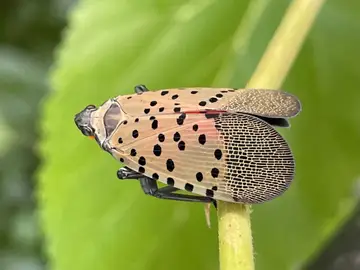
Spotted Lanternfly. Indiana Department of Natural Resources, Division of Entomology & Plant Pathology. dateModified 2026-03-09; checked November 3, 2026.
Brown Marmorated Stink Bug. Indiana Department of Natural Resources, Division of Entomology & Plant Pathology. dateModified 2026-03-12; checked November 3, 2026.
Lady Beetles. Indiana Department of Natural Resources, Division of Entomology & Plant Pathology. dateModified 2026-03-09; checked November 3, 2026.
Tick Bite Prevention. Indiana Department of Health. dateModified 2026-09-09; checked November 3, 2026.Quoted passages (1)
“The best way to prevent tick-borne illnesses is to prevent the bites of infected ticks. … Check your body for ticks soon after being outdoors.”
Eastern Massasauga Rattlesnake. Indiana Department of Natural Resources, Division of Fish & Wildlife. dateModified 2026-03-09; checked November 3, 2026.Quoted passages (1)
“The season of activity for the eastern massasauga in Indiana is relatively long. Individuals have been reported as early as April and as late as November.”
Ixodes scapularis (Blacklegged tick). Indiana Department of Health. Page Last Reviewed/Updated: March 2025; checked November 3, 2026.Quoted passages (1)
“In Indiana, nymphs are most active during spring and summer and adults are most active during the fall and early spring. However, adult ticks may be active any time winter temperatures are above freezing.”