Asian Lady Beetle
Harmonia axyridis · also called multicolored Asian lady beetle, Asian beetle, ladybug and lady beetle · Last checked November 3, 2026.
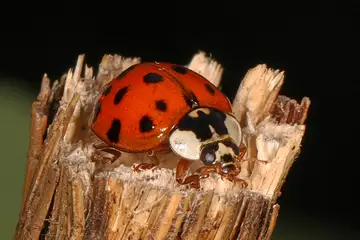

The Asian lady beetle is a non-native ladybug, usually orange or red with a variable number of black spots and a black M- or W-shaped mark behind the head. It eats aphids and other soft-bodied pests but gathers on and enters buildings in fall. It cannot sting or carry diseases, according to Iowa State University Extension, but it occasionally bites people, and Penn State links infestations to allergy symptoms in some people. It has spread across the United States. Penn State Extension
On this page
Is the Asian lady beetle dangerous?
Iowa State University Extension: cannot sting or carry diseases, though lady beetles infrequently pinch exposed skin. Iowa State University Extension
“They cannot sting or carry diseases.”
Bites and stings: It occasionally bites people. Penn State says this can vary from slightly annoying to painful; Iowa State calls it an infrequent pinch of exposed skin; NC State a mild nip.
No official source we use states whether this animal is venomous. That does not mean it is harmless: do not handle it.
If someone is bitten or stung, call 911 or Poison Help at 1-800-222-1222.
How to identify an Asian lady beetle
A photo or description can narrow it down, but cannot confirm what an animal is or that it is safe. Look from a distance and do not handle wild animals.
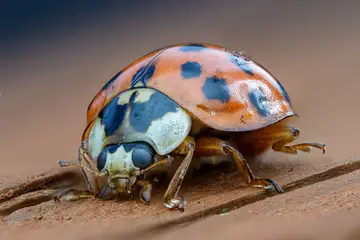
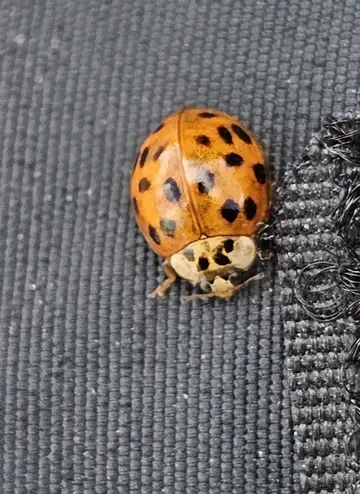
Size: About 1/4 to 1/3 in long; Penn State gives 9/32 in (7 mm) long, larger than most native lady beetles. Penn State Extension
Colors: orange, yellow, red or even black; color is highly variable; uSDA: most common US form is mustard to red. Pattern: typically 19 black spots, but they may have fewer or none.
Key features
- Black mark behind the head, the most reliable identifying feature per Minnesota Extension, which describes it as an M. Penn State and Iowa State describe it as a W, and it may look thick, thin, broken or filled in. It can be hard to see on dark beetles. University of Minnesota Extension
- Dome-shaped, oval body Iowa State University Extension
- Releases a smelly yellow fluid from the leg joints when disturbed, which can stain surfaces USDA Agricultural Research Service
Young
Larvae are alligator-like, dark gray with rows of orange markings and double-branched spines. Pupae are orange with black spots.
Animals mistaken for the Asian lady beetle
Asian Lady Beetle or Native lady beetles?
Asian Lady Beetle
Native lady beetles
Penn State says the white pronotum with a black mark separates it from many, not all, other lady beetles, and Minnesota Extension calls the black mark the most reliable feature. The mark can be hard to see on dark beetles. Color and spots are not useful for identification. University of Minnesota Extension
Not stated.
Asian Lady Beetle or Mexican bean beetle?
Asian Lady Beetle
Mexican bean beetle
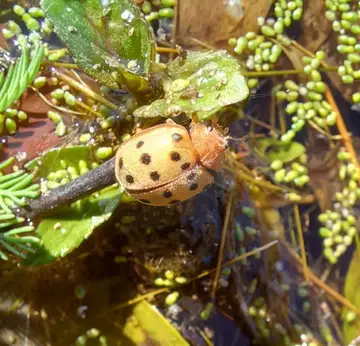
A plant-feeding lady beetle: orange with eight black spots on each wing cover. Larvae are yellow and spiny. University of Kentucky Entomology
Not stated; a garden pest per University of Kentucky.
Asian Lady Beetle or Squash beetle?
Asian Lady Beetle
Squash beetle
A plant-feeding lady beetle. University of Kentucky says it has only seven spots and attacks squash, pumpkin and cantaloupe. Larvae are yellow and spiny. University of Kentucky Entomology
Not stated; a garden pest per University of Kentucky.
Where the Asian lady beetle lives
- Native or listed
- Nonnative or not established
- No official record in our data
- 1–9
- 10–99
- 100–999
- 1,000+
On our state guides
State boundaries: U.S. Census Bureau, cartographic boundary file cb_2024_us_state_20m.
When it is active
Fall flights to buildings usually mid-September through October, depending on weather. Overwintering beetles may become active on warm days in late winter and early spring. In warm areas without freezes, adults are active year-round. Iowa State University Extension
US open-licence records peak in May to August and October.
Habitat and habits
Habitat: Trees, fields and gardens in summer; in fall it moves to buildings, leaf litter and other protected sites to overwinter. Iowa State University Extension
Behavior: Gathers on sunny, light-colored building walls in fall and moves into wall spaces. It does not chew structures or feed or breed indoors.
Diet: Aphids, insect eggs and other soft-bodied arthropods. It sometimes feeds on fruit, usually fruit already damaged.
Young: Eggs are laid on host plants beginning in early spring and hatch in about 3 to 5 days. USDA says development from egg to adult takes about 15 to 25 days, depending on temperature and food; Penn State says three to six weeks.
Legal status and reporting
Federal: No record returned by the USFWS ECOS query for Harmonia axyridis on 2026-11-03; not itself a statement of listing status. US Fish and Wildlife Service
Invasive status: Non-native. West Virginia DNR's invasive species plan lists it, and Penn State says it is displacing native lady beetles. WVDNR
Questions about the Asian lady beetle
Asian lady beetle
A non-native ladybug from Asia, usually orange or red with variable spots and a black M- or W-shaped mark behind the head. It eats aphids and other pests but enters buildings in fall and occasionally bites people.
Bug that looks like a ladybug
The Asian lady beetle is itself a ladybug, per Minnesota Extension, and it looks similar to some other lady beetles. University of Kentucky also describes two plant-feeding lady beetles, the Mexican bean beetle and the squash beetle.
Kentucky ladybugs
University of Kentucky lists the Asian lady beetle among lady beetles there, a large orange beetle that may or may not have spots. Fall groups find their way into homes, but they do not breed or feed inside.
Sources
- Multicolored Asian Lady Beetle. Penn State Extension. Updated August 12, 2026; checked November 3, 2026.
Quoted passages (3)
“They are larger than most native lady beetle species at 9/32 inch (7 mm) long and 7/32 inch (5.5 mm) wide.”
“The larvae have been described as "alligator-like" and are dark grey with rows of orange markings and double-branched spines”
“Larvae and adults are voracious predators of aphids, insect eggs, and other soft-bodied arthropods”
- Sorting out myths about lady beetles: What's in a name? University of Minnesota Extension (Minnesota Crop News). October 9, 2026; checked November 3, 2026.
Quoted passages (2)
“The most reliable identifying characteristic is the black 'M'-shaped marking behind the head.”
“Other characteristics such as color or spots are highly variable and not useful for identification.”
- Ladybug - Multicolored Asian Lady Beetle. Iowa State University Extension. originally published September 12, 2016; checked November 3, 2026.
Quoted passages (4)
“They cannot sting or carry diseases.”
“…dome-shaped; yellowish-orange to red with variable black spots on the back”
“Asian lady beetles are a beneficial biological control in trees during the summer, and in fields and gardens during the fall”
“The time of beetle flight varies but is usually from mid-September through October (depending on weather).”
- The Multicolored Asian Lady Beetle. USDA Agricultural Research Service. March 6, 2024; checked November 3, 2026.
Quoted passages (3)
“…a yellow fluid with an unpleasant odor is released from leg joints”
“Lady beetles do not chew or bore holes in walls or eat carpet or furniture. They do not lay their eggs in homes.”
“Development time from egg to adult requires about 15-25 days depending on temperature and food availability.”
- ECOS species report query for the four taxa. U.S. Fish and Wildlife Service. live query result 2026-11-03; checked November 3, 2026.
- West Virginia Invasive Species Strategic Plan and Voluntary Guidelines (Appendix B). West Virginia Division of Natural Resources (WVDNR). 2014; checked November 3, 2026.
Quoted passages (1)
“Insects Asian Lady beetle Harmonia axyridis”
- Ladybugs (ENTFACT-702). University of Kentucky Entomology. Revised January 2026; checked November 3, 2026.
Quoted passages (2)
“…have orange bodies with eight black spots on each wing cover”
“Squash beetles, which attack squash, pumpkin, and cantaloupe, have only seven spots.”
- GBIF.org occurrence records, human observations licensed CC0 1.0 or CC BY 4.0 only, accessed November 3, 2026. The datasets behind these counts are listed on our Sources page.
- State boundaries: U.S. Census Bureau, cartographic boundary file cb_2024_us_state_20m.