Spotted lanternfly
Lycorma delicatula · also called SLF · Last checked November 3, 2026.
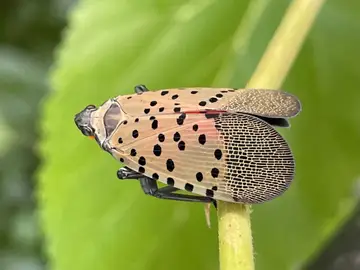
The spotted lanternfly is an invasive planthopper from Asia. It was first found in the US in Pennsylvania in 2014. It feeds on grapevines, hops, fruit trees and hardwoods, and its favorite host is tree-of-heaven. Adults are about 1 inch long, with spotted gray-brown forewings and red hind wings. Penn State Extension says it does not bite or sting. Its threat is to plants and crops, not people. As of USDA APHIS's August 2025 page, it was in 19 states and the District of Columbia. Officials ask the public to report sightings. APHIS
On this page
Is the spotted lanternfly dangerous?
Penn State Extension: the spotted lanternfly does not bite or sting. The harm officials describe is to plants: feeding damage, honeydew and sooty mold. Penn State Extension
“No, the spotted lanternfly does not bite or sting.”
Bites and stings: Does not bite or sting (Penn State Extension).
No official source we use states whether this animal is venomous. That does not mean it is harmless: do not handle it.
How to identify a spotted lanternfly
A photo or description can narrow it down, but cannot confirm what an animal is or that it is safe. Look from a distance and do not handle wild animals.
Size: Adults are roughly 1 inch long and 1/2 inch wide. APHIS
Colors: gray, brown, black, red, white and yellow. Pattern: black spots, red hind wings and banded abdomen.
Key features
- Forewings brown or gray with black spots, ending in a speckled band. APHIS
- Hind wings scarlet with black spots, plus white and black bars. APHIS
- Abdomen yellow with black bars. Legs and head black. Pennsylvania Department of Agriculture
- Gathers in large groups when feeding, often on tree-of-heaven. APHIS
- Egg masses about 1 inch long, gray and putty-like when new, later brown like cracked mud. Found on trees, stones, vehicles and outdoor items in fall, winter and spring. APHIS
Young
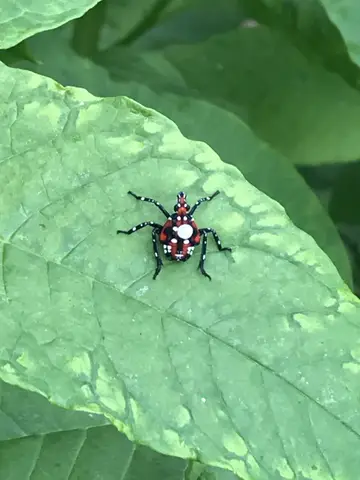
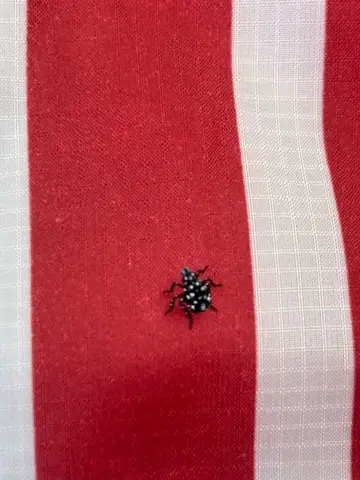
Nymphs are black with white spots, then turn red before becoming adults. Black nymphs appear April to July; red nymphs July to September.
Where the spotted lanternfly lives
- Native or listed
- Nonnative or not established
- No official record in our data
- 1–9
- 10–99
- 100–999
- 1,000+
On our state guides
- Connecticut insects and bugsNonnative
- Delaware insects and bugsNonnative
- Georgia insects and bugsNonnative
- Illinois insects and bugsNonnative
- Indiana insects and bugsNonnative
- Iowa insects and bugsNonnative
- Maryland insects and bugsNonnative
- New Hampshire insects and bugsNonnative
- New Jersey insects and bugsNonnative
- New York insects and bugsNonnative
- Pennsylvania insects and bugsNonnative
- Vermont insects and bugsNonnative
- Virginia insects and bugsNonnative
- West Virginia insects and bugsNonnative
State boundaries: U.S. Census Bureau, cartographic boundary file cb_2024_us_state_20m.
When it is active
Black nymphs from about April to July, red nymphs July to September, adults from July. Adults lay eggs in fall, and egg masses can be seen through fall, winter and spring (New York DEC; USDA APHIS). NYSDEC
US open-licence records peak in June to September.
Habitat and habits
Habitat: Feeds on a wide range of plants, including grapevines, hops, stone fruit trees and hardwoods. Its preferred host is tree-of-heaven. Lays eggs on almost any hard surface. APHIS
Behavior: A hitchhiking pest. It lays eggs on vehicles, firewood, outdoor furniture and other items that get moved, and all mobile stages hitchhike on vehicles and clothing.
Diet: Nymphs and adults suck sap from more than 70 plant species.
Young: Egg masses hold 30-50 eggs and are laid in fall on trees, rocks, vehicles and many other surfaces. Nymphs hatch in spring.
Legal status and reporting
Federal: Regulated invasive plant pest; USDA APHIS works with State and Tribal cooperators on detection and control. APHIS
Invasive status: Invasive, native to Asia; first detected in the US in Pennsylvania in 2014. APHIS
Report: Report sightings to your state. USDA APHIS: in states with existing populations, use the state contact list on the APHIS page; elsewhere, contact your State plant regulatory official or State plant health director. Pennsylvania: report online or call 1-888-4BADFLY (PDA). New York: report with photos through iMapInvasives (NYSDEC). Georgia: upload a photo with the GDA reporting tool. APHIS
Questions about the spotted lanternfly
Spotted lanternfly bite
No. Penn State Extension says the spotted lanternfly does not bite or sting.
Spotted lanternfly nymph
Young nymphs are black with white spots and turn red before becoming adults. New York DEC says black nymphs show up from about April through July and red nymphs from July through September.
Spotted lanternfly eggs
Egg masses are about 1 inch long and hold 30-50 eggs. They look like wet gray putty when new, then dry brown like cracked mud. Look for them in fall, winter and spring on trees, stones, fences, grills, equipment and vehicles. USDA APHIS says to smash them and scrape them into a bag with hand sanitizer or rubbing alcohol.
Spotted lanternfly life cycle
Eggs are laid in fall and last through winter. Black-and-white nymphs appear from about April to July, red nymphs from July to September, and adults from July (New York DEC).
Spotted lanternfly in Connecticut, Massachusetts and Ohio
Yes. USDA APHIS lists these states among the 19 states with spotted lanternfly populations.
Spotted lanternfly new york
Yes. USDA APHIS lists New York, and NYSDEC says it is widespread on Long Island and in New York City, the Hudson Valley, the Capital Region, the Finger Lakes and Western New York. Report sightings through iMapInvasives.
Sources
- Spotted Lanternfly. USDA Animal and Plant Health Inspection Service (APHIS). archived copy, captured October 26, 2026; checked November 3, 2026.
Quoted passages (10)
“Adults are roughly 1-inch long and 1/2-inch wide with large, visually striking wings.”
“Adults have brown forewings with black spots at the front and a speckled band at the rear.”
“Their hind wings are scarlet with black spots at the front and white and black bars at the rear.”
“Spotted lanternflies (both nymphs and adults) frequently gather in large numbers when feeding.”
“Newly laid egg masses (holding 30–50 eggs) resemble wet, gray putty before turning dull and brown, mirroring a smear of cracked mud.”
“Spotted lanternfly (Lycorma delicatula) is an invasive planthopper that feeds on a wide range of plants, including grapevines, hops, stone fruit trees, and hardwood trees.”
“The spotted lanternfly is a hitchhiking pest that is native to Asia. It lays its eggs on any hard surface including grills, vehicles, trailers, firewood, outdoor furniture, bikes and toys.”
“We are working with State and Tribal cooperators to detect, control, and manage spotted lanternfly populations in the United States.”
“The pest was first detected in 2014 in Pennsylvania.”
“If you live in a State with existing spotted lanternfly populations, use the dropdown below to look up contact information for your area. For all other States, contact your State plant regulatory official or State plant health director.”
- Spotted Lanternfly Frequently Asked Questions. Penn State Extension. updated June 15, 2026; checked November 3, 2026.
Quoted passages (1)
“No, the spotted lanternfly does not bite or sting.”
- Spotted Lanternfly Alert. Pennsylvania Department of Agriculture. undated page; checked November 3, 2026.
Quoted passages (1)
“The legs and head are black; the abdomen is yellow with broad black bands.”
- Spotted Lanternfly. NYSDEC. archived copy, captured August 15, 2026; checked November 3, 2026.
Quoted passages (3)
“Nymphs, or newly hatched SLF, are black with white spots and turn red before transitioning into adults. The black nymphs can be seen as early as April through July. The late-stage red nymphs can be seen from July through September.”
“Adults and nymphs use their sucking mouthparts to feed on the sap of more than 70 plant species.”
“Adults begin to appear in July and are approximately 1 inch long and ½ inch wide at rest, with eye-catching wings.”
- GBIF.org occurrence records, human observations licensed CC0 1.0 or CC BY 4.0 only, accessed November 3, 2026. The datasets behind these counts are listed on our Sources page.
- State boundaries: U.S. Census Bureau, cartographic boundary file cb_2024_us_state_20m.