Africanized Honey Bee
Apis mellifera (African-derived hybrids; A. m. scutellata) · also called killer bee, African honey bee, AHB and Africanized bee · Last checked November 3, 2026.
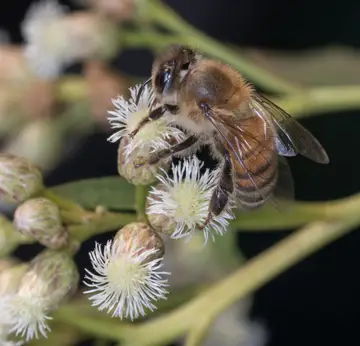
The Africanized honey bee, or "killer bee", is a hybrid honey bee that looks the same as an ordinary honey bee; only lab tests can tell them apart. Its venom is no stronger, but it defends its nest far more readily and in greater numbers, so a disturbed colony can deliver many stings, which can kill people and animals. Official sources place it across much of the Southwest and South, including Texas, Arizona, New Mexico, southern California, southern Nevada, southern Utah, parts of Oklahoma and Arkansas, and Florida. If attacked by a swarm, get away and into shelter; for a medical emergency call 911 or Poison Help at 1-800-222-1222. University of Florida IFAS Extension
On this page
Is the Africanized honey bee dangerous?
Dangerous mainly because of numbers, not stronger venom. UF/IFAS: capable of killing large mammals including people, with children, the elderly and some disabled people at highest risk because they cannot escape easily. One sting can also be fatal to a person with a severe allergy. University of Florida IFAS Extension
“Because of these characteristics, African bees are capable of killing large mammals, including man.”
Bites and stings: Stings, does not bite. Each worker can sting once. Foraging bees and swarm clusters are no more dangerous than European bees; the danger is near a nest. A disturbed colony sends more bees, reacts to less disturbance, and pursues farther. Alabama says they may pursue a threat for over a mile. Agitated by vibrations from power equipment and lawnmowers. Pets and livestock confined near a nest are very vulnerable.
If someone is bitten or stung, call 911 or Poison Help at 1-800-222-1222.
How to identify an Africanized honey bee
A photo or description can narrow it down, but cannot confirm what an animal is or that it is safe. Look from a distance and do not handle wild animals.
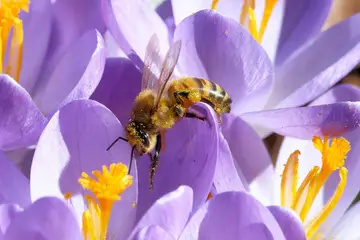
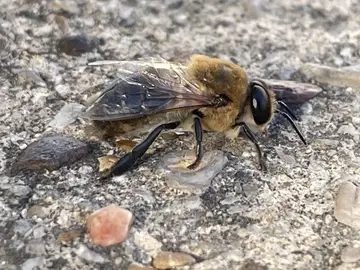
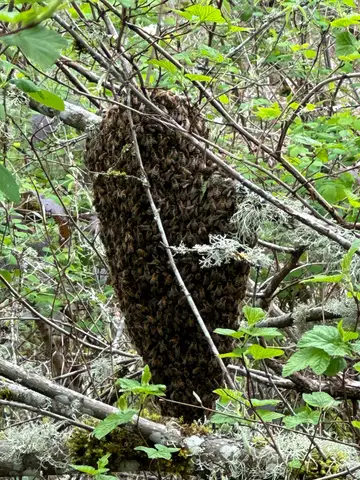
Size: About 10 percent smaller than a European honey bee, a difference too subtle to see without measurement or lab tests. University of Florida IFAS Extension
Key features
- Cannot be identified by eye: only DNA testing or microscopic measurements can tell it from a European honey bee. Texas A&M AgriLife Extension
- Clue is behavior and nest site: very defensive, and may nest in small cavities such as water meter boxes, old tires, house eaves or the ground. University of Florida IFAS Extension
Animals mistaken for the Africanized honey bee
Africanized Honey Bee or European honey bee?
Africanized Honey Bee
European honey bee Apis mellifera
Not by sight: same species and same appearance. Differences are behavior and nest choice, and a confirmed ID needs testing. University of California Statewide IPM Program
Also stings and can attack anyone too close to the hive; same venom.
Where the Africanized honey bee lives
- Native or listed
- Nonnative or not established
- No official record in our data
- 1–9
- 10–99
- 100–999
- 1,000+
On our state guides
- California insects and bugs
- Hawaii insects and bugsNonnative
- Illinois insects and bugsNonnative
- Indiana insects and bugs
- Kansas insects and bugs
- Louisiana insects and bugsNonnative
- Maryland insects and bugsNonnative
- Minnesota insects and bugs
- Missouri insects and bugs
- Montana insects and bugsNonnative
- Ohio insects and bugsNonnative
- Pennsylvania insects and bugs
- Texas insects and bugs
State boundaries: U.S. Census Bureau, cartographic boundary file cb_2024_us_state_20m.
When it is active
US open-licence records peak in April and June to September.
Habitat and habits
Habitat: Nests in almost any cavity or in the open, including water meter boxes, cement blocks, tires, eaves, junk piles, holes in the ground and tree limbs. Alabama Department of Agriculture and Industries
Behavior: More easily disturbed and quicker to mass-defend the nest. Swarms and abandons nests more often than European bees. Small swarms can take over European colonies.
Diet: Gathers nectar and pollen from flowers, like other honey bees.
Young: Reproduces at colony level by swarming. Colonies may swarm more than 10 times a year (UF/IFAS) or as often as every six weeks (Alabama), compared with once to three times a year for European colonies.
Legal status and reporting
Invasive status: Called invasive by Alabama and by UF/IFAS; on the Louisiana watch list; Hawaii treats it as an invasive species to report. Alabama Department of Agriculture and Industries
Report: Keep away and do not disturb the nest. Alabama: State Apiary Unit (334) 240-7228 or (334) 240-7172. Hawaii: report highly aggressive bees to HDOA and 808 643-PEST. North Carolina: NCDA&CS Apiary Inspector 919-233-8214. For other states, no statewide contact was collected. A person being attacked needs 911, not an apiary contact. Alabama Department of Agriculture and Industries
Questions about the Africanized honey bee
Are there killer bees in the us?
Yes. They were first found in south Texas in 1990 and official sources now place them across much of the Southwest and South, including Texas, Arizona, New Mexico, southern California, southern Nevada, southern Utah, parts of Oklahoma and Arkansas, and Florida.
Are there killer bees in texas?
Yes. They entered South Texas in 1990 and had been detected in 163 of 254 Texas counties when formal testing stopped in 2006. Texas A&M says most feral colonies in the state are now assumed to carry some African genes.
Are there killer bees in florida?
Yes. New Mexico State says they arrived by ship at Tampa in 2005 and are now widespread in Florida. NC State dates central Florida findings from 2005.
Are there killer bees in north carolina?
Two swarms that arrived on ships were found and destroyed at North Carolina ports (1989 and 1991). NC State says they will almost certainly be introduced again and it is unclear whether they would establish.
Are there killer bees in ohio?
None of the official range statements collected names these states. Any honey bee colony should be left alone.
Sources
- ENY-147/IN784: Differences Between European and African Honey Bees. University of Florida IFAS Extension. undated page; checked November 3, 2026.
Quoted passages (1)
“Africanized honey bees are slightly (approximately 10%) smaller than European honey bees. However, this size difference is very subtle, and it is nearly impossible to differentiate between the two without specific measurements and/or laboratory testing.”
- Honey Bees In and Around Buildings (ENTO-080). Texas A&M AgriLife Extension. 12/17; checked November 3, 2026.
Quoted passages (1)
“Only DNA testing or microscopic measurements can determine whether a colony is of European descent or is some form of African hybrid.”
- Africanized Bees. Texas Apiary Inspection Service (Texas A&M AgriLife). archived copy, captured July 12, 2026; checked November 3, 2026.
- Guide L-110: Honey Bees in New Mexico. New Mexico State University Cooperative Extension Service (College of ACES). Revised January 2017; checked November 3, 2026.
- Pest Notes: Bee and Wasp Stings. University of California Statewide IPM Program (UC ANR, Cooperative Extension). 2011-09; checked November 3, 2026.
Quoted passages (3)
“An individual Africanized bee can sting only once and has the same venom as the European honey bee.”
“Neither is likely to sting when gathering nectar and pollen from flowers, but both will sting in defense if provoked.”
“The two types of bees look the same, and their behavior is similar in many respects.”
- EENY 429/IN790: African Honey Bee, Africanized Honey Bee, Killer Bee, Apis mellifera scutellata Lepeletier. University of Florida IFAS Extension (Featured Creatures). footer 2024; checked November 3, 2026.
Quoted passages (4)
“Because of these characteristics, African bees are capable of killing large mammals, including man.”
“They will nest in a much smaller volume than European honey bees and have been found in water meter boxes, cement blocks, old tires, house eaves, barbecue grills, cavities in the ground, and hanging exposed from tree limbs”
“African honey bees swarm and abscond in greater frequencies than their European counterparts.”
“European colonies commonly swarm one to three times per year. African colonies may swarm more than 10 times per year.”
- Africanized Honeybees Detected in Alabama. Alabama Department of Agriculture and Industries. June 18, 2024; checked November 3, 2026.
Quoted passages (3)
“AHB will nest in any available cavity or in the open.”
“ADAI is taking swift action to mitigate any risks associated with these invasive bees.”
“If you believe you have found a colony of Africanized Honeybees, contact the ADAI’s State Apiary Unit at (334) 240-7228 or (334) 240-7172.”
- Africanized Honey Bees: Some Questions and Answers. NC State Extension. Published Feb. 5, 2015; checked November 3, 2026.
- Africanized Honey Bees: Where Are They Now, and When Will They Arrive in North Carolina? NC State Extension. Published Feb. 5, 2015; checked November 3, 2026.
- GBIF.org occurrence records, human observations licensed CC0 1.0 or CC BY 4.0 only, accessed November 3, 2026. The datasets behind these counts are listed on our Sources page.
- State boundaries: U.S. Census Bureau, cartographic boundary file cb_2024_us_state_20m.