Bald-faced Hornet
Dolichovespula maculata · also called Baldfaced Hornet and aerial yellowjacket · Last checked November 3, 2026.
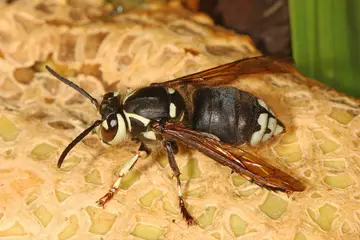

The bald-faced hornet is a large black-and-white social wasp that builds big gray paper nests in trees, shrubs and sometimes on buildings. Despite its name it is not a true hornet but an aerial yellowjacket. It stings, and can sting repeatedly when its nest is disturbed; stings can be dangerous for people who are allergic. Away from the nest it is not aggressive. Penn State Extension says it is found in most of the 48 contiguous states, D.C. and Alaska. Penn State Extension
On this page
Is the bald-faced hornet dangerous?
Aggressive nest defense makes them a stinging threat, but they are not aggressive away from the nest. People allergic to wasp stings may have their health endangered if stung. Missouri Department of Conservation
“Aggressive nest defense makes these wasps a stinging threat, but their foragers do not collect sweets or food scraps and are not aggressive away from the nest.”
Bites and stings: It stings rather than bites. Workers defend the nest and can sting repeatedly; away from the nest they are not aggressive.
If someone is bitten or stung, call 911 or Poison Help at 1-800-222-1222.
How to identify a bald-faced hornet
A photo or description can narrow it down, but cannot confirm what an animal is or that it is safe. Look from a distance and do not handle wild animals.
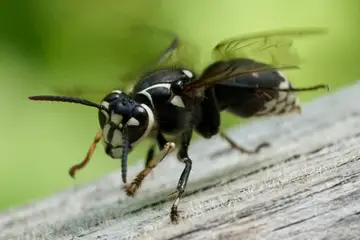

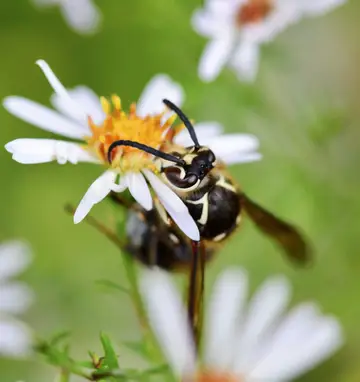
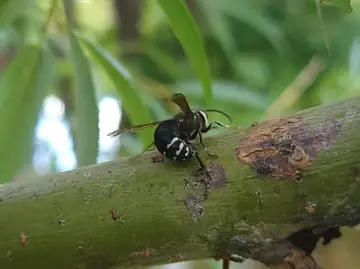
Size: Missouri: workers 1/2 to 3/4 inch, queens 3/4 inch. University of Maryland: workers 5/8 to 3/4 inch, queens just over an inch. Penn State gives 13 to 20 mm for the queen and her offspring. Missouri Department of Conservation
Colors: Mostly black with white or ivory markings on the face, thorax and toward the tip of the abdomen; wings translucent dark brown. Pattern: White face (the source of the name).
Key features
- Not yellow, unlike typical yellowjackets; larger, black and ivory Missouri Department of Conservation
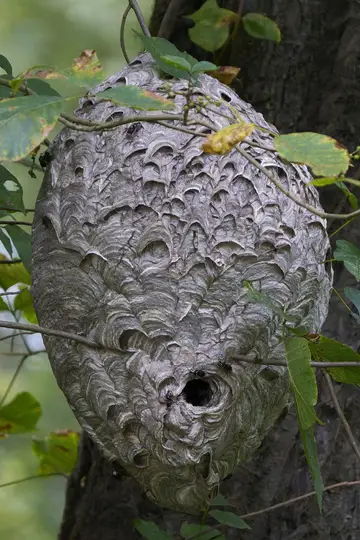
- Large, rounded, gray paper nest hanging in trees or shrubs, sometimes on buildings Missouri Department of Conservation
- Nest entrance is the lowest opening of the cone- or egg-shaped nest University of Maryland Extension
Animals mistaken for the bald-faced hornet
Bald-faced Hornet or Yellowjackets?
Bald-faced Hornet
Yellowjackets Vespula spp.
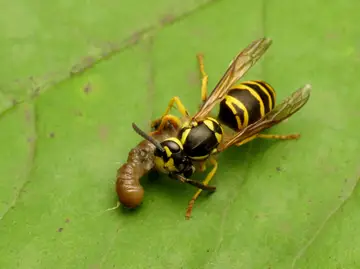
Yellowjackets are yellow and black and usually nest in the ground; the bald-faced hornet is black and ivory, larger, and nests above ground. Missouri Department of Conservation
Also stinging social wasps (CDC/NIOSH groups bees, wasps and hornets as stinging insects).
Bald-faced Hornet or European Hornet?
Bald-faced Hornet
European Hornet Vespa crabro
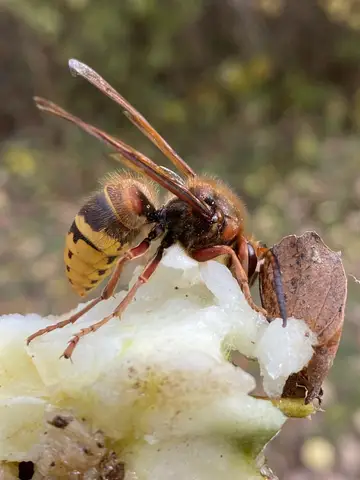
NC State Extension: European hornets are much larger (about 1 1/2 in.), brownish red with a dull yellow abdomen, and rarely build free-hanging or exposed nests (the bald-faced hornet is black and ivory and hangs its nest in the open). NC State Extension
A stinging social wasp; NC State Extension notes its defensive nature near nests.
Where the bald-faced hornet lives
- Native or listed
- Nonnative or not established
- No official record in our data
- 1–9
- 10–99
- 100–999
- 1,000+
On our state guides
- Arkansas insects and bugs
- Colorado insects and bugs
- Idaho insects and bugs
- Illinois insects and bugs
- Indiana insects and bugs
- Kansas insects and bugs
- Kentucky insects and bugs
- Maine insects and bugs
- Minnesota insects and bugs
- Missouri insects and bugs
- Montana insects and bugs
- Ohio insects and bugs
- Oklahoma insects and bugs
- Pennsylvania insects and bugs
- Vermont insects and bugs
State boundaries: U.S. Census Bureau, cartographic boundary file cb_2024_us_state_20m.
When it is active
Active from spring through fall; nests may not be noticed until mid to late summer. Nest occupants do not survive freezing temperatures, and nests are not reused (University of Minnesota Extension). University of Minnesota Extension
US open-licence records peak in July to September.
Habitat and habits
Habitat: Forest edges, suburbs and sometimes urban sites; nests in trees, shrubs or berry canes, sometimes under eaves. Ohio Department of Natural Resources, Division of Wildlife
Behavior: Social wasp; one overwintered queen starts each nest in spring. Colonies reach about 100 to 400 workers. Nests are not reused. Females may sting in a quick fly-by.
Diet: Adults generally eat flower nectar; they collect insects and other arthropods to chew up and feed to their larvae (Ohio DNR names flies and even yellowjackets).
Young: Queens overwinter in sheltered places and start a paper nest in spring; the first brood become workers. New queens and males are produced late in the season; only mated queens survive the winter.
Legal status and reporting
Federal: No record returned by the USFWS ECOS species query on 2026-11-03; not itself a statement of listing status. US Fish and Wildlife Service
Invasive status: Native: University of Maryland Extension says it is native to the U.S. University of Maryland Extension
Report: Not a reportable invasive species. For a nest near a home, Missouri advises consulting licensed professionals. Penn State says people with known sting sensitivity should have nearby nests removed by professionals. Missouri Department of Conservation
Questions about the bald-faced hornet
Bald faced hornet sting
Bald-faced hornets sting to defend their nest and can sting repeatedly. Missouri says people allergic to wasp stings may have their health endangered if stung. NC State says hypersensitive people may die without prompt medical attention. Call 911 or Poison Help at 1-800-222-1222.
Bald faced hornet sting pain
NC State Extension says the sting is instantly painful, and soreness, swelling and itching may last for days. Ohio DNR rates it a 2 on the Schmidt sting pain scale.
Bald faced hornet size
Missouri gives 1/2 to 3/4 inch for workers and 3/4 inch for queens. Penn State gives 13 to 20 mm, with the queen usually the largest.
Bald faced hornet nest
A large, rounded, gray paper nest hanging in trees or shrubs, sometimes under eaves. Penn State says nests in Pennsylvania can be up to 24 inches tall and 18 inches across. Nests are used for one season only.
Bald faced hornet nest removal
Penn State says nests away from buildings, doors and mowed areas can be left alone because the hornets eat pest insects. People with known sting sensitivity should have nests near their homes removed by professional pest management personnel. Missouri advises consulting licensed professionals.
Bald faced hornet queen
A single queen that survived the winter starts each nest in spring and later lays only eggs. Queens are the largest members of the colony. Only newly mated queens survive the winter.
Bald faced hornet vs yellow jacket
The bald-faced hornet is actually an aerial yellowjacket. It is black and ivory rather than yellow, larger, and builds hanging paper nests above ground. Penn State says most yellowjackets nest underground.
Bald faced hornet wisconsin
Penn State says the species is found in most of the 48 contiguous states, D.C. and Alaska, but that does not confirm Wisconsin specifically.
Sources
- Baldfaced Hornet. Penn State Extension. Updated June 24, 2026 (authored February 2010; checked November 3, 2026.
Quoted passages (1)
“Most of the colony, other than newly fertilized potential queens that will overwinter, will die before or shortly after the first hard frost.”
- Bald-Faced Hornet (Field Guide). Missouri Department of Conservation. undated page; checked November 3, 2026.
Quoted passages (7)
“Aggressive nest defense makes these wasps a stinging threat, but their foragers do not collect sweets or food scraps and are not aggressive away from the nest.”
“Length (excluding appendages): ½ to ¾ inch (workers); ¾ inch (queen)”
“Unlike the wasps we usually call yellowjackets, this species is not yellow. Its larger size and black and ivory coloration make it easy to distinguish as a distinct type of social wasp.”
“In winter after leaf-fall, look up into trees for old nests, which are large, rounded, papery, and gray.”
“Adults generally eat nectar from flowers, but they collect insects and other arthropods to chew up and feed to their growing larvae.”
“If you wish to remove a wasp colony, consult licensed professionals and follow pesticide instructions carefully.”
“Unlike the wasps we usually call yellowjackets, this species is not yellow.”
- Baldfaced Hornets in Landscapes. NC State Extension. Reviewed/Revised June 24, 2026; checked November 3, 2026.
- Insects and Scorpions at Work (Outdoor Workers). CDC / NIOSH. archived copy, captured October 4, 2026; checked November 3, 2026.
- Social Wasps: Yellowjackets, Hornets, and Paper Wasps. University of Maryland Extension. Updated April 17, 2026; checked November 3, 2026.
Quoted passages (2)
“The main entrance is the lowest and most prominent opening in the cone- or egg-shaped nest”
“They are native to the U.S. and widespread in Maryland.”
- Bees and Wasps of Ohio Field Guide (Publication 5488). Ohio Department of Natural Resources, Division of Wildlife. Publication 5488, dated 3/16; checked November 3, 2026.
Quoted passages (2)
“Common along forest edges, suburbs, and sometimes in urban sites.”
“Female wasps deliver the sting in flight; a quick flyby stinging that happens so quickly you may not realize what hit you.”
- What insect is this? Bald-faced hornet. University of Minnesota Extension. undated page; checked November 3, 2026.
Quoted passages (1)
“They are active from spring through fall, although the presence of nests may not be detected until mid to late summer. … Occupants of nests do not survive freezing temperatures and nest are not reused.”
- ECOS species report query (p16). U.S. Fish and Wildlife Service. live query 2026-11-03; checked November 3, 2026.
Quoted passages (1)
“Dolichovespula maculata: no record returned”
- Non-Honey Bee Stinging Insects in North Carolina. NC State Extension. Published Feb. 5, 2015; checked November 3, 2026.
Quoted passages (1)
“Adults resemble yellow jackets, but are much larger (about 1 1/2 in.) and are brownish red with a dull yellow abdomen. … Unlike its cousin, the bald-faced hornet, European hornets rarely build nests that are free hanging or in unprotected areas.”
- Common Social Bees and Wasps of Pennsylvania: Behavior, Lifecycle, and Management. Penn State Extension. Updated February 4, 2024; checked November 3, 2026.
- GBIF.org occurrence records, human observations licensed CC0 1.0 or CC BY 4.0 only, accessed November 3, 2026. The datasets behind these counts are listed on our Sources page.
- State boundaries: U.S. Census Bureau, cartographic boundary file cb_2024_us_state_20m.