
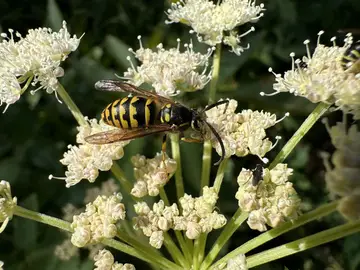
Aerial Yellowjacket
Dolichovespula arenaria
What the sources say
Venom: “Spiders, scorpions, rattlesnakes, and wasps are all venomous.” (University of Idaho Extension)
Last checked November 3, 2026 against official sources.
This page lists 13 insects. 11 are venomous by official accounts. 3 are nonnative.
Not every species: no complete official list of Idaho insects exists, so this page covers the ones state and Extension sources name. How lists are built.
Official sources single out these insects in Idaho, in their own words:
High sting hazard (UI Extension). “It poses a high sting hazard to people because it also aggressively scavenges meats and sweets” University of Idaho Extension
Stings. “Systemic allergic reactions to sting venoms occur in 1%–3% of the population” University of Idaho Extension
Carry West Nile virus (Idaho DHW). “Mosquitoes transmit the West Nile virus (WNV).” Idaho Department of Health and Welfare
Official sources single out these ticks in Idaho, in their own words:
Disease. “In Idaho, public health officials are most concerned about West Nile virus from mosquitoes and Rocky Mountain Spotted Fever, tick-borne relapsing fever, and tularemia from ticks.” Idaho Department of Health and Welfare
Venomous species first, then A to Z. Do not handle them.
Dolichovespula arenaria
Venom: “Spiders, scorpions, rattlesnakes, and wasps are all venomous.” (University of Idaho Extension)
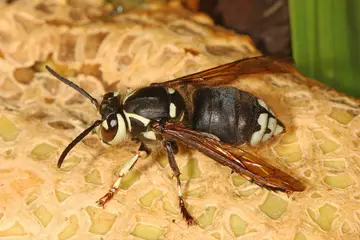
Dolichovespula maculata
Venom: “Spiders, scorpions, rattlesnakes, and wasps are all venomous.” (University of Idaho Extension)
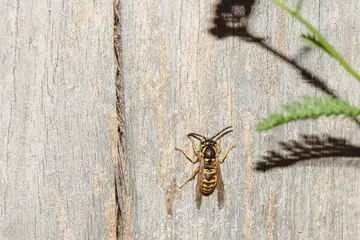
Vespula vulgaris
Venom: “Spiders, scorpions, rattlesnakes, and wasps are all venomous.” (University of Idaho Extension)
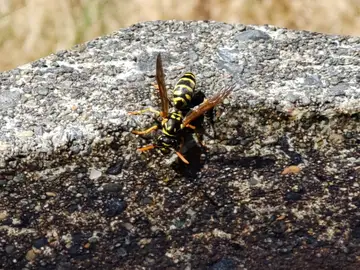
Polistes dominula
Venom: “Spiders, scorpions, rattlesnakes, and wasps are all venomous.” (University of Idaho Extension)
Vespula germanica
Venom: “Spiders, scorpions, rattlesnakes, and wasps are all venomous.” (University of Idaho Extension)
Polistes aurifer
Venom: “Spiders, scorpions, rattlesnakes, and wasps are all venomous.” (University of Idaho Extension)
Polistes fuscatus
Venom: “Spiders, scorpions, rattlesnakes, and wasps are all venomous.” (University of Idaho Extension)
Sphecius grandis
Venom: “They provision their nests with live insects and spiders that they paralyze with venom by stinging their prey item.” (University of Idaho Extension)
Sphecius convallis
Venom: “They provision their nests with live insects and spiders that they paralyze with venom by stinging their prey item.” (University of Idaho Extension)
Dasymutilla spp.
Venom: “Spiders, scorpions, rattlesnakes, and wasps are all venomous.” (University of Idaho Extension)
Habitat: Sunny, sandy ground, especially rangeland and canyon habitats. (University of Idaho Extension)
Vespula pensylvanica
Venom: “Spiders, scorpions, rattlesnakes, and wasps are all venomous.” (University of Idaho Extension)
Pogonomyrmex spp.
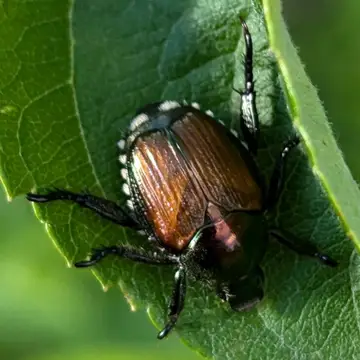
Popillia japonica
Records of insects in Idaho peak in July to August. They show when people record insects, not how many there are (about month bars).
Call 911 or Poison Help at 1-800-222-1222 right away. Poison Help connects you to your local poison center, any time of day.
Official advice from Idaho Department of Fish and Game and Idaho Department of Health and Welfare:
Invasive species: Idaho Invasive Species Hotline 1-877-336-8676 (ISDA). Wildlife crimes: Citizens Against Poaching 1-800-632-5999 (IDFG). Bear sightings and conflicts: report to the state wildlife agency (IDFG regional offices). Idaho State Department of Agriculture
The species list comes from No official complete list; stinging and commonly asked insects from UI Extension BUL 852 and BUL 853, ISDA and Idaho DHW (University of Idaho Extension, BUL 852 page June 22, 2026; BUL 853 page October 23, 2025). 5 more entries come from other official sources named on each card.
Venom labels come only from official sources and link to them; "Not stated" never means harmless. How labels work.
"Nonnative" and "Invasive" follow the wording of the source list. See invasive species in Idaho.
“It poses a high sting hazard to people because it also aggressively scavenges meats and sweets”
“Systemic allergic reactions to sting venoms occur in 1%–3% of the population”
“Spiders, scorpions, rattlesnakes, and wasps are all venomous.”
“They provision their nests with live insects and spiders that they paralyze with venom by stinging their prey item.”
“Mosquitoes transmit the West Nile virus (WNV).”
“For both mosquitoes and ticks, use insect repellent approved by the EPA on exposed skin and clothing.”
“In Idaho, public health officials are most concerned about West Nile virus from mosquitoes and Rocky Mountain Spotted Fever, tick-borne relapsing fever, and tularemia from ticks.”
“…particularly during dusk and dawn hours when mosquitoes are most active.”
“If you are working or playing in rattlesnake country, it's good practice to wear tall, leather boots, and long, loose pants.”
“Idaho Invasive Species Hotline [toll-free]: 1-877-336-8676”
