Brown marmorated stink bug
Halyomorpha halys · also called BMSB and stink bug · Last checked November 3, 2026.
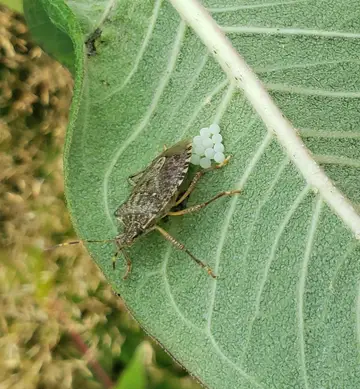
The brown marmorated stink bug is an invasive, shield-shaped brown stink bug from East Asia, about 5/8 inch long, with white bands on its antennae. It was first found in the US in Pennsylvania and has since spread across most of the country. UC IPM says it is not harmful to people, houses or pets: it does not bite or sting. Missouri's Department of Conservation says the same about bites. It gives off a bad smell when crushed or disturbed. Penn State notes that the smell can trigger allergy symptoms in people sensitive to it, and crushing the bugs against bare skin can cause dermatitis in a small percentage of people. It damages fruit, vegetable and field crops, and in fall large numbers move into homes for the winter. University of California Statewide IPM Program
On this page
Is the brown marmorated stink bug dangerous?
UC IPM: not harmful to people, houses or pets; indoors they can become a nuisance and give off an offensive odor if disturbed or crushed. Penn State: the odor can cause allergic reactions (rhinitis and/or conjunctivitis) in people sensitive to it, and bugs crushed against bare skin can cause dermatitis, which appears to affect only a small percentage of people. University of California Statewide IPM Program
“Brown marmorated stink bugs are not harmful to people, houses, or pets.”
Bites and stings: Does not bite people or animals (UC IPM; Missouri Department of Conservation).
No official source we use states whether this animal is venomous. That does not mean it is harmless: do not handle it.
How to identify a brown marmorated stink bug
A photo or description can narrow it down, but cannot confirm what an animal is or that it is safe. Look from a distance and do not handle wild animals.
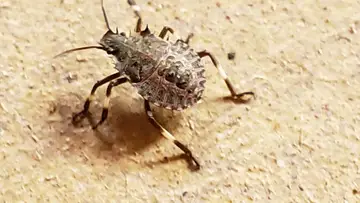
Size: Adults about 5/8 inch (about 17 mm) long; shield-shaped, almost as wide as long. University of California Statewide IPM Program
Colors: marbled/mottled brown above; mottled brown, black and dark red on the back; lighter tan, beige or whitish underside; coppery or bluish-metallic punctures on head and pronotum. Pattern: white bands on antennae and legs; alternating light and dark bands along the abdomen edge.
Key features
- two white bands on the antennae; blunt front edge of head; smooth shoulder margin; dark bands at the tip of the membranous forewings; banded abdominal edge visible beside the wings University of California Statewide IPM Program
- smooth (not spiny) shoulders; slightly larger than most native stink bugs MDC
Young
Five nymph stages, 2.4 mm to 12 mm. Newly hatched nymphs have an orange abdomen with dark brown plates; third to fifth stages have a marbled brown head and thorax with reddish brown, black and white abdomen markings. Nymphs have white banding on blackish antennae (MDC) and deep red eyes (Penn State). Eggs are laid in clusters of about 20 to 30, usually on the undersides of leaves.
Animals mistaken for the brown marmorated stink bug
Brown marmorated stink bug or Rough stink bug?
Brown marmorated stink bug
Rough stink bug Brochymena sulcata
Rough shoulder margin, front of head extended into two points, and no white bands on the antennae. University of California Statewide IPM Program
Brown marmorated stink bug or Consperse stink bug?
Brown marmorated stink bug
Consperse stink bug Euschistus conspersus
Banded abdomen edges like BMSB but no bands on the antennae; legs with distinct dark spots; a little smaller (about 1/2 inch). University of California Statewide IPM Program
Where the brown marmorated stink bug lives
- Native or listed
- Nonnative or not established
- No official record in our data
- 1–9
- 10–99
- 100–999
- 1,000+
On our state guides
- Indiana insects and bugsNonnative
- Maryland insects and bugsNonnative
- Montana insects and bugsNonnative
- West Virginia insects and bugsNonnative
State boundaries: U.S. Census Bureau, cartographic boundary file cb_2024_us_state_20m.
When it is active
Adults become active in spring (late April to mid-May in Pennsylvania), breed through summer, and look for overwintering sites from September through October. Penn State Extension
US open-licence records peak in July to October.
Habitat and habits
Habitat: Wide variety of habitats wherever its many host plants grow: orchards, crops, gardens, ornamental trees. In fall adults gather on buildings and trees and overwinter in cracks, under bark, and inside homes. MDC
Behavior: In late summer and fall, adults gather in large numbers on the sides of buildings and move indoors to overwinter. Indoors they do not reproduce or cause damage, but they fly noisily around lights and smell when crushed.
Diet: Plant juices, especially from developing fruits, seeds, beans, corn kernels and buds; recorded on at least 175 plant species in the US, including apples, peaches, tomatoes, peppers, corn and soybeans.
Young: Females lay eggs in clusters of 20-28, 212-486 eggs per lifetime; one or two generations a year in the mid-Atlantic, up to five in southern states.
Legal status and reporting
Invasive status: Invasive, native to East Asia (federal, state agency and extension sources). NISIC
Report: StopBMSB asks people who believe they have found BMSB in a new area to report it to specialists in their state; suspected specimens can be mailed to the Rutgers Department of Entomology for verification. StopBMSB.org
Questions about the brown marmorated stink bug
Brown marmorated stink bug
An invasive stink bug from East Asia, about 5/8 inch long and marbled brown, with white bands on its antennae. UC IPM says it is not harmful to people, houses or pets and does not bite or sting. It damages crops and enters homes in fall to spend the winter.
California stink bugs
The brown marmorated stink bug is one of them. UC IPM says it has been found in numerous locations in California. A reproducing population was first found in Los Angeles County in 2006, and large populations were found in Sacramento and Yuba City in 2013.
Oregon stink bugs
The brown marmorated stink bug was first found in Oregon in 2004. It has since spread through many parts of the state and into Washington (UC IPM).
Washington stink bugs
UC IPM says the brown marmorated stink bug spread from Oregon into Washington.
Colorado stink bugs
StopBMSB's state map lists Colorado as 'BMSB detected': at least one properly identified specimen, but not known to occur in significant numbers (map undated; companion page as of 2021).
Stink bugs in Idaho, Kansas, Maine, Montana and Nebraska
StopBMSB's state map lists these states as 'BMSB detected': at least one properly identified specimen, but not known in significant numbers (as of the map, about 2021).
South dakota stink bugs
On StopBMSB's state map (about 2021), South Dakota was a state where BMSB was not known to be present. This is a dated project map, not a current survey.
Wyoming stink bugs
On StopBMSB's state map (about 2021), Wyoming was a state where BMSB was not known to be present. This is a dated project map, not a current survey.
Sources
- Pest Notes: Brown Marmorated Stink Bug. University of California Statewide IPM Program (UC ANR, Cooperative Extension). page 'Updated: 05/2014'; checked November 3, 2026.
Quoted passages (9)
“Brown marmorated stink bugs are not harmful to people, houses, or pets.”
“They do not bite, sting, suck blood, or spread mammalian diseases; and they do not eat or bore into wood structures.”
“The adult BMSB is a typically-shaped stink bug, about 5/8 inch long, and marbled brown.”
“…the antennae have two white bands; the forward edge of the head is blunt; the margin of the shoulder (thorax) is smooth; the legs are marbled brown with faint white bands; the membranous parts of the forewings have dark bands at the tip; and a banded abdominal edge is visible to the side of the wings.”
“Nymphs range in size from 2.4 mm (first instar) to 12 mm (fifth instar). The newly hatched nymph has an orange abdomen with dark brown plates and brown head and thorax.”
“However, the stink bug will not reproduce or cause damage inside structures.”
“The female begins to lay eggs in clusters of 20 to 28 with a range of 212 to 486 per lifetime. In mid-Atlantic states, there are one or two generations per year.”
“The rough stink bug has a rough shoulder margin, the forward edge of the head is extended with two points, and there are no white bands on the antennae, although there are tiny light-colored striations where the antennae segments join.”
“The consperse stink bug, Euschistus conspersus, has banded abdomen edges like BMSB but no bands on its antennae, and the legs have distinct dark spots rather than marbled markings and white bands; it is also a little smaller with a length of about 1/2 inch.”
- MDC Field Guide: Brown Marmorated Stink Bug. Missouri Department of Conservation (MDC). undated page; checked November 3, 2026.
Quoted passages (3)
“They are slightly larger than most of our native stink bug species. Adult brown marmorated stink bugs also have smooth (not spiny) ‘shoulders’ (smooth humeral margins).”
“Because the brown marmorated stink bug eats a wide variety of plant species, it occurs in a wide variety of habitats.”
“In the United States, this species has been recorded feeding on at least 175 species of plants, many of them economically important crops.”
- Brown Marmorated Stink Bug. Penn State Extension. authored February 2015, revised December 2017; checked November 3, 2026.
Quoted passages (1)
“Adults emerge in the spring (late April to mid-May) and mate and deposit eggs from May through August. The eggs hatch into small black and red nymphs that go through five molts. Adults begin to search for overwintering sites starting in September through October.”
- Where Is BMSB? StopBMSB.org (USDA NIFA SCRI project; Northeastern IPM Center). page states 'As of 2021'; checked November 3, 2026.
Quoted passages (1)
“Find out where it’s been detected in each state or, if you believe you’ve found BMSB in your area, report the finding to specialists in your state.”
- Brown Marmorated Stink Bug. USDA National Agricultural Library, National Invasive Species Information Center (NISIC). undated page; checked November 3, 2026.
Quoted passages (1)
“The brown marmorated stink bug (BMSB), Halyomorpha halys, originally from East Asia, is an invasive pest that is present throughout much of the United States.”
- Where Is BMSB? State-by-State. StopBMSB.org (USDA NIFA SCRI project; Northeastern IPM Center). undated page; checked November 3, 2026.
- BMSB Detected (map category page). StopBMSB.org (USDA NIFA SCRI project; Northeastern IPM Center). undated page; checked November 3, 2026.
- BMSB Not Detected (map category page). StopBMSB.org (USDA NIFA SCRI project; Northeastern IPM Center). undated page; checked November 3, 2026.
- GBIF.org occurrence records, human observations licensed CC0 1.0 or CC BY 4.0 only, accessed November 3, 2026. The datasets behind these counts are listed on our Sources page.
- State boundaries: U.S. Census Bureau, cartographic boundary file cb_2024_us_state_20m.