States Wildlife

Minnesota Frogs and Toads: Pictures & ID Guide

Last checked November 3, 2026 against official sources.

On this page
  1. Which frogs and toads can hurt you
  2. All 14 frogs and toads
  3. Lookalikes
  4. When they are active
  5. If you are bitten or stung
  6. How to report
  7. About this list
  8. Sources

Minnesota Department of Natural Resources: The 14 species of toads and frogs found in Minnesota are grouped into three families: toads, treefrogs, and true frogs.

This page lists 14 species.

Which frogs and toads can hurt you

Official sources single out these frogs and toads in Minnesota, in their own words:

All 14 frogs and toads

From A to Z. Do not handle them.

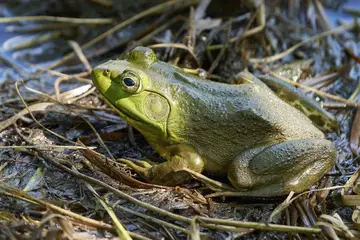
American Bullfrog
Photo: Paul Danese · CC BY-SA 4.0 · Wikimedia Commons · resized

American Bullfrog

Lithobates catesbeianus

Not stated

Venom
No official source we use states whether this animal is venomous. That does not mean it is harmless: do not handle it.
Size
Usually 6 to 8 inches long (NCWRC); can reach 8 inches or more and weigh over 2 pounds (CDFW). Missouri gives 3.5 to 6 inches snout to vent, occasionally to 8.75.
How to recognize it
  • No ridge (dorsolateral fold) down each side of the back
  • Large round eardrum: about twice the eye in males, about eye-sized in females
  • Fully webbed hind feet, longest toe extends past the webbing
What the sources say

Habitat: This highly aquatic frog prefers permanent bodies of water such as lakes, ponds, sluggish streams, and backwaters of rivers. This species is only native to the southeastern corner of the state though they have been introduced outside of their native range in various areas of the state. (Minnesota Department of Natural Resources)

Full American Bullfrog guide

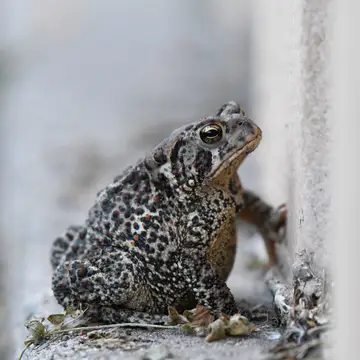
American toad
Photo: U.S. Fish and Wildlife Service - Midwest Region · Public domain · Wikimedia Commons

American toad

Anaxyrus americanus

Not stated

Venom
No official source we use states whether this animal is venomous. That does not mean it is harmless: do not handle it.
Size
2 to 3.5 inches long (NCWRC: up to 4 inches); females are larger than males.
How to recognize it
  • Dark spots on the back hold only a few large warts; the similar Fowler's toad has three or more. Agencies give different counts for the American toad (TWRA: one or two; Ohio DNR: one, two or three; Georgia DNR: usually no more than one), so wart count alone does not settle it; check the head crests too (see lookalikes).
  • A large, kidney- or bean-shaped parotoid gland behind each eye that usually does not touch the bony ridge (cranial crest) above the eye, or touches it only by a short spur.
  • Enlarged warts on the lower leg.
531 records by month.
What the sources say

Habitat: While this species is most often associated with forest and woodland habitat, it also occupies grasslands, residential yards, and gardens. (Minnesota Department of Natural Resources)

Full American toad guide

No confirmed photo of Blanchard's Cricket Frog

Blanchard's Cricket Frog

Acris blanchardi

Not stated

Venom
No official source we use states whether this animal is venomous. That does not mean it is harmless: do not handle it.
Conservation
Minnesota endangered
What the sources say

Habitat: Identical to breeding habitat with some travel over land during dry spells. (Minnesota Department of Natural Resources)

No confirmed photo of Canadian toad

Canadian toad

Anaxyrus hemiophrys

Not stated

Venom
No official source we use states whether this animal is venomous. That does not mean it is harmless: do not handle it.
Where in Minnesota
Mainly the western third of Minnesota Minnesota Department of Natural Resources
What the sources say

Habitat: More aquatic than most toads, typically found in or near the margins of prairie wetlands. Capable of tolerating extreme heat by remaining dormant for several days. (Minnesota Department of Natural Resources)

No confirmed photo of Cope's gray treefrog

Cope's gray treefrog

Hyla chrysoscelis

Not stated

Venom
No official source we use states whether this animal is venomous. That does not mean it is harmless: do not handle it.
What the sources say

Habitat: Associated with a variety of habitats, including urban environments, but often found in grasslands or forest edges. (Minnesota Department of Natural Resources)

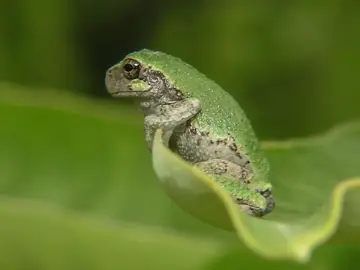
Gray treefrog
Photo: Erik Schiff · CC0 1.0 · iNaturalist

Gray treefrog

Hyla versicolor

Not stated

Venom
No official source we use states whether this animal is venomous. That does not mean it is harmless: do not handle it.
Size
Small: body usually 1¼ to 2½ inches long (snout to vent); Tennessee gives 1.25 to 2 inches.
How to recognize it
  • Large white or gray spot below each eye
  • Warty (granular) skin and sticky pads on fingers and toes
  • Bright orange or golden yellow on the underside of each hind leg, shown as a flash color
88 records by month.
What the sources say

Habitat: Closely associated with woodland and forest habitats. Often found in residential areas where it may be seen on windows feeding on insects attracted to lights. (Minnesota Department of Natural Resources)

Full Gray treefrog guide

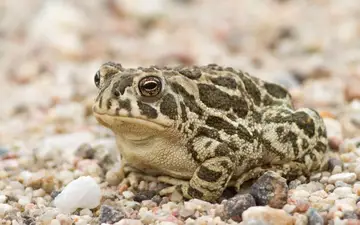
Great plains toad
Photo: Fyn Kynd · CC BY-SA 4.0 · iNaturalist · resized

Great plains toad

Anaxyrus cognatus

Not stated

Venom
No official source we use states whether this animal is venomous. That does not mean it is harmless: do not handle it.
Where in Minnesota
Along Minnesota's western border Minnesota Department of Natural Resources
Conservation
Minnesota special concern species
What the sources say

Habitat: An accomplished burrower, this species may hide underground during the day or for extended periods of extreme heat or drought. Prefers wide open spaces, occupying grasslands and agricultural fields of western Minnesota. (Minnesota Department of Natural Resources)

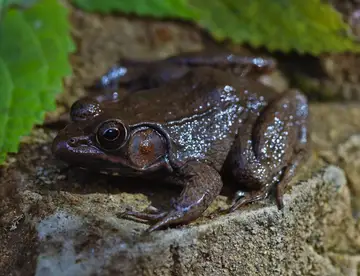
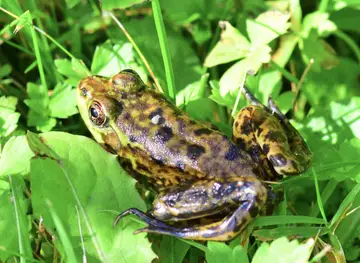
Green frog
Photo: Peter Paplanus from St. Louis, Missouri · CC BY 2.0 · Wikimedia Commons

Green frog

Lithobates clamitans

Not stated

Venom
No official source we use states whether this animal is venomous. That does not mean it is harmless: do not handle it.
226 records by month.
What the sources say

Habitat: This highly aquatic species is often associated with streams and ditches, although it also inhabits shallow water of lakes and ponds. (Minnesota Department of Natural Resources)

Mink frog
Photo: Bernie Paquette · CC BY 4.0 · iNaturalist

Mink frog

Lithobates septentrionalis

Not stated

Venom
No official source we use states whether this animal is venomous. That does not mean it is harmless: do not handle it.
What the sources say

Habitat: Inhabits borders of forested ponds and lakes where water lilies are plentiful. Individuals frequently move about by hopping from pad to pad. (Minnesota Department of Natural Resources)

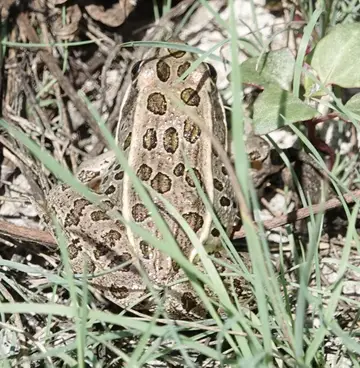
Northern leopard frog
Photo: Colin Croft · CC BY 4.0 · iNaturalist

Northern leopard frog

Lithobates pipiens

Not stated

Venom
No official source we use states whether this animal is venomous. That does not mean it is harmless: do not handle it.
306 records by month.
What the sources say

Habitat: A frog frequently found in grasslands, wet meadows, and forest edges. During the summer they may travel one to two miles from water. (Minnesota Department of Natural Resources)

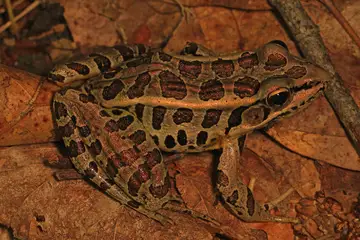
Pickerel frog
Photo: Judy Gallagher · CC BY 2.0 · Wikimedia Commons

Pickerel frog

Lithobates palustris

Not stated

Venom
No official source we use states whether this animal is venomous. That does not mean it is harmless: do not handle it.
Danger to people
“This chemical can irritate humans” Minnesota Department of Natural Resources
Size
About 1.75 to 3 inches long; large females reach about 3.5 inches. Males are smaller than females.
How to recognize it
  • Two rows of square or rectangular dark spots down the back between two light ridges (dorsolateral folds); spots sometimes merge into bars
  • Bright yellow or orange on the hidden inner surfaces of the hind legs and groin
  • No white spot on the eardrum (tympanum), unlike the southern leopard frog
What the sources say

Habitat: Inhabits cool, clear water of wooded streams with a dense forest canopy. Feeds in grassy openings adjacent to streams. (Minnesota Department of Natural Resources)

Full Pickerel frog guide

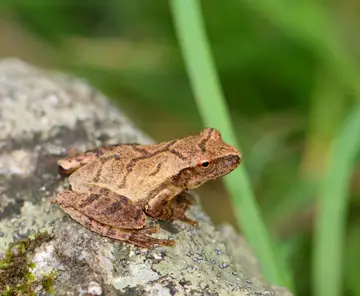
Spring peeper
Photo: Christine Young · CC BY 4.0 · iNaturalist

Spring peeper

Pseudacris crucifer

Not stated

Venom
No official source we use states whether this animal is venomous. That does not mean it is harmless: do not handle it.
Size
Adults 3/4 to 1 1/4 inches snout to vent, occasionally to 1 1/2 inches; males are smaller than females.
How to recognize it
  • Clear, high-pitched peep about once per second; a chorus can sound like small jingle bells
  • Adhesive pads on the tips of fingers and toes
  • Some individuals have little to no markings
127 records by month.
What the sources say

Habitat: Inhabits forested areas, especially areas with brushy undergrowth. May be heard calling in the fall. (Minnesota Department of Natural Resources)

Full Spring peeper guide

No confirmed photo of Western/Boreal chorus frog

Western/Boreal chorus frog

Pseudacris maculata

Not stated

Venom
No official source we use states whether this animal is venomous. That does not mean it is harmless: do not handle it.
What the sources say

Habitat: Associated with a variety of habitats, including urban environments, but often found in grasslands or forest edges. (Minnesota Department of Natural Resources)

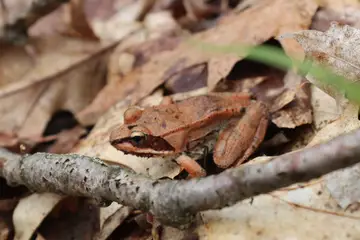
Wood frog
Photo: Jackson Kusack · CC0 1.0 · iNaturalist

Wood frog

Lithobates sylvaticus

Not stated

Venom
No official source we use states whether this animal is venomous. That does not mean it is harmless: do not handle it.
Size
Adults 1.5 to 2.75 inches snout to vent, occasionally to 3.5 inches; females are larger than males.
How to recognize it
  • Dark eye mask: SREL calls it the only frog in the Southeast with such a facial pattern
  • Distinct ridge of skin (dorsolateral fold) down each side of the back to the groin
  • Call: a rapid, hoarse 'waaaduck' like a quacking duck, repeated three or four times
203 records by month.
What the sources say

Habitat: Occupies woodland and forest habitat, sometimes traveling a considerable distance from water. (Minnesota Department of Natural Resources)

Full Wood frog guide

Frogs and Toads people confuse

Spring Peeper or Gray Treefrog?

Spring Peeper
Photo: Christine Young · CC BY 4.0 · iNaturalist

Spring Peeper Not stated

Gray Treefrog
Photo: Erik Schiff · CC0 1.0 · iNaturalist

Gray Treefrog Not stated

Maine IF&W lists the spring peeper's distinguishing characteristics: Maine's smallest frog (about 0.8 to 1.5 inches), grayish- or orangish-brown above with a distinct dark X on the back, and smooth skin; it notes it is commonly confused with the gray treefrog.

American Bullfrog or Green Frog (Bronze Frog)?

American Bullfrog
Photo: Paul Danese · CC BY-SA 4.0 · Wikimedia Commons · resized

American Bullfrog Not stated

Green Frog (Bronze Frog)
Photo: Peter Paplanus from St. Louis, Missouri · CC BY 2.0 · Wikimedia Commons

Green Frog (Bronze Frog) Not stated

Bullfrogs lack the dorsolateral ridges that green frogs have.

Wood frog or Green frog (young; including bronze color form)?

Wood frog
Photo: Jackson Kusack · CC0 1.0 · iNaturalist

Wood frog Not stated

Green frog (young; including bronze color form)
Photo: Peter Paplanus from St. Louis, Missouri · CC BY 2.0 · Wikimedia Commons

Green frog (young; including bronze color form) Not stated

MDC: young green frogs can be similar in color but lack the dark brown mask through each eye.

Photos show typical adults; individuals vary. Never get close to compare.

When frogs and toads are active in Minnesota

Records of frogs and toads in Minnesota peak in May to August. They show when people record frogs and toads, not how many there are (about month bars).

1,907 records of frogs and toads in Minnesota by month (GBIF, CC0 and CC BY records).

If you are bitten or stung

Call 911 or Poison Help at 1-800-222-1222 right away. Poison Help connects you to your local poison center, any time of day.

How to report

Invasive insects (emerald ash borer, spongy moth, Asian long-horned beetle, brown marmorated stink bug): Minnesota Department of Agriculture "Report a Pest" line 1-888-545-6684. Invasive vertebrates (mute swans, Eurasian swine/wild pigs): the DNR Invasive Species Program and your local conservation officer or wildlife office. Aquatic invasives: your local DNR invasive species specialist. Cougar sightings: the nearest DNR area wildlife office or conservation officer. General DNR line: 888-646-6367. Minnesota Department of Natural Resources
About this list

The species list comes from Reptiles / Amphibians of Minnesota: Frogs and toads (Minnesota DNR species pages) (Minnesota Department of Natural Resources, Internet Archive captures 2026-02 to 2026-10). 14 more entries come from other official sources named on each card.

Venom labels come only from official sources and link to them; "Not stated" never means harmless. How labels work.

Want a paper copy? Print the Minnesota frogs and toads ID chart.

Sources

  1. Reptiles / Amphibians of Minnesota. Minnesota Department of Natural Resources. archived copy, captured October 12, 2026; checked November 3, 2026.
  2. Frogs and Toads. Minnesota Department of Natural Resources. archived copy, captured May 12, 2026; checked November 3, 2026.
    Quoted passages (1)
    “The 14 species of toads and frogs found in Minnesota are grouped into three families: toads, treefrogs, and true frogs.”
  3. American toad. Minnesota Department of Natural Resources. archived copy, captured July 13, 2026; checked November 3, 2026.
  4. Canadian toad. Minnesota Department of Natural Resources. archived copy, captured May 16, 2026; checked November 3, 2026.
  5. Great plains toad. Minnesota Department of Natural Resources. archived copy, captured April 22, 2026; checked November 3, 2026.
  6. Blanchard's Cricket Frog. Minnesota Department of Natural Resources. archived copy, captured June 7, 2026; checked November 3, 2026.
  7. Cope's gray treefrog. Minnesota Department of Natural Resources. archived copy, captured May 18, 2026; checked November 3, 2026.
  8. Gray treefrog. Minnesota Department of Natural Resources. archived copy, captured June 5, 2026; checked November 3, 2026.
  9. Spring peeper. Minnesota Department of Natural Resources. archived copy, captured April 22, 2026; checked November 3, 2026.
  10. Western/Boreal chorus frog. Minnesota Department of Natural Resources. archived copy, captured February 11, 2026; checked November 3, 2026.
  11. American Bullfrog. Minnesota Department of Natural Resources. archived copy, captured May 17, 2026; checked November 3, 2026.
  12. Green frog. Minnesota Department of Natural Resources. archived copy, captured June 15, 2026; checked November 3, 2026.
  13. Mink frog. Minnesota Department of Natural Resources. archived copy, captured June 6, 2026; checked November 3, 2026.
  14. Northern leopard frog. Minnesota Department of Natural Resources. archived copy, captured April 10, 2026; checked November 3, 2026.
  15. Pickerel frog. Minnesota Department of Natural Resources. archived copy, captured May 19, 2026; checked November 3, 2026.
    Quoted passages (1)
    “This chemical can irritate humans”
  16. Wood frog. Minnesota Department of Natural Resources. archived copy, captured October 12, 2026; checked November 3, 2026.
  17. How do I report an invasive terrestrial animal? Minnesota Department of Natural Resources. archived copy, captured April 14, 2026; checked November 3, 2026.
    Quoted passages (1)
    “Report new locations to Minnesota Department of Agriculture or call the ‘Report a Pest’ phone number: 1-888-545-6684.”
  18. GBIF.org occurrence records, human observations licensed CC0 1.0 or CC BY 4.0 only, accessed November 3, 2026. The datasets behind these counts are listed on our Sources page.