States Wildlife

Minnesota Lizards: Identification Guide With Pictures

Last checked November 3, 2026 against official sources.

On this page
  1. All 3 lizards
  2. When they are active
  3. How to report
  4. What official sources say
  5. About this list
  6. Sources

Minnesota Department of Natural Resources, Nongame Wildlife Program: …since we only have three lizard species

This page lists 3 lizards: all from Minnesota Department of Natural Resources, Nongame Wildlife Program's Snakes and Lizards of Minnesota.

All 3 lizards

From A to Z.

No confirmed photo of Common Five-lined Skink

Common Five-lined Skink

Plestiodon fasciatus

Not stated

Venom
No official source we use states whether this animal is venomous. That does not mean it is harmless: do not handle it.
Size
5 to 8.5 inches
How to recognize it
  • Smooth, shiny scales
  • Enlarged middle row of scales under the tail (separates it from the southeastern five-lined skink)
  • Tail breaks off easily and twitches to distract predators; it grows back shorter
Conservation
Minnesota special concern species
What the sources say

Habitat: South‑facing, rocky outcrops, old woodlots, along moist forest edges, and openings in pine barrens, oak savannas and dry northern hardwood forests (Minnesota Department of Natural Resources, Nongame Wildlife Program)

Full Common Five-lined Skink guide

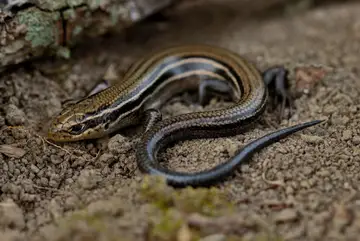
Prairie Skink
Photo: Peter Paplanus · CC BY 2.0 · Wikimedia Commons

Prairie Skink

Plestiodon septentrionalis

Not stated

Venom
No official source we use states whether this animal is venomous. That does not mean it is harmless: do not handle it.
What the sources say

Habitat: Often found along stream banks or openings in pine barrens, oak savannas and grasslands (Minnesota Department of Natural Resources, Nongame Wildlife Program)

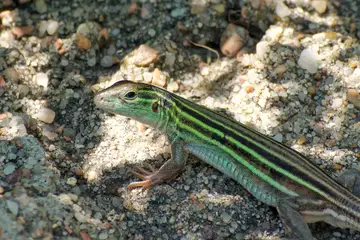
Six-lined Racerunner
Photo: Joe Brewer · CC BY 4.0 · iNaturalist

Six-lined Racerunner

Aspidoscelis sexlineata

Not stated

Venom
No official source we use states whether this animal is venomous. That does not mean it is harmless: do not handle it.
What the sources say

Habitat: Open sandy or gravelly areas with little ground vegetation, prairies on south facing bluffs and sand outwashes in river floodplains (Minnesota Department of Natural Resources, Nongame Wildlife Program)

When lizards are active in Minnesota

Records of lizards in Minnesota peak in May to June and August. They show when people record lizards, not how many there are (about month bars).

40 records of lizards in Minnesota by month (GBIF, CC0 and CC BY records).

How to report

Invasive insects (emerald ash borer, spongy moth, Asian long-horned beetle, brown marmorated stink bug): Minnesota Department of Agriculture "Report a Pest" line 1-888-545-6684. Invasive vertebrates (mute swans, Eurasian swine/wild pigs): the DNR Invasive Species Program and your local conservation officer or wildlife office. Aquatic invasives: your local DNR invasive species specialist. Cougar sightings: the nearest DNR area wildlife office or conservation officer. General DNR line: 888-646-6367. Minnesota Department of Natural Resources
What official sources say

Are there lizards in Minnesota?

Yes. Three: common five-lined skink, prairie skink and six-lined racerunner. Minnesota Department of Natural Resources, Nongame Wildlife Program

“…since we only have three lizard species”

About this list

The species list comes from Snakes and Lizards of Minnesota (Minnesota DNR booklet, EWR_448_18) (Minnesota Department of Natural Resources, Nongame Wildlife Program, ©2018).

Venom labels come only from official sources and link to them; "Not stated" never means harmless. How labels work.

Sources

  1. Reptiles / Amphibians of Minnesota. Minnesota Department of Natural Resources. archived copy, captured October 12, 2026; checked November 3, 2026.
  2. Snakes and Lizards of Minnesota (EWR_448_18). Minnesota Department of Natural Resources, Nongame Wildlife Program. ©2018; checked November 3, 2026.
    Quoted passages (2)
    “…since we only have three lizard species”
    “…they are typically only active in Minnesota from April through late October”
  3. How do I report an invasive terrestrial animal? Minnesota Department of Natural Resources. archived copy, captured April 14, 2026; checked November 3, 2026.
    Quoted passages (1)
    “Report new locations to Minnesota Department of Agriculture or call the ‘Report a Pest’ phone number: 1-888-545-6684.”
  4. GBIF.org occurrence records, human observations licensed CC0 1.0 or CC BY 4.0 only, accessed November 3, 2026. The datasets behind these counts are listed on our Sources page.