This page lists 21 spiders.
1 is venomous by official accounts. 1 is nonnative.
University of Minnesota Extension says: “All spiders inject venom through their hollow fangs into living prey to disable the prey.” Official sources name Northern widow as dangerous to people; it is marked venomous, with the source, and listed first. The other 20 spiders are marked “Not named as dangerous”. That does not make them harmless: do not handle spiders.
Not every species: no complete official list of Minnesota spiders exists, so this page covers the ones state and Extension sources name. How lists are built.
Which spiders can hurt you
Official sources single out these spiders in Minnesota, in their own words:
Official sources say the brown recluse is not native to Minnesota or not found there. It is not counted on this page; each entry quotes the source.
Brown recluse ("fiddleback spider")
Not native. “Neither black widow spiders or brown recluse are native to the upper Midwest and are rarely encountered.” University of Minnesota Extension
It is venomous, per NIOSH. If you find one, do not touch it.
All 21 spiders
Venomous species first, then A to Z. Do not handle them.
Venom: “The only spiders capable of surviving in Minnesota which may be dangerous to humans are the brown recluse and the northern widow.” (University of Minnesota Agricultural Extension Service)
Habitat: Piles of rubble, outdoor sheds or garages, crawl spaces, and basements are common web locations. (University of Minnesota Agricultural Extension Service)
“All spiders inject venom through their hollow fangs into living prey to disable the prey.” University of Minnesota Extension. University of Minnesota Extension says this of the whole group; it does not name this species as dangerous to people. Do not handle it.
Conservation
Minnesota special concern species
No confirmed photo of Barn funnel weaver
Barn funnel weaver
Tegenaria domestica
Not named as dangerous
Venom
“All spiders inject venom through their hollow fangs into living prey to disable the prey.” University of Minnesota Extension. University of Minnesota Extension says this of the whole group; it does not name this species as dangerous to people. Do not handle it.
“All spiders inject venom through their hollow fangs into living prey to disable the prey.” University of Minnesota Extension. University of Minnesota Extension says this of the whole group; it does not name this species as dangerous to people. Do not handle it.
Size
Females 3/4 to 1 inch long, not counting legs (Missouri); 19 to 28 mm (Penn State); Texas A&M says the female body is more than 1 inch. Males about 1/4 inch (Missouri); 5 to 8 mm (Penn State).
How to recognize it
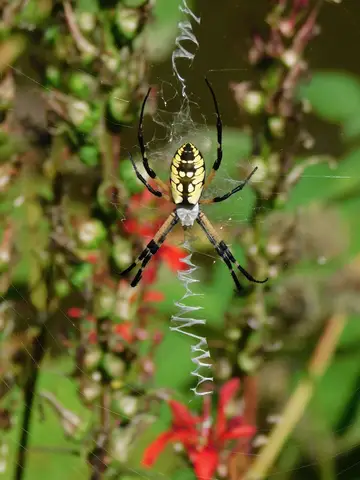
Round web about 2 feet across, built only by females; the spider rests head-down at the center, where a zigzag silk band (stabilimentum) runs vertically.
Abdomen an elongated oval, pointed at the rear, with two humps (shoulders) at the front.
Males are much smaller than females and rarely noticed.
“All spiders inject venom through their hollow fangs into living prey to disable the prey.” University of Minnesota Extension. University of Minnesota Extension says this of the whole group; it does not name this species as dangerous to people. Do not handle it.
“All spiders inject venom through their hollow fangs into living prey to disable the prey.” University of Minnesota Extension. University of Minnesota Extension says this of the whole group; it does not name this species as dangerous to people. Do not handle it.
“All spiders inject venom through their hollow fangs into living prey to disable the prey.” University of Minnesota Extension. University of Minnesota Extension says this of the whole group; it does not name this species as dangerous to people. Do not handle it.
“All spiders inject venom through their hollow fangs into living prey to disable the prey.” University of Minnesota Extension. University of Minnesota Extension says this of the whole group; it does not name this species as dangerous to people. Do not handle it.
JFMAMJJASOND
117 records by month.
No confirmed photo of jumping spider
jumping spider
Marpissa formosa
Not named as dangerous
Venom
“All spiders inject venom through their hollow fangs into living prey to disable the prey.” University of Minnesota Extension. University of Minnesota Extension says this of the whole group; it does not name this species as dangerous to people. Do not handle it.
“All spiders inject venom through their hollow fangs into living prey to disable the prey.” University of Minnesota Extension. University of Minnesota Extension says this of the whole group; it does not name this species as dangerous to people. Do not handle it.
Conservation
Minnesota special concern species
No confirmed photo
Tutelina formicaria
Not named as dangerous
Venom
“All spiders inject venom through their hollow fangs into living prey to disable the prey.” University of Minnesota Extension. University of Minnesota Extension says this of the whole group; it does not name this species as dangerous to people. Do not handle it.
Conservation
Minnesota threatened
No confirmed photo
Habronattus calcaratus maddisoni
Not named as dangerous
Venom
“All spiders inject venom through their hollow fangs into living prey to disable the prey.” University of Minnesota Extension. University of Minnesota Extension says this of the whole group; it does not name this species as dangerous to people. Do not handle it.
Conservation
Minnesota special concern species
No confirmed photo
Habronattus texanus
Not named as dangerous
Venom
“All spiders inject venom through their hollow fangs into living prey to disable the prey.” University of Minnesota Extension. University of Minnesota Extension says this of the whole group; it does not name this species as dangerous to people. Do not handle it.
“All spiders inject venom through their hollow fangs into living prey to disable the prey.” University of Minnesota Extension. University of Minnesota Extension says this of the whole group; it does not name this species as dangerous to people. Do not handle it.
Conservation
Minnesota special concern species
No confirmed photo
Paradamoetas fontana
Not named as dangerous
Venom
“All spiders inject venom through their hollow fangs into living prey to disable the prey.” University of Minnesota Extension. University of Minnesota Extension says this of the whole group; it does not name this species as dangerous to people. Do not handle it.
Conservation
Minnesota special concern species
No confirmed photo
Pelegrina arizonensis
Not named as dangerous
Venom
“All spiders inject venom through their hollow fangs into living prey to disable the prey.” University of Minnesota Extension. University of Minnesota Extension says this of the whole group; it does not name this species as dangerous to people. Do not handle it.
Conservation
Minnesota special concern species
No confirmed photo
Phidippus pius
Not named as dangerous
Venom
“All spiders inject venom through their hollow fangs into living prey to disable the prey.” University of Minnesota Extension. University of Minnesota Extension says this of the whole group; it does not name this species as dangerous to people. Do not handle it.
“All spiders inject venom through their hollow fangs into living prey to disable the prey.” University of Minnesota Extension. University of Minnesota Extension says this of the whole group; it does not name this species as dangerous to people. Do not handle it.
No confirmed photo of Wolf spiders
Wolf spiders
Not named as dangerous
Venom
“All spiders inject venom through their hollow fangs into living prey to disable the prey.” University of Minnesota Extension. University of Minnesota Extension says this of the whole group; it does not name this species as dangerous to people. Do not handle it.
“All spiders inject venom through their hollow fangs into living prey to disable the prey.” University of Minnesota Extension. University of Minnesota Extension says this of the whole group; it does not name this species as dangerous to people. Do not handle it.
No confirmed photo of Yellow sac spider
Yellow sac spider
Cheiracanthium spp.
Not named as dangerous
Venom
“All spiders inject venom through their hollow fangs into living prey to disable the prey.” University of Minnesota Extension. University of Minnesota Extension says this of the whole group; it does not name this species as dangerous to people. Do not handle it.
When spiders are active in Minnesota
Records of spiders in Minnesota peak in June to September. They show when people record spiders, not how many there are (about month bars).
JanFebMarAprMayJunJulAugSepOctNovDec
3,011 records of spiders in Minnesota by month (GBIF, CC0 and CC BY records).
If you are bitten or stung
Call 911 or Poison Help at 1-800-222-1222 right away. Poison Help connects you to your local poison center, any time of day.
How to report
Invasive insects (emerald ash borer, spongy moth, Asian long-horned beetle, brown marmorated stink bug): Minnesota Department of Agriculture "Report a Pest" line 1-888-545-6684. Invasive vertebrates (mute swans, Eurasian swine/wild pigs): the DNR Invasive Species Program and your local conservation officer or wildlife office. Aquatic invasives: your local DNR invasive species specialist. Cougar sightings: the nearest DNR area wildlife office or conservation officer. General DNR line: 888-646-6367. Minnesota Department of Natural Resources
Rarely. UMN Extension says neither black widows nor brown recluses are native to the upper Midwest and they are rarely encountered. The 1979 UMN fact sheet said the brown recluse had not been found in Minnesota. University of Minnesota Extension
“Neither black widow spiders or brown recluse are native to the upper Midwest and are rarely encountered.”
Spiders. University of Minnesota Extension (Jeffrey Hahn et al.). archived copy, captured August 14, 2026; checked November 3, 2026.Quoted passages (2)
“All spiders inject venom through their hollow fangs into living prey to disable the prey.”
“Neither black widow spiders or brown recluse are native to the upper Midwest and are rarely encountered.”
Venomous Spiders at Work. CDC / National Institute for Occupational Safety and Health (NIOSH). archived copy, captured October 13, 2026; checked November 3, 2026.Quoted passages (1)
“Black widows and brown recluses are two types of venomous spiders in the United States.”