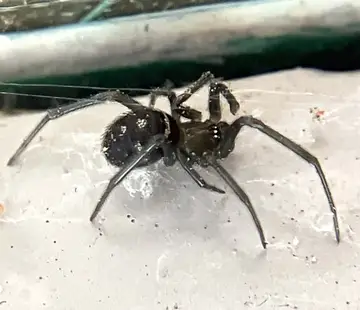
UMN Extension (reviewed 2019) says black widow spiders are not native to the upper Midwest and are rarely encountered; its 1979 fact sheet says the northern widow, a close relative of the black widow, is occasionally found in Minnesota.
University of Minnesota Agricultural Extension Service: “The northern widow, a close relative of the black widow, is occasionally found in Minnesota.” Source
Rarely. UMN Extension says neither black widows nor brown recluses are native to the upper Midwest and they are rarely encountered. The 1979 UMN fact sheet said the brown recluse had not been found in Minnesota. University of Minnesota Extension
Venom: “The only spiders capable of surviving in Minnesota which may be dangerous to humans are the brown recluse and the northern widow.” (University of Minnesota Agricultural Extension Service)
Habitat: Piles of rubble, outdoor sheds or garages, crawl spaces, and basements are common web locations. (University of Minnesota Agricultural Extension Service)
Official presence. 15 states where a state list or official source names it. Gray means no official record in our data, not that it is absent.
Native or listed
Nonnative or not established
No official record in our data
Observation records. Open-licence records on GBIF for the three US black widows (Latrodectus mactans, L. variolus and L. hesperus) in 44 states. Records are sightings people shared, not confirmation that a population lives there.
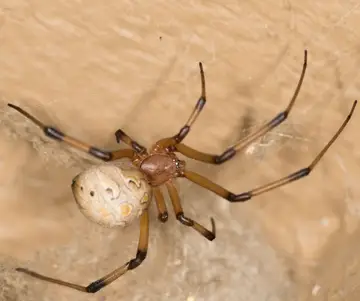
Chocolate brown and never has red on the belly; slightly smaller than a mature western black widow (about 3/8 in body length); egg sac looks like a cotton ball with indistinct margins. Caution: UC IPM says a black widow's hourglass can be almost imperceptible or, rarely, completely absent, so a lack of red alone does not rule out a black widow.
No red hourglass and not pure black; looks purplish-brown in bright light, and larger ones have a light T-shaped mark on the abdomen. Caution: a black widow's hourglass can rarely be almost or completely absent (UC IPM), so a lack of red alone does not rule out a black widow.
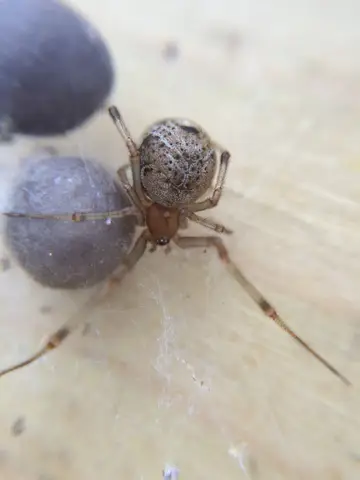
Usually a mottled mix of tan, brown and gray, with a lengthwise stripe and diagonal side stripes; colour varies from almost white to almost black, and very dark ones are flat black rather than shiny black. Mature females are smaller than mature female western black widows (about 3/8 in body length). The egg sac is covered in silk bumps, like a very large pollen grain; UC IPM calls the egg sac a much surer way to confirm a brown widow. Caution: brown widows also have a red hourglass on the underside (UF/IFAS), and a mature brown widow looks very similar to an immature western black widow (UC IPM).
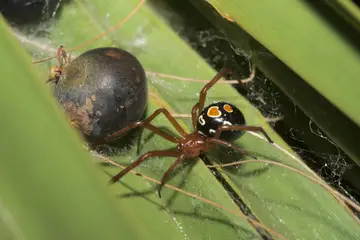
Penn State Extension: the female common house spider is 5 to 6 mm long with a yellowish-brown carapace and a dirty-white to brown abdomen with gray chevrons; its legs are yellow with darker rings at the end of each segment.
Keep your distance and do not try to catch or handle it. Invasive insects (emerald ash borer, spongy moth, Asian long-horned beetle, brown marmorated stink bug): Minnesota Department of Agriculture "Report a Pest" line 1-888-545-6684. Invasive vertebrates (mute swans, Eurasian swine/wild pigs): the DNR Invasive Species Program and your local conservation officer or wildlife office. Aquatic invasives: your local DNR invasive species specialist. Cougar sightings: the nearest DNR area wildlife office or conservation officer. General DNR line: 888-646-6367. Minnesota Department of Natural Resources
What official sources advise
Adult blacklegged ticks are active right after snowmelt, peak in May, and are active again from late September through October; nymphs peak from late May through June. Minnesota Department of Health
“The northern widow, a close relative of the black widow, is occasionally found in Minnesota.”
“The only spiders capable of surviving in Minnesota which may be dangerous to humans are the brown recluse and the northern widow.”
“The bite deserves prompt medical attention.”
Ticks (Tickborne Diseases). Minnesota Department of Health. updated June 30, 2025; checked November 3, 2026.Quoted passages (1)
“In Minnesota, adult ticks will usually emerge right after the snow melts and reach peak spring-time activity during the month of May.”
Spiders. University of Minnesota Extension (Jeffrey Hahn et al.). archived copy, captured August 14, 2026; checked November 3, 2026.Quoted passages (1)
“Neither black widow spiders or brown recluse are native to the upper Midwest and are rarely encountered.”