States Wildlife

Venomous Snakes in Minnesota: 2 Species & How to Tell

Last checked November 3, 2026 against official sources.

On this page
  1. The 2 venomous snakes
  2. Lookalikes
  3. When they are active
  4. If you are bitten or stung
  5. How to report
  6. About this list
  7. Sources

Minnesota has 2 venomous snakes named by official sources: Massasauga and Timber Rattlesnake. Each one is labelled venomous by Minnesota Department of Natural Resources, Nongame Wildlife Program.

The 2 venomous snakes of Minnesota

Recognize them from a distance; a photo cannot confirm that a snake is safe. Identifying animals safely.

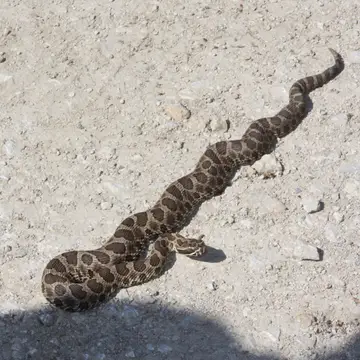
Massasauga
Photo: User:Rstanton13 · CC BY-SA 4.0 · Wikimedia Commons · resized

Massasauga

Sistrurus catenatus

Venomous per Minnesota Department of Natural Resources, Nongame Wildlife Program

Danger to people
“The massasauga is one of Minnesota's two venomous snakes.” Minnesota Department of Natural Resources
Size
Usually 18 to 30 inches long (New York DEC: 18 to 40 inches, average 27.5). The western massasauga in Arizona reaches only about 22 inches.
How to recognize it
  • A segmented rattle (a single button in newborns) and vertical, catlike pupils. In Michigan it is the only snake with both.
  • Nine large plates on top of the head (the timber rattlesnake has many small scales there)
  • A heat-sensing pit on each side of the head between the eye and nostril; the head is flat and much wider than the neck
Where in Minnesota
Southeast (historical; possibly extirpated) Minnesota Department of Natural Resources
Conservation
Minnesota endangered
What the sources say

Venom: “MASSASAUGA (Sistrurus catenatus) Venomous” (Minnesota Department of Natural Resources, Nongame Wildlife Program)

Habitat: Prefers moist habitats such as marshes and other wetlands, backwater areas, and bottomland forests; often forages in more open, upland areas adjacent to water bodies (Minnesota Department of Natural Resources, Nongame Wildlife Program)

Full Massasauga guide

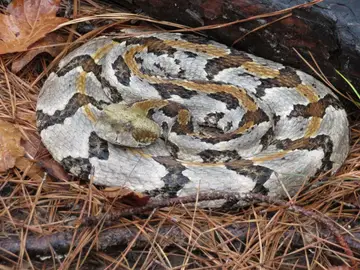
Timber Rattlesnake
Photo: NPS Photo · Public domain · Wikimedia Commons

Timber Rattlesnake

Crotalus horridus

Venomous per Minnesota Department of Natural Resources, Nongame Wildlife Program

Danger to people
“Although timber rattlesnake bites are rarely life threatening, they should always be taken seriously” Minnesota Department of Natural Resources, Nongame Wildlife Program
Size
Most adults 36 to 60 inches (3 to 5 feet); record 74.5 inches.
How to recognize it
  • Black tail ending in a rattle
  • Heat-sensing pit between nostril and eye
  • Large, thick head distinct from the neck; cat-like vertical pupil
Where in Minnesota
Blufflands of southeastern Minnesota only Minnesota Department of Natural Resources
Conservation
Minnesota threatened
What the sources say

Venom: “TIMBER RATTLESNAKE (Crotalus horridus) Venomous” (Minnesota Department of Natural Resources, Nongame Wildlife Program)

Habitat: Prefers south to west facing bluff prairies and associated oak forests (Minnesota Department of Natural Resources, Nongame Wildlife Program)

Full Timber Rattlesnake guide

See all 17 snakes, venomous and not, on Minnesota snakes.

Snakes people confuse

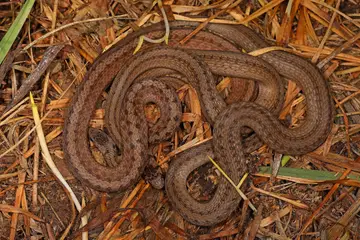
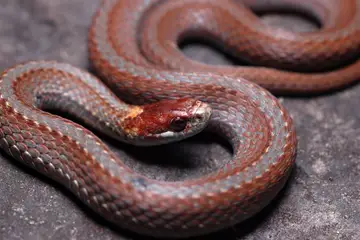
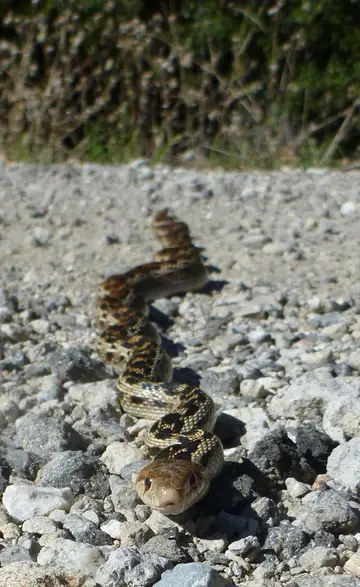
Brown Snake (Dekay's Brownsnake) or Red-bellied Snake?

Brown Snake (Dekay's Brownsnake)
Photo: Judy Gallagher · CC BY 2.0 · Wikimedia Commons

Brown Snake (Dekay's Brownsnake) Non-venomous

Red-bellied Snake
Photo: Rstanton13 · CC BY-SA 4.0 · Wikimedia Commons · resized

Red-bellied Snake Non-venomous

The red-bellied snake has a red underside; the brown snake's belly is cream, yellow or pink.

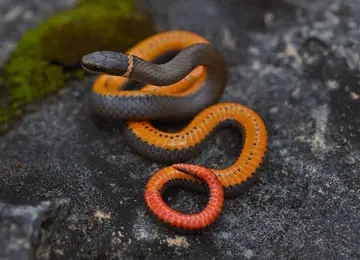
Brown Snake (Dekay's Brownsnake) or Ring-necked Snake?

Brown Snake (Dekay's Brownsnake)
Photo: Judy Gallagher · CC BY 2.0 · Wikimedia Commons

Brown Snake (Dekay's Brownsnake) Non-venomous

Ring-necked Snake
Photo: Peter Paplanus from St. Louis, Missouri · CC BY 2.0 · Wikimedia Commons

Ring-necked Snake Non-venomous

Ring-necked snakes have smooth scales and yellow bellies with paired dots down the center.

Gopher snake (gophersnake) or Rattlesnakes?

Gopher snake (gophersnake)
Photo: National Park Service from USA · Public domain · Wikimedia Commons

Gopher snake (gophersnake) Non-venomous

Rattlesnakes
Photo: NPS Photo · Public domain · Wikimedia Commons

Rattlesnakes Venomous

WDFW: gopher snakes lack a rattle and facial pits and have smaller, square back spots. NPS Cabrillo: the gopher snake's tail is long, skinny and pointed with no rattle, its head is about as slender as its neck (rattlesnakes have large spade- or triangle-shaped heads), and its back pattern is a rectangular chain rather than the circles or diamonds of a rattlesnake. Caution: a defensive gopher snake flattens its head into a triangle and vibrates its tail, so do not rely on head shape or sound alone.

Massasauga rattlesnake or Timber rattlesnake?

Massasauga rattlesnake
Photo: NPS photo · Public domain · Wikimedia Commons

Massasauga rattlesnake Venomous

Timber rattlesnake
Photo: NPS Photo · Public domain · Wikimedia Commons

Timber rattlesnake Venomous

The timber rattlesnake has many small scales on top of the head (the massasauga has nine large plates), a uniformly black tail (the massasauga's tail has 4 to 7 black rings) and narrow, often chevron-shaped back bands rather than bow-tie-shaped blotches. INHS warns that head plates are hard to see on a live snake and says not to get close enough to check, because this is a venomous species.

Massasauga rattlesnake or Common (northern) watersnake?

Massasauga rattlesnake
Photo: NPS photo · Public domain · Wikimedia Commons

Massasauga rattlesnake Venomous

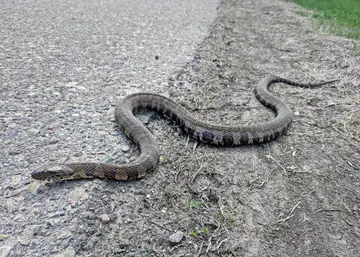
Common (northern) watersnake
Photo: U.S. Fish and Wildlife Service - Midwest Region · Public domain · Wikimedia Commons

Common (northern) watersnake Non-venomous

Minnesota DNR says many people who see a common watersnake mistake it for a massasauga. Minnesota Department of Natural Resources, Nongame Wildlife Program

Massasauga rattlesnake or Eastern vs. western (prairie) massasauga?

Massasauga rattlesnake
Photo: NPS photo · Public domain · Wikimedia Commons

Massasauga rattlesnake Venomous

Eastern vs. western (prairie) massasauga
Photo: User:Rstanton13 · CC BY-SA 4.0 · Wikimedia Commons · resized

Eastern vs. western (prairie) massasauga Venomous

The two massasaugas look almost the same; Missouri identifies them mainly by where they are found.

Photos show typical adults; individuals vary. Never get close to compare.

When venomous snakes are active in Minnesota

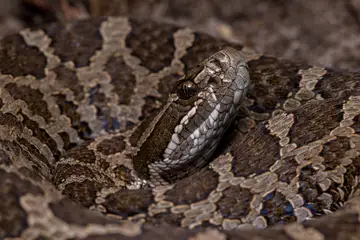
Records of snakes in Minnesota peak in May to June and September to October. They show when people record snakes, not how many there are (about month bars).

547 records of snakes in Minnesota by month (GBIF, CC0 and CC BY records).

If you are bitten or stung

Call 911 or Poison Help at 1-800-222-1222 right away. Poison Help connects you to your local poison center, any time of day.

Official advice from Minnesota Department of Natural Resources, Nongame Wildlife Program and Minnesota Department of Natural Resources:

How to report

Invasive insects (emerald ash borer, spongy moth, Asian long-horned beetle, brown marmorated stink bug): Minnesota Department of Agriculture "Report a Pest" line 1-888-545-6684. Invasive vertebrates (mute swans, Eurasian swine/wild pigs): the DNR Invasive Species Program and your local conservation officer or wildlife office. Aquatic invasives: your local DNR invasive species specialist. Cougar sightings: the nearest DNR area wildlife office or conservation officer. General DNR line: 888-646-6367. Minnesota Department of Natural Resources

About this list

The species list comes from Snakes and Lizards of Minnesota (Minnesota DNR booklet, EWR_448_18) (Minnesota Department of Natural Resources, Nongame Wildlife Program, ©2018).

Venom labels come only from official sources and link to them; "Not stated" never means harmless. How labels work.

Sources

  1. Reptiles / Amphibians of Minnesota. Minnesota Department of Natural Resources. archived copy, captured October 12, 2026; checked November 3, 2026.
  2. Snakes and Lizards of Minnesota (EWR_448_18). Minnesota Department of Natural Resources, Nongame Wildlife Program. ©2018; checked November 3, 2026.
    Quoted passages (11)
    “Minnesota has seventeen snake species, two of which are rattle‑ snakes, and three lizard species”
    “Minnesota has two venomous snakes, both of which are rattlesnakes There are several characteristics that differentiate our rattlesnakes from our 15 nonvenomous snake species”
    “MASSASAUGA (Sistrurus catenatus) Venomous”
    “TIMBER RATTLESNAKE (Crotalus horridus) Venomous”
    “Although timber rattlesnake bites are rarely life threatening, they should always be taken seriously”
    “If you do not recognize a snake that you encounter, be safe Leave the snake alone, slowly back away, and if you need to pass the snake, stay at least 6 feet away”
    “If you have a dog with you, it is important to get your dog on a leash or under your control until you are well past the snake”
    “…they are typically only active in Minnesota from April through late October”
    “May is the peak time for spring movements and September for fall movements, making them the peak months for most snake‑human encounters However, the peak encounter time for timber rattlesnakes in Minnesota is July through August”
    “Water moccasins (cottonmouths) and copperheads do not occur in Minnesota”
    “(Many people who encounter the common watersnake mistake it for a massasauga)”
  3. Rare Species Guide: Massasauga. Minnesota Department of Natural Resources. archived copy, captured May 17, 2026; checked November 3, 2026.
    Quoted passages (1)
    “The massasauga is one of Minnesota's two venomous snakes.”
  4. Avoiding and Treating Timber Rattlesnake Bites (Updated 2020). Minnesota Department of Natural Resources. Updated 2020; checked November 3, 2026.
    Quoted passages (3)
    “If you encounter a rattlesnake, or a snake you cannot identify, please do not try to capture or kill it.”
    “If you have a timber rattlesnake in your yard that is causing concern, you may contact your local law enforcement center for assistance.”
    “Timber rattlesnakes live in the blufflands of southeastern Minnesota. They are not found anywhere else in the state.”
  5. How do I report an invasive terrestrial animal? Minnesota Department of Natural Resources. archived copy, captured April 14, 2026; checked November 3, 2026.
    Quoted passages (1)
    “Report new locations to Minnesota Department of Agriculture or call the ‘Report a Pest’ phone number: 1-888-545-6684.”
  6. Living with Wildlife: Snakes. Minnesota Department of Natural Resources. archived copy, captured October 25, 2026; checked November 3, 2026.
    Quoted passages (1)
    “Of the 17 snake species in the state, only two are venomous -- the Timber Rattlesnake and the Eastern Massasauga. Both are found only in the southeastern counties and are rarely encountered.”
  7. GBIF.org occurrence records, human observations licensed CC0 1.0 or CC BY 4.0 only, accessed November 3, 2026. The datasets behind these counts are listed on our Sources page.