Brown Snake (Dekay's Brownsnake)
Storeria dekayi · also called Dekay's Brownsnake, DeKay's Brownsnake, Brownsnake and Northern Brown Snake · Last checked November 3, 2026.
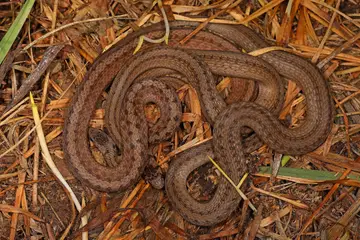

The brown snake (Dekay's brownsnake) is a small, slender snake, usually 9 to 13 inches long. It is gray to reddish brown with a pale stripe down the back bordered by two rows of small dark spots. It is nonvenomous: Missouri's conservation department calls it a harmless nonvenomous snake, and the Florida Museum says it is not dangerous to people or pets. It lives across the eastern US and is often the most common snake in yards, parks and cities. Not every brown snake is this species: the venomous copperhead is often confused with it. Missouri Department of Conservation
On this page
Is the brown snake dangerous?
Nonvenomous and not dangerous to people or pets. Florida Museum of Natural History
“Non-venomous. Dekay’s Brownsnakes are not dangerous to people or pets.”
Bites and stings: Rarely. Florida Museum: it typically does not bite in defense, and a stressed snake will rarely strike with its mouth closed as a bluff. Louisiana: the mouth stays closed when it strikes. When handled it squirms, flattens its body and releases a foul-smelling musk.
How to identify a brown snake
A photo or description can narrow it down, but cannot confirm what an animal is or that it is safe. Look from a distance and do not handle wild animals.
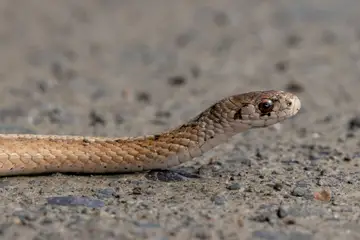

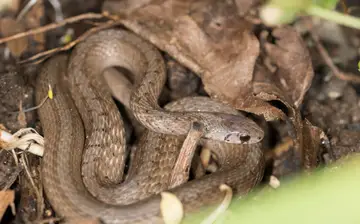
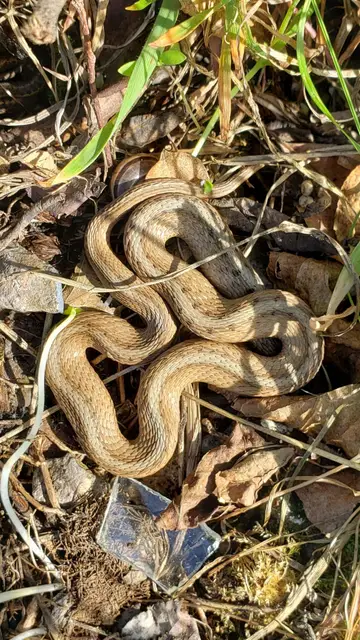
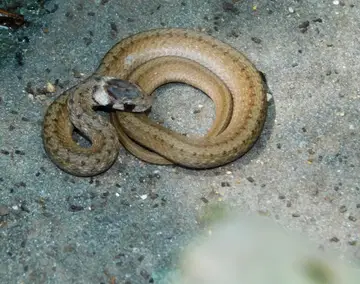
Size: Most adults 9 to 13 inches; occasionally up to about 20 inches. Missouri Department of Conservation
Colors: Gray, brown or reddish brown above; sometimes yellowish or grayish-brown; belly cream, yellow or pink, often with tiny black dots along the edges. Pattern: Pale tan stripe down the back bordered by two rows of small dark spots, often linked by thin lines; coastal Louisiana snakes may lack the dark spots.
Key features
- Dark top of head; a dark spot under each eye and on each side of the neck Missouri Department of Conservation
- Keeled (ridged) scales in 17 rows; round pupil Florida Museum of Natural History
- Tennessee: a small dark downward streak on the side of the head Tennessee Wildlife Resources Agency
Young
Young are darker, with a pale (whitish or yellowish) collar across the back of the head; newborns are about 4 inches long.
Animals mistaken for the brown snake
Brown Snake (Dekay's Brownsnake) or Copperhead?
Brown Snake (Dekay's Brownsnake)
Copperhead Agkistrodon contortrix
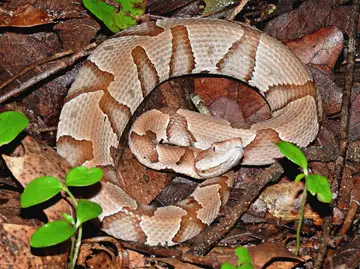

Copperheads have bold hourglass-shaped bands, and young copperheads under about 12 inches have bright yellow tail tips. Brown snakes have small spots, not hourglass bands. University of Georgia Savannah River Ecology Laboratory
Venomous (Virginia DWR and New Jersey Division of Fish and Wildlife list it among their venomous snakes).
Brown Snake (Dekay's Brownsnake) or Red-bellied Snake?
Brown Snake (Dekay's Brownsnake)
Red-bellied Snake Storeria occipitomaculata
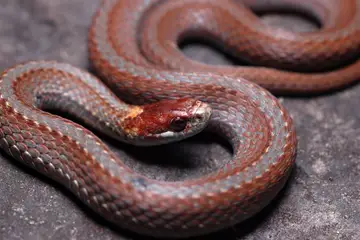

The red-bellied snake has a red underside; the brown snake's belly is cream, yellow or pink. University of Georgia Savannah River Ecology Laboratory
Non-venomous (Florida Museum).
Brown Snake (Dekay's Brownsnake) or Earth snakes?
Brown Snake (Dekay's Brownsnake)
Earth snakes Virginia spp. / Haldea striatula
Earth snakes have no spots on the back or head. University of Georgia Savannah River Ecology Laboratory
Non-venomous (Florida Museum).
Brown Snake (Dekay's Brownsnake) or Florida Brownsnake?
Brown Snake (Dekay's Brownsnake)
Florida Brownsnake Storeria victa
Told apart mainly by range: the Florida brownsnake replaces Dekay's brownsnake in peninsular Florida and extreme southern Georgia (Dekay's occurs in the Florida Panhandle west of the Aucilla River). Florida Museum also gives 17 scale rows at midbody for Dekay's brownsnake and 15 for the Florida brownsnake. University of Georgia Savannah River Ecology Laboratory
Non-venomous; not dangerous to people or pets (Florida Museum).
Brown Snake (Dekay's Brownsnake) or Ring-necked Snake?
Brown Snake (Dekay's Brownsnake)
Ring-necked Snake Diadophis punctatus
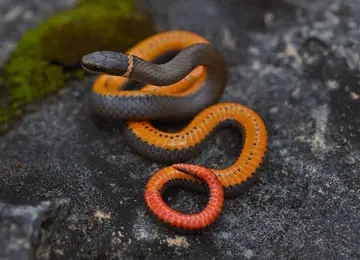

Ring-necked snakes have smooth scales and yellow bellies with paired dots down the center. Tennessee Wildlife Resources Agency
Non-venomous (Florida Museum).
Where the brown snake lives
- Native or listed
- Nonnative or not established
- No official record in our data
- 1–9
- 10–99
- 100–999
- 1,000+
On our state guides
- Arkansas snakes
- Connecticut snakes
- Delaware snakes
- Florida snakes
- Georgia snakes
- Illinois snakes
- Indiana snakes
- Iowa snakes
- Kansas snakes
- Kentucky snakes
- Louisiana snakes
- Maine snakes
- Maryland snakes
- Massachusetts snakes
- Michigan snakes
- Minnesota snakes
- Mississippi snakes
- Missouri snakes
- Nebraska snakes
- New Hampshire snakes
- New Jersey snakes
- New York snakes
- North Carolina snakes
- Ohio snakes
- Oklahoma snakes
- Pennsylvania snakes
- Rhode Island snakes
- South Carolina snakes
- South Dakota snakes
- Tennessee snakes
- Texas snakes
- Vermont snakes
- Virginia snakes
- West Virginia snakes
- Wisconsin snakes
State boundaries: U.S. Census Bureau, cartographic boundary file cb_2024_us_state_20m.
When it is active
Missouri: active from late March to early November; seen crossing trails and roads in spring and fall; may be active at night in hot weather. Missouri Department of Conservation
US open-licence records peak in March to June and October.
Habitat and habits
Habitat: Moist forests and woodlands, especially along ravines, creeks and floodplains; also prairies near wetlands, and city parks, cemeteries and yards. Hides under logs, rocks, boards and leaf litter. Missouri Department of Conservation
Behavior: Secretive and inoffensive; usually hidden under cover. It rarely bites. If handled it squirms, flattens its body and releases foul-smelling musk.
Diet: Earthworms, slugs, land snails and soft-bodied insects; one study found 75 percent slugs.
Young: Gives birth to live young, mid-July to September; litters of 3 to 41.
Legal status and reporting
Federal: No ESA record: the USFWS ECOS query returned no record for Storeria dekayi. US Fish and Wildlife Service
Protection: Tennessee: common, with no conservation concern. SREL says it is protected throughout Georgia, and New Jersey protects all its snakes under state law. University of Georgia Savannah River Ecology Laboratory
Questions about the brown snake
Brown snake
In the eastern US, "brown snake" usually means Dekay's brownsnake, a small, nonvenomous snake that eats slugs and earthworms. Missouri calls it a harmless nonvenomous snake. Other snakes are brown too, including the venomous copperhead, so check the pattern: brown snakes have small spots, copperheads have hourglass bands.
Brown snake florida
Florida has two: Dekay's brownsnake in the Panhandle west of the Aucilla River, and the Florida brownsnake in peninsular Florida and the Keys. The Florida Museum says both are nonvenomous and not dangerous to people or pets. The Florida Keys population of the Florida brownsnake is State Threatened.
Brown snake georgia
Georgia DNR lists the brown snake and the Florida brown snake among Georgia's nonvenomous snakes. SREL says the Florida brown snake replaces it in extreme southern Georgia.
Brown snake nc
NCWRC says the brown snake is light brown with a row of dark spots on its sides, eats snails, slugs and earthworms, and is non-venomous.
Brown snakes in michigan
MSU Extension's guide to Michigan snakes includes the brown snake. Michigan DNR says 17 of Michigan's 18 snake species are harmless to humans; the only venomous one is the eastern massasauga rattlesnake.
Brown snakes in texas
Herps of Texas (University of Texas) lists DeKay's brownsnake for Texas. Missouri notes the former Texas brownsnake subspecies is no longer considered distinct.
Brown snakes in virginia
Virginia DWR lists Dekay's brownsnake as a native species. Virginia DWR says only three of its 32 snake species are venomous: the cottonmouth, copperhead and timber rattlesnake.
Brown snake with black spots
Dekay's brownsnake usually has a pale stripe down the back with two rows of small dark spots along it. Coastal Louisiana snakes may lack the spots.
Brown snake with yellow belly
Dekay's brownsnake can have a cream, yellow or pink belly. Ring-necked snakes also have yellow bellies but have smooth scales and paired dots down the belly.
Brown snake with diamond pattern
Missouri describes Dekay's brownsnake as having two rows of small spots along a tan back stripe, not diamonds. A brown snake with a row of large dark diamonds with cream borders may be an eastern diamond-backed rattlesnake, which the Florida Museum lists as venomous. If someone is bitten, call 911 or Poison Help at 1-800-222-1222.
Sources
- Dekay's Brownsnake (MDC Field Guide). Missouri Department of Conservation. undated page; checked November 3, 2026.
Quoted passages (6)
“Adult length: 9 to 13 inches; occasionally to 20 inches.”
“A dark spot is present under each eye and on each side of the neck.”
“The most common habitats in Missouri are moist forests or woodlands, especially along the edges of ravines, creeks, and river floodplains.”
“Brownsnakes eat earthworms, slugs, land snails, and soft-bodied insects.”
“Active from late March to early November, this species can be found under logs, rocks, boards, or other objects.”
“Females give birth to live young between mid-July and September; litters comprise 3–41 young.”
- Florida Snake ID Guide species account: Dekays Brownsnake. Florida Museum of Natural History (University of Florida). updated March 18, 2026; checked November 3, 2026.
Quoted passages (4)
“Non-venomous. Dekay’s Brownsnakes are not dangerous to people or pets.”
“The scales on the back are keeled (each scale has a prominent raised ridge) and arranged in 17 scale rows at midbody. The pupil is round.”
“Juveniles are dark brown with a whitish band across back of head.”
“These inoffensive snakes typically do not bite in defense, but stressed snakes will rarely strike with the mouth closed as a bluff.”
- Brown Snake (Storeria dekayi). University of Georgia Savannah River Ecology Laboratory (linked by SCDNR as its species information). undated page; checked November 3, 2026.
Quoted passages (5)
“This species is protected throughout the state of Georgia.”
“Copperheads have prominent hourglass-shaped bands and have bright yellow tail tips when less than 12 in long.”
“They can be distinguished from redbellied snakes (Storeria occipitomaculata) by their lack of red underside”
“This snake looks similar to earth snakes (Virginia sp.) but those species lack spots on the back and head.”
“In extreme southern Georgia and Florida, brown snakes are replaced by the closely-related Florida brown snake (Storeria victa).”
- Reptiles » Snakes (Tennessee Watchable Wildlife species accounts). Tennessee Wildlife Resources Agency (Tennessee Watchable Wildlife website). undated page; checked November 3, 2026.
Quoted passages (2)
“The top of the head is dark and a dark, downward streak occurs on each side of the head.”
“Ring-necked Snakes have smooth scales and yellow bellies with paired dots down the center.”
- ECOS species report query (Crotalus adamanteus, Storeria dekayi, Carcharhinus limbatus, Vespa crabro). U.S. Fish and Wildlife Service. live query 2026-11-03; checked November 3, 2026.
- Florida Snake ID Guide species account: Florida Brownsnake. Florida Museum of Natural History (University of Florida). updated March 18, 2026; checked November 3, 2026.
- Checklist of Florida's Amphibians and Reptiles (Revised 2023). Florida Fish and Wildlife Conservation Commission (FWC). Revised 2023; checked November 3, 2026.
- Snake Information & Resources (Snakes of Georgia). Georgia DNR Wildlife Resources Division. undated page; checked November 3, 2026.
- Brown Snake (NCWRC species page). N.C. Wildlife Resources Commission. undated page; checked November 3, 2026.
- Michigan Snakes: A Field Guide and Pocket Reference (MSU Extension Bulletin E-2000). Michigan State University Extension (MSU Library archive). Revised 1999; checked November 3, 2026.
- When encountering Michigan's snakes, best to leave them be. Michigan Department of Natural Resources. May 31, 2016; checked November 3, 2026.
- Herps of Texas: Snakes of Texas. Herps of Texas, Biodiversity Collections, Dept. of Integrative Biology, The University of Texas at Austin. 2020-07-23 (archive capture date; checked November 3, 2026.
- List of Native and Naturalized Fauna of Virginia. Virginia Department of Wildlife Resources (DWR). May, 2026; checked November 3, 2026.
- Not So Spooky: Mythbusting Snakes and Bats. Virginia DWR (blog, Molly Kirk/DWR). October 25, 2024; checked November 3, 2026.
- Snake Species Field Guide: Dekay's Brownsnake. Louisiana Department of Wildlife and Fisheries. undated page; checked November 3, 2026.
- Florida Snake ID Guide species account: Eastern Diamond Backed Rattlesnake. Florida Museum of Natural History (University of Florida). updated September 23, 2022; checked November 3, 2026.
- GBIF.org occurrence records, human observations licensed CC0 1.0 or CC BY 4.0 only, accessed November 3, 2026. The datasets behind these counts are listed on our Sources page.
- State boundaries: U.S. Census Bureau, cartographic boundary file cb_2024_us_state_20m.