Rhode Island DEM, Division of Fish & Wildlife: It provides meticulous accounts of the state’s seven native turtles and 13 native snakes and their respective habitats
This page lists 13 snakes: all from Rhode Island Department of State (Code of Regulations); Rhode Island DEM rule's Rules and Regulations Governing Importation and Possession of Wild Animals, § 3.17 Appendix A: native snakes; with DEM factsheet Snakes of Rhode Island.
Venomous snakes in Rhode Island
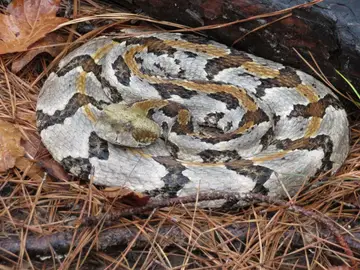
Official sources label these snakes venomous in Rhode Island. The timber rattlesnake is on the official list with the status: Extirpated circa 1963 per DEM; still on RI Species of Greatest Conservation Need (2015 Wildlife Action Plan). Venomous snakes in Rhode Island has more on each one.
Most adults 36 to 60 inches (3 to 5 feet); record 74.5 inches.
How to recognize it
Black tail ending in a rattle
Heat-sensing pit between nostril and eye
Large, thick head distinct from the neck; cat-like vertical pupil
Conservation
Extirpated circa 1963 per DEM; still on RI Species of Greatest Conservation Need (2015 Wildlife Action Plan)
What the sources say
Venom: “Venomous snakes found in the United States include rattlesnakes, copperheads, cottonmouths (also called water moccasins), and coral snakes.” (CDC / NIOSH)
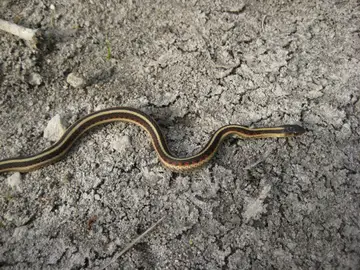
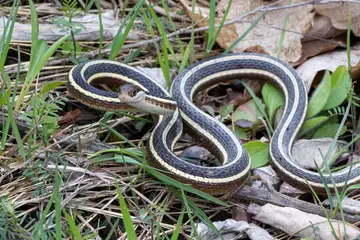
“…gartersnake saliva seems to be toxic to the small animals upon which they prey, and some people may develop a rash if bitten.”
JFMAMJJASOND
58 records by month.What the sources say
Venom: “There are NO VENEMOUS snakes that occur in Rhode Island.” (Rhode Island DEM, Division of Fish & Wildlife)
Habitat: Wetlands, forests, rocky hillsides and residential areas. Often spotted basking in the sun on rocks, hedges, and concrete surfaces. (Rhode Island Department of State (Code of Regulations); Rhode Island DEM rule)
Venom: “There are NO VENEMOUS snakes that occur in Rhode Island.” (Rhode Island DEM, Division of Fish & Wildlife)
Habitat: Inhabit moist woodland habitats with sandy substrates. Very rarely seen in the open, but can be found beneath stones, boards or inside rotting logs. (Rhode Island Department of State (Code of Regulations); Rhode Island DEM rule)
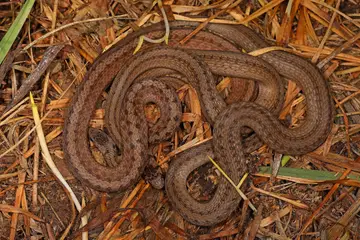
Most adults 9 to 13 inches; occasionally up to about 20 inches.
How to recognize it
Dark top of head; a dark spot under each eye and on each side of the neck
Keeled (ridged) scales in 17 rows; round pupil
Tennessee: a small dark downward streak on the side of the head
What the sources say
Venom: “There are NO VENEMOUS snakes that occur in Rhode Island.” (Rhode Island DEM, Division of Fish & Wildlife)
Habitat: Most commonly encountered in developed or residential areas. Typi- cally found in groups under debris. (Rhode Island Department of State (Code of Regulations); Rhode Island DEM rule)
RI Species of Greatest Conservation Need (2015 Wildlife Action Plan)
What the sources say
Venom: “Despite its intimidating display, this snake isn’t venomous, poses no threat to humans, and is perhaps the most docile of RI’s local snakes.” (Rhode Island DEM)
Habitat: Sandy soil; sandy woodland and grasslands. More common in interi- or areas of Rhode Island than along the coast. (Rhode Island Department of State (Code of Regulations); Rhode Island DEM rule)
RI Species of Greatest Conservation Need (2015 Wildlife Action Plan)
What the sources say
Venom: “There are NO VENEMOUS snakes that occur in Rhode Island.” (Rhode Island DEM, Division of Fish & Wildlife)
Habitat: Woodlands, fields or river bottoms. Often reside in hollow trees, outbuildings and old barns. Only found in the extreme southwestern portion of Rhode Island, primarily within the towns of Hopkinton and Exeter. (Rhode Island Department of State (Code of Regulations); Rhode Island DEM rule)
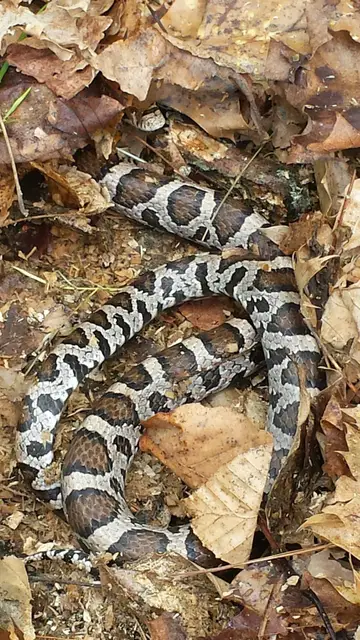
Eastern milksnake 24 to 52 inches (Alabama); TN gives 24 to 36 inches for eastern and 21 to 28 for red milksnake.
How to recognize it
Eastern milksnake: black-and-white checkerboard belly (Ohio). Western milksnake in Louisiana: underside dull white with scattered black marks.
Eastern milksnake: a light Y- or V-shaped mark is usually present on the nape
Smooth, shiny scales and round pupils
What the sources say
Venom: “There are NO VENEMOUS snakes that occur in Rhode Island.” (Rhode Island DEM, Division of Fish & Wildlife)
Habitat: Barns, houses, stone walls and other man-made structures. Wood- lands, fields, and the outskirts of wetland areas. (Rhode Island Department of State (Code of Regulations); Rhode Island DEM rule)
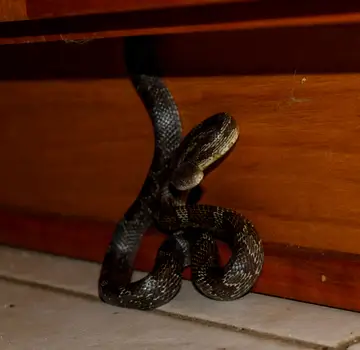
Most adults about 3 to 5 ft. Sources range from 20 to 56 inches (Florida Museum) to 34 to 77 inches (New Jersey); Alabama says some exceed 6 ft.
How to recognize it
Smooth scales
Long and slender with large eyes
White chin
Conservation
RI Species of Greatest Conservation Need (2015 Wildlife Action Plan)
What the sources say
Venom: “There are NO VENEMOUS snakes that occur in Rhode Island.” (Rhode Island DEM, Division of Fish & Wildlife)
Habitat: Dry, terrestrial habitats. Grassy fields, agricultural land or adjacent open forests. (Rhode Island Department of State (Code of Regulations); Rhode Island DEM rule)
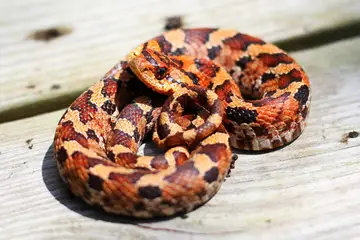
Adults 22 to 42 inches long, occasionally to 59 inches (Missouri). Pennsylvania gives 24 to over 50 inches; females are usually bigger than males.
How to recognize it
Dark crossbands on the front part of the body break up into rows of blotches from the middle of the body to the tail.
Belly white, yellow or orange, usually with dark half-moon-shaped spots.
Keeled (ridged) scales, so it feels rough; round pupils like other nonvenomous snakes in Missouri.
What the sources say
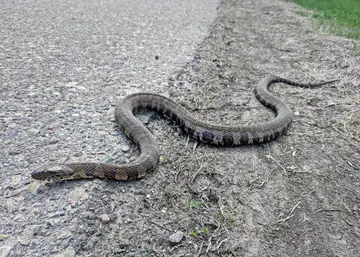
Venom: “They are often confused with our native, non-venomous, Northern watersnake (Nerodia sipedon sipedon), which can appear to have a ‘triangle-shaped’ head, similar to cottonmouths.” (Rhode Island DEM, Division of Fish & Wildlife)
Habitat: Usually found in and around wetlands, lakes and streams. (Rhode Island Department of State (Code of Regulations); Rhode Island DEM rule)
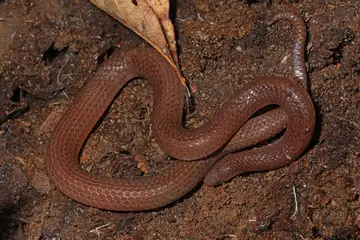
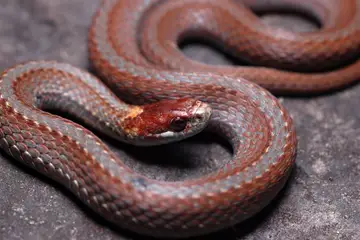
Usually 8 to 10 inches; state figures run from about 4 to 16 inches, with a Florida record of 16.6 inches.
How to recognize it
Plain, unmarked red or orange belly.
Three light spots just behind the head, which may fuse into a collar.
Keeled (ridged) scales in 15 rows at midbody and round pupils.
What the sources say
Venom: “There are NO VENEMOUS snakes that occur in Rhode Island.” (Rhode Island DEM, Division of Fish & Wildlife)
Habitat: Mostly woodlands, occasionally found near bogs or marshes. More common in rural western Rhode Island. (Rhode Island Department of State (Code of Regulations); Rhode Island DEM rule)
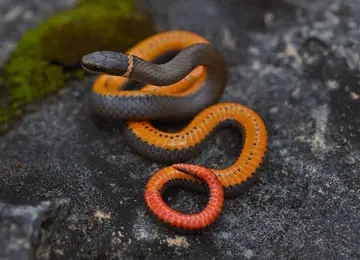
Usually 8 to 15 inches long; Alabama reports up to about 18 inches, rarely 24. AZGFD gives a maximum of 34 inches for Arizona animals.
How to recognize it
A yellow, cream or orange ring around the neck; it may be incomplete, and some Lower Florida Keys and western Arizona snakes lack it.
Bright yellow to orange or red belly, often with a row of black half-moon spots; the underside of the tail is often red.
Smooth, shiny scales and a small head only slightly wider than the neck.
What the sources say
Venom: “There are NO VENEMOUS snakes that occur in Rhode Island.” (Rhode Island DEM, Division of Fish & Wildlife)
Habitat: Moist woodlands. Found on ledges, under piles of debris. Often make their way into basements of older homes. (Rhode Island Department of State (Code of Regulations); Rhode Island DEM rule)
Venom: “There are NO VENEMOUS snakes that occur in Rhode Island.” (Rhode Island DEM, Division of Fish & Wildlife)
Habitat: Grassy meadows, open woodlands or even weedy vacant lots. In Rhode Island, they are found nearly throughout, but are more common in coastal regions. (Rhode Island Department of State (Code of Regulations); Rhode Island DEM rule)
Snakes people confuse
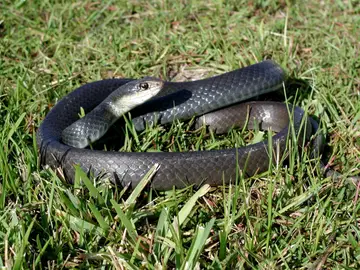
Black Racer or Timber rattlesnake?
Photo: Everglades NPS from Homestead, Florida, United States · Public domain · Wikimedia Commons
No. DEM says no venomous snakes occur in Rhode Island. Snakes kept as pets can still be involved in bites, and the regional poison center lists two venomous species for the Massachusetts and Rhode Island region. Rhode Island DEM, Division of Fish & Wildlife
“…one species, the Timber Rattlesnake, is extirpated circa 1963”
Are there copperheads in Rhode Island?
No. DEM says copperheads occur in southern New England but have never been documented in Rhode Island. RINHS (2015) reports one bite in East Providence and attributes it to a non-wild snake. Rhode Island DEM, Division of Fish & Wildlife
“Copperheads (Agkistrodon contortrix) are also found in southern New England, but have never been documented in Rhode Island.”
“Cottonmouths (Agkistrodon piscivorus), also called ‘water moccasins’ are a southern species, occurring no farther north than Virginia, and are unable to survive in northern climates.”
Learn about RI wildlife. Rhode Island DEM, Division of Fish & Wildlife. archived copy, captured June 8, 2026; checked November 3, 2026.Quoted passages (1)
“There are NO VENEMOUS snakes that occur in Rhode Island.”
“They are often confused with our native, non-venomous, Northern watersnake (Nerodia sipedon sipedon), which can appear to have a ‘triangle-shaped’ head, similar to cottonmouths.”
“…gartersnake saliva seems to be toxic to the small animals upon which they prey, and some people may develop a rash if bitten.”
“Leave the snake alone.”
“If a snake feels cornered or threatened, it may act aggressively.”
“In spring and autumn, garter snakes often find their way into basements.”
“Most active in the spring, which is also when they mate”
“There are no venomous snakes in Rhode Island.”
“Copperheads (Agkistrodon contortrix) are also found in southern New England, but have never been documented in Rhode Island.”
“Cottonmouths (Agkistrodon piscivorus), also called ‘water moccasins’ are a southern species, occurring no farther north than Virginia, and are unable to survive in northern climates.”
“…one species, the Timber Rattlesnake, is extirpated circa 1963”
A Copperhead in Rhode Island? Rhode Island Natural History Survey (non-profit survey; not a state agency). July 30, 2015; checked November 3, 2026.Quoted passages (1)
“But also don’t pick up a snake if you can’t identify it.”