Ringneck snake
Diadophis punctatus · also called Ring-necked snake, Southern ring-necked snake, Northern ring-necked snake and Key ring-necked snake · Last checked November 3, 2026.
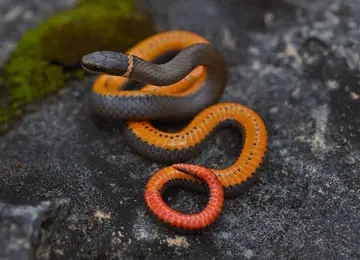

The ringneck (ring-necked) snake is a small, slender snake, usually about 8 to 15 inches long, gray to black above with a yellow, cream or orange ring around the neck and a bright yellow, orange or red belly. It lives in most of the lower 48 states and is often found under logs, rocks and leaf litter, including in yards and gardens. It has a mild venom from enlarged rear teeth that it uses on small prey: Arizona Game and Fish classes it as mildly venomous, while Florida, North Carolina, Louisiana and Alabama sources list it as non-venomous. The official sources that address danger say it is not dangerous to people (Florida Museum) or harmless to humans (Colorado, SREL, Pennsylvania, Oklahoma); AZGFD does not address danger to people. It rarely bites and instead releases musk and curls its tail to show its red underside. Florida Museum of Natural History
On this page
Is the ringneck snake dangerous?
Florida Museum: ring-necked snakes are not dangerous to people or pets. Florida Museum of Natural History
“Non-venomous. Ring-necked Snakes are not dangerous to people or pets.”
Bites and stings: Rarely bites. Florida Museum: these mild-mannered snakes typically do not bite in defense; Alabama and Louisiana: they rarely bite when handled. When disturbed they squirm, release a foul-smelling musk and curl the tail to show the bright underside. AZGFD notes that captured individuals often drool from the corner of the mouth, possibly venom.
If someone is bitten or stung, call 911 or Poison Help at 1-800-222-1222.
How to identify a ringneck snake
A photo or description can narrow it down, but cannot confirm what an animal is or that it is safe. Look from a distance and do not handle wild animals.
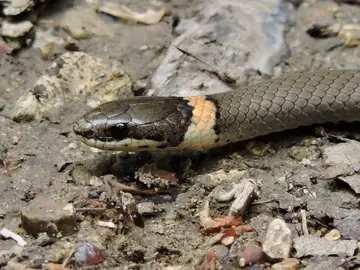
Size: Usually 8 to 15 inches long; Alabama reports up to about 18 inches, rarely 24. AZGFD gives a maximum of 34 inches for Arizona animals. Florida Museum of Natural History
Colors: black, slate gray, blue-gray, olive, yellow, orange and red. Pattern: neck ring; plain back; bright belly with black half-moon spots (some subspecies).
Key features
- A yellow, cream or orange ring around the neck; it may be incomplete, and some Lower Florida Keys and western Arizona snakes lack it. Florida Museum of Natural History
- Bright yellow to orange or red belly, often with a row of black half-moon spots; the underside of the tail is often red. Florida Museum of Natural History
- Smooth, shiny scales and a small head only slightly wider than the neck. University of Georgia Savannah River Ecology Laboratory
- When threatened it coils its tail and lifts it to show the red or yellow underside. Florida Museum of Natural History
Young
Look like small adults, already showing the neck ring; hatchlings are about 3 to 5.5 inches long. Virginia DWR says juveniles have a velvety black back and an even blacker head.
Animals mistaken for the ringneck snake
Ringneck snake or Brown snake (juvenile)?
Ringneck snake
Brown snake (juvenile) Storeria dekayi
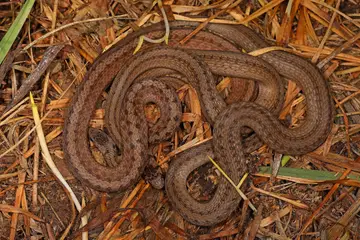

Young brown snakes also have a light collar, but their scales are keeled (ridged); the ringneck's scales are smooth. Pennsylvania Fish and Boat Commission
Non-venomous; not dangerous to people or pets (Florida Museum).
Ringneck snake or Flat-headed snake?
Ringneck snake
Flat-headed snake Tantilla gracilis
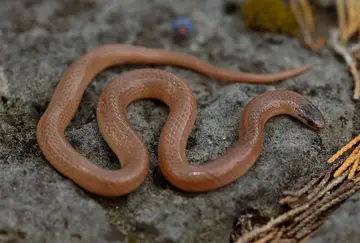

Flat-headed snakes have no neck ring, are lighter in color and have a pink belly without spots. Oklahoma Department of Wildlife Conservation
Ringneck snake or Chihuahuan black-headed snake?
Ringneck snake
Chihuahuan black-headed snake Tantilla wilcoxi
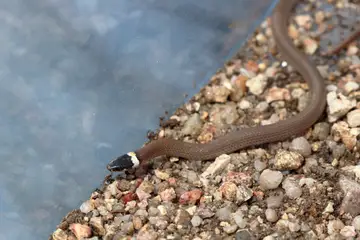

In Arizona, the ringneck's dark belly markings and blue-gray color separate it from the similar Chihuahuan black-headed snake. Arizona Game and Fish Department
Ringneck snake or Florida brownsnake, rough earthsnake, smooth earthsnake?
Ringneck snake
Florida brownsnake, rough earthsnake, smooth earthsnake Storeria victa; Haldea striatula; Virginia valeriae
Florida Museum: ring-necked snakes are small and slender with a black or slate-gray body and a yellowish ring across the neck (which may be incomplete or missing); the belly and underside of the tail are bright yellow, orange or red. Florida Museum of Natural History
Non-venomous (Florida Museum).
Where the ringneck snake lives
- Native or listed
- Nonnative or not established
- No official record in our data
- 1–9
- 10–99
- 100–999
- 1,000+
On our state guides
- Alabama snakes
- Arizona snakes
- Arkansas snakes
- California snakes
- Colorado snakes
- Connecticut snakes
- Delaware snakes
- Florida snakes
- Georgia snakes
- Idaho snakes
- Illinois snakes
- Iowa snakes
- Kansas snakes
- Kentucky snakes
- Louisiana snakes
- Maine snakes
- Massachusetts snakes
- Minnesota snakes
- Nebraska snakes
- Nevada snakes
- New Mexico snakes
- New York snakes
- Oklahoma snakes
- Oregon snakes
- Rhode Island snakes
- South Carolina snakes
- South Dakota snakes
- Tennessee snakes
- Texas snakes
- Utah snakes
- Vermont snakes
- Washington snakes
State boundaries: U.S. Census Bureau, cartographic boundary file cb_2024_us_state_20m.
When it is active
Varies by region. Florida Museum and SREL: mostly nocturnal, especially on humid nights after rain. Arizona and Oklahoma: mainly active by day, mid-morning or late afternoon to dusk. Often found under surface cover in spring; hibernates in the cold months. University of Georgia Savannah River Ecology Laboratory
US open-licence records peak in April to June and September.
Habitat and habits
Habitat: Wooded areas with cover: under stumps, logs, rocks, bark and leaf litter, and in gardens and flower beds. In the Southeast also pine flatwoods and hammocks; in the West, grassy slopes, canyon bottoms and near springs and streams. Often in suburban yards. Outdoor Alabama
Behavior: Secretive and rarely seen in the open. When disturbed it squirms, releases foul musk, hides its head and curls its tail to show the bright underside. Florida Museum notes it often falls into swimming pools and cannot climb out.
Diet: Earthworms, slugs, insects, salamanders, small frogs and toads, small lizards and other small snakes. It subdues larger prey with mild venom; smaller prey is often swallowed alive.
Young: Mates in spring (sometimes fall). Lays about 2 to 10 eggs (Arizona: up to 18), usually in or under rotting logs, from about April to July; eggs hatch in late summer or early fall. Louisiana's guide says it gives birth to 6 to 15 young, which conflicts with the other sources that describe egg-laying.
Legal status and reporting
Protection: Florida: the Key ring-necked snake (Lower Florida Keys subspecies) is state Threatened, protected under Florida's Endangered and Threatened Species Act. SREL says ringneck snakes are protected in Georgia and South Carolina; Georgia DNR says all non-venomous snakes are protected by state law. Alabama ranks it Lowest Conservation Concern. Florida Museum of Natural History
Questions about the ringneck snake
Ringneck snake venomous
It has a mild venom from enlarged rear teeth that it uses on small prey. Arizona Game and Fish classes it as mildly venomous. The Florida Museum, NCWRC and Louisiana list it as non-venomous, and Colorado and SREL say it is harmless to humans. The Florida Museum says it is not dangerous to people or pets; AZGFD does not address danger to people. It rarely bites. If someone is bitten by a snake, call 911 or Poison Help at 1-800-222-1222.
Ringneck snake size
Most adults are about 8 to 15 inches long. Alabama reports up to about 18 inches (rarely 24), and AZGFD gives up to 34 inches for Arizona animals.
Ringneck snake diet
Mostly earthworms and slugs, plus insects, salamanders, small frogs and toads, small lizards and other small snakes.
Ringneck snake baby
Young look like small adults and already have the neck ring. Hatchlings are about 3 to 5.5 inches long and hatch in late summer or early fall.
Ringneck snake florida
The Florida Museum says ring-necked snakes are found in every county of mainland Florida and on the Keys, and are often found in swimming pools. The Key ring-necked snake of the Lower Keys is state Threatened.
Ringneck snake pa
The Pennsylvania Fish and Boat Commission lists the northern ring-necked snake as native and calls it harmless. It is secretive, moves mostly after dark and reaches 10 to 24 inches in Pennsylvania.
Sources
- Florida Snake ID Guide: Ring-necked Snake. Florida Museum of Natural History (University of Florida). updated March 18, 2026; checked November 3, 2026.
Quoted passages (8)
“Non-venomous. Ring-necked Snakes are not dangerous to people or pets.”
“Most adult Ring-necked Snakes are about 8-14 inches (21-36 cm) in total length.”
“The neck ring may be incomplete, and snakes in the Lower Florida Keys may lack a ring entirely.”
“The belly is bright yellow, orange, or red with a single row of black half-moon markings down the center.”
“…they will often roll their tail into a tight coil and elevate it to display the bright red or yellow coloration beneath”
“…feed primarily on small lizards, snakes, salamanders, frogs, toads, earthworms, slugs, and insects. These snakes are not constrictors.”
“Due to its very small range, this subspecies is listed as a Threatened Species in the state of Florida.”
“Adults are small and slender with a black or slate gray body and a yellowish ring across the neck, which may be incomplete or missing. The belly and underside of the tail are bright yellow, orange, or red.”
- Online Field Guide species account: Ring-Necked Snake (Diadophis punctatus). Arizona Game and Fish Department. 2023; checked November 3, 2026.
Quoted passages (1)
“The dark markings on its belly and its blue-gray coloration distinguish this snake from the similar looking Chihuahuan Black-headed Snake.”
- Species profile: Ring-Necked Snake. Colorado Parks and Wildlife. undated page; checked November 3, 2026.
- Ringneck Snake (Diadophis punctatus). University of Georgia Savannah River Ecology Laboratory (linked by SCDNR as its species information). undated page; checked November 3, 2026.
Quoted passages (5)
“The head is small and only slightly wider than the neck, and the scales are smooth, giving a shiny appearance.”
“Juveniles resemble miniature adults, already showing the neck ring and belly pattern (if a southern variant).”
“When disturbed, they seldom bite. Instead, they coil their tails tightly, display their bright belly, and hide their head beneath their bodies. In addition, they will release foul musk.”
“Ring-necked snakes are secretive and mostly nocturnal, though they may be active during the day under certain conditions.”
“Breeding occurs in the spring, and females typically lay eggs from April through July in the Southeast.”
- Ringneck Snake. Alabama Department of Conservation and Natural Resources (Outdoor Alabama). undated page; checked November 3, 2026.
Quoted passages (1)
“Ringneck snakes are found in wooded, terrestrial type habitats, commonly under objects such as stumps, logs and leaf litter, and can be found in gardens, flower beds and occasionally in salt marshes.”
- Snakes (species accounts). Pennsylvania Fish and Boat Commission. undated page; checked November 3, 2026.
Quoted passages (1)
“The smooth scales help distinguish this snake from the juvenile northern brown snake, which also has a collar but which has keeled scales.”
- Ring-necked Snake (ODWC Field Guide). Oklahoma Department of Wildlife Conservation. undated page; checked November 3, 2026.
Quoted passages (1)
“Ringed-neck snakes could be confused with the flat-headed snake, but flat-headed snakes have no neck ring, are lighter in color and have a pink belly with no spots.”
- Ring-necked Snake (NCWRC species page). N.C. Wildlife Resources Commission. undated page; checked November 3, 2026.
- Snake Species Field Guide: Ring-necked Snake. Louisiana Department of Wildlife and Fisheries. undated page; checked November 3, 2026.
- Checklist of Florida's Amphibians and Reptiles (Revised 2023). Florida Fish and Wildlife Conservation Commission (FWC). Revised 2023; checked November 3, 2026.
- Pennsylvania Native Reptile and Amphibian Species (PA Species and Endangered Species Act listing status). Pennsylvania Fish and Boat Commission. undated page; checked November 3, 2026.
- GBIF.org occurrence records, human observations licensed CC0 1.0 or CC BY 4.0 only, accessed November 3, 2026. The datasets behind these counts are listed on our Sources page.
- State boundaries: U.S. Census Bureau, cartographic boundary file cb_2024_us_state_20m.