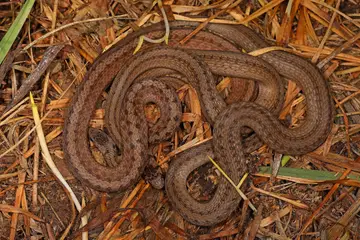
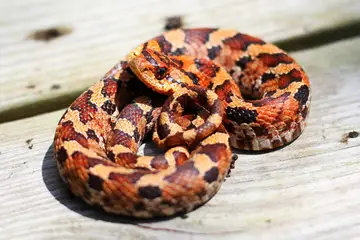
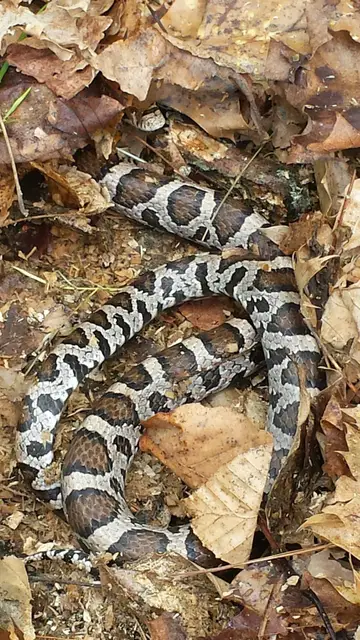
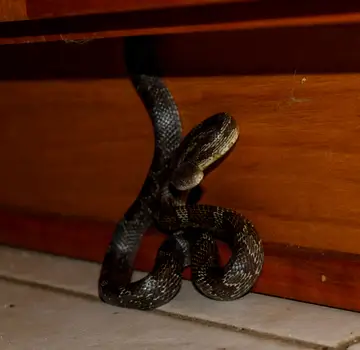
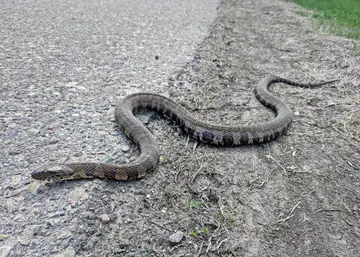
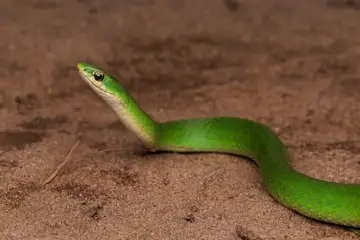
Connecticut Department of Energy and Environmental Protection (DEEP), Wildlife Division: The answer is 14! Only 2 of the 14 native snake species are venomous -- the northern copperhead and timber rattlesnake.
This page lists 14 snakes: all from Connecticut Department of Energy and Environmental Protection (DEEP), Wildlife Division's Snakes of Connecticut with DEEP Wildlife Fact Sheets for each species.
2 are venomous by official accounts: Northern Copperhead and Timber Rattlesnake.
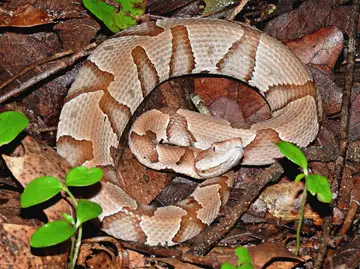
Venom: “The copperhead is one of two venomous snake species found in Connecticut; the other is the state-endangered timber rattlesnake.” (Connecticut Department of Energy and Environmental Protection (DEEP), Wildlife Division)
Range: Populations are spread out in Connecticut, but the greatest abundance of copperheads is found in the Central Connecticut Lowland (trap rock) ridges. These ridges are located on the western side of the Connecticut River in Hartford, Middlesex, and New Haven Counties.
Habitat: They are predominantly found along wooded, basalt ridges, talus slopes, and rocky hillsides, or at the edges of meadows. (Connecticut Department of Energy and Environmental Protection (DEEP), Wildlife Division)
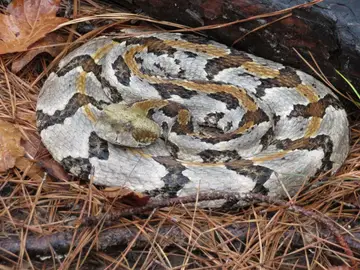
Venom: “The timber rattlesnake is one of only two venomous species found in Connecticut; the other is the northern copperhead.” (Connecticut Department of Energy and Environmental Protection (DEEP), Wildlife Division)
Habitat: In Connecticut, timber rattlesnakes inhabit deciduous forests (often second growth) in rugged terrain with steep ledges, rock slides, and a nearby water supply. (Connecticut Department of Energy and Environmental Protection (DEEP), Wildlife Division)
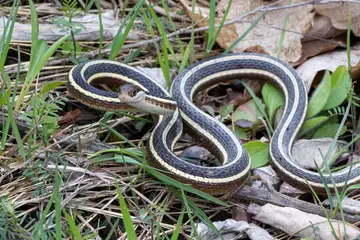
“The saliva of the common gartersnake appears to be toxic to amphibians and other small animals and a bite may produce swelling or a rash in some people.”
JFMAMJJASOND
157 records by month.What the sources say
Venom: “Gartersnakes are harmless to people and are NOT venomous.” (Connecticut Department of Energy and Environmental Protection (DEEP), Wildlife Division)
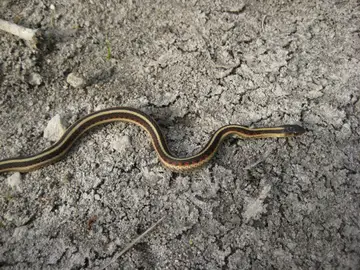
Venom: “The common ribbonsnake is non-venomous and harmless to humans.” (Connecticut Department of Energy and Environmental Protection (DEEP), Wildlife Division)
Most adults 9 to 13 inches; occasionally up to about 20 inches.
How to recognize it
Dark top of head; a dark spot under each eye and on each side of the neck
Keeled (ridged) scales in 17 rows; round pupil
Tennessee: a small dark downward streak on the side of the head
What the sources say
Venom: “This harmless snake is non-venomous and does not bite.” (Connecticut Department of Energy and Environmental Protection (DEEP), Wildlife Division)
Venom: “This completely harmless, non-venomous snake can put on an act that often frightens or alarms those who encounter it.” (Connecticut Department of Energy and Environmental Protection (DEEP), Wildlife Division)
Eastern milksnake 24 to 52 inches (Alabama); TN gives 24 to 36 inches for eastern and 21 to 28 for red milksnake.
How to recognize it
Eastern milksnake: black-and-white checkerboard belly (Ohio). Western milksnake in Louisiana: underside dull white with scattered black marks.
Eastern milksnake: a light Y- or V-shaped mark is usually present on the nape
Smooth, shiny scales and round pupils
What the sources say
Venom: “Understanding that the milksnake is non-venomous is important.” (Connecticut Department of Energy and Environmental Protection (DEEP), Wildlife Division)
Venom: “Eastern ratsnakes are harmless to people and are NOT venomous.” (Connecticut Department of Energy and Environmental Protection (DEEP), Wildlife Division)
Venom: “The northern redbelly snake is sometimes confused with the northern brownsnake, northern ring-necked snake, and eastern wormsnake. All are nonvenomous species.” (Connecticut Department of Energy and Environmental Protection (DEEP), Wildlife Division)
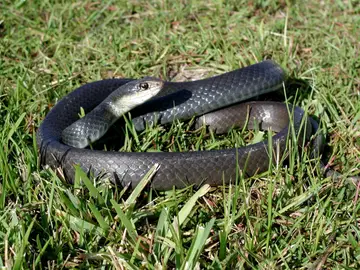
Photo: Everglades NPS from Homestead, Florida, United States · Public domain · Wikimedia Commons
Most adults about 3 to 5 ft. Sources range from 20 to 56 inches (Florida Museum) to 34 to 77 inches (New Jersey); Alabama says some exceed 6 ft.
How to recognize it
Smooth scales
Long and slender with large eyes
White chin
What the sources say
Venom: “Understanding that the black racer is non-venomous is important.” (Connecticut Department of Energy and Environmental Protection (DEEP), Wildlife Division)
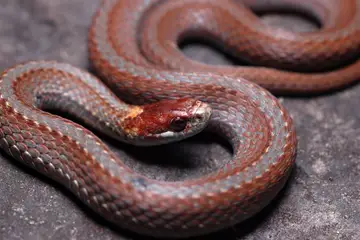
Usually 8 to 10 inches; state figures run from about 4 to 16 inches, with a Florida record of 16.6 inches.
How to recognize it
Plain, unmarked red or orange belly.
Three light spots just behind the head, which may fuse into a collar.
Keeled (ridged) scales in 15 rows at midbody and round pupils.
What the sources say
Venom: “The northern redbelly snake is sometimes confused with the northern brownsnake, northern ring-necked snake, and eastern wormsnake. All are nonvenomous species.” (Connecticut Department of Energy and Environmental Protection (DEEP), Wildlife Division)
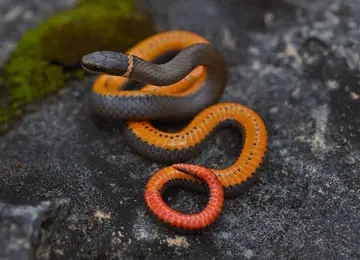
Usually 8 to 15 inches long; Alabama reports up to about 18 inches, rarely 24. AZGFD gives a maximum of 34 inches for Arizona animals.
How to recognize it
A yellow, cream or orange ring around the neck; it may be incomplete, and some Lower Florida Keys and western Arizona snakes lack it.
Bright yellow to orange or red belly, often with a row of black half-moon spots; the underside of the tail is often red.
Smooth, shiny scales and a small head only slightly wider than the neck.
JFMAMJJASOND
41 records by month.What the sources say
Venom: “The northern redbelly snake is sometimes confused with the northern brownsnake, northern ring-necked snake, and eastern wormsnake. All are nonvenomous species.” (Connecticut Department of Energy and Environmental Protection (DEEP), Wildlife Division)
Adults 22 to 42 inches long, occasionally to 59 inches (Missouri). Pennsylvania gives 24 to over 50 inches; females are usually bigger than males.
How to recognize it
Dark crossbands on the front part of the body break up into rows of blotches from the middle of the body to the tail.
Belly white, yellow or orange, usually with dark half-moon-shaped spots.
Keeled (ridged) scales, so it feels rough; round pupils like other nonvenomous snakes in Missouri.
JFMAMJJASOND
78 records by month.What the sources say
Venom: “The answer is 14! Only 2 of the 14 native snake species are venomous -- the northern copperhead and timber rattlesnake.” (Connecticut Department of Energy and Environmental Protection (DEEP), Wildlife Division)
Venom: “Smooth greensnakes are nonvenomous and completely harmless to humans.” (Connecticut Department of Energy and Environmental Protection (DEEP), Wildlife Division)
Copperheads have bold hourglass-shaped bands, and young copperheads under about 12 inches have bright yellow tail tips. Brown snakes have small spots, not hourglass bands.
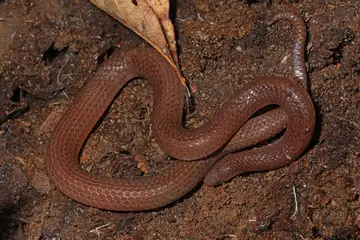
Brown Snake (Dekay's Brownsnake) or Red-bellied Snake?
The copperhead's head is coppery with no marks; the milksnake's head is light with brownish marks (Pennsylvania). Tennessee: copperhead has a copper-colored, unmarked head and triangular shapes on the side of the body. Pennsylvania says the eastern milksnake is the snake most often killed by mistake for a copperhead. Belly colour is not used here: Pennsylvania's own pages describe the copperhead belly two different ways (uniform cream in one account, mottled white to gray in another).
Black Racer or Timber rattlesnake?
Photo: Everglades NPS from Homestead, Florida, United States · Public domain · Wikimedia Commons
Call 911 or Poison Help at 1-800-222-1222 right away. Poison Help connects you to your local poison center, any time of day.
Official advice from Connecticut Department of Environmental Protection (now DEEP), Bureau of Natural Resources, Wildlife Division and Connecticut Department of Energy and Environmental Protection (DEEP), Wildlife Division:
Bear-related emergencies: DEEP 24-hour Dispatch Center 860-424-3333. Wildlife sightings (bear, bobcat, moose, fisher, bats, endangered species and others) via the DEEP Report a Wildlife Sighting page; DEEP Wildlife Division 860-424-3011. Spotted lanternfly: CAES SLF Reporting Form. Timber rattlesnake violations: TIP hotline 800-842-HELP. Connecticut Department of Energy and Environmental Protection (DEEP), Wildlife Division
“Once documented in over 20 towns in Connecticut, this snake is now limited to isolated populations in about 10 towns in the central and western portions of the state.”
Report a Wildlife Sighting. Connecticut Department of Energy and Environmental Protection (DEEP), Wildlife Division. Content last updated September 22, 2026; checked November 3, 2026.Quoted passages (1)
“For bear-related emergencies, please call DEEP's 24-hour Dispatch Center at 860-424-3333.”
Snakes of Connecticut. Connecticut Department of Energy and Environmental Protection (DEEP), Wildlife Division. Content last updated July 2026; checked November 3, 2026.Quoted passages (1)
“The answer is 14! Only 2 of the 14 native snake species are venomous -- the northern copperhead and timber rattlesnake.”
Common Gartersnake (Wildlife Fact Sheet). Connecticut Department of Energy and Environmental Protection (DEEP), Wildlife Division. Content last updated on; checked November 3, 2026.Quoted passages (2)
“Gartersnakes are harmless to people and are NOT venomous.”
“The saliva of the common gartersnake appears to be toxic to amphibians and other small animals and a bite may produce swelling or a rash in some people.”
Common Ribbonsnake (Wildlife Fact Sheet). Connecticut Department of Energy and Environmental Protection (DEEP), Wildlife Division. Content last updated on; checked November 3, 2026.Quoted passages (1)
“The common ribbonsnake is non-venomous and harmless to humans.”
Dekay's Brownsnake (Wildlife Fact Sheet). Connecticut Department of Energy and Environmental Protection (DEEP), Wildlife Division. Content last updated August 15, 2022; checked November 3, 2026.Quoted passages (1)
“This harmless snake is non-venomous and does not bite.”
Eastern Hog-nosed Snake (Wildlife Fact Sheet). Connecticut Department of Energy and Environmental Protection (DEEP), Wildlife Division. Content last updated on; checked November 3, 2026.Quoted passages (1)
“This completely harmless, non-venomous snake can put on an act that often frightens or alarms those who encounter it.”
Eastern Milksnake (Wildlife Fact Sheet). Connecticut Department of Energy and Environmental Protection (DEEP), Wildlife Division. Content last updated on; checked November 3, 2026.Quoted passages (1)
“Understanding that the milksnake is non-venomous is important.”
Eastern Ratsnake (Wildlife Fact Sheet). Connecticut Department of Energy and Environmental Protection (DEEP), Wildlife Division. Content last updated on; checked November 3, 2026.Quoted passages (1)
“Eastern ratsnakes are harmless to people and are NOT venomous.”
Northern Redbelly Snake (Wildlife Fact Sheet). Connecticut Department of Energy and Environmental Protection (DEEP), Wildlife Division. Content last updated on; checked November 3, 2026.Quoted passages (2)
“The northern redbelly snake is sometimes confused with the northern brownsnake, northern ring-necked snake, and eastern wormsnake. All are nonvenomous species.”
“Northern redbelly snakes are typically active in May through October.”
Eastern Wormsnake (Wildlife Fact Sheet). Connecticut Department of Energy and Environmental Protection (DEEP), Wildlife Division. Content last updated on; checked November 3, 2026.Quoted passages (1)
“Eastern wormsnakes are active from May through September.”
Northern Black Racer (Wildlife Fact Sheet). Connecticut Department of Energy and Environmental Protection (DEEP), Wildlife Division. Content last updated on; checked November 3, 2026.Quoted passages (1)
“Understanding that the black racer is non-venomous is important.”
Northern Copperhead (Wildlife Fact Sheet). Connecticut Department of Energy and Environmental Protection (DEEP), Wildlife Division. Content last updated on; checked November 3, 2026.Quoted passages (5)
“The copperhead is one of two venomous snake species found in Connecticut; the other is the state-endangered timber rattlesnake.”
“If provoked or handled, a copperhead may strike and bite. The bite, while painful and capable of producing severe illness, rarely results in the death of a human. However, seek medical attention immediately if bitten.”
“However, seek medical attention immediately if bitten.”
“Copperheads are active from April through October, spending the rest of the year in dens.”
“Copperheads are mostly absent from the northeastern and northwestern portions of the state and less common east of the Connecticut River”
Smooth Greensnake (Wildlife Fact Sheet). Connecticut Department of Energy and Environmental Protection (DEEP), Wildlife Division. Content last updated on; checked November 3, 2026.Quoted passages (1)
“Smooth greensnakes are nonvenomous and completely harmless to humans.”
Timber Rattlesnake (Wildlife Fact Sheet). Connecticut Department of Energy and Environmental Protection (DEEP), Wildlife Division. Content last updated March 8, 2018; checked November 3, 2026.Quoted passages (4)
“The timber rattlesnake is one of only two venomous species found in Connecticut; the other is the northern copperhead.”
“Do NOT attempt to kill any rattlesnakes under any circumstances as this is an illegal action.”
“Connecticut’s rattlesnakes are active mid-April through October.”
“Once documented in over 20 towns in Connecticut, this snake is now limited to isolated populations in about 10 towns in the central and western portions of the state.”
“These venomous snakes, along with the other 12 Connecticut snake species, are not aggressive and will only bite if threatened or handled. If left alone, snakes pose no threat to people.”
“If you suspect a snake in your yard is venomous, observe it from a safe distance and call the Wildlife Division for advice.”
Northern Ring-necked Snake (Wildlife Fact Sheet). Connecticut Department of Energy and Environmental Protection (DEEP), Wildlife Division. Content last updated on; checked November 3, 2026.Quoted passages (1)
“Ring-necked snakes are active from May through mid-October.”
Northern Watersnake (Wildlife Fact Sheet). Connecticut Department of Energy and Environmental Protection (DEEP), Wildlife Division. Content last updated on; checked November 3, 2026.Quoted passages (1)
“Although these two species may be similar in appearance, water moccasins do not occur in Connecticut.”