Red-bellied snake
Storeria occipitomaculata · also called Redbelly snake, Northern red-bellied snake, Florida red-bellied snake and Northern redbelly snake · Last checked November 3, 2026.
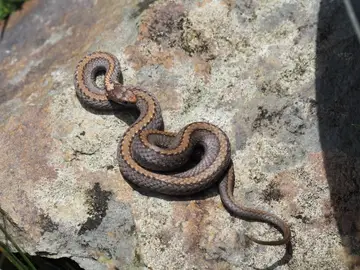
The red-bellied snake is a tiny, secretive woodland snake, usually 8 to 10 inches long, gray, brown or black above with three pale spots or a light collar on the neck and a plain red or orange belly. Official sources say it is non-venomous: the Florida Museum says it is not dangerous to people or pets, and Missouri Department of Conservation calls it a harmless nonvenomous snake. It rarely if ever bites and may curl its upper lip instead. It lives under logs, rocks and leaf litter across much of the eastern US. Missouri warns that it is sometimes mistaken for a young copperhead, which is venomous. Florida Museum of Natural History
On this page
Is the red-bellied snake dangerous?
Florida Museum: red-bellied snakes are non-venomous and not dangerous to people or pets. Florida Museum of Natural History
“Non-venomous. Red-bellied Snakes are not dangerous to people or pets.”
Bites and stings: Rarely or not at all. Florida Museum: does not bite in defense. Ohio: makes no attempt to bite, even when first captured. SREL and Louisiana: rarely bites. When threatened it may flatten its body, release musk and curl its upper lip to show its teeth.
If someone is bitten or stung, call 911 or Poison Help at 1-800-222-1222.
How to identify a red-bellied snake
A photo or description can narrow it down, but cannot confirm what an animal is or that it is safe. Look from a distance and do not handle wild animals.
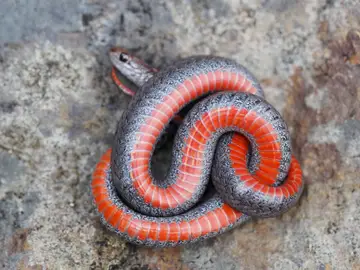
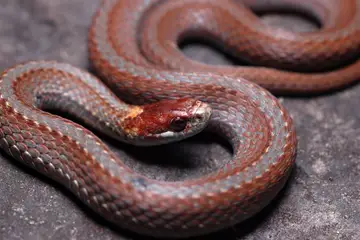

Size: Usually 8 to 10 inches; state figures run from about 4 to 16 inches, with a Florida record of 16.6 inches. Florida Museum of Natural History
Colors: gray, brown, reddish brown, black, red, orange and yellow. Pattern: striped, plain belly and neck spots.
Key features
- Plain, unmarked red or orange belly. University of Georgia Savannah River Ecology Laboratory
- Three light spots just behind the head, which may fuse into a collar. Illinois Natural History Survey (INHS), Prairie Research Institute, University of Illinois Urbana-Champaign
- Keeled (ridged) scales in 15 rows at midbody and round pupils. Florida Museum of Natural History
- Head black or dark brown, with a small white spot under the eye on the upper lip. Florida Museum of Natural History
Young
Young are darker than adults, with a whitish band or more distinct collar across the back of the head. Newborns are only about 2.5 to 4 inches long.
Animals mistaken for the red-bellied snake
Red-bellied snake or Copperhead?
Red-bellied snake
Copperhead Agkistrodon contortrix
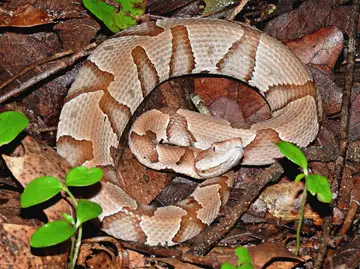

Missouri: red-bellied snakes are sometimes mistaken for young copperheads. Copperheads are stout-bodied with hourglass-shaped markings on the back, vertical pupils, a sensory pit between each nostril and eye and, sometimes, especially in young copperheads, a yellow tail tip. MDC
VENOMOUS
Red-bellied snake or Dekay's brownsnake?
Red-bellied snake
Dekay's brownsnake Storeria dekayi
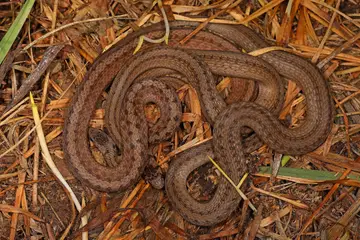

Tennessee: Dekay's brownsnake has a yellowish, tan or pinkish belly with very small black dots on the sides. Tennessee Wildlife Resources Agency
Non-venomous (Florida Museum)
Red-bellied snake or Ring-necked snake?
Red-bellied snake
Ring-necked snake Diadophis punctatus
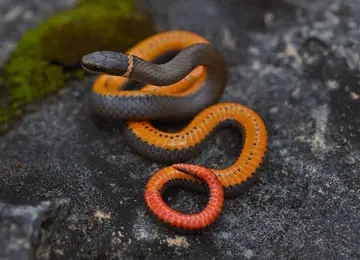

Connecticut: juvenile redbelly snakes have neck spots that look like a ring, which causes confusion with the ring-necked snake. Connecticut Department of Energy and Environmental Protection
Non-venomous per Florida Museum; see the ringneck snake page, because Arizona classes it as mildly venomous
Red-bellied snake or Eastern wormsnake?
Red-bellied snake
Eastern wormsnake Carphophis amoenus
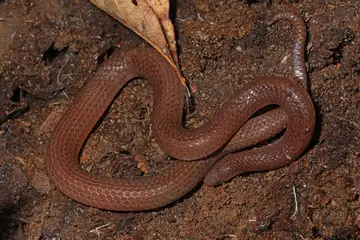

Massachusetts: look at the neck; the wormsnake has no constriction between the head and body. Connecticut also lists it as confused with the redbelly snake. MassWildlife
Non-venomous (Connecticut)
Red-bellied snake or Kirtland's snake?
Red-bellied snake
Kirtland's snake Clonophis kirtlandii
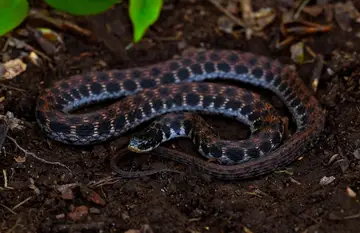

Pennsylvania: the red-bellied snake's belly is unmarked, while Kirtland's snake has a double row of black spots down the belly. Pennsylvania Fish and Boat Commission
Not addressed in this source
Red-bellied snake or Copper-bellied watersnake and red-bellied mudsnake?
Red-bellied snake
Copper-bellied watersnake and red-bellied mudsnake
Tennessee: these are much larger and their red bellies are not plain. Tennessee Wildlife Resources Agency
Not addressed in this source
Where the red-bellied snake lives
- Native or listed
- Nonnative or not established
- No official record in our data
- 1–9
- 10–99
- 100–999
- 1,000+
On our state guides
- Arkansas snakes
- Connecticut snakes
- Delaware snakes
- Florida snakes
- Georgia snakes
- Illinois snakes
- Indiana snakes
- Iowa snakes
- Kansas snakes
- Kentucky snakes
- Louisiana snakes
- Maine snakes
- Maryland snakes
- Massachusetts snakes
- Minnesota snakes
- Missouri snakes
- Nebraska snakes
- New York snakes
- North Carolina snakes
- North Dakota snakes
- Ohio snakes
- Oklahoma snakes
- Pennsylvania snakes
- Rhode Island snakes
- South Carolina snakes
- Tennessee snakes
- Texas snakes
- Vermont snakes
- Virginia snakes
- West Virginia snakes
- Wisconsin snakes
- Wyoming snakes
State boundaries: U.S. Census Bureau, cartographic boundary file cb_2024_us_state_20m.
When it is active
Season varies by state: late March through early November in Missouri, March into November in Illinois, March to October in Arkansas, May through October in Connecticut. Typically active at night (Florida, Maryland, Connecticut); Illinois says by day in spring and autumn and at night or twilight in summer. MDC
US open-licence records peak in May to July and September to October.
Habitat and habits
Habitat: Moist forests and woodlands, wetland edges, bogs, wet meadows and old fields, usually hidden under logs, rocks, bark and leaf litter. It also turns up in suburban neighborhoods and vacant lots. Outdoor Alabama
Behavior: Very secretive and rarely seen unless uncovered during yard work or after heavy rain. If disturbed it may squirm, flatten its head and body, release musk and curl its upper lip to show its teeth.
Diet: Mainly slugs and earthworms; also land snails and soft-bodied insects.
Young: Gives birth to live young in summer or early fall, about 1 to 25 at a time depending on the source and state; Missouri reports up to 41.
Legal status and reporting
Protection: Georgia: may not be held as a pet; SREL says protected throughout Georgia. Mississippi: a nongame species in need of management under state rule. Tennessee: not protected by state or federal law. Ohio: uncommon. Alabama: lowest conservation concern. Check your state agency. Georgia DNR Wildlife Resources Division
Questions about the red-bellied snake
Red bellied snake
A very small, non-venomous woodland snake with a plain red or orange belly and three pale neck spots. The Florida Museum says it is not dangerous to people or pets and does not bite in defense. Missouri says it is sometimes mistaken for a young copperhead; if you are not sure what bit you, call 911 or Poison Help at 1-800-222-1222.
Sources
- Florida Snake ID Guide species account: Red Bellied Snake. Florida Museum of Natural History (University of Florida). updated March 18, 2026; checked November 3, 2026.
Quoted passages (7)
“Non-venomous. Red-bellied Snakes are not dangerous to people or pets.”
“Adult Red-bellied Snakes in Florida are about 8-10 inches (20-26 cm) in total length, with a record length recorded of 16.6 inches (42.2 cm).”
“The scales on the back are keeled (each scale has a prominent raised ridge) and arranged in 15 scale rows at midbody. The pupil is round.”
“The head is black or dark brown, and there is a small white spot under the eye on the upper lip scales.”
“Juveniles are darker than adults and have a whitish band across back of the head.”
“…they feed primarily on slugs and earthworms. However, they will occasionally eat snails and insect larvae.”
“If captured or molested, Red-bellied Snakes will often squirm vigorously, flatten their heads and bodies, and release foul-smelling musk from two glands in the base of the tail.”
- MDC Field Guide: Reptiles and Amphibians > Snakes (species accounts). Missouri Department of Conservation (MDC). undated page; checked November 3, 2026.
Quoted passages (2)
“Active from late March through early November”
“Copperheads, however, are stout-bodied and have hourglass-shaped markings on the back, vertical pupils in the eyes, a sensory pit between each nostril and eye, and, sometimes, especially in young copperheads, a yellow tail tip.”
- Red-bellied Snake (DNR field guide species page). Maryland Department of Natural Resources (DNR). archived copy, captured February 16, 2026; checked November 3, 2026.
- Snake Species Field Guide: Red-bellied Snake. Louisiana Department of Wildlife and Fisheries. undated page; checked November 3, 2026.
- Reptiles of Ohio Field Guide (Pub 5354). Ohio Department of Natural Resources. 2/18; checked November 3, 2026.
- Northern Redbelly Snake (fact sheet). Connecticut Department of Energy and Environmental Protection. Content last updated on March 8, 2018; checked November 3, 2026.
Quoted passages (1)
“…the spots around the neck tend to resemble a ring (often causing confusion with the northern ring-necked snake)”
- Redbellied Snake (Storeria occipitomaculata). University of Georgia Savannah River Ecology Laboratory (linked by SCDNR as its species information). undated page; checked November 3, 2026.
Quoted passages (1)
“This species can easily be distinguished from all other small woodland snakes by their unmarked bright orange to red underside.”
- Red-bellied Snake (Field Guide to Amphibians and Reptiles of Illinois). Illinois Natural History Survey (INHS), Prairie Research Institute, University of Illinois Urbana-Champaign. undated page; checked November 3, 2026.
Quoted passages (1)
“Three light spots just behind the head; plain red belly”
- Northern Red-bellied Snake. Alabama Department of Conservation and Natural Resources (Outdoor Alabama). undated page; checked November 3, 2026.
Quoted passages (2)
“They prefer mesic forested habitats that are relatively moist and well shaded, with moderately heavy soils.”
“Females give birth to live young once a year, litters average about eight individuals.”
- Laws Related to Native Wildlife. Georgia DNR Wildlife Resources Division. undated page; checked November 3, 2026.
Quoted passages (1)
“…may not be held as a pet regardless of its origin or morphology”
- Reptiles: Snakes (Tennessee Watchable Wildlife). Tennessee Wildlife Resources Agency. footer 2026; checked November 3, 2026.
Quoted passages (2)
“DeKay’s Brownsnake has a yellowish, tan, or pinkish belly with very small black dots on the sides.”
“Copper-bellied Watersnake and Red-bellied Mudsnake are much larger and their red bellies are not plain.”
- Learn about eastern wormsnakes. Massachusetts Division of Fisheries and Wildlife (MassWildlife). archived copy, captured September 2, 2025; checked November 3, 2026.
Quoted passages (1)
“Look at the neck: there is no constriction between the head and body”
- Snakes. Pennsylvania Fish and Boat Commission. undated page; checked November 3, 2026.
Quoted passages (1)
“…can be distinguished from Kirtland's snake, which has a double row of black spots down the belly”
- GBIF.org occurrence records, human observations licensed CC0 1.0 or CC BY 4.0 only, accessed November 3, 2026. The datasets behind these counts are listed on our Sources page.
- State boundaries: U.S. Census Bureau, cartographic boundary file cb_2024_us_state_20m.