Worm Snake (wormsnakes)
Carphophis · also called Wormsnake, Eastern Wormsnake, Eastern Worm Snake and Common Wormsnake · Last checked November 3, 2026.
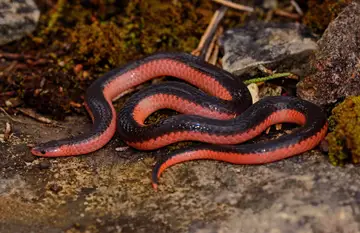

Worm snakes (wormsnakes) are small, shiny, burrowing snakes, usually 7 to 11 inches long, that look like large earthworms: plain brown to purplish black above with a pink belly, a small pointed head, tiny eyes and a sharp spine on the tail tip. There are two species, the eastern wormsnake in the eastern US and the western wormsnake from Missouri and Iowa to Oklahoma and Texas. They are nonvenomous: Louisiana lists both as nonvenomous, and Missouri calls the western wormsnake a common, harmless snake that has never been known to bite. If picked up, a wormsnake may push its pointed tail against your skin; state agencies say the tail spine is harmless and no snake has a stinger. They live under logs, rocks and leaf litter in moist woods and are seldom seen. Missouri Department of Conservation
This page covers a genus (Carphophis), not a single species.
On this page
Is the worm snake dangerous?
Missouri: a common, harmless burrowing snake that has never been known to bite. Missouri Department of Conservation
“This common, harmless, burrowing snake has never been known to bite.”
Bites and stings: Official sources say wormsnakes do not bite or are not known to bite. When handled they may release musk, try to push their head between your fingers, and press the sharp tail tip into the skin. North Carolina Extension and Missouri say the tail spine is harmless; Ohio DNR and Connecticut DEEP say no snake has a stinger.
How to identify a worm snake
A photo or description can narrow it down, but cannot confirm what an animal is or that it is safe. Look from a distance and do not handle wild animals.
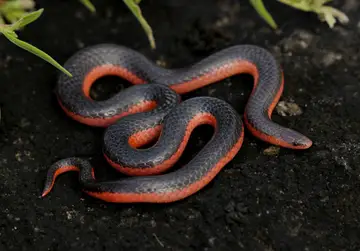

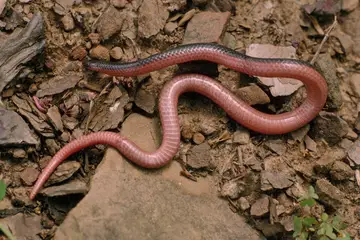
Size: Most adults 7 to 11 inches long; the largest reach about 15 inches. University of Georgia Savannah River Ecology Laboratory
Colors: Eastern wormsnake: plain brown, dark brown or chestnut above; western wormsnake: purplish brown to black above; belly pink (salmon pink, sometimes orange or red), extending onto the lower sides. Pattern: No pattern: no stripes, spots or bands; just the two-tone dark back and pink belly.
Key features
- Looks like an earthworm: round, glossy body with smooth scales Outdoor Alabama
- Small, pointed head with tiny eyes; head barely wider than the neck MassWildlife
- Short tail ending in a sharp spine University of Georgia Savannah River Ecology Laboratory
- Telling the two species apart: in the eastern wormsnake the pink reaches 1 to 2 scale rows up the side and the back is brown; in the western wormsnake the pink reaches 3 scale rows and the back is purplish black or black AGFC
Young
Young look like adults but are darker; hatchlings are about 3 to 4 inches long.
Animals mistaken for the worm snake
Worm Snake (wormsnakes) or Red-bellied Snake?
Worm Snake (wormsnakes)
Red-bellied Snake Storeria occipitomaculata
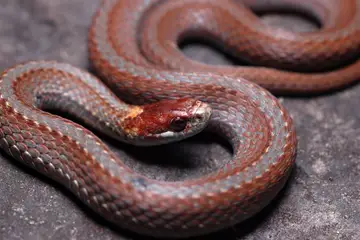

MassWildlife names the juvenile red-bellied snake as the similar species: look at the neck. A wormsnake has no narrowing between head and body. MassWildlife
Non-venomous (Florida Museum); North Carolina Extension says it is not known to bite.
Worm Snake (wormsnakes) or Ring-necked Snake?
Worm Snake (wormsnakes)
Ring-necked Snake Diadophis punctatus
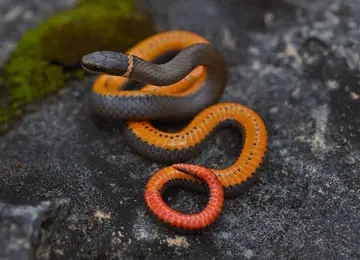

The ring-necked snake has a complete or partial golden ring around the neck. Tennessee Wildlife Resources Agency
Has a mild venom used on prey (SREL), but official sources say it is harmless to humans; North Carolina Extension labels it Harmless. See its own page.
Worm Snake (wormsnakes) or Dekay's Brownsnake?
Worm Snake (wormsnakes)
Dekay's Brownsnake Storeria dekayi
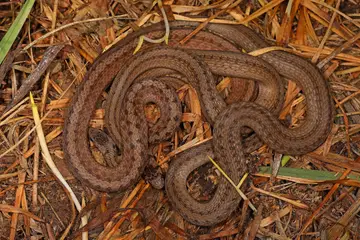

Brownsnakes have a small, downward dark streak on the side of the head. Tennessee Wildlife Resources Agency
Non-venomous (NCWRC).
Worm Snake (wormsnakes) or Smooth Earthsnake?
Worm Snake (wormsnakes)
Smooth Earthsnake Virginia valeriae
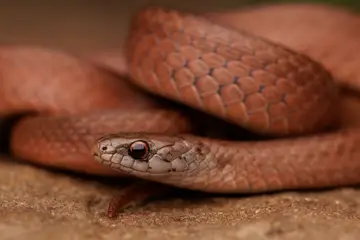

New Jersey DFW says the worm snake resembles the eastern smooth earth snake in its dull brown color. In the same brochure, the worm snake's underside and lowest one or two scale rows are pink, while the smooth earth snake has a white belly; Pennsylvania describes the smooth earthsnake's belly as grayish, off-white or yellowish. New Jersey Division of Fish and Wildlife, Endangered and Nongame Species Program
North Carolina Extension labels it Harmless.
Worm Snake (wormsnakes) or Flat-headed Snake?
Worm Snake (wormsnakes)
Flat-headed Snake Tantilla gracilis
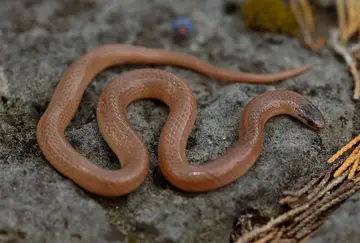

Oklahoma: the flat-headed snake is lighter above, slimmer, its pink belly color does not reach the sides, and it has no sharp tail tip. Oklahoma Department of Wildlife Conservation
Missouri lists it in the non-venomous section of its snake guide; Missouri says only six of its snakes are venomous (pit vipers).
Where the worm snake lives
- Native or listed
- Nonnative or not established
- No official record in our data
- 1–9
- 10–99
- 100–999
- 1,000+
State boundaries: U.S. Census Bureau, cartographic boundary file cb_2024_us_state_20m.
When it is active
Missouri: active March to October, going deeper underground in hot, dry summers; most often found in spring and fall. Missouri Department of Conservation
US open-licence records for all worm snakes (genus Carphophis) peak in April to June.
Habitat and habits
Habitat: Moist deciduous and mixed hardwood forests, wooded hillsides and forest edges. They live underground or under leaf litter, rotting logs, rocks and boards, and can turn up anywhere earthworms are found, including fields, yards and gardens. University of Georgia Savannah River Ecology Laboratory
Behavior: Secretive burrowers that spend most of their lives underground; seldom seen even where common. Not aggressive.
Diet: Mainly earthworms; also slugs, snails, soft-bodied insects and insect larvae.
Young: Lays eggs: usually 1 to 8 eggs in early summer under rocks, in rotting wood or loose soil; hatchlings appear in late summer or fall.
Legal status and reporting
Federal: No ESA record: the USFWS ECOS query returned no record for Carphophis amoenus or Carphophis vermis. US Fish and Wildlife Service
Protection: State-listed in several states: threatened in Massachusetts (eastern) and Iowa (western); special concern in New York and Pennsylvania (eastern) and Wisconsin (western). SREL says it is protected in Georgia and South Carolina. MassWildlife
Report: Massachusetts asks people to submit observations of this threatened snake to MassWildlife (Heritage Hub account or Rare Animal Observation Form). MassWildlife
Questions about the worm snake
Worm snake
A worm snake (wormsnake) is a small, shiny, burrowing snake, usually 7 to 11 inches long, that looks like an earthworm: brown to purplish black above, pink below, with a pointed head, tiny eyes and a sharp spine on the tail tip. The US has two species, the eastern wormsnake and the western wormsnake. They are nonvenomous; Missouri calls the western wormsnake a common, harmless snake never known to bite. If handled, it may poke with its tail tip, which state agencies say is harmless; no snake has a stinger.
Sources
- Western Wormsnake (MDC Field Guide). Missouri Department of Conservation. undated page; checked November 3, 2026.
Quoted passages (2)
“This common, harmless, burrowing snake has never been known to bite.”
“In Missouri, they are active between March and October.”
- Snake Species Field Guide: Common Wormsnake. Louisiana Department of Wildlife and Fisheries. undated page; checked November 3, 2026.
- Snake Species Field Guide: Western Wormsnake. Louisiana Department of Wildlife and Fisheries. undated page; checked November 3, 2026.
- Worm Snake (Carphophis amoenus). University of Georgia Savannah River Ecology Laboratory (linked by SCDNR as its species information). undated page; checked November 3, 2026.
Quoted passages (7)
“The Eastern Wormsnake is a small, glossy, highly fossorial snake, usually 7-11 in (18-28 cm) long, with maximum lengths approaching 15 in (38 cm).”
“The tail ends in a sharp, spine-like tip, which is used defensively to press against predators or believed to brace against the soil during feeding.”
“Juveniles resemble adults, though they are occasionally slightly darker.”
“Wormsnakes are associated with deciduous and mixed hardwood forests with moist soils.”
“Wormsnakes are specialist predators of earthworms, using their narrow heads and pointed snouts to pull worms from soil and detritus.”
“They are not aggressive and are not commonly encountered.”
“Females lay clutches of 2-8 eggs in rotting wood, under rocks, or in loose soil in early summer.”
- Snakes: Family Colubridae (AG-472-02). NC State Extension (N.C. Cooperative Extension, NC State University). Publication date: Aug. 21, 2019; checked November 3, 2026.
- Reptiles of Ohio Field Guide (Publication 5354). Ohio Department of Natural Resources, Division of Wildlife. PUBLICATION 5354; checked November 3, 2026.
- Arkansas Snake Guide (pocket guide; Kelly J. Irwin, AGFC herpetologist). Arkansas Game and Fish Commission (AGFC). undated page; checked November 3, 2026.
Quoted passages (1)
“Eastern worm snake: uniform brown above, belly and one to two scale rows above are pink Western worm snake: purplish black or black above, belly and three scale rows above are pink”
- Worm Snake. Alabama Department of Conservation and Natural Resources (Outdoor Alabama). undated page; checked November 3, 2026.
Quoted passages (1)
“Worm snakes greatly resemble earthworms which is how they got their name.”
- Learn about eastern wormsnakes. Massachusetts Division of Fisheries and Wildlife (MassWildlife). archived copy, captured September 2, 2025; checked November 3, 2026.
Quoted passages (4)
“With sloping heads, tiny eyes, and lack of constriction behind the head, in some ways they resemble the earthworms they consume.”
“Conservation status: Listed as threatened in Massachusetts”
“To help with conservation efforts, please submit your observations with us.”
“Identification tips: Look at the neck: there is no constriction between the head and body”
- ECOS species report query (Carphophis amoenus, Carphophis vermis). U.S. Fish and Wildlife Service. live query 2026-11-03; checked November 3, 2026.
- Reptiles » Snakes (Tennessee Watchable Wildlife species accounts). Tennessee Wildlife Resources Agency (Tennessee Watchable Wildlife website). undated page; checked November 3, 2026.
Quoted passages (2)
“Ring-necked Snake has complete or partial golden-colored ring around the neck.”
“Northern and Midland Brownsnake have small, downward, dark streak on side of head.”
- Snakes of New Jersey (brochure). New Jersey Division of Fish and Wildlife, Endangered and Nongame Species Program. PDF Last-Modified 2021-06-23; checked November 3, 2026.
Quoted passages (1)
“It resembles the eastern smooth earth snake with its dull brown ground color.”
- Western Wormsnake (ODWC Field Guide). Oklahoma Department of Wildlife Conservation. undated page; checked November 3, 2026.
Quoted passages (1)
“The flat-headed snake is much more common, is lighter in coloration on the dorsal surface, is much more streamlined in form, and the ventral pink coloration does not extend to the sides.”
- GBIF.org occurrence records, human observations licensed CC0 1.0 or CC BY 4.0 only, accessed November 3, 2026. The datasets behind these counts are listed on our Sources page.
- State boundaries: U.S. Census Bureau, cartographic boundary file cb_2024_us_state_20m.