Copperhead
Agkistrodon contortrix · also called copperhead snake, eastern copperhead, northern copperhead and southern copperhead · Last checked November 3, 2026.
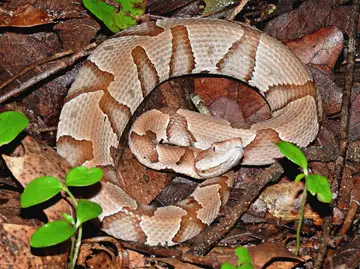

The copperhead is a stout, tan to coppery-brown pit viper with dark hourglass-shaped crossbands (narrow across the back, wide on the sides). It is venomous: CDC/NIOSH lists copperheads among the venomous snakes of the United States, and several state agencies call it their most common or most frequently encountered venomous snake. Bites are painful and need medical care but are rarely fatal; most happen when people step on, handle or try to kill one. CDC says copperheads live in Eastern states and as far west as Texas, in forests, rocky areas, swamps and near water. If bitten, call 911 or Poison Help at 1-800-222-1222. CDC / NIOSH
On this page
Is the copperhead dangerous?
Venomous. A bite is painful and should be treated as serious with immediate medical attention, but it is rarely life-threatening for healthy adults. The Florida Museum adds that bites can be dangerous to children, older people in poor health and small pets. N.C. Wildlife Resources Commission
“While a copperhead bite is painful and should be treated as serious, it is not considered life threatening.”
Bites and stings: Copperheads are not aggressive and usually stay still or retreat; bites mostly happen when a snake is stepped on, cornered, handled, or someone tries to kill it. Bites are painful; agencies describe the venom as relatively weak or mild and deaths as very rare. Dry bites (no venom injected) are common. Young copperheads are venomous too: NCWRC and Georgia DNR say they are no more dangerous than adults.
If someone is bitten or stung, call 911 or Poison Help at 1-800-222-1222.
How to identify a copperhead
A photo or description can narrow it down, but cannot confirm what an animal is or that it is safe. Look from a distance and do not handle wild animals.
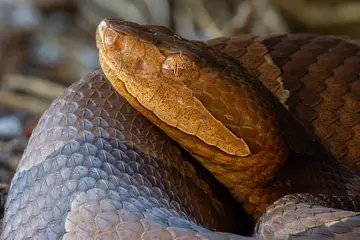

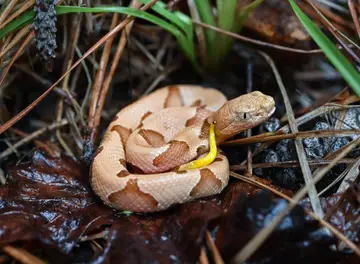
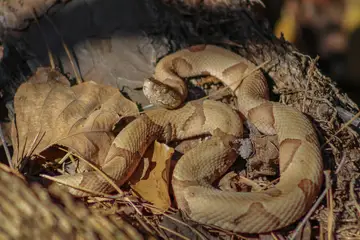

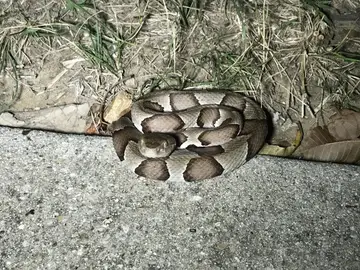
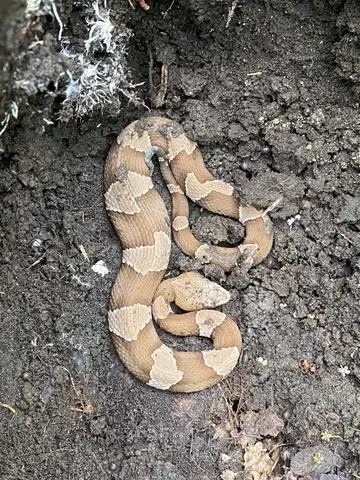
Size: Adults usually about 2 to 3 feet (24-36 in); record about 53 inches. Missouri Department of Conservation
Colors: light brown, coppery or tan background, sometimes grayish or pinkish tan; tan or copper head; top of the head has no pattern; thin dark line from the eye to the rear of the jaw; varies from reddish to golden tan (CDC). Pattern: dark hourglass-shaped crossbands: narrow across the middle of the back, wide on the sides; from the side they look like 'Hershey's Kisses'; bands may break up; some have small dark spots between bands, but nearly all have some complete hourglass bands.
Key features
- vertical (cat-like) pupils and a heat-sensing pit between eye and nostril N.C. Wildlife Resources Commission
- heavy-bodied; keeled scales Georgia DNR Wildlife Resources Division
- head shape alone is not a reliable way to identify copperheads Florida Museum of Natural History
- may vibrate the tail in dry leaves but has no rattle Georgia DNR Wildlife Resources Division
Young
Young look like small adults (sometimes duller or grayer) with a bright yellow or greenish-yellow tail tip used to lure prey; the tip fades with age.
Animals mistaken for the copperhead
Copperhead or Cottonmouth (water moccasin)?
Copperhead
Cottonmouth (water moccasin) Agkistrodon piscivorus / A. conanti
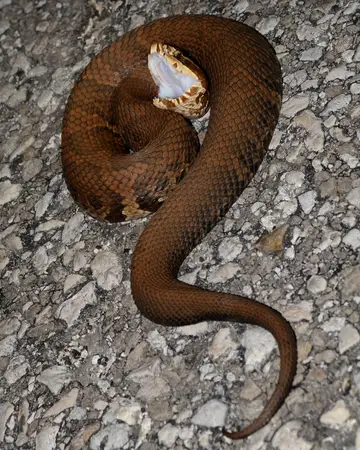

Also venomous. Juvenile cottonmouths have many dark spots and speckles inside their dark crossbands (copperhead bands have none or at most one). The Florida Museum says adult Florida cottonmouths are typically uniformly dark, but SCDNR says cottonmouth color ranges from dark brown and black to olive drab and yellow-tan, so a pale snake is not ruled out. The copperhead's eye is not obscured by the dark facial band typical of the cottonmouth. Cottonmouths are almost always associated with wetlands. Florida Museum of Natural History
Venomous (CDC/NIOSH: "Venomous snakes found in the United States include rattlesnakes, copperheads, cottonmouths (also called water moccasins), and coral snakes.").
Copperhead or Northern water snake?
Copperhead
Northern water snake Nerodia sipedon
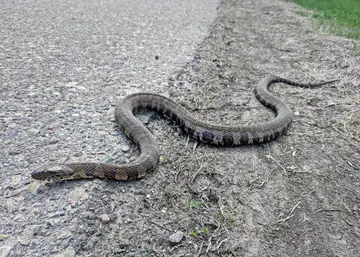

Its dark bands form a 'reverse hourglass': wider across the back and narrower on the sides (the copperhead's are narrow on the back, wide on the sides). Older water snakes can look solid dark. New Jersey Division of Fish and Wildlife, Endangered and Nongame Species Program
NJ Division of Fish and Wildlife: non-venomous ("Northern Water Snake (non-venomous but quite temperamental)").
Copperhead or Southern and midland watersnakes?
Copperhead
Southern and midland watersnakes Nerodia fasciata fasciata; Nerodia sipedon pleuralis
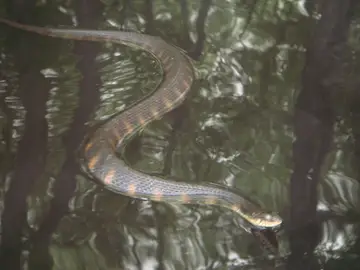
Florida Museum, for Florida: crossbands (in the Southern Watersnake, on juveniles) are darker, narrower and much more numerous than a copperhead's; pupils are round; dark vertical lines on the sides of the face near the mouth, which copperheads lack. Large adults are typically uniformly dark brown or black. Florida Museum of Natural History
Florida Museum lists both as "Non-venomous".
Copperhead or Eastern milk snake?
Copperhead
Eastern milk snake Lampropeltis triangulum
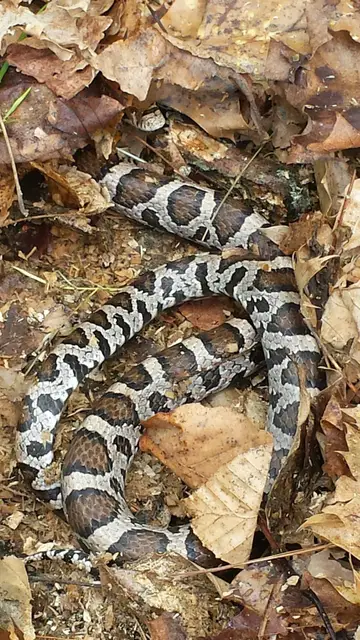
Milk snake blotches are outlined in black and widest across the middle of the back; belly is a black-and-white checkerboard (copperhead belly is mottled white to gray). Pennsylvania Fish and Boat Commission
NJ Division of Fish and Wildlife: "Eastern Milk Snake (non-venomous and quite docile)".
Copperhead or Corn snake?
Copperhead
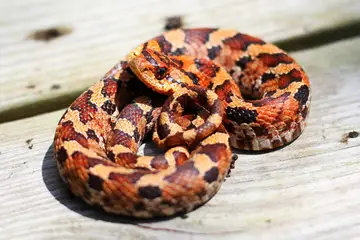
Corn snake Pantherophis guttatus
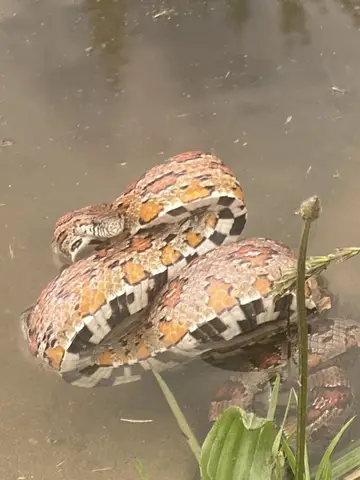
Longer and slender with smooth, shiny scales, an elongated head and square, black-outlined blotches; more red, orange and yellow. Georgia DNR Wildlife Resources Division
Georgia DNR calls corn snakes harmless ("Because of similar coloration, harmless corn snakes are occasionally confused with copperheads.").
Copperhead or Young rat snakes (black rat snake / eastern ratsnake)?
Copperhead
Young rat snakes (black rat snake / eastern ratsnake) Pantherophis alleghaniensis / P. obsoletus
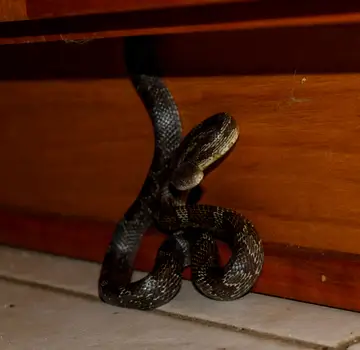
Hatchling and yearling rat snakes have irregular blotches, not hourglass bands, and turn virtually all black as adults (NJ Division of Fish and Wildlife). New Jersey says no other snake there has the copperhead's hourglass pattern; Delaware DNREC says the same for Delaware. New Jersey Division of Fish and Wildlife, Endangered and Nongame Species Program
Rutgers Cooperative Extension lists immature black rat snakes under "Non-venomous snakes that have a banded or splotched pattern" confused with copperheads. Virginia DWR says most baby snakes people meet are harmless ("a vast majority of the baby snakes you are most likely to encounter are harmless and quite beneficial").
Copperhead or Eastern hognose snake?
Copperhead
Eastern hognose snake Heterodon platirhinos
Named by Delaware DNREC and Rutgers as a frequent copperhead misidentification. Use the hourglass test: in Delaware only the copperhead has dark hourglass crossbands narrowest at the center of the back. Delaware DNREC, Division of Fish and Wildlife
Rutgers Cooperative Extension lists eastern hognose snakes under "Non-venomous snakes that have a banded or splotched pattern" confused with copperheads. See the hognose-snake page.
Copperhead or Eastern fox snake?
Copperhead
Eastern fox snake Elaphe gloydi (1999 name as printed in the source)
Michigan: often called 'copperhead' for its reddish head. Michigan State University Extension
Where the copperhead lives
- Native or listed
- Nonnative or not established
- No official record in our data
- 1–9
- 10–99
- 100–999
- 1,000+
On our state guides
- Alabama snakes
- Arkansas snakes
- Connecticut snakes
- Delaware snakes
- Florida snakes
- Georgia snakes
- Illinois snakes
- Indiana snakes
- Iowa snakes
- Kansas snakes
- Kentucky snakes
- Louisiana snakes
- Maryland snakes
- Massachusetts snakes
- Missouri snakes
- Nebraska snakes
- New York snakes
- North Carolina snakes
- Ohio snakes
- Oklahoma snakes
- Pennsylvania snakes
- South Carolina snakes
- Tennessee snakes
- Texas snakes
- Virginia snakes
- West Virginia snakes
State boundaries: U.S. Census Bureau, cartographic boundary file cb_2024_us_state_20m.
When it is active
Active roughly March/April to October/early November and dormant in winter. Active by day in spring and fall, mostly at night in the hottest summer months. Missouri Department of Conservation
US open-licence records peak in May to July and September.
Habitat and habits
Habitat: Mostly forests, especially rocky wooded hillsides, plus floodplains, swamp and stream edges, brushy areas, woodpiles, abandoned buildings and wooded suburbs. Missouri Department of Conservation
Behavior: Relies on camouflage and usually lies still when approached; may vibrate its tail and release musk; strikes as a last resort.
Diet: Mainly mice, voles and other small mammals; also frogs, lizards, small birds, other snakes and insects, especially cicadas. Young use the yellow tail tip as a lure.
Young: Mates in spring and fall (NCWRC) or spring and late summer (Georgia DNR); gives birth to live young in late summer or early fall, roughly July to October. Litter sizes: around 4-8 (Florida Museum), usually fewer than ten (Georgia DNR), 3 to 14 and up to 20 (NCWRC).
Legal status and reporting
Protection: Protected in some states: Missouri protects all native snakes by law (killing a venomous snake is allowed only when it is so close to people that someone might be bitten); in New Jersey it is illegal to disturb, harass or harm copperheads; in North Carolina it is a nongame species with no open season. Missouri Department of Conservation
Questions about the copperhead
Copperhead snake
A venomous pit viper of the eastern and central US, tan to coppery with dark hourglass-shaped bands. Bites are painful and need medical care but are rarely fatal. If bitten, call 911 or Poison Help at 1-800-222-1222.
Copperhead vs cottonmouth
Both are venomous. Copperheads are tan to coppery with hourglass bands and live mostly in forests. Cottonmouths are almost always associated with wetlands, and the dark facial band typical of the cottonmouth obscures its eye. Adult Florida cottonmouths are typically uniformly dark, but cottonmouth color can range from dark brown and black to olive drab and yellow-tan (SCDNR). Young cottonmouths resemble copperheads, but their bands have numerous dark spots and speckles.
Copperhead vs rat snake
Young black rat snakes have irregular blotches, not hourglasses, and turn virtually all black as adults. Copperhead bands are hourglass-shaped, narrow across the back and wide on the sides, and copperheads have vertical pupils and a heat pit. Rutgers Cooperative Extension groups immature black rat snakes with the non-venomous snakes confused with copperheads; copperheads are venomous.
Copperhead vs milk snake
Milk snake blotches are outlined in black and widest across the middle of the back, and the belly is a black-and-white checkerboard. Copperhead bands are narrowest on the back and the belly is mottled white to gray.
Copperhead vs northern water snake
A northern water snake has a 'reverse hourglass': its bands are wider across the back and narrower on the sides, the opposite of a copperhead. NJ Fish and Wildlife says it is non-venomous.
Copperhead vs corn snake
Corn snakes are longer and more slender, with smooth shiny scales, a long head and square black-outlined blotches, often more red, orange and yellow. Georgia DNR calls them harmless.
Baby copperhead
Baby copperheads look like small adults with the same hourglass pattern, but with a bright yellow or greenish-yellow tail tip. They are venomous from birth, and NCWRC says they are no more or less dangerous than adults.
When do copperheads have babies?
Late summer to early fall. The Florida Museum says between July and October; Missouri says August through early October.
What states have copperheads?
CDC/NIOSH: Eastern states and as far west as Texas. Official sources confirm copperheads in AL, CT, DE, FL (Panhandle), GA, IL, IN, LA, MO, NJ, NY, NC, OH, OK, PA, SC, TN, TX and VA. Other states could not be confirmed from official sources here, which does not mean copperheads are absent there.
Are there copperheads in florida?
Yes, but only in the Panhandle, mainly the western tip and along the Apalachicola River.
Are there copperheads in ohio?
Yes. ODNR: widely scattered through most of unglaciated Ohio, especially the rocky wooded hillsides of the southeast; status uncommon.
Are there copperheads in michigan?
The eastern fox snake is often mistaken for a copperhead there.
Are there copperheads in pennsylvania?
Yes. PFBC names the eastern copperhead as one of Pennsylvania's three venomous snakes; it is a Species of Special Concern.
Are there copperheads in new jersey?
Yes, only in the northern half (Piedmont, Highlands and Ridge-and-Valley regions). It is one of New Jersey's two venomous snakes and a state species of special concern.
Are there copperheads in north carolina?
Yes, across the state except the Outer Banks; it is NC's most common venomous snake.
Are there copperheads in virginia?
Yes, statewide (Virginia DWR).
Are there copperheads in south carolina?
Yes, statewide; SCDNR calls it the state's most common venomous snake.
Are there copperheads in georgia?
Yes, throughout most of Georgia except the southeastern corner.
Are there copperheads in alabama?
Yes, common statewide; the most frequently encountered venomous snake in Alabama.
Are there copperheads in tennessee?
Yes, across the entire state (TWRA).
Are there copperheads in texas?
Yes. TPWD lists three subspecies: southern (eastern third), broad-banded (central and western) and Trans-Pecos (springs in the southern Trans-Pecos).
Are there copperheads in louisiana?
Yes, in wooded and forested areas statewide except permanent swamps and coastal cheniers.
Are there copperheads in missouri?
Yes, statewide except the extreme northern border with Iowa; MDC calls it Missouri's most common venomous snake.
Are there copperheads in oklahoma?
Yes, in eastern and central Oklahoma.
Are there copperheads in illinois?
Yes, in the southern one-third of Illinois.
Are there copperheads in indiana?
Yes, only in the southern half of the state.
Are there copperheads in new york?
Yes, mainly the lower Hudson Valley south of Kingston and scattered in the Catskills.
Copperhead snakes in connecticut
Yes. CT DEEP: one of two venomous snakes in Connecticut, most abundant on the Central Connecticut Lowland trap rock ridges.
Copperhead snakes in delaware
Yes, but only in southern Sussex County and near Wilmington; most other reports turn out to be misidentified rat snakes, watersnakes or hog-nosed snakes.
Are there copperheads in wisconsin?
Not among Wisconsin's venomous snakes: UW Extension names only two, the timber rattlesnake and the massasauga.
Are there copperheads in california?
Not on the official list: California's CDFW complete species list has no copperhead.
Are there copperheads in arizona?
Not on the official list: the Arizona Game and Fish field guide snake list has no copperhead.
Copperhead bite
Painful and should be treated as serious, but rarely life-threatening; seek medical attention immediately. Call 911 or Poison Help at 1-800-222-1222.
Sources
- Venomous Snakes (NIOSH Outdoor Workers). CDC / NIOSH. archived copy, captured October 6, 2026; checked November 3, 2026.
Quoted passages (1)
“Venomous snakes found in the United States include rattlesnakes, copperheads, cottonmouths (also called water moccasins), and coral snakes.”
- Copperhead (NCWRC species page). N.C. Wildlife Resources Commission. undated page; checked November 3, 2026.
Quoted passages (2)
“While a copperhead bite is painful and should be treated as serious, it is not considered life threatening.”
“The pupils are vertical and elliptical, and there is a heat sensory pit between the eye and nostril.”
- Copperhead. Alabama Department of Conservation and Natural Resources (Outdoor Alabama). undated page; checked November 3, 2026.
- Eastern Copperhead (MDC Field Guide). Missouri Department of Conservation. undated page; checked November 3, 2026.
Quoted passages (5)
“Length: typically 24 to 36 inches (2–3 feet). Have been known to reach 53 inches (nearly 4½ feet).”
“Natural habitat includes open, rocky, wooded hillsides, brushy areas along creeks, and around swamps that offer abundant ground cover (scattered rocks, crevices along rock ledges, logs, and brush piles).”
“Copperheads eat a wide variety of prey, but mice and voles make up the bulk of their diet. They also will eat frogs, lizards, small birds, insects (especially cicadas), and occasionally other small snakes.”
“Copperheads are normally active from mid-March through early November.”
“All snakes native to our state are protected by law. It is against the law to kill them, except when a venomous snake is in such close association with people that it might result in someone being bitten.”
- Venomous Snakes Fact Sheet Series: Copperhead. Georgia DNR Wildlife Resources Division. PDF Last-Modified Fri, 02 Feb 2024 14:12:53 GMT; checked November 3, 2026.
Quoted passages (3)
“They are thick snakes with keeled scales.”
“Though they do not have rattles on the tail, copperheads will vigorously rattle their tails creating noise as it hits dried grass or leaves.”
“However, corn snakes are longer and slender and have smooth, shiny scales. Corn snakes also have an elongated head, and square blotches with black outlines going down the back.”
- Florida Snake ID Guide species account: Eastern Copperhead. Florida Museum of Natural History (University of Florida). updated September 23, 2022; checked November 3, 2026.
Quoted passages (6)
“Head shape is not a reliable way to identify copperheads.”
“The coloration of juveniles is similar to adults, except that the tail tip of newborn copperheads is bright sulfur yellow.”
“When frightened, these snakes often remain motionless and expand their ribs so their bodies appear flattened against the ground.”
“Females typically give birth to around 4-8 live young between July and October.”
“The dark crossbands on the body of juvenile cottonmouths have numerous dark spots and speckles, whereas the dark crossbands on copperheads have no dark spots or at most only one. Adult Florida Cottonmouths are typically uniformly dark with very little discernable pattern. The eye of the copperhead is not obscured by the dark facial band typical of the cottonmouth.”
“The sides of the face have dark vertical lines near the mouth, whereas the copperhead has no such lines.”
- Snake Identification: Avoid Being Confused! New Jersey Division of Fish and Wildlife, Endangered and Nongame Species Program. PDF Last-Modified 2019-04-03; checked November 3, 2026.
Quoted passages (2)
“The pattern (the darker color) is roughly a ‘reverse hourglass;’ wider across the back and more narrow on the sides.”
“Rat snakes have irregularly shaped (but uniform to each other) blotches down the length of the body.”
- Snakes (species accounts). Pennsylvania Fish and Boat Commission. undated page; checked November 3, 2026.
Quoted passages (1)
“Thus, the dark pattern on the milksnake is at its widest across the midline of the back, compared to the narrower dark band on the midline of the copperhead.”
- Snakes (Delaware DNREC). Delaware DNREC, Division of Fish and Wildlife. published 2021-07-09; checked November 3, 2026.
Quoted passages (1)
“Reports from other localities, when supported with photographs, have turned out to be misidentifications most often of young rat snakes, watersnakes and eastern hog-nosed snakes.”
- Michigan Snakes: A Field Guide and Pocket Reference (MSU Extension Bulletin E-2000). Michigan State University Extension (MSU Library archive). Revised 1999; checked November 3, 2026.
Quoted passages (1)
“The Eastern Fox Snake is often called "copperhead" because of its head coloring. Note that the non-venomous fox snake has a round eye pupil, while the venomous copperhead has an elliptical eye pupil and a heat-sens ing pit between eye and nostril.”
- Venomous Snakes of South Carolina (poster). SCDNR and South Carolina Wildlife Magazine. SCDNR 03CE4028 3/03; checked November 3, 2026.
- It’s Baby Snake Season! Virginia DWR (J.D. Kleopfer/DWR). September 18, 2019; checked November 3, 2026.
- Fact Sheet FS1320: Eastern Copperheads in New Jersey. Rutgers Cooperative Extension (NJAES). December 2024; checked November 3, 2026.
- Northern Copperhead (Wildlife in Connecticut fact sheet). Connecticut DEEP, Wildlife Division. 2018; checked November 3, 2026.
- Eastern Copperhead (Wild About Snakes). Illinois Department of Natural Resources. undated page; checked November 3, 2026.
- Snakes. Indiana Department of Natural Resources, Division of Fish & Wildlife. dateModified 2026-03-09; checked November 3, 2026.
- Snake Species Field Guide: Eastern Copperhead. Louisiana Department of Wildlife and Fisheries. undated page; checked November 3, 2026.
- Snakes of New York (Environmental Information Series). SUNY College of Environmental Science and Forestry. undated page; checked November 3, 2026.
- Snakes: Family Viperidae (AG-472-02). NC State Extension (N.C. Cooperative Extension, NC State University). Publication date: Aug. 21, 2019; checked November 3, 2026.
- Reptiles of Ohio Field Guide (Publication 5354). Ohio Department of Natural Resources, Division of Wildlife. PUBLICATION 5354; checked November 3, 2026.
- Copperhead (ODWC Field Guide). Oklahoma Department of Wildlife Conservation. undated page; checked November 3, 2026.
- Pennsylvania Native Reptile and Amphibian Species (PA Species and Endangered Species Act listing status). Pennsylvania Fish and Boat Commission. undated page; checked November 3, 2026.
- Reptiles » Snakes (Tennessee Watchable Wildlife species accounts). Tennessee Wildlife Resources Agency (Tennessee Watchable Wildlife website). undated page; checked November 3, 2026.
- Venomous Snake Safety (Texas Junior Naturalists). Texas Parks and Wildlife Department. undated page; checked November 3, 2026.
- Problems with Snakes. Virginia DWR. undated page; checked November 3, 2026.
- Snakes of New Jersey (brochure). New Jersey Division of Fish and Wildlife, Endangered and Nongame Species Program. PDF Last-Modified 2021-06-23; checked November 3, 2026.
- Outdoor Hazards in Wisconsin: A Guide to Insects, Plants, and Wildlife (G3564). University of Wisconsin-Extension. Copyright 2010; checked November 3, 2026.
- Complete List of Amphibian, Reptile, Bird and Mammal Species in California. California Department of Fish and Wildlife (CWHR Program). 2016-05 (document dated "May, 2016"; checked November 3, 2026.
- Online Field Guide to The Reptiles and Amphibians of Arizona - Snakes of Arizona. Arizona Game and Fish Department. 2023; checked November 3, 2026.
- GBIF.org occurrence records, human observations licensed CC0 1.0 or CC BY 4.0 only, accessed November 3, 2026. The datasets behind these counts are listed on our Sources page.
- State boundaries: U.S. Census Bureau, cartographic boundary file cb_2024_us_state_20m.