Hognose Snake
Heterodon (hog-nosed snakes: H. platirhinos, H. simus, H. nasicus, H. kennerlyi) · also called Hog-nosed Snake, Puff Adder, Spreading Adder and Hissing Adder · Last checked November 3, 2026.
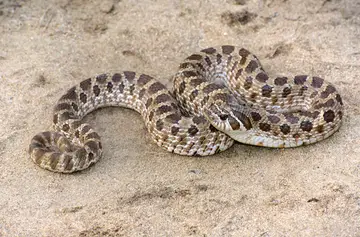
Hognose snakes are stout snakes with an upturned snout, known for hissing, flattening their necks and playing dead. Eastern and southern hognose snakes are officially classed as nonvenomous and not dangerous to people, but they do produce a mild venom for prey, and bites are extremely rare. Colorado and Arizona class the western and Mexican hognose snakes as venomous or mildly venomous, with Colorado calling the western non-dangerous to humans. They live across the eastern US and in parts of the plains and Southwest. Florida Museum of Natural History
This page covers a genus (Heterodon (hog-nosed snakes: H. platirhinos, H. simus, H. nasicus, H. kennerlyi)), not a single species.
On this page
Is the hognose snake dangerous?
Eastern hog-nosed snakes are classed non-venomous and not dangerous to people or pets, though they produce a mild venom; people allergic to it have had local swelling and irritation, and no human death has occurred. Florida Museum of Natural History
“Humans that are allergic to the small amount of venom produced have experienced local swelling and irritation, but no human death from this species has ever occurred.”
Bites and stings: Extremely rare per Florida Museum (eastern and southern species); the strike display is a bluff with the mouth closed, and virtually all bites occurred when the snake was intentionally handled.
No official source we use states whether this animal is venomous. That does not mean it is harmless: do not handle it.
If someone is bitten or stung, call 911 or Poison Help at 1-800-222-1222.
How to identify a hognose snake
A photo or description can narrow it down, but cannot confirm what an animal is or that it is safe. Look from a distance and do not handle wild animals.
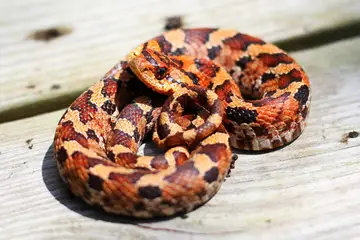
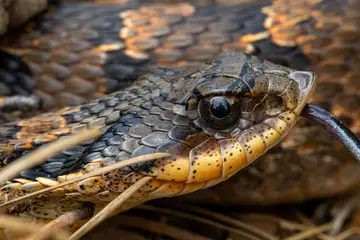

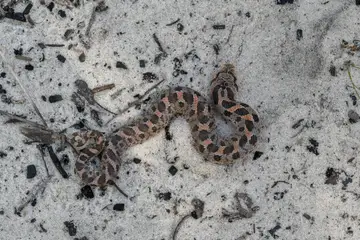
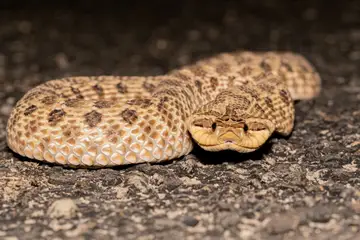
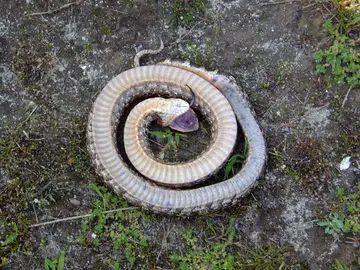

Size: Eastern: most adults about 20 to 33 inches (Florida Museum, Missouri), with a record of 49.9 inches; Alabama gives 20 to 30, up to 46. Southern: most adults about 18 to 22 inches (Florida Museum) or 14 to 21 (Alabama), with a record of 24. Florida Museum of Natural History
Colors: Eastern is highly variable: yellow, tan, olive, brown, gray, orange or reddish-brown; some entirely black or dark gray. Pattern: Large dark blotches on the back with smaller blotches on the sides; some have no pattern.
Key features
- Upturned snout and broad head Outdoor Alabama
- Stout body Florida Museum of Natural History
- Flattens neck, hisses, then may roll over and play dead Louisiana Department of Wildlife and Fisheries
- Keeled scales Outdoor Alabama
Young
Newly hatched eastern hognose snakes are more colorful than adults, about 9 inches long.
Animals mistaken for the hognose snake
Hognose Snake or Pygmy Rattlesnake?
Hognose Snake
Pygmy Rattlesnake Sistrurus miliarius
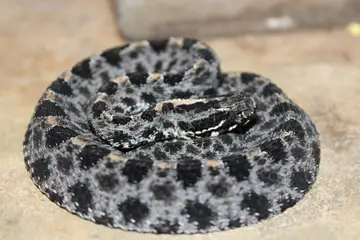

Georgia DNR says the venomous pigmy rattlesnake is often confused with hognose snakes, particularly the southern hognose: both are stout with blunt heads and a row of dark spots on the back with an orangeish stripe. Hognose snakes have a thick tail that does not end in a rattle and a very pointed, sharply upturned snout. Florida Museum says the pygmy rattlesnake has a blunt nose and a small rattle on the tail tip. Georgia Department of Natural Resources, Wildlife Resources Division
Venomous (Florida Museum).
Hognose Snake or Southern Hognose Snake?
Hognose Snake
Southern Hognose Snake Heterodon simus
Southern has a light-colored belly and underside of tail, and a more upturned snout, than the eastern. Florida Museum of Natural History
Classed non-venomous; produces mild venom (Florida Museum).
Hognose Snake or Western Hognose Snake?
Hognose Snake
Western Hognose Snake Heterodon nasicus
Western has a sharply upturned snout and black pigment under the tail. Missouri Department of Conservation
Venomous but considered non-dangerous to humans (Colorado).
Where the hognose snake lives
- Native or listed
- Nonnative or not established
- No official record in our data
- 1–9
- 10–99
- 100–999
- 1,000+
State boundaries: U.S. Census Bureau, cartographic boundary file cb_2024_us_state_20m.
When it is active
Eastern: active during the day, often seen crossing roads in spring and fall; in Missouri, overwinters from early November to April. Outdoor Alabama
US open-licence records for all hognose snakes (genus Heterodon) peak in April to June and September.
Habitat and habits
Habitat: Eastern: open woods, old fields, river floodplains and rocky wooded hillsides with sandy or loose soil. Western: sandhills, plains grassland and sandy floodplains. Missouri Department of Conservation
Behavior: Bluffs by flattening head and neck, hissing and striking with the mouth closed; may then convulse, roll over and play dead.
Diet: Mainly toads, which they dig up with the upturned snout (Florida Museum, Missouri); also frogs, salamanders, lizards and small mammals.
Young: Eastern lays one clutch a year in June or July, 4 to 61 eggs averaging 22, hatching in August or September (Missouri).
Legal status and reporting
Federal: Southern hognose snake is Proposed Threatened, wherever found (USFWS ECOS). No ECOS record returned for eastern, western or Mexican species. US Fish and Wildlife Service
Protection: Varies by state and species. Georgia says all non-venomous snakes are protected by state law and lists the southern hognose as threatened. North Carolina lists the southern hognose as threatened, Alabama lists it as a protected nongame species and possibly extirpated, and South Carolina lists it under its Non-Game Species in Need of Management laws. Ohio lists the eastern as a species of concern. Check the state agency.
Questions about the hognose snake
Is a hognose snake venomous?
It depends on the species. Eastern and southern hognose snakes are officially classed as non-venomous, though Florida Museum says they produce a mild venom for prey. Colorado calls the western hognose venomous but non-dangerous to humans, and Arizona calls the Mexican hog-nosed mildly venomous.
Is a hognose snake venomous to humans?
Florida Museum says eastern hog-nosed snakes are not dangerous to people, though people allergic to the venom have had local swelling and irritation. Missouri says they are not considered a threat to humans. Arizona says the Mexican hog-nosed venom might be mildly toxic to humans.
Is a hognose snake dangerous?
Florida Museum says eastern and southern hog-nosed snakes are not dangerous to people or pets, and bites are extremely rare. Colorado calls the western hognose non-dangerous to humans. Virtually all bites happened when snakes were intentionally handled.
Is a hognose snake poisonous?
Official sources checked describe venom, not poison: a mild venom delivered by enlarged rear teeth, used on prey. Separately, hognose snakes eat toads, and Missouri says they are immune to toad toxins.
Is a hognose snake a viper?
Official sources place it in the family Colubridae. Blow Viper and Hissing Viper are local nicknames listed by Florida Museum and Missouri.
Is a hognose snake a colubrid?
Yes. Missouri and Ohio list hog-nosed snakes in the family Colubridae.
Is a hognose snake a constrictor?
No official source checked calls them constrictors. Florida Museum says eastern and southern hog-nosed snakes are not constrictors and subdue prey with a mild venom. Arizona says Mexican hog-nosed snakes do not constrict prey, but may partly restrain it with a body coil.
Hognose snake playing dead
When bluffing fails, it may roll on its back with mouth open and tongue out, and may release a foul smell and regurgitate. If rolled onto its belly, it rolls back over.
Hognose snake size
Most adult eastern hognose snakes are about 20 to 33 inches, with a record of 49.9 inches (Florida Museum). Alabama gives 20 to 30 inches, up to 46. Most adult southern hognose snakes are about 18 to 22 inches (Florida Museum) or 14 to 21 (Alabama), with a record of 24.
Are there hognose snakes in alabama?
Yes. The eastern hognose is statewide. The southern hognose is listed as endangered or possibly extirpated, with no records known since 1975.
Are there hognose snakes in louisiana?
Yes. Louisiana says the eastern hog-nosed snake is found throughout the state in non-wetland habitats, and ranks it S3 (rare and local).
Are there hognose snakes in missouri?
Yes. The eastern hog-nosed snake is presumed statewide. Western hog-nosed subspecies are very rare, and the plains subspecies has probably been lost from the state.
Sources
- Florida Snake ID Guide species account: Eastern Hog Nosed Snake. Florida Museum of Natural History (University of Florida). updated March 18, 2026; checked November 3, 2026.
Quoted passages (5)
“Humans that are allergic to the small amount of venom produced have experienced local swelling and irritation, but no human death from this species has ever occurred.”
“Most adult Eastern Hog-nosed Snakes are about 20-33 inches (51-84 cm) in total length, with a record length of 49.9 inches (126.8 cm).”
“These are stout-bodied snakes with slightly upturned, pointed snouts.”
“It may strike, but only as a bluff with its mouth closed.”
“Southern Hog-nosed Snake (Heterodon simus) Non-venomous has a light-colored belly and underside of the tail, and a more upturned snout.”
- Eastern Hog-Nosed Snake. Missouri Department of Conservation. undated page; checked November 3, 2026.
Quoted passages (3)
“Newly hatched eastern hog-nosed snakes are more colorful than adults”
“Eastern hog-nosed snakes live in areas of sandy or loose soil in open woods, old fields, open river floodplains, and on rocky, wooded hillsides.”
“The female lays only 1 clutch per year, in June or July, consisting of 4-61 eggs (with an average of 22).”
- Western Hognose Snake. Colorado Parks and Wildlife. undated page; checked November 3, 2026.
- Online Field Guide species account: Mexican Hog-Nosed Snake (Heterodon kennerlyi). Arizona Game and Fish Department. 2023; checked November 3, 2026.
- Eastern Hognose Snake. Alabama Department of Conservation and Natural Resources (Outdoor Alabama). undated page; checked November 3, 2026.
Quoted passages (3)
“Eastern hognose snakes are called "hognose" because of their upturned snout and broad head.”
“Their scales are keeled.”
“Hognose snakes are active by day, and often are seen crossing roads during the spring and fall.”
- Snake Species Field Guide: Eastern Hog-nosed Snake. Louisiana Department of Wildlife and Fisheries. undated page; checked November 3, 2026.
Quoted passages (1)
“…the snake will roll onto its back and play dead, often regurgitating any recent meal.”
- ECOS species report query. U.S. Fish and Wildlife Service. live query 2026-11-03; checked November 3, 2026.
- Venomous Snakes Fact Sheet Series: Pigmy Rattlesnake. Georgia Department of Natural Resources, Wildlife Resources Division. PDF Last-Modified Fri, 02 Feb 2024 14:12:53 GMT; checked November 3, 2026.
Quoted passages (1)
“The pigmy rattlesnake is often confused with the hognose snakes, and particularly the southern hognose snake (Heterodon simus). They both have stout bodies and blunt heads, and a row of dark spots on the back with an orangeish stripe. But the hognose snakes also have a thick tail that does not end in a rattle, and a very pointed, sharply upturned snout.”
- Plains Hog-Nosed Snake. Missouri Department of Conservation. undated page; checked November 3, 2026.
Quoted passages (1)
“The plains hog-nosed snake has a sharply upturned snout, black pigment on the underside of the tail”
- Florida Snake ID Guide species account: Southern Hog Nosed Snake. Florida Museum of Natural History (University of Florida). updated March 18, 2026; checked November 3, 2026.
- Reptiles of Ohio Field Guide (Publication 5354). Ohio Department of Natural Resources, Division of Wildlife. PUBLICATION 5354; checked November 3, 2026.
- Southern Hognose Snake. Alabama Department of Conservation and Natural Resources (Outdoor Alabama). undated page; checked November 3, 2026.
- GBIF.org occurrence records, human observations licensed CC0 1.0 or CC BY 4.0 only, accessed November 3, 2026. The datasets behind these counts are listed on our Sources page.
- State boundaries: U.S. Census Bureau, cartographic boundary file cb_2024_us_state_20m.