Pygmy rattlesnake
Sistrurus miliarius · also called pigmy rattlesnake, ground rattler, dusky pygmy rattlesnake and Carolina pigmy rattlesnake · Last checked November 3, 2026.
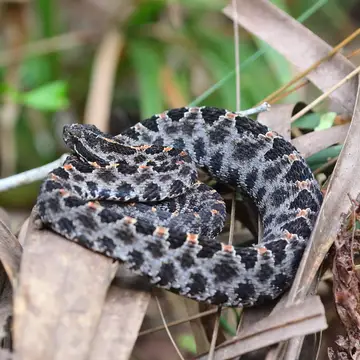
The pygmy rattlesnake is a small, venomous pit viper, usually 12 to 24 inches long. It is gray to reddish with a row of dark blotches down the back, often over a reddish or orange stripe, and has a tiny rattle that is hard to hear. State wildlife agencies or state extension services list it as venomous in Alabama, Arkansas, Florida, Georgia, Kentucky, Louisiana, Missouri, North Carolina, Oklahoma, South Carolina, Tennessee and Texas. Bites are painful and can cause a lot of local tissue damage. Missouri calls its venom quite toxic. Florida Museum says bites are generally not life-threatening but can be more serious for children and small pets. If bitten, call 911 or Poison Help at 1-800-222-1222. Florida Museum of Natural History
On this page
Is the pygmy rattlesnake dangerous?
Venomous. Bites are painful and can cause a lot of swelling, local tissue damage and scarring, and could cause the loss of a finger or toe. No documented deaths (Alabama), and generally not considered life-threatening to people or pets (Florida Museum), but bites can be more serious for children and small pets, and Missouri calls the venom quite toxic. Outdoor Alabama
“There are no documented cases of death caused by a pigmy rattler, although a bite can be very painful and could cause the loss of a digit.”
Bites and stings: Florida Museum says it is not aggressive and avoids people and pets, and most bites happen when the snake is molested or stepped on. It relies on camouflage and often lies still. But Alabama notes some individuals may be very aggressive and strike with little provocation, and Missouri says some defend themselves vigorously. The faint rattle can be hard to hear.
If someone is bitten or stung, call 911 or Poison Help at 1-800-222-1222.
How to identify a pygmy rattlesnake
A photo or description can narrow it down, but cannot confirm what an animal is or that it is safe. Look from a distance and do not handle wild animals.
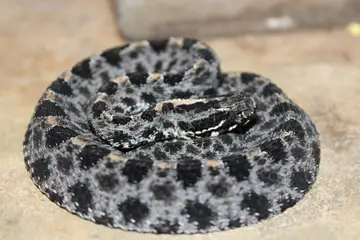

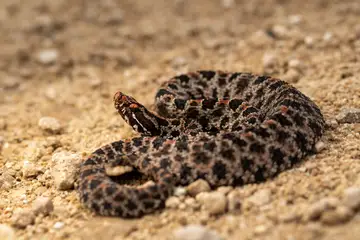
Size: Adults usually 12-24 inches (30-61 cm); record 31-33 inches. Newborns about 5-6 inches. Florida Museum of Natural History
Colors: light to dark gray body; reddish-brown stripe down the middle of the back (dusky); carolina subspecies: brownish, bluish gray or reddish background; western: gray with an orange to orange-red stripe down the back. Pattern: row of dark spots/blotches down the back and rows of spots on each side; black diagonal line behind the eye.
Key features
- tiny rattle at the end of a slender tail; buzz sounds like an insect Outdoor Alabama
- pit viper: heat-sensing pit between nostril and eye, vertical (cat-like) pupils, keeled scales; nine large plates on top of the head Florida Museum of Natural History
- large head scales (other rattlesnakes have small scales on the head) Georgia DNR Wildlife Resources Division
Young
Look like small adults but have a bright sulfur-yellow (yellow-green) tail tip used as a lure.
Animals mistaken for the pygmy rattlesnake
Pygmy rattlesnake or Hognose snakes?
Pygmy rattlesnake
Hognose snakes Heterodon platirhinos, H. simus
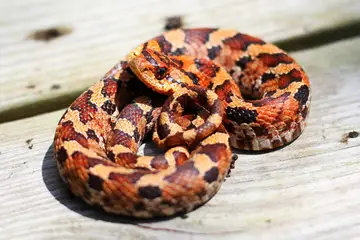
Hognose snakes have an upturned snout, round pupils, a thick tail with no rattle, and no facial pits. Florida Museum of Natural History
Florida Museum labels the eastern and southern hog-nosed snakes non-venomous.
Pygmy rattlesnake or North American racer (juvenile)?
Pygmy rattlesnake
North American racer (juvenile) Coluber constrictor
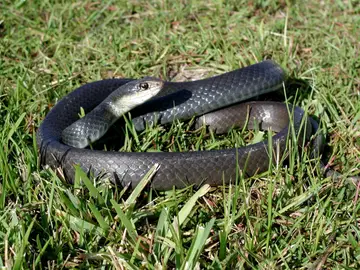

Juvenile racers have reddish-brown saddles on gray and may buzz their tail in leaf litter, but they are pencil-thin with tiny heads, large eyes, round pupils and no rattle. Florida Museum of Natural History
Florida Museum labels the North American racer non-venomous.
Pygmy rattlesnake or Timber rattlesnake (especially juveniles)?
Pygmy rattlesnake
Timber rattlesnake (especially juveniles) Crotalus horridus
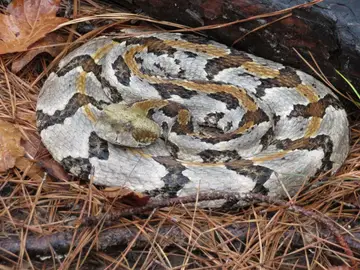

Adult timber rattlesnakes are 3 to 5 feet long and have large rattles, but Oklahoma warns that pygmy rattlesnakes may be confused with juvenile timber rattlesnakes, which are small. Pygmy rattlesnakes have large scales (nine large plates) on top of the head; timber rattlesnakes have small scales there. Both are venomous. MDC
Venomous (a timber rattlesnake is one of Alabama's six venomous snakes).
Where the pygmy rattlesnake lives
- Native or listed
- Nonnative or not established
- No official record in our data
- 1–9
- 10–99
- 100–999
- 1,000+
On our state guides
- Alabama snakes
- Arkansas snakes
- Florida snakes
- Georgia snakes
- Louisiana snakes
- Oklahoma snakes
- South Carolina snakes
- Tennessee snakes
- Texas snakes
State boundaries: U.S. Census Bureau, cartographic boundary file cb_2024_us_state_20m.
When it is active
Active March-November in Oklahoma, early April to mid-October in Missouri, April-October in Arkansas. Active by day in spring and fall, shifting to late afternoon and night in summer. Often seen crossing roads in late summer, late afternoon or night (Alabama). Oklahoma Department of Wildlife Conservation
US open-licence records peak in May to October.
Habitat and habits
Habitat: Pine flatwoods, sandhills, longleaf pine woods, scrub, hammocks, prairies, edges of marshes, lakes and cypress swamps; in the west, forests and rocky glades. Often near fresh water; also found in suburban neighborhoods next to good habitat. Florida Museum of Natural History
Behavior: Relies on camouflage: often stays motionless and flattens its body. If provoked it may buzz its tail, bob its head and strike; Florida Museum says striking is defensive only, but Alabama notes some individuals may be very aggressive and strike with little provocation, while others seem lethargic.
Diet: Small prey: centipedes and other arthropods, frogs, lizards, snakes and small mammals. Mostly a sit-and-wait ambush hunter; juveniles wiggle the yellow tail tip as a lure.
Young: Live-bearing: about 1-14 young born July-September. Females often breed every other year.
Legal status and reporting
Federal: Not federally listed. USFWS ECOS has no species record for Sistrurus miliarius; the only Sistrurus entries are the eastern massasauga (Threatened) and desert massasauga (Not Listed). US Fish and Wildlife Service
Protection: State conservation status varies: Tennessee lists the western pygmy rattlesnake as Threatened (TWRA); North Carolina lists the Carolina pigmy rattlesnake as Special Concern; Louisiana ranks it S2 (imperiled); Alabama lists it as of moderate conservation concern. In Louisiana a Restricted Snake Permit is required to possess any venomous snake. Whether killing is illegal was not stated by the cited sources. Tennessee Wildlife Resources Agency
Report: North Carolina's Wildlife Resources Commission asks for rattlesnake sightings (Rattlesnake Sightings Wanted). N.C. Wildlife Resources Commission
Questions about the pygmy rattlesnake
Pygmy rattlesnake
A small venomous rattlesnake, usually 12-24 inches long, gray with dark blotches and often a reddish stripe, and a tiny rattle that is hard to hear. It lives in the southeastern US from North Carolina and Florida west to Oklahoma and Texas. If bitten, call 911 or Poison Help at 1-800-222-1222.
Are there pygmy rattlesnakes in oklahoma?
Yes. The western pygmy rattlesnake is venomous and lives in Oklahoma's forests, including the Cross Timbers. It is largely absent from prairie patches in the east (ODWC).
Are there pygmy rattlesnakes in alabama?
Yes. All three subspecies occur in Alabama, statewide, but they are uncommon to rare and rarely encountered in recent years except in extreme southern Alabama. It is one of Alabama's six venomous snakes (ADCNR).
Pygmy rattlesnakes in alabama
Statewide but uncommon to rare; most recent encounters are in extreme southern Alabama (ADCNR). Venomous.
Are there pygmy rattlesnakes in georgia?
Yes. Georgia DNR lists the pigmy rattlesnake among Georgia's seven venomous snakes. The Carolina subspecies is in the Piedmont and Mountains, mainly on the eastern side, and the dusky subspecies is in the lower Coastal Plain.
Are there pygmy rattlesnakes in missouri?
Yes. The venomous western pygmy rattlesnake lives in extreme southern Missouri along the Arkansas border and in the eastern Ozarks and St. Francois Mountains. It is rarely encountered (MDC).
Pygmy rattlesnakes in missouri
Found in extreme southern Missouri along the Arkansas border and in the eastern Ozarks and St. Francois Mountains, and active from early April to mid-October (MDC). Venomous.
Pygmy rattlesnakes in arkansas
Yes. The western pigmy rattlesnake is one of Arkansas's six venomous snakes. AGFC's snake guide gives its range as statewide, with few records from most of the Mississippi Delta.
Pygmy rattlesnakes in florida
Yes. The dusky pygmy rattlesnake is found throughout Florida, in every county, but it is not known from the Florida Keys (Florida Museum). FWC lists it among Florida's six venomous snakes.
Pygmy rattlesnakes in kentucky
Yes, but it is Kentucky's smallest and rarest venomous snake, and its range is limited to the Land Between the Lakes area (University of Kentucky Extension).
Pygmy rattlesnakes in louisiana
Yes. LDWF lists it as native and venomous, in upland areas and pine flatwoods of the Florida Parishes and northern and central Louisiana, with isolated populations further south. It is rarely encountered and ranked S2 (imperiled).
Pygmy rattlesnakes in oklahoma
Yes. The venomous western pygmy rattlesnake is found mainly in forest habitats, including the Cross Timbers, and is active from March through November (ODWC).
Pygmy rattlesnakes in tennessee
Yes. The western pygmy rattlesnake occurs along the western Highland Rim from Stewart County to the southern border. It is Tennessee's smallest venomous snake and is listed as Threatened by TWRA.
Sources
- Florida Snake ID Guide species account: Dusky Pygmy Rattlesnake. Florida Museum of Natural History (University of Florida). updated September 23, 2022; checked November 3, 2026.
Quoted passages (9)
“Most adult Dusky Pygmy Rattlesnakes are about 12-24 inches (30-61 cm) in total length, with a record length recorded of 31 inches (79 cm).”
“The pupil is vertically elliptical, and there is a deep facial pit organ located between the nostril and the eye.”
“The coloration of juveniles is the same as described for adults, except the tail tip of juveniles is bright sulfur-yellow in color.”
“This species can be locally very abundant, and it is often found in suburban neighborhoods where development encroaches into favorable habitats.”
“Pygmy Rattlesnakes feed on a wide range of small prey including centipedes and other arthropods, frogs, snakes, lizards, and small mammals.”
“However, these snakes are not aggressive, and striking is only used in defense.”
“In Florida, females typically give birth to around 1-14 live young between July and August.”
“However, hognose snakes have both an upturned nose (rostral scale) and round pupils, and they lack both facial pits and rattles.”
“However, juvenile black racers are pencil thin, have tiny heads with large eyes and round pupils, and lack rattles on their tails.”
- Pigmy Rattlesnake. Alabama Department of Conservation and Natural Resources (Outdoor Alabama). undated page; checked November 3, 2026.
Quoted passages (2)
“There are no documented cases of death caused by a pigmy rattler, although a bite can be very painful and could cause the loss of a digit.”
“The tip of their tail contains a very small delicate rattle or button that is not much wider than the end of the tail itself. When vibrated for a warning, the rattle is often difficult to hear and has been compared to the sound of an insect buzzing.”
- Venomous Snakes Fact Sheet Series: Pigmy Rattlesnake. Georgia DNR Wildlife Resources Division. PDF Last-Modified Fri, 02 Feb 2024 14:12:53 GMT; checked November 3, 2026.
Quoted passages (1)
“The head has 9 large scales on it, whereas the other two species of rattlesnakes have small scales covering the head.”
- MDC Field Guide: Western Pygmy Rattlesnake. Missouri Department of Conservation (MDC). undated page; checked November 3, 2026.
Quoted passages (1)
“The timber rattlesnake (Crotalus horridus) occurs statewide; adults are 3 to 5 feet long and have large rattles.”
- Venomous Snakes (NIOSH Outdoor Workers). CDC / NIOSH. archived copy, captured October 6, 2026; checked November 3, 2026.
Quoted passages (1)
“Venomous snakes found in the United States include rattlesnakes, copperheads, cottonmouths (also called water moccasins), and coral snakes.”
- Western Pygmy Rattlesnake (field guide). Oklahoma Department of Wildlife Conservation. undated page; checked November 3, 2026.
Quoted passages (1)
“These snakes are active from March through November, depending on the temperatures. During spring and fall, they are often found active during the day, but during summer, their activity shifts to late afternoon and night.”
- ECOS species report query (scientific name starts with Sistrurus). U.S. Fish and Wildlife Service. live query 2026-11-03; checked November 3, 2026.
- Reptiles » Snakes (Tennessee Watchable Wildlife species accounts). Tennessee Wildlife Resources Agency (Tennessee Watchable Wildlife website). undated page; checked November 3, 2026.
Quoted passages (1)
“Status in Tennessee: Western Pygmy Rattlesnake is listed as Threatened by TWRA, and considered rare to very rare and imperiled by Tennessee Department of Environment and Conservation.”
- Pigmy Rattlesnake (NCWRC species page). N.C. Wildlife Resources Commission. undated page; checked November 3, 2026.
Quoted passages (1)
“See a rattlesnake in the wild? We want to know!”
- Nongame Wildlife FAQs. Alabama Department of Conservation and Natural Resources (Outdoor Alabama). undated page; checked November 3, 2026.
- Venomous Snakes of Georgia (brochure). Georgia DNR Wildlife Resources Division, Wildlife Conservation Section. PDF Last-Modified 2024-02-02; checked November 3, 2026.
- Arkansas Snake Guide (K. J. Irwin, AGFC herpetologist). Arkansas Game and Fish Commission (PDF hosted by University of Arkansas Cooperative Extension Service). Spring 2004; checked November 3, 2026.
- Snakes of Arkansas (FSA9102). University of Arkansas Cooperative Extension Service. printed code FSA9102-PD-8-2021R; checked November 3, 2026.
- Living with Snakes. Florida Fish and Wildlife Conservation Commission (FWC). archived copy, captured June 16, 2026; checked November 3, 2026. Archived copy.
- Venomous Snakes of Kentucky (FORFS 18-02). University of Kentucky Forestry and Natural Resources Extension. FORFS 18-02; checked November 3, 2026.
- Snake Species Field Guide: Pygmy Rattlesnake. Louisiana Department of Wildlife and Fisheries. undated page; checked November 3, 2026.
- GBIF.org occurrence records, human observations licensed CC0 1.0 or CC BY 4.0 only, accessed November 3, 2026. The datasets behind these counts are listed on our Sources page.
- State boundaries: U.S. Census Bureau, cartographic boundary file cb_2024_us_state_20m.