Black Racer
Coluber constrictor · also called North American racer, racer, northern black racer and southern black racer · Last checked November 3, 2026.
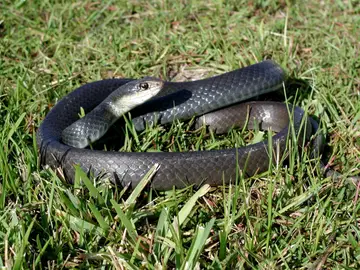

The black racer is a long, slender, fast snake, solid black as an adult with a white chin and smooth scales. It is not venomous: the Florida Museum says it is not dangerous to people or pets, but it will readily bite to defend itself. Young racers look very different, gray with reddish-brown blotches. Racers live across the eastern US, with other color forms farther west. Not every black snake is a racer, and NPS warns the venomous cottonmouth can look similar, so leave any snake you cannot identify alone. Florida Museum of Natural History
On this page
Is the black racer dangerous?
Non-venomous. The Florida Museum says racers are not dangerous to people or pets, though they will readily bite to defend themselves. NPS says harmless to humans as long as they are left alone. Florida Museum of Natural History
“Non-Venomous. North American racers are not dangerous to people or pets, but they will readily bite to defend themselves.”
Bites and stings: Will bite if cornered or handled. The Florida Museum says virtually all bites happen when the snake is deliberately molested; Ohio says the small, numerous teeth can give a painful bite.
How to identify a black racer
A photo or description can narrow it down, but cannot confirm what an animal is or that it is safe. Look from a distance and do not handle wild animals.
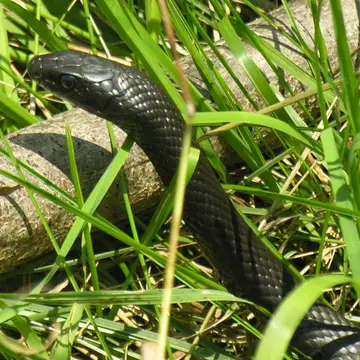
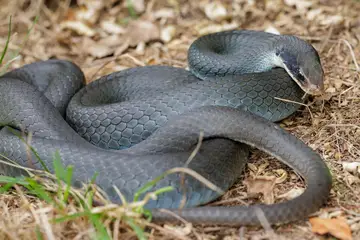

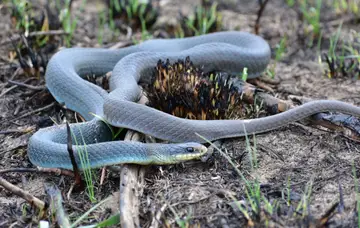
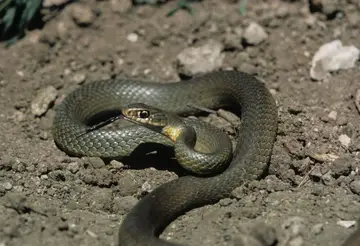

Size: Most adults about 3 to 5 ft. Sources range from 20 to 56 inches (Florida Museum) to 34 to 77 inches (New Jersey); Alabama says some exceed 6 ft. Outdoor Alabama
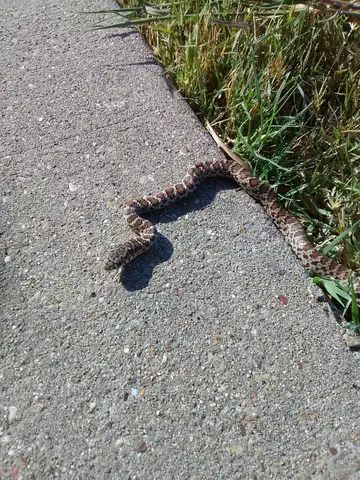
Colors: Adults solid deep black above, dark gray to black or bluish below, white on chin and throat. Eyes brown; other forms: blue, greenish or gray in the blue racer; blue-green, brown or olive in Arizona; four color forms in Louisiana. Pattern: Plain, with no pattern on adults.
Key features
- Smooth scales Tennessee Wildlife Resources Agency
- Long and slender with large eyes Florida Museum of Natural History
- White chin Florida Museum of Natural History
- May vibrate its tail in dry leaves, which can sound like a rattlesnake MassWildlife Natural Heritage & Endangered Species Program
Young
Gray or tan with reddish-brown blotches down the back, unlike the adult. Pattern fades to black as they grow; MassWildlife says after about a year, Louisiana says during the second year. Hatchlings about 7.5 to 14 inches.
Animals mistaken for the black racer
Black Racer or Cottonmouth?
Black Racer
Cottonmouth Agkistrodon piscivorus
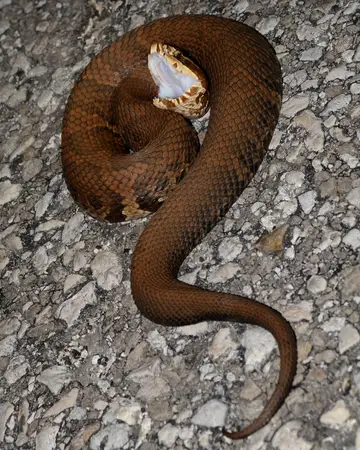

NPS says black racers can resemble the venomous water moccasin and advises leaving alone any snake you cannot identify. It gives no safe field mark, and none is offered here. National Park Service
VENOMOUS. See the cottonmouth record.
Black Racer or Timber rattlesnake?
Black Racer
Timber rattlesnake Crotalus horridus
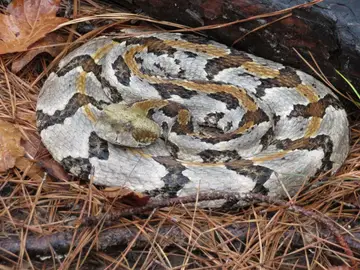

NH Fish and Game: the rattlesnake has a blunt rattle, is thicker, and has keeled scales and a triangular head. New Hampshire Fish and Game Department
VENOMOUS. See the timber rattlesnake record.
Black Racer or Pygmy rattlesnake?
Black Racer
Pygmy rattlesnake Sistrurus miliarius
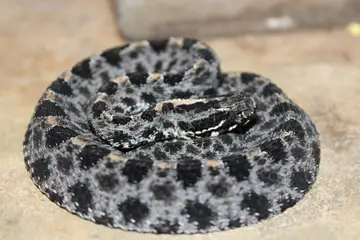

The Florida Museum lists it as a comparison species and marks it venomous; the guide compares photos and gives no text field mark. Florida Museum of Natural History
VENOMOUS.
Black Racer or Gray or eastern ratsnake?
Black Racer
Gray or eastern ratsnake Pantherophis spiloides
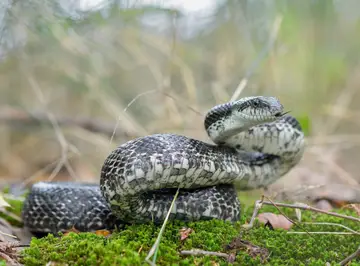

Ratsnakes have keeled scales and a loaf-of-bread body shape; young have distinct dark blotches on the tail. Tennessee Wildlife Resources Agency
See the rat snake record.
Black Racer or Eastern coachwhip (black variant)?
Black Racer
Eastern coachwhip (black variant) Masticophis flagellum
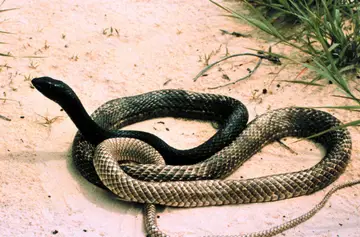

Distinctly lighter or reddish toward the rear of the body. Tennessee Wildlife Resources Agency
Non-venomous per the Florida Museum.
Black Racer or Eastern indigo snake?
Black Racer
Eastern indigo snake Drymarchon couperi
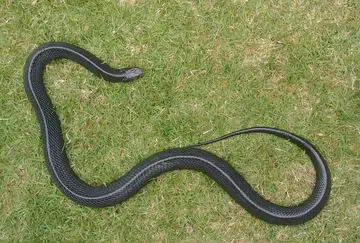
The Florida Museum lists it as a comparison species, non-venomous; no text field mark. Florida Museum of Natural History
Non-venomous per the Florida Museum.
Black Racer or Northern water snake?
Black Racer
Northern water snake Nerodia sipedon
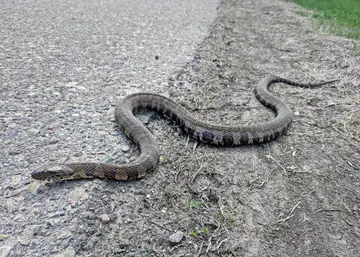

NH lists it as commonly confused; it gives no separating feature. New Hampshire Fish and Game Department
See the northern water snake record.
Where the black racer lives
- Native or listed
- Nonnative or not established
- No official record in our data
- 1–9
- 10–99
- 100–999
- 1,000+
On our state guides
- Alabama snakes
- Arizona snakes
- Arkansas snakes
- California snakes
- Colorado snakes
- Connecticut snakes
- Delaware snakes
- Florida snakes
- Georgia snakes
- Idaho snakes
- Illinois snakes
- Iowa snakes
- Kansas snakes
- Kentucky snakes
- Louisiana snakes
- Maine snakes
- Maryland snakes
- Massachusetts snakes
- Minnesota snakes
- Missouri snakes
- Montana snakes
- Nebraska snakes
- New Hampshire snakes
- New Mexico snakes
- New York snakes
- North Dakota snakes
- Ohio snakes
- Oklahoma snakes
- Oregon snakes
- Rhode Island snakes
- South Carolina snakes
- South Dakota snakes
- Tennessee snakes
- Texas snakes
- Utah snakes
- Vermont snakes
- Washington snakes
- Wisconsin snakes
State boundaries: U.S. Census Bureau, cartographic boundary file cb_2024_us_state_20m.
When it is active
Active by day. New Jersey: active April through September. Connecticut: in dens from late October to about late March; more territorial and defensive right after emerging. Louisiana also reports spring territorial behavior. New Jersey Division of Fish and Wildlife
US open-licence records peak in March to June and September.
Habitat and habits
Habitat: Habitat generalist: open woods, old fields, edges of swamps and farmland, suburban edges. Alabama says most abundant where habitats meet. Outdoor Alabama
Behavior: Alert, fast and active by day, hunting by sight, often with its head raised. Usually flees, but will strike, vibrate its tail and release musk if cornered. Top speed about 8 to 10 mph.
Diet: Rodents, birds, lizards, other snakes, frogs, toads and insects. Despite the scientific name, it pins prey rather than constricting.
Young: Mates in spring and lays eggs in early summer, with eggs hatching late summer or early fall. Clutch sizes differ: up to 36 (Alabama), 3 to 32 (Connecticut), 6 to 29 (Louisiana).
Legal status and reporting
Federal: No federal conservation status under the Endangered Species Act, per MassWildlife; Maine also gives Federal Status: None. MassWildlife Natural Heritage & Endangered Species Program
Protection: Varies by state. Maine: Endangered. New Hampshire: Species of Special Concern, state rank Threatened. Massachusetts: species of greatest conservation need. SREL: protected in Georgia and South Carolina. UGA Savannah River Ecology Laboratory
Questions about the black racer
Black racer
A long, slender, fast, non-venomous snake, solid black as an adult with a white chin and smooth scales. The Florida Museum says it is not dangerous to people or pets but will readily bite to defend itself.
Black racer snake bite
Racers are not venomous, but they bite if cornered or handled, and Ohio says the bite can be painful. If you are not sure what kind of snake bit you, call 911 or Poison Help at 1-800-222-1222.
Black racer baby
Young racers are gray or tan with reddish-brown blotches down the back, so they look nothing like adults and can resemble young rat snakes. The pattern fades to black as they grow.
Black racer snake baby
Hatchlings are about 7.5 to 14 inches long (Alabama) and blotched rather than black. Alabama says the pattern fades to black with age.
Black racer florida
Yes. The Florida Museum says they are found in every county of mainland Florida and on the Keys. It lists them as non-venomous.
Black racer snake florida
NPS at Fort Matanzas calls it one of the most common snakes spotted at the monument, and warns it can resemble the venomous water moccasin. Leave any snake you cannot identify alone.
Black racer dc
Not confirmed. A 2025 draft DC wildlife plan lists the northern black racer in Tier II, meaning rare and known or likely present, and the 2015 plan had removed it. Rock Creek Park's reptile list does not name it.
Sources
- Florida Snake ID Guide: North American Racer. Florida Museum of Natural History. updated March 18, 2026; checked November 3, 2026.
Quoted passages (6)
“Non-Venomous. North American racers are not dangerous to people or pets, but they will readily bite to defend themselves.”
“This is a long and slender snake with large and prominent eyes.”
“Adults are black or bluish/black with white or whitish markings on the chin and throat.”
“Juveniles are gray with distinct reddish-brown blotches running down the back of the head and body.”
“Pygmy Rattlesnake (Sistrurus miliarius) Venomous”
“Eastern Indigo Snake (Drymarchon couperi) Non-venomous”
- Black Racer. Alabama Department of Conservation and Natural Resources (Outdoor Alabama). undated page; checked November 3, 2026.
Quoted passages (4)
“They are usually between three and five feet long, but some individuals may reach lengths of more than six feet.”
“…but are more abundant in edge type habitats where two or more habitats meet such as the borders of swamps, old fields, and agricultural lands.”
“Rodents, birds, lizards, other snakes, frogs, toads, and insects are all a part of their diet.”
“Black racers mate in the spring. Females lay up to 36 eggs in early summer.”
- Racer. N.C. Wildlife Resources Commission. undated page; checked November 3, 2026.
- Black Racer - Fort Matanzas National Monument. National Park Service. undated page; checked November 3, 2026.
Quoted passages (1)
“Black racers can resemble another snake, the venomous water moccasin.”
- Reptiles: Snakes (Tennessee Watchable Wildlife). Tennessee Wildlife Resources Agency. footer 2026; checked November 3, 2026.
Quoted passages (3)
“A large, slender, solid black snake (36.0 to 60.0 inches in length) with smooth and shiny scales.”
“Gray Ratsnake has keeled scales and body has loaf of bread shape”
“Eastern Coachwhip (black variant) is distinctly lighter or reddish towards rear of body.”
- North American Racer. MassWildlife Natural Heritage & Endangered Species Program. archived copy, captured September 2, 2025; checked November 3, 2026.
Quoted passages (2)
“If they feel trapped, they will fight, bite, or rattle their tails in dry leaves to mimic rattlesnakes.”
“…does not have a federal conservation status under the U.S. Endangered Species Act.”
- Black Racer (Coluber constrictor). UGA Savannah River Ecology Laboratory. undated page; checked November 3, 2026.
Quoted passages (2)
“When threatened, racers often flee quickly, but if cornered, they may vibrate their tails, strike repeatedly, and excrete a foul musk.”
“…they are protected in the states of Georgia and South Carolina.”
- Excerpt from Field Guide to Reptiles and Amphibians of New Jersey: Northern Black Racer. New Jersey Division of Fish and Wildlife. 2002; checked November 3, 2026.
Quoted passages (1)
“When to find them: Active April through September.”
- Black Racer Snake. New Hampshire Fish and Game Department. archived copy, captured June 3, 2025; checked November 3, 2026.
Quoted passages (2)
“…the timber rattlesnake has a blunt rattle and is thicker with keeled scales and a triangular head.”
“Commonly Confused Species: Northern water snake”
- Reptiles of Ohio Field Guide (Pub 5354). Ohio Department of Natural Resources. 2/18; checked November 3, 2026.
- Checklist of Florida's Amphibians and Reptiles. Florida Fish and Wildlife Conservation Commission. Revised 2023; checked November 3, 2026.
- DRAFT District of Columbia State Wildlife Action Plan 2025, Chapter 4: Species of Greatest Conservation Need. DC Department of Energy and Environment (DOEE). Draft 2025 plan; checked November 3, 2026.
- Reptiles and Amphibians - Rock Creek Park. National Park Service. undated page; checked November 3, 2026.
- GBIF.org occurrence records, human observations licensed CC0 1.0 or CC BY 4.0 only, accessed November 3, 2026. The datasets behind these counts are listed on our Sources page.
- State boundaries: U.S. Census Bureau, cartographic boundary file cb_2024_us_state_20m.