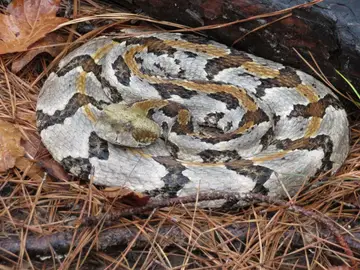
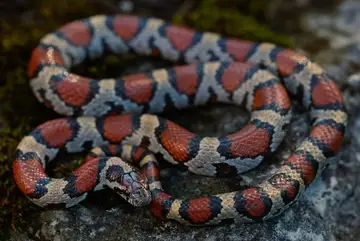
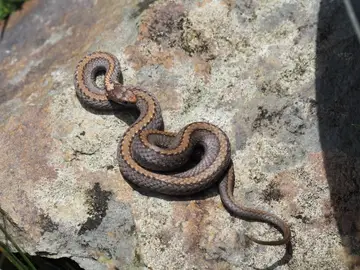
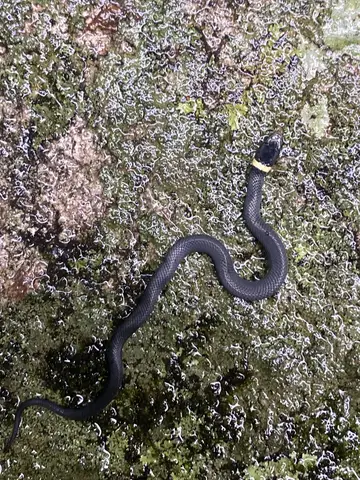
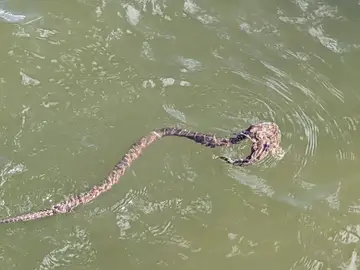
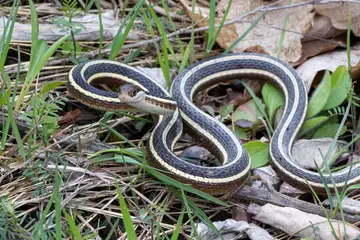
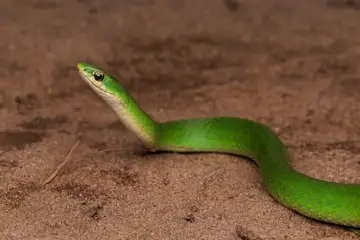
Most adults 36 to 60 inches (3 to 5 feet); record 74.5 inches.
How to recognize it
Black tail ending in a rattle
Heat-sensing pit between nostril and eye
Large, thick head distinct from the neck; cat-like vertical pupil
Where in New Hampshire
Historically ranged from Massachusetts border up to the White Mountains. Currently there is only one known population in NH. New Hampshire Fish and Game Department
Conservation
NH endangered; Species of Greatest Conservation Need
What the sources say
Venom: “New Hampshire has only one venomous snake, the timber rattlesnake, which is protected by law.” (New Hampshire Fish and Game Department)
Habitat: Rocky, south-facing hillsides in wooded areas that are exposed to an abundance of sunlight. Rock ledges and outcroppings on hilltops are used for basking. Deep rock crevices are used as den sites for hibernation. During summer their habitat expands to brushy, forested areas where they often bask in sunspots. Males may travel several miles from den sites during summer and return in the fall. (New Hampshire Fish and Game Department)
NH threatened; Species of Greatest Conservation Need
What the sources say
Venom: “New Hampshire has only one venomous snake, the timber rattlesnake, which is protected by law.” (New Hampshire Fish and Game Department)
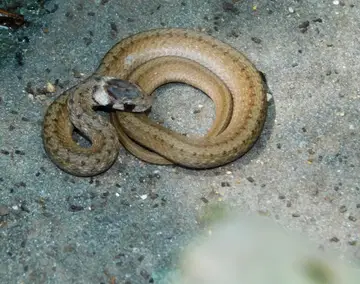
Habitat: Found in a variety of habitats including dry brushy pastures, powerline corridors, rocky ledges, and woodlands. Have large home ranges and require large patches of suitable habitat. (New Hampshire Fish and Game Department)
Venom: “New Hampshire has only one venomous snake, the timber rattlesnake, which is protected by law.” (New Hampshire Fish and Game Department)
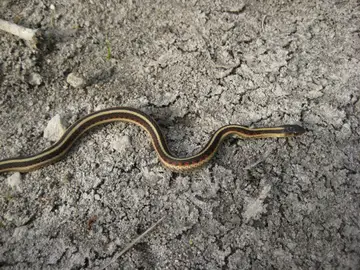
Habitat: Found in urban and rural areas including vacant lots, parks, woodlands, fields, and marshes. Uses cover objects such as woody debris, rocks, and trash piles. (New Hampshire Fish and Game Department)
Venom: “New Hampshire has only one venomous snake, the timber rattlesnake, which is protected by law.” (New Hampshire Fish and Game Department)
Habitat: Found in a variety of habitats including woodlands, hillsides, wetlands, backyards, and even urban areas. Will use a variety of cover objects for shelter including rocks, logs, stumps and other debris such as trash piles and sheet metal. (New Hampshire Fish and Game Department)
NH endangered; Species of Greatest Conservation Need
What the sources say
Venom: “New Hampshire has only one venomous snake, the timber rattlesnake, which is protected by law.” (New Hampshire Fish and Game Department)
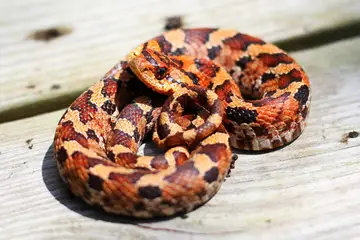
Habitat: Requires sandy, gravely soils such as open fields, river valleys, pine forests, and upland hillsides. Feeds predominately on toads; therefore needs breeding habitat (e.g., wetlands, vernal pools) for amphibians. (New Hampshire Fish and Game Department)
Venom: “New Hampshire has only one venomous snake, the timber rattlesnake, which is protected by law.” (New Hampshire Fish and Game Department)
Habitat: Found in a variety of habitats including fields, farmland, woodlands, and rocky hillsides. May also be found in barns or old basements with stone foundations. Uses logs, stones, boards, or trash piles for cover. (New Hampshire Fish and Game Department)
Venom: “New Hampshire has only one venomous snake, the timber rattlesnake, which is protected by law.” (New Hampshire Fish and Game Department)
Habitat: Found in a variety of areas including moist or dry woodlands, upland fields, shorelines, swamps, and sphagnum bogs. Redbelly snakes use a variety of cover objects including woody debris, rocks, and human trash and debris piles. Eats mostly slugs and snails. (New Hampshire Fish and Game Department)
Venom: “New Hampshire has only one venomous snake, the timber rattlesnake, which is protected by law.” (New Hampshire Fish and Game Department)
Habitat: Mostly found in moist, shady woodlands under rocks, logs, or other woody debris. May also be found on rocky wooded hillsides. (New Hampshire Fish and Game Department)
Venom: “New Hampshire has only one venomous snake, the timber rattlesnake, which is protected by law.” (New Hampshire Fish and Game Department)
Habitat: Found in aquatic and semi-aquatic habitats such as streams, ponds, swamps, and marshes. Often uses logs or branches overhanging the water for basking. Rarely found far from water. (New Hampshire Fish and Game Department)
Venom: “New Hampshire has only one venomous snake, the timber rattlesnake, which is protected by law.” (New Hampshire Fish and Game Department)
Habitat: Found in and near aquatic habitats such as ponds, swamps, bogs, and stream edges. May be found in wet woodlands but seldom stray far from water. Uses brushy areas on the edges of water for concealment. (New Hampshire Fish and Game Department)
NH Fish and Game Wildlife Division (603) 271-2461; Law Enforcement (603) 271-3361. Invasive insects: NHBugs reporting form (nhbugs.org/reporting-form). Stranded marine animals: Seacoast Science Center (603) 997-9448 or the Northeast hotline (866) 755-6622. Sharks: Northeast Shark Hotline (401) 859-1043. New Hampshire Fish and Game Department
Yes. NH Fish and Game says the timber rattlesnake is the only venomous snake in New Hampshire, and it is protected by law. New Hampshire Fish and Game Department
“New Hampshire has only one venomous snake, the timber rattlesnake, which is protected by law.”
“…water moccasin or cottonmouth (not a NH species)”
About this list
The species list comes from Snakes of New Hampshire; Species Occurring in NH (New Hampshire Fish and Game Department, Internet Archive capture 2025-08-07 of the undated official page). 11 more entries come from other official sources named on each card.
Venom labels come only from official sources and link to them; "Not stated" never means harmless. How labels work.
Sources
Snakes of NH (old site page). New Hampshire Fish and Game Department. archived copy, captured August 1, 2023; checked November 3, 2026.Quoted passages (2)
“New Hampshire has only one venomous snake, the timber rattlesnake, which is protected by law.”
“If you think you see a timber rattlesnake, please leave it alone, and let us know. There is no reason to kill a New Hampshire snake.”
Snakes of New Hampshire. New Hampshire Fish and Game Department. archived copy, captured August 7, 2025; checked November 3, 2026.Quoted passages (1)
“There are 11 species of snakes that are native to New Hampshire.”